🚀 Power Platform Solution Architect Roadmap (with Modern AI Skills)

The role of a Power Platform Solution Architect is rapidly evolving. It’s no longer just about building apps—it’s about designing intelligent, scalable, AI-powered business solutions.
This roadmap will guide you from fundamentals to advanced architecture, including Copilot, AI, and enterprise design patterns.
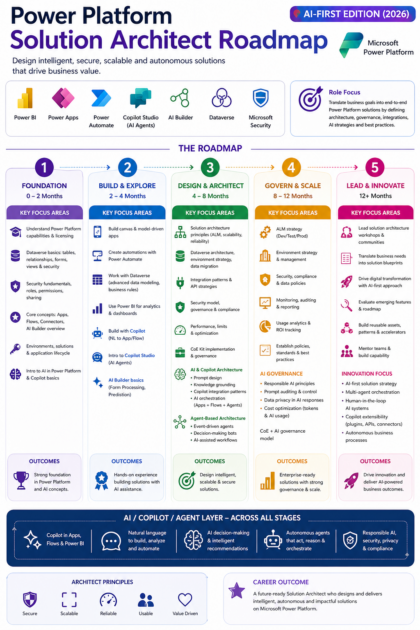
🧭 Phase 1: Strong Foundations (0–3 Months)
Start with core platform understanding.
🔹 Power Platform Basics
- Power Apps (Canvas + Model-driven apps)
- Power Automate (Cloud flows, approvals)
- Power BI (basic dashboards)
- Dataverse (tables, relationships, security)
🔹 Essential Concepts
- Data modeling
- Business rules
- Security roles
- Environment strategy
👉 Goal: Build 3–5 small apps (CRUD, approval system, dashboard)
⚙️ Phase 2: Advanced Development (3–6 Months)
Move from “builder” to “developer mindset”.
🔹 Power Apps Advanced
- Component Framework (PCF)
- Custom controls
- Responsive design patterns
🔹 Power Automate Advanced
- Error handling
- Child flows
- API integrations
🔹 Dataverse Deep Dive
- Plugins (C#)
- JavaScript customizations
- Web API usage
👉 Goal: Build enterprise-grade solutions with integrations
🏗️ Phase 3: Architecture Thinking (6–9 Months)
Now shift to Solution Architect mindset.
🔹 Solution Design
- Layered architecture
- Managed vs unmanaged solutions
- ALM (Application Lifecycle Management)
🔹 Integration Patterns
- REST APIs
- Azure Functions
- Service Bus
🔹 Security & Governance
- DLP policies
- Environment strategy
- Role-based access
👉 Goal: Design scalable multi-environment solutions
☁️ Phase 4: Azure + Enterprise Integration (9–12 Months)
A Solution Architect must understand Azure.
🔹 Key Azure Services
- Azure Functions
- Azure Logic Apps
- Azure API Management
- Azure Service Bus
🔹 Use Cases
- Event-driven architecture
- Microservices integration
- External system connectivity
👉 Goal: Build hybrid solutions (Power Platform + Azure)
🤖 Phase 5: AI & Copilot Skills (Modern Must-Have)
This is what differentiates a modern architect from a traditional one.
🔹 AI in Power Platform
- Microsoft Copilot Studio
- AI Builder (form processing, predictions)
- Copilot in Power Apps & Power Automate
🔹 Generative AI Concepts
- Prompt engineering
- LLM basics
- Retrieval-Augmented Generation (RAG)
🔹 Azure AI Ecosystem
- Azure OpenAI Service
- Azure AI Search
👉 Goal: Build AI-powered apps (chatbots, smart automation, predictions)
🧠 Phase 6: Solution Architect Mastery
Now focus on decision-making and leadership.
🔹 Responsibilities
- Requirement analysis
- Stakeholder communication
- Technology selection
- Performance optimization
🔹 Design Patterns
- Low-code + pro-code fusion
- Event-driven systems
- API-first architecture
🔹 Documentation
- Solution diagrams
- Architecture blueprints
- Governance models
👉 Goal: Lead end-to-end enterprise implementations
📜 Certifications Path
Recommended certifications:
- PL-900 (Fundamentals)
- PL-100 / PL-200 (Functional Consultant)
- PL-400 (Developer)
- PL-600 (Solution Architect) ⭐
🧪 Real-World Projects to Build
To stand out, build:
- AI-powered Helpdesk (Copilot + Dataverse)
- Smart Sales CRM (prediction + automation)
- Document processing system (AI Builder)
- Integration hub (Power Platform + Azure)
🔥 Pro Tips for 2026
- Learn Copilot-first development
- Focus on business problem solving, not just tools
- Combine low-code + AI + cloud
- Stay updated with Microsoft releases
🎯 Final Thought
The future Solution Architect is not just a system designer—but an AI-powered business transformer.
If you combine:
- Power Platform expertise
- Azure integration
- AI & Copilot skills
👉 You become top 1% in the market