MICROSOFT DEVELOPER CAREER RADAR 2026
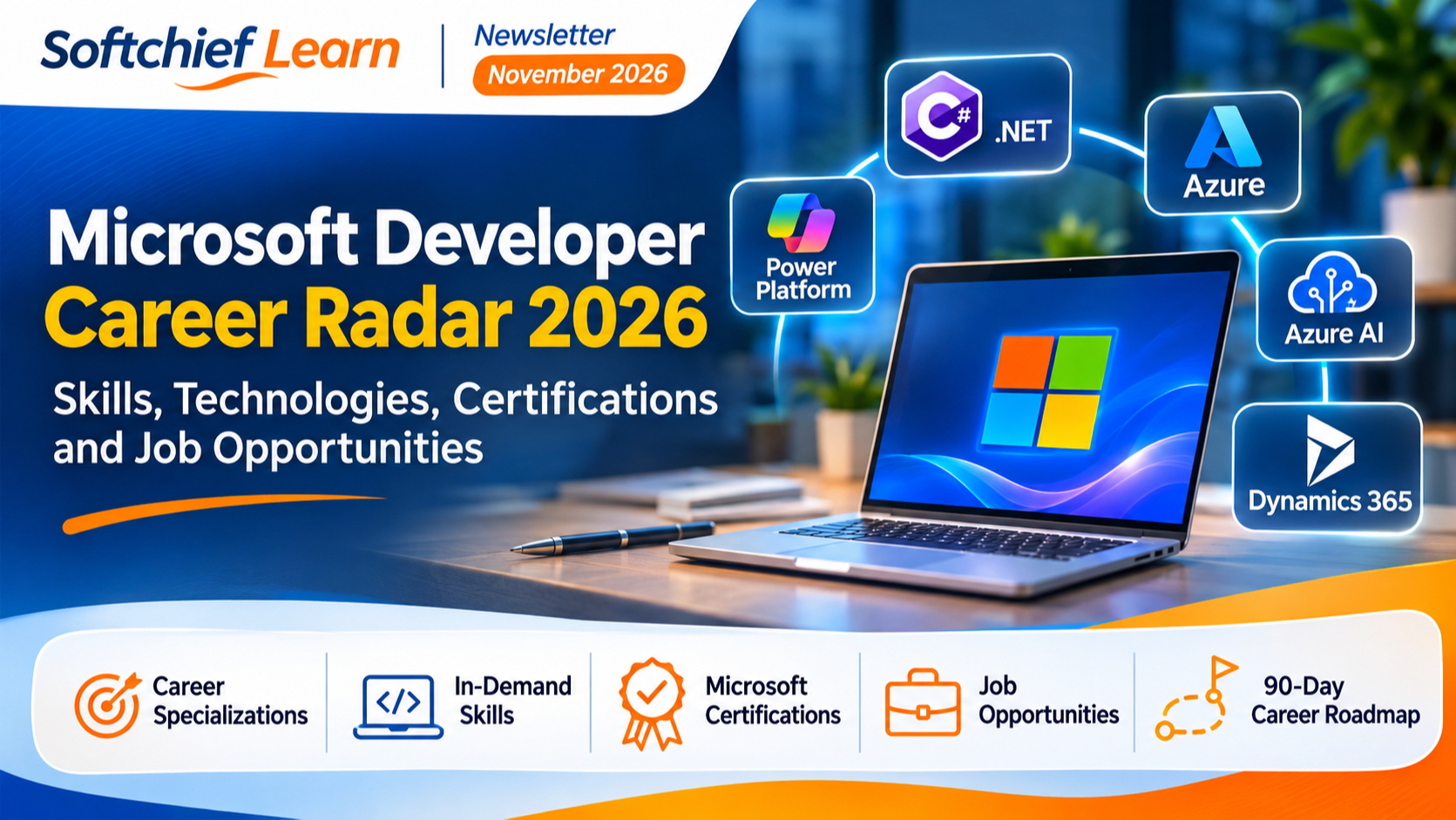
Skills. Specializations. Certifications. Job Opportunities. The Road Ahead.
Softchief Learn | November 2026 Career Intelligence Edition
The Microsoft Developer Career Is Evolving. Your Skills Must Evolve With It.
The technology industry is no longer looking only for developers who can write code, build forms, connect databases, or develop basic APIs.
Organizations need professionals who can understand business requirements, design application architectures, build secure solutions, integrate cloud services, automate workflows, work with AI, and maintain applications in production.
This is changing the expectations placed on Microsoft technology professionals.
A C# developer may now need to understand cloud deployment, distributed messaging, API security, and AI integration.
An Azure developer may need to understand containerized applications, event-driven architectures, monitoring, and vector databases.
A Power Platform developer may need to understand Dataverse security, enterprise integrations, governance, and custom development.
A Dynamics 365 developer may need to understand extensibility, business processes, integrations, and enterprise solution architecture.
The opportunity is not simply to learn another technology. It is to become the professional who can deliver a complete technical solution.
In this edition, we examine the Microsoft developer career landscape, the skills worth investing in, the roles to target, relevant certification pathways, and how to build a career that progresses beyond entry-level development.
1. The Microsoft Developer Career Landscape: Five Major Specializations
Microsoft technology offers several distinct career directions. Choosing the right specialization is one of the most important decisions a developer can make.
Career Track 1: C# and .NET Full-Stack Development
From writing code to engineering complete business applications.
C# and .NET remain important foundations for enterprise application development.
Companies need developers who can build applications that are secure, maintainable, scalable, and integrated with business systems.
But knowing C# syntax is only the beginning.
Core technical skills:
- Advanced C# and object-oriented programming.
- ASP.NET Core MVC and Web API.
- Entity Framework Core and SQL Server.
- REST API design and integration.
- Dependency Injection and asynchronous programming.
- Authentication, authorization, and security.
- JavaScript, React or Angular.
- Unit testing and application performance.
- Azure deployment and monitoring.
- CI/CD and application architecture.
Career progression:
Junior .NET Developer → Software Developer → C# Full-Stack Developer → Senior Software Engineer → Technical Lead → Solution Architect.
What differentiates a strong candidate?
A developer who can independently design a business application, build its APIs, integrate a database, implement authentication, troubleshoot performance, and deploy the solution to Azure demonstrates a broader engineering capability than someone who only knows CRUD operations.
Portfolio project to build: An enterprise customer management application with ASP.NET Core, SQL Server, authentication, role-based access, API integration, and Azure deployment.
Career Track 2: Microsoft Azure and Cloud Engineering
From application development to cloud solution engineering.
Cloud development is not limited to deploying applications.
Developers need to understand how applications communicate, scale, process events, secure data, and operate reliably.
Core technical skills:
- Azure App Service.
- Azure Functions.
- Azure Storage.
- Azure Service Bus.
- Azure Event Grid.
- Azure API Management.
- Azure Key Vault.
- Azure SQL and Cosmos DB.
- Azure Container Apps.
- Azure Kubernetes Service.
- Application Insights and KQL.
- Azure DevOps and CI/CD.
Career opportunities:
- Azure Developer.
- Cloud Application Developer.
- Azure Integration Developer.
- Cloud Engineer.
- Senior Cloud Engineer.
- Cloud Solution Architect.
What differentiates a strong candidate?
The ability to design and troubleshoot real cloud workloads.
For example, a developer should understand how to build an event-driven application using Azure Functions and Service Bus, handle failed messages, secure service communication, monitor execution, and optimize performance.
Portfolio project to build: A cloud-based order processing application using Azure Functions, Service Bus, Azure SQL, Key Vault, and Application Insights.
Career Track 3: Azure AI and Generative AI Development
From traditional application development to intelligent application engineering.
AI is creating another technical specialization within the Microsoft ecosystem.
Organizations are exploring AI-powered customer support, document processing, knowledge retrieval, workflow automation, and intelligent enterprise applications.
Developers who understand both application engineering and AI integration can work on a broader range of solutions.
Core technical skills:
- Python and API development.
- Large Language Models.
- Microsoft Foundry.
- Azure AI services.
- Prompt engineering.
- Embeddings and vector search.
- Retrieval-Augmented Generation (RAG).
- AI agents and tool integration.
- AI application security.
- Model evaluation and monitoring.
- Enterprise data integration.
Career opportunities:
- Azure AI Developer.
- Generative AI Developer.
- AI Application Developer.
- AI Engineer.
- AI Solutions Developer.
- AI Solution Architect.
What differentiates a strong candidate?
Not simply knowing how to send a prompt to an AI model.
A capable AI developer should understand how to connect enterprise data, implement retrieval, control access, manage conversation context, integrate tools, evaluate responses, and monitor application behaviour.
Portfolio project to build: An enterprise knowledge assistant using Microsoft Foundry, RAG, vector search, secure document retrieval, and an ASP.NET Core backend.
Career Track 4: Microsoft Power Platform Development
From low-code application building to enterprise business solution engineering.
Power Platform offers opportunities for professionals who understand business requirements as well as technical implementation.
However, enterprise Power Platform development requires much more than creating a canvas application.
Core technical skills:
- Power Apps.
- Power Automate.
- Microsoft Dataverse.
- Power Fx.
- Model-driven applications.
- Custom connectors.
- Dataverse security.
- Solution management.
- Power Platform governance.
- PCF controls.
- API integration.
- ALM and deployment pipelines.
Career opportunities:
- Power Platform Developer.
- Power Apps Developer.
- Power Automate Developer.
- Technical Consultant.
- Power Platform Solution Architect.
What differentiates a strong candidate?
The ability to convert business requirements into secure, maintainable, integrated solutions.
For example, a developer should understand how to design Dataverse tables, configure security roles, build automation, integrate external systems, and manage solutions across environments.
Portfolio project to build: An enterprise approval management solution using Power Apps, Dataverse, Power Automate, custom connectors, and role-based access.
Career Track 5: Dynamics 365 Technical Development
From platform customization to enterprise business application engineering.
Dynamics 365 remains an important specialization for professionals working with Microsoft business applications.
The platform offers opportunities across customer engagement, finance, operations, and business management.
Core technical skills:
- Dynamics 365 Customer Engagement.
- Dynamics 365 Sales and Customer Service.
- Dynamics 365 Finance and Operations.
- Dynamics 365 Business Central.
- Dataverse.
- Plugins and custom APIs.
- JavaScript and form scripting.
- Web API integration.
- X++ development for Finance and Operations.
- AL development for Business Central.
- Azure integration.
- Security and solution management.
Career opportunities:
- Dynamics 365 CE Developer.
- D365 Technical Consultant.
- Dynamics 365 F&O Developer.
- Business Central Developer.
- Dynamics 365 Technical Lead.
- Dynamics 365 Solution Architect.
What differentiates a strong candidate?
Understanding both the technical platform and the business process.
For example, a Dynamics 365 developer should know how a business requirement translates into entities, tables, business logic, plugins, workflows, security, and integrations.
Portfolio project to build: An enterprise customer engagement solution with custom Dataverse tables, plugins, business rules, JavaScript, Web API, and Azure integration.
2. The Skills Employers Need Beyond Basic Coding
One important career mistake is concentrating only on programming languages.
Technical interviews increasingly require developers to explain how they design, implement, secure, and troubleshoot complete solutions.
Consider the following skill expectations.
| Technical area | What a developer should demonstrate |
|---|---|
| Programming | Write maintainable and reusable code |
| Database | Design schemas and optimize queries |
| API development | Build secure and reliable APIs |
| Architecture | Understand application layers and dependencies |
| Integration | Connect multiple services and systems |
| Security | Implement authentication and authorization |
| Cloud | Deploy and monitor applications |
| Troubleshooting | Diagnose real production issues |
| DevOps | Understand CI/CD and deployment practices |
| AI | Integrate intelligent capabilities responsibly |
A developer who understands the relationship between these areas is better prepared for complex implementation responsibilities.
An important shift: From technology knowledge to implementation capability
Consider two candidates.
Candidate A
Knows C#, ASP.NET Core, SQL Server, and Azure terminology.
Candidate B
Can design an ASP.NET Core API, implement authentication, optimize SQL queries, integrate Azure Service Bus, deploy the application, monitor failures, and troubleshoot performance issues.
Both may know similar technologies, but Candidate B can demonstrate a much stronger end-to-end implementation capability.
That is the difference developers should work towards.
3. Microsoft Certifications: Choose Based on Your Career Destination
Certifications can validate your knowledge, but they should support a clear career objective.
For November 2026, some relevant Microsoft credentials include:
| Certification | Career direction |
|---|---|
| Azure AI Cloud Developer Associate (AI-200) | Azure AI and cloud development |
| Azure AI Apps and Agents Developer Associate (AI-103) | AI application and agent development |
| Azure Solutions Architect Expert (AZ-305) | Cloud solution architecture |
| DevOps Engineer Expert (AZ-400) | DevOps and delivery engineering |
| Power Platform Developer Associate | Power Platform development |
| Dynamics 365 Finance and Operations Apps Developer Associate | F&O development |
| Business Central Developer Associate | Business Central development |
Check the official Microsoft Credentials catalogue for current exam availability and requirements before planning your certification.
A particularly relevant development is Microsoft’s Azure AI Cloud Developer Associate credential.
Its assessed skills include containerized solutions, Azure data services, messaging, Azure Functions, security, monitoring, and troubleshooting.
This reflects an important shift: modern AI development requires strong cloud and backend engineering, not just familiarity with AI models.
Certification strategy:
- Freshers: Build fundamentals and select an appropriate entry-level learning path.
- Working developers: Choose a role-specific associate credential.
- Senior developers: Consider advanced architecture, DevOps, or specialist credentials.
- Architects: Focus on architecture, security, governance, integration, and enterprise design.
Do not collect certifications without implementation experience.
4. Microsoft Developer Job Opportunities: What Roles Should You Target?
Your target role should determine what you learn next.
Here is a practical role-to-skill mapping.
| Target position | Essential skills to demonstrate |
|---|---|
| Junior C# Developer | C#, OOP, SQL, basic Web API |
| .NET Full-Stack Developer | C#, ASP.NET Core, JavaScript, SQL, frontend framework |
| Senior .NET Developer | Architecture, security, performance, testing, cloud |
| Azure Developer | Functions, Service Bus, Storage, APIs, monitoring |
| Azure AI Developer | Python, Foundry, RAG, vector search, cloud integration |
| Power Platform Developer | Power Apps, Dataverse, Power Automate, ALM |
| Dynamics 365 CE Developer | Plugins, JavaScript, Dataverse, Web API |
| D365 F&O Developer | X++, extensions, integrations |
| Business Central Developer | AL, extensions, APIs |
| Cloud Solution Architect | Architecture, security, networking, integration, governance |
These are career targets, not claims about specific live vacancies.
How to search for relevant jobs
Avoid searching only for “Microsoft Developer.”
Use more targeted combinations:
- C# ASP.NET Core Developer.
- .NET Full-Stack Engineer.
- Azure Cloud Developer.
- Azure Integration Developer.
- Azure AI Application Developer.
- Power Platform Technical Consultant.
- Dynamics 365 CE Technical Consultant.
- Dynamics 365 F&O Developer.
- Business Central AL Developer.
Explore opportunities through LinkedIn Jobs, Microsoft Careers, Naukri, Indeed, and Microsoft partner company career pages.
When reviewing job descriptions, identify repeated technical requirements and use them to guide your learning priorities.
5. Freshers: How to Become Employable in the Microsoft Ecosystem
A fresher does not need to master five Microsoft technology platforms before applying for a job.
The better approach is to build one strong specialization.
Recommended progression
Month 1 – Programming foundation
- C# fundamentals.
- Object-oriented programming.
- Collections and exception handling.
- SQL fundamentals.
- Git and GitHub.
Month 2 – Application development
- ASP.NET Core.
- Web API.
- Entity Framework Core.
- Database integration.
- Authentication fundamentals.
Month 3 – Practical implementation
- Build a complete application.
- Integrate external APIs.
- Implement validation and error handling.
- Write basic unit tests.
- Deploy the application.
Month 4 – Career preparation
- Document your project.
- Prepare technical explanations.
- Practice coding interviews.
- Build a technical resume.
- Apply for suitable entry-level positions.
What should your first project demonstrate?
Build an application that contains:
- User authentication.
- CRUD operations.
- Role-based authorization.
- Database relationships.
- REST API integration.
- Validation and exception handling.
- Responsive frontend.
- Deployment documentation.
Don’t just upload code to GitHub. Explain the architecture, design decisions, problems encountered, and how you solved them.
That demonstrates engineering thinking.
6. Working Professionals: How to Move to the Next Career Level
Experienced developers should focus on moving beyond task-based development.
A developer with several years of experience should begin demonstrating ownership of technical decisions.
Consider these career transitions:
| Current role | Possible next specialization |
|---|---|
| C# Developer | Senior .NET Engineer |
| .NET Developer | Cloud Application Developer |
| Azure Developer | Cloud Solution Architect |
| Power Apps Developer | Power Platform Solution Architect |
| Dynamics 365 Developer | Senior Technical Consultant |
| Business Central Developer | Technical Lead |
| AI Developer | AI Solutions Architect |
These are possible progression paths, not automatic promotions. Each requires deeper technical capability, delivery experience, and responsibility.
Five areas to strengthen
- Architecture: Understand how to design complete solutions.
- Performance: Diagnose bottlenecks and optimize applications.
- Security: Design secure identity, authorization, and data access.
- Integration: Understand messaging, APIs, events, and distributed systems.
- Production ownership: Monitor, troubleshoot, and improve applications after deployment.
The strongest career move is often to become capable of owning a complete solution rather than simply completing assigned development tasks.
7. The Portfolio That Can Differentiate You
A certificate proves that you passed an assessment. A practical project demonstrates how you apply knowledge.
Build projects that reflect actual enterprise requirements.
Here are five project ideas:
Project 1: Enterprise CRM Application
C#, ASP.NET Core, SQL Server, authentication, and REST APIs.
Project 2: Cloud-Based Order Processing
Azure Functions, Service Bus, Azure SQL, Key Vault, and Application Insights.
Project 3: AI-Powered Enterprise Knowledge Assistant
Microsoft Foundry, RAG, vector search, secure retrieval, and API integration.
Project 4: Business Process Automation
Power Apps, Dataverse, Power Automate, and custom connectors.
Project 5: Dynamics 365 Enterprise Integration
Dynamics 365, Dataverse Web API, Azure Functions, and asynchronous messaging.
For each project, document:
- Business requirement.
- Architecture.
- Technology selection.
- Data flow.
- Security approach.
- Implementation.
- Testing.
- Deployment.
- Challenges and solutions.
This turns a project into evidence of your technical capability.
8. The 90-Day Career Acceleration Plan
A focused 90-day plan can help turn scattered learning into measurable progress.
| Period | Career objective | Expected outcome |
|---|---|---|
| Days 1–15 | Select a specialization and assess skills | Defined career direction |
| Days 16–30 | Strengthen technical foundations | Better conceptual understanding |
| Days 31–45 | Learn platform-specific implementation | Working technical components |
| Days 46–60 | Build an end-to-end project | Practical portfolio |
| Days 61–75 | Study architecture and troubleshooting | Stronger technical confidence |
| Days 76–90 | Resume, interviews and certification preparation | Job-ready evidence and career plan |
Track progress using completed modules, implemented features, GitHub commits, project milestones, and interview readiness.
The objective is not to finish 20 courses in 90 days.
It is to become demonstrably better at solving technical problems.
9. Five Career Mistakes Microsoft Developers Should Avoid
1. Learning every technology without specialization
Breadth is useful, but depth creates professional differentiation.
2. Collecting certifications without building projects
Credentials should support practical capability, not replace it.
3. Learning only basic CRUD development
Modern enterprise development requires security, architecture, integrations, performance, and monitoring.
4. Ignoring AI and cloud integration
Developers should understand how AI and cloud capabilities can be incorporated into real applications.
5. Waiting until a job change to upgrade skills
Career development should be continuous. Build your next skill before you urgently need it.
10. The Final Word: Build a Career, Not Just a Technology Skill Set
The Microsoft developer ecosystem offers several meaningful specialization paths.
You can build a career in .NET engineering, Azure cloud development, AI application engineering, Power Platform, or Dynamics 365.
But the real differentiator is your ability to translate business requirements into working, secure, maintainable solutions.
A developer who understands code, data, APIs, cloud, security, integration, and application behaviour is developing the foundation for long-term technical growth.
The next stage of your career should not be decided by whichever technology is trending this month.
It should be decided by the technical problems you want to become exceptionally good at solving.
Choose your specialization. Build real projects. Validate your skills. Demonstrate your ability. Keep progressing.
Build Your Next Microsoft Technology Career with Softchief Learn
At Softchief Learn, our focus is to help students, freshers, and working professionals move beyond theoretical learning and develop practical Microsoft technology skills.
Our training programmes cover:
- C# and .NET Full-Stack Development.
- Advanced Microsoft Azure and Azure AI.
- Microsoft Dynamics 365.
- Power Platform.
- Enterprise application development and integration.
Whether you are preparing for your first developer role, upgrading your existing technical skills, or moving towards a specialized Microsoft technology career, building practical implementation experience is an important step.
Explore upcoming training batches:
https://softchieflearngo.web.app/training-batches
Your career deserves more than another course completion certificate. It deserves practical skills, technical confidence, and the ability to deliver real solutions.
Softchief Learn – Learn. Build. Grow.