API Access Control Architecture: Build Secure Permissions That Scale

Introduction
A valid login doesn’t mean a caller should see every record or run every operation. In API access control architecture, weak permission checks can expose another user’s data or give a service more power than it needs. Your design affects security, ease of use, and the effort required to manage access.
API access control architecture is the set of policies, components, and checks that decide which identities can perform which actions on which resources. Key choices include how you identify callers, select authorization rules, enforce decisions, manage tokens and policies, and monitor requests.
There’s no single design that fits every API. The right approach depends on data sensitivity, client types, and how often permissions change. The standards and documented examples below offer a basis for making those choices without relying on unsupported performance claims.
Build an API access control architecture around clear boundaries
Authentication identifies the caller; authorization evaluates the request
Authentication checks who or what is making a request. Authorization checks whether that identity can perform the requested action on the requested resource. A valid token may identify a user, but it doesn’t prove that user can read every account or delete every file.
A typical request flow has two separate decisions. First, the API verifies the caller’s identity; then it checks whether that caller can access the requested endpoint and record. Both checks matter.
Map the protected assets, actions, and identities
List your API consumers, such as people, mobile apps, partner clients, and internal services. Then map the data and operations they need, including sensitive records and actions like exporting or deleting information. Note any conditions that affect access, such as account ownership or tenant membership.
This inventory gives you a basis for permission rules. It also helps reveal where the same data or operation appears across multiple endpoints. Set these boundaries before choosing an authorization model.
Apply least privilege without breaking legitimate workflows
Least privilege means granting only the access needed for a defined task. Begin with the specific actions each user or service requires, and avoid broad wildcard permissions that cover unrelated resources. A reporting service, for example, may need to read selected records without permission to update or delete them.
Review access when job duties, services, or data change. Narrow permissions can reduce the impact of a stolen credential, but rules must still support normal work. Test common user and service tasks before rollout.
Choose an authorization model that fits your API
Use role-based access control for stable job functions
Role-based access control (RBAC) assigns permissions to roles, then assigns users or services to those roles. Roles such as “support agent” or “billing service” work well when duties are clear and change slowly. Teams can manage access by changing role membership instead of editing every permission.
RBAC may not capture resource ownership on its own. A role might allow a user to read invoices, but a service still needs to check whether a specific invoice belongs to that user’s account. Add resource-level checks where roles don’t provide enough detail.
Use attribute- or policy-based rules for context
Attribute-based access control (ABAC) evaluates attributes about the identity, resource, action, and request context. A rule could allow a staff member to view a case only when they belong to its team and are on an approved network. Policy-based access control applies such rules through defined policies, sometimes combining several conditions.
These methods can express fine-grained decisions, but their rules need care. Set clear policy owners, test both allowed and denied cases, and keep conditions readable. Many APIs combine ABAC or policy rules with RBAC rather than choosing only one model.
Use scopes and resource permissions for delegated access
OAuth scopes can limit what a client may request on a user’s behalf. The OAuth 2.0 Authorization Framework (RFC 6749) defines the framework, while the OAuth 2.0 Security Best Current Practice (RFC 9700) recommends restricting token privileges to what the use case needs. Scopes can narrow permitted actions, but they don’t always decide whether a caller can access a particular record.
For example, a token may allow reading invoices, while the API checks whether the requested invoice belongs to the user’s tenant. Use both checks when delegated access and object ownership matter. This keeps broad permission to call an endpoint from becoming permission to read every object.
Put policy checks where they protect every request
Use gateways for shared controls
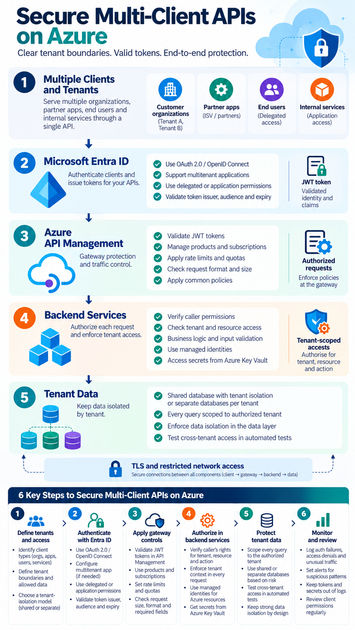
An API gateway can validate tokens, apply broad access rules, limit request rates, and pass verified identity details to services. It gives teams a shared place to handle controls that apply across many APIs. This can make common checks easier to manage.
A gateway should not replace authorization inside each service. It may know that a caller has a valid token but not whether a particular record belongs to that caller. Treat identity details forwarded by a gateway as trustworthy only when internal services can confirm the request came through a trusted path.
Enforce resource-level permissions in the service
The service that handles a request should check access to the specific record and action. For a multi-tenant API, verify the caller’s tenant against the record’s tenant; don’t rely on a record ID supplied by the client. Apply checks to sensitive actions such as viewing, changing, or deleting data.
Make authorization checks explicit in service code. Test every sensitive operation, including alternate routes to the same data. This helps catch cases where one endpoint enforces ownership and another forgets.
Keep service identity distinct from user identity
A workload may call an API using its own service credential or workload identity. A user may also grant a client permission to act on their behalf. These identities have different authority and should be checked separately.
Don’t treat a service token as proof that a user approved an action. Restrict workload permissions to the service’s task, and apply user-level rules when a request acts on a person’s behalf. Keep credentials out of source code and limit who can issue or rotate them.
Design tokens and policy lifecycle for secure access
Validate tokens and handle claims deliberately
Before using token contents, verify the token according to its format and your trust settings. For signed tokens, validate the signature and relevant claims, such as issuer, audience, and expiration. A valid signature alone doesn’t mean a token was issued for your API or grants the requested access.
Accept claims only from trusted issuers and define which claims your authorization rules use. Don’t grant permissions based on unreviewed fields or data that a caller can control. The RFC 9700 security guidance also recommends limiting tokens to the intended resource and needed actions.
Plan for expiration, revocation, and permission changes
Short-lived access tokens can limit the time a lost credential remains useful. Refresh or reauthorization flows can provide new credentials, while key rotation helps replace signing keys safely. Choose these controls based on your risks and how clients work.
Decide how quickly a permission change or revocation must affect active access. Cached decisions and tokens can delay that change, so document the expected timing and test it. Make sure the process works when a user leaves a role, a service is retired, or a credential is exposed.
Version and review authorization policies as code
Store policy rules in version control so teams can review who changed them and why. Require review for sensitive changes, and test both allow and deny cases before deployment. Keep an audit trail that links policy versions to releases.
Give each policy a clear owner. Without one, rules can become hard to explain or safely update as APIs change. Regular review can also catch permissions that no longer match actual service needs.
Prove the architecture works through testing and observability
Test denied access as carefully as successful access
Test requests with missing permissions, expired credentials, altered identifiers, and conflicting policy conditions. Include attempts to cross user and tenant boundaries, even when the caller has a valid token. Verify that denied requests don’t expose private fields or change data.
The OWASP API Security Top 10 (2023) names broken object-level authorization, broken function-level authorization, and broken object-property authorization among its risk areas. It’s a useful checklist, not a ranking of every organization’s specific risks. Use it to guide tests for records, operations, and individual data fields.
Log decisions without exposing sensitive data
Useful authorization logs can record the identity, requested action, resource context, outcome, and policy version. These details help teams investigate denied requests and unexpected access. Keep records focused on what an investigation needs.
Never log secrets, full credential values, or unnecessary personal data. Restrict access to logs and apply retention rules that match their purpose. Review log events for repeated denials or unexpected access patterns.
Learn from documented permission maps
GitHub’s fine-grained personal access token permissions documentation maps permissions to REST API endpoints. It also describes an X-Accepted-GitHub-Permissions response header that indicates permissions an endpoint requires. This is a practical example of documenting access at the operation level, rather than relying on one broad token permission.
Use this kind of map to make API permissions easier to review and explain. Keep your own endpoint requirements current as routes and functions change. Documentation supports enforcement; it doesn’t replace checks in the service.
Conclusion: Make every API decision explicit
A sound API access control architecture ties trusted identity to clear permissions and resource-level checks. It also treats tokens and policies as things that need ongoing review, testing, and monitoring.
- Separate authentication from authorization.
- Choose RBAC, ABAC, OAuth scopes, or a mix based on real access needs.
- Apply shared controls at gateways and resource-specific checks inside services.
- Plan for token expiry, revocation, and policy changes.
- Test denied requests and review authorization logs.
Start with one sensitive API operation. Map who can call it, what data it touches, and which checks must pass, then carry that pattern across your services.