Azure OpenAI Service: Complete Guide for Beginners
Introduction
Artificial Intelligence is transforming how businesses build software, automate workflows and deliver personalised customer experiences. Among the leading AI platforms available today, Azure OpenAI Service has become one of the most trusted choices for enterprises, developers and organisations looking to integrate generative AI into their applications securely and at scale.
Powered by OpenAI’s advanced language models and hosted on Microsoft’s Azure cloud platform, Azure OpenAI Service combines cutting-edge AI capabilities with enterprise-grade security, compliance and scalability.
Whether you’re a beginner exploring AI for the first time or a developer looking to build intelligent applications, this guide will help you understand Azure OpenAI Service, how it works and why it has become a key technology for modern software development in 2026.
What is Azure OpenAI Service?
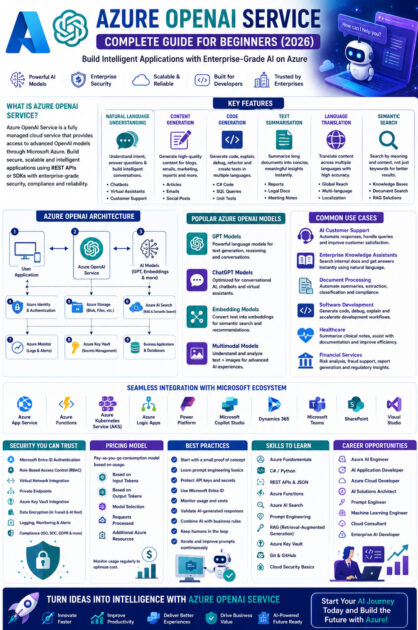
Azure OpenAI Service is a fully managed cloud service that provides access to powerful AI models through the Microsoft Azure platform. Developers can integrate these models into applications using REST APIs or SDKs while benefiting from Azure’s security, networking and governance features.
Unlike using public AI services directly, Azure OpenAI enables organisations to deploy AI solutions within their existing Azure environment, making it suitable for enterprise workloads and regulated industries.
With Azure OpenAI Service, you can build applications that:
- Answer user questions
- Generate high-quality content
- Summarise documents
- Translate languages
- Analyse text
- Write code
- Build intelligent chatbots
- Create virtual assistants
- Automate business processes
- Search organisational knowledge bases
Why Azure OpenAI Service is Popular in 2026
Businesses increasingly require AI solutions that are secure, scalable and easy to integrate with existing systems.
Azure OpenAI Service provides:
- Enterprise-grade security
- Global Azure infrastructure
- Flexible APIs
- High availability
- Compliance with industry standards
- Integration with Microsoft services
- Scalable cloud architecture
- Advanced monitoring and management
These capabilities make it a preferred choice for organisations adopting generative AI.
Key Features of Azure OpenAI Service
Azure OpenAI Service offers a wide range of capabilities designed for developers and enterprises.
Natural Language Understanding
Applications can understand user intent, answer questions and generate human-like responses.
Examples include:
- AI chatbots
- Virtual assistants
- Customer support automation
- Knowledge management systems
Content Generation
Generate:
- Blog articles
- Product descriptions
- Marketing copy
- Emails
- Reports
- Documentation
- Social media content
Content can be customised based on prompts and business requirements.
Code Generation
Developers can use Azure OpenAI to:
- Generate C# code
- Build APIs
- Explain existing code
- Create SQL queries
- Generate unit tests
- Refactor legacy applications
- Produce documentation
This helps accelerate software development while improving productivity.
Text Summarisation
Large documents can be condensed into concise summaries.
Useful for:
- Legal documents
- Meeting notes
- Research papers
- Medical records
- Business reports
Language Translation
Applications can translate content between multiple languages, supporting global businesses and multilingual users.
Semantic Search
Instead of keyword matching, Azure OpenAI enables semantic search, allowing users to retrieve information based on meaning and context.
This is particularly valuable for enterprise knowledge management.
Azure OpenAI Architecture
A typical Azure OpenAI solution consists of several components working together.
- User Application
- Azure OpenAI Service
- AI Models
- Azure Identity and Authentication
- Azure Storage
- Azure AI Search (for Retrieval-Augmented Generation)
- Azure Monitor
- Azure Key Vault
- Business Applications or Databases
This architecture supports secure, scalable and intelligent AI-powered applications.
Popular Azure OpenAI Models
Azure OpenAI provides access to different models depending on your use case.
Common model categories include:
- Large language models for text generation
- Models for conversational AI
- Embedding models for semantic search
- Multimodal models capable of understanding text and images
Choosing the right model depends on your application’s performance, cost and capability requirements.
Common Use Cases
AI Customer Support
Build chatbots that:
- Answer customer questions
- Resolve common issues
- Escalate complex cases
- Operate 24/7
Enterprise Knowledge Assistants
Employees can search internal documentation using natural language instead of traditional keyword searches.
Document Processing
Automate:
- Invoice analysis
- Contract review
- Report generation
- Policy summaries
- Compliance documentation
Software Development
Developers can:
- Generate code
- Review code
- Debug applications
- Explain complex algorithms
- Produce documentation
Healthcare
Healthcare organisations can:
- Summarise clinical notes
- Assist with documentation
- Support patient communication
- Improve operational efficiency
Financial Services
Financial institutions use Azure OpenAI for:
- Risk analysis
- Fraud detection support
- Customer service automation
- Report generation
- Regulatory document analysis
Azure OpenAI and Azure AI Search
One of the most powerful capabilities is combining Azure OpenAI with Azure AI Search to build Retrieval-Augmented Generation (RAG) solutions.
Benefits include:
- More accurate responses
- Access to organisation-specific knowledge
- Reduced hallucinations
- Better factual grounding
- Improved search experiences
This approach is widely used for enterprise chatbots and internal knowledge assistants.
Azure OpenAI Security Features
Security is one of Azure OpenAI’s biggest strengths.
Features include:
- Microsoft Entra ID authentication
- Role-Based Access Control (RBAC)
- Virtual Network integration
- Private Endpoints
- Azure Key Vault integration
- Data encryption
- Network isolation
- Logging and monitoring
- Compliance controls
These capabilities help organisations deploy AI responsibly while protecting sensitive data.
Integration with Microsoft Services
Azure OpenAI integrates seamlessly with many Microsoft technologies.
Popular integrations include:
- Azure App Service
- Azure Functions
- Azure Kubernetes Service (AKS)
- Azure Logic Apps
- Microsoft Power Platform
- Microsoft Copilot Studio
- Dynamics 365
- Microsoft Teams
- SharePoint
- Visual Studio
These integrations simplify the development of intelligent business applications.
Azure OpenAI Pricing
Azure OpenAI uses a consumption-based pricing model.
Costs generally depend on:
- Model selection
- Number of input tokens
- Number of output tokens
- Requests processed
- Additional Azure resources used
Because pricing varies by region and model, it’s important to estimate expected usage before deployment and monitor consumption regularly.
Best Practices for Beginners
If you’re new to Azure OpenAI Service, follow these recommendations:
- Start with a small proof of concept.
- Learn prompt engineering fundamentals.
- Protect API keys and secrets.
- Use Microsoft Entra ID where possible.
- Monitor usage and costs.
- Validate AI-generated responses.
- Combine AI with business rules.
- Keep humans involved in high-risk decisions.
- Regularly update prompts based on user feedback.
These practices will help you build secure, reliable and effective AI applications.
Skills to Learn Alongside Azure OpenAI
To maximise your effectiveness with Azure OpenAI, consider learning:
- Microsoft Azure fundamentals
- C#
- ASP.NET Core
- Python
- REST APIs
- JSON
- Azure Functions
- Azure AI Search
- Azure Storage
- Azure Key Vault
- Microsoft Power Platform
- Prompt engineering
- Retrieval-Augmented Generation (RAG)
- Git and GitHub
- Cloud security fundamentals
A combination of cloud, AI and software development skills will prepare you for modern AI projects.
Career Opportunities
Demand for Azure OpenAI expertise continues to grow across industries.
Popular job roles include:
- Azure AI Engineer
- AI Application Developer
- Azure Cloud Developer
- .NET Developer
- AI Solutions Architect
- Prompt Engineer
- Machine Learning Engineer
- Cloud Consultant
- Enterprise AI Developer
Professionals with Azure OpenAI knowledge are increasingly sought after for digital transformation and AI adoption initiatives.
Challenges to Consider
While Azure OpenAI offers significant benefits, organisations should also consider:
- Prompt optimisation
- Managing token usage and costs
- Handling AI inaccuracies
- Data governance
- Security configuration
- Compliance requirements
- Model updates
- Responsible AI practices
Addressing these challenges through careful planning and governance helps ensure successful deployments.
The Future of Azure OpenAI
Azure OpenAI continues to evolve rapidly.
Future developments are expected to include:
- More capable AI models
- Improved multimodal experiences
- Smarter AI agents
- Enhanced enterprise automation
- Better integration across Microsoft products
- Faster inference performance
- Expanded support for autonomous workflows
As AI becomes a core part of business applications, Azure OpenAI is expected to remain a leading platform for enterprise AI innovation.
Conclusion
Azure OpenAI Service has become one of the most powerful platforms for building secure, scalable and intelligent AI applications. By combining OpenAI’s advanced language models with Microsoft’s trusted Azure cloud infrastructure, it provides developers and organisations with the tools needed to create modern AI-powered solutions while maintaining enterprise-grade security and governance.
For beginners, Azure OpenAI offers an excellent entry point into generative AI. Starting with simple applications such as chatbots or document summarisation and gradually exploring advanced concepts like Retrieval-Augmented Generation, AI agents and enterprise integrations will help build practical expertise.
As businesses continue to embrace artificial intelligence in 2026 and beyond, learning Azure OpenAI Service is a valuable investment for developers, IT professionals and organisations aiming to stay competitive in the evolving digital landscape.