Best IT Courses After B.Tech in 2026: Which Microsoft Career Path Is Right for You?
Introduction
Graduating with a B.Tech degree is an exciting milestone—but it also brings one of the biggest questions every engineering student faces:
“Which IT course should I choose to build a successful career?”
In 2026, the IT industry is evolving faster than ever. Artificial Intelligence, Cloud Computing, Business Applications, Low-Code Development, and Enterprise Automation are transforming how companies operate. Employers are no longer looking only for programming knowledge—they want professionals who can solve business problems using modern technologies.
If you’re a B.Tech graduate wondering which course offers the best combination of job opportunities, salary, future growth, and career stability, this guide will help you make an informed decision.
At Softchief Learn, we’ve trained thousands of learners to build careers in Microsoft’s technology ecosystem. In this article, we’ll explore the best Microsoft technologies to learn after B.Tech and help you identify the path that aligns with your interests and career goals.
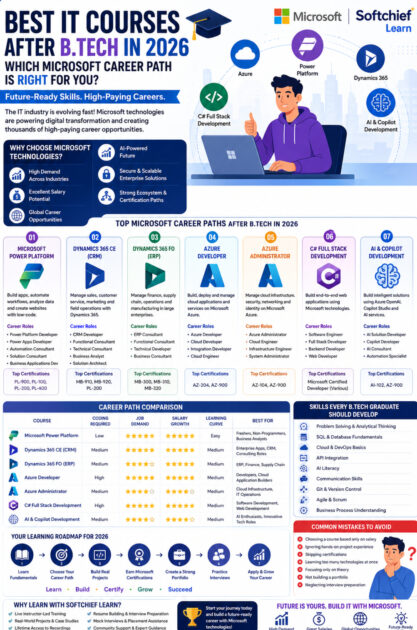
Why Microsoft Technologies Are Dominating the IT Industry
While many technologies come and go, Microsoft’s enterprise ecosystem continues to grow because organizations of all sizes rely on it for digital transformation.
Microsoft technologies power:
- Enterprise Resource Planning (ERP)
- Customer Relationship Management (CRM)
- Business Intelligence
- Cloud Infrastructure
- Workflow Automation
- Artificial Intelligence
- Business Applications
- Secure Enterprise Development
According to industry trends, organizations worldwide are investing heavily in:
- Microsoft Azure
- Microsoft Power Platform
- Dynamics 365
- Microsoft Copilot
- AI-powered business applications
This growing adoption has created a strong demand for skilled professionals.
Factors to Consider Before Choosing an IT Course
Don’t choose a course simply because it’s trending. Instead, evaluate it based on:
- Market demand
- Salary potential
- Learning curve
- Long-term career growth
- Certification opportunities
- Global demand
- Practical project experience
- AI readiness
- Industry relevance
Let’s explore the best options.
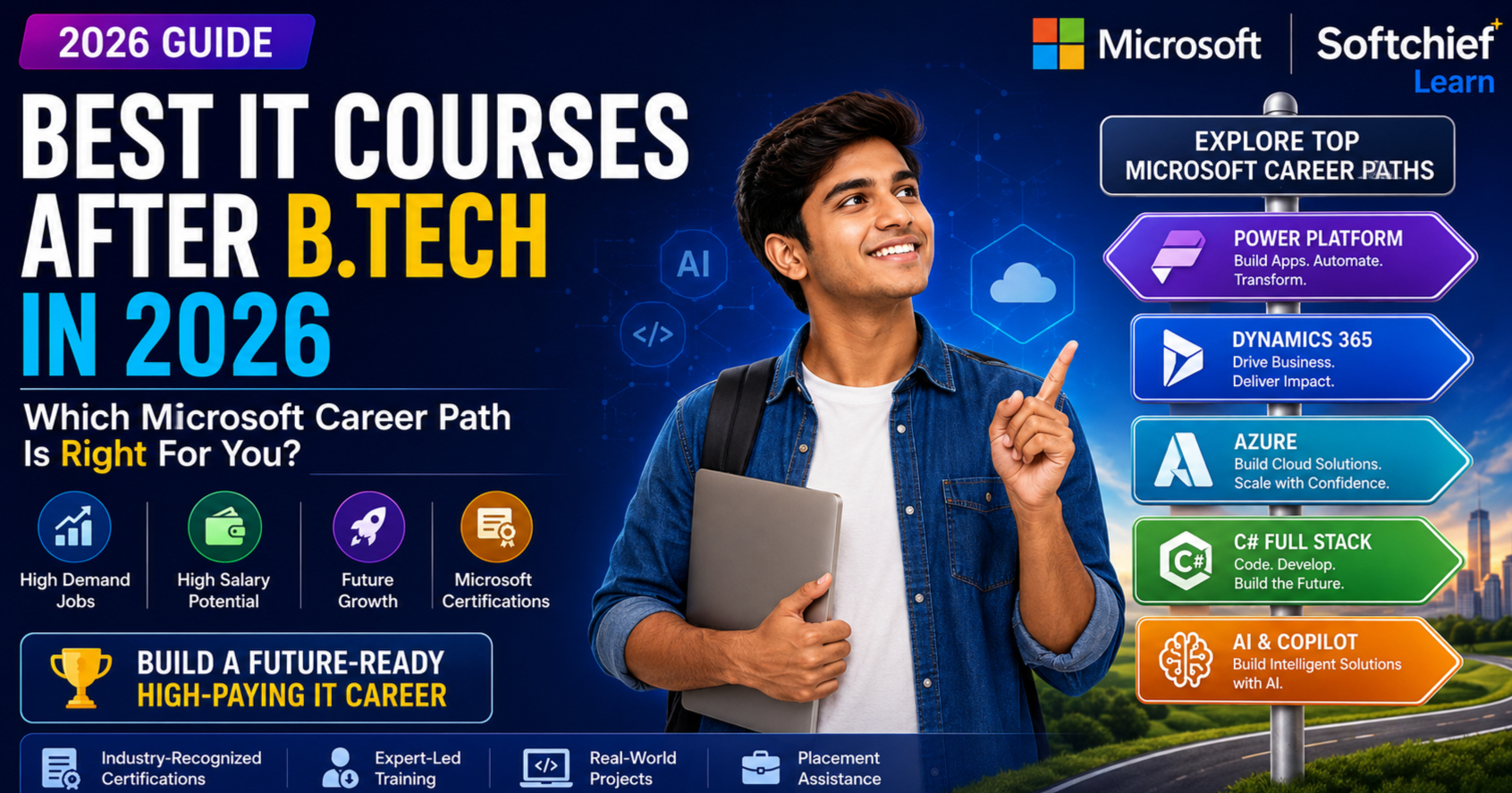
1. Microsoft Power Platform – The Fastest Growing Low-Code Career
Who is it for?
- Freshers
- Non-programmers
- B.Tech graduates
- Business Analysts
- Developers
- Working professionals
Power Platform enables organizations to build applications, automate workflows, create dashboards, develop websites, and integrate AI solutions—all with minimal coding.
What You’ll Learn
- Power Apps
- Power Automate
- Power BI
- Dataverse
- Power Pages
- Copilot Studio
- AI Builder
Career Roles
- Power Platform Developer
- Power Apps Developer
- Automation Consultant
- Solution Consultant
- Functional Consultant
- Business Applications Developer
Why Choose Power Platform?
✔ Huge enterprise demand
✔ Low-code development
✔ AI integration
✔ Easy learning curve
✔ Excellent salary growth
Recommended Certifications
- PL-900
- PL-100
- PL-200
- PL-400
2. Dynamics 365 CE (CRM)
Customer Relationship Management is one of Microsoft’s most valuable enterprise platforms.
Companies use Dynamics 365 to manage:
- Sales
- Customer Service
- Marketing
- Field Service
- Customer Engagement
Career Opportunities
- CRM Developer
- Functional Consultant
- Technical Consultant
- Solution Architect
- Business Analyst
Skills You’ll Learn
- Dataverse
- Model-driven Apps
- JavaScript
- Plugins
- Power Platform Integration
- Security Model
Ideal For
Students interested in enterprise software and business applications.
3. Dynamics 365 Finance & Operations (ERP)
Large organizations manage finance, supply chain, manufacturing, and operations using Dynamics 365 Finance & Operations.
You’ll Learn
- ERP concepts
- Finance
- Procurement
- Inventory
- Supply Chain
- X++
- Reporting
Career Roles
- ERP Consultant
- Functional Consultant
- Technical Developer
- Business Consultant
4. Microsoft Azure Developer
Cloud computing continues to dominate enterprise IT.
Azure developers build secure, scalable cloud applications and services.
Topics Covered
- Azure App Services
- Azure Functions
- Storage Accounts
- Azure SQL
- Azure AI Services
- Azure DevOps
- Containers
- APIs
Career Roles
- Azure Developer
- Cloud Developer
- Cloud Engineer
- Integration Developer
Recommended Certifications
- AZ-204
- AZ-900
5. Azure Administrator
If you’re interested in cloud infrastructure rather than application development, Azure Administration is an excellent choice.
Skills
- Virtual Machines
- Networking
- Storage
- Security
- Identity Management
- Monitoring
- Backup
Career Opportunities
- Azure Administrator
- Cloud Engineer
- Infrastructure Engineer
Certification:
AZ-104
6. C# Full Stack Development
If you enjoy programming and software engineering, Full Stack Development remains one of the most rewarding career paths.
Technologies
- C#
- .NET
- ASP.NET Core
- Web API
- SQL Server
- JavaScript
- React
- HTML
- CSS
- Git
- Azure Deployment
Career Roles
- Software Engineer
- Backend Developer
- Full Stack Developer
- Web Developer
7. Microsoft AI & Copilot Development
Artificial Intelligence is transforming enterprise applications.
Microsoft’s AI ecosystem now includes:
- Copilot Studio
- Azure OpenAI
- AI Builder
- Azure AI Services
- Intelligent Agents
Career Roles
- AI Solution Developer
- Copilot Developer
- AI Consultant
- Intelligent Automation Specialist
Comparing the Best Microsoft Career Paths
| Course | Coding Required | Job Demand | Salary Growth | Learning Curve | Best For |
|---|---|---|---|---|---|
| Power Platform | Low | ⭐⭐⭐⭐⭐ | ⭐⭐⭐⭐⭐ | Easy | Freshers |
| Dynamics 365 CE | Medium | ⭐⭐⭐⭐⭐ | ⭐⭐⭐⭐⭐ | Medium | Enterprise Apps |
| Dynamics 365 FO | Medium | ⭐⭐⭐⭐ | ⭐⭐⭐⭐⭐ | Medium | ERP |
| Azure Developer | High | ⭐⭐⭐⭐⭐ | ⭐⭐⭐⭐⭐ | Medium | Developers |
| Azure Administrator | Medium | ⭐⭐⭐⭐ | ⭐⭐⭐⭐ | Medium | Cloud Infrastructure |
| C# Full Stack | High | ⭐⭐⭐⭐⭐ | ⭐⭐⭐⭐⭐ | Medium | Software Development |
| AI & Copilot | Medium | ⭐⭐⭐⭐⭐ | ⭐⭐⭐⭐⭐ | Medium | Future Technologies |
Which Course Should You Choose?
Choose Power Platform If
- You want faster placement.
- You enjoy solving business problems.
- You prefer low-code development.
- You want to build apps quickly.
Choose Dynamics 365 CE If
- You like enterprise applications.
- You enjoy customer-facing business solutions.
- You want consulting opportunities.
Choose Azure Developer If
- You enjoy coding.
- You want to build cloud-native applications.
- You like APIs and backend development.
Choose Azure Administrator If
- You prefer infrastructure over coding.
- You enjoy networking and cloud operations.
Choose C# Full Stack If
- You love programming.
- You want to become a software engineer.
- You enjoy building end-to-end web applications.
Choose AI & Copilot If
- You want to work on cutting-edge technologies.
- You enjoy automation and intelligent systems.
- You want to future-proof your career.
Skills Every B.Tech Graduate Should Develop
Regardless of the technology you choose, employers value these core skills:
- Problem-solving
- Communication
- SQL fundamentals
- API integration
- Git & version control
- Cloud basics
- AI literacy
- Agile methodology
- Business process understanding
Technical skills open the door, but professional skills help you grow.
Common Mistakes Students Make
Avoid these pitfalls:
- Choosing a course based only on salary.
- Ignoring hands-on project work.
- Skipping certifications.
- Learning too many technologies at once.
- Focusing only on theory.
- Neglecting interview preparation.
- Not building a portfolio or GitHub profile.
A focused learning path with practical experience is far more effective than trying to master everything at once.
Learning Roadmap for 2026
Step 1: Learn Fundamentals
Understand programming basics, databases, and cloud concepts.
Step 2: Choose One Microsoft Career Path
Focus on one specialization instead of multiple technologies.
Step 3: Build Real Projects
Develop applications that solve real business problems.
Step 4: Earn Microsoft Certifications
Validate your skills with industry-recognized certifications.
Step 5: Create a Strong Portfolio
Showcase your projects, certifications, and technical expertise.
Step 6: Practice Interviews
Prepare for technical and scenario-based interview questions.
Step 7: Apply Consistently
Leverage LinkedIn, job portals, and your professional network.
Why Learn with Softchief Learn?
At Softchief Learn, our mission is to prepare learners for real-world careers—not just certifications. Our programs are designed by experienced Microsoft professionals and focus on practical, job-oriented learning.
What You’ll Get
- Live instructor-led training
- Lifetime access to recordings
- Real-world projects and case studies
- Resume building guidance
- Mock interviews and interview preparation
- Placement assistance
- Community support
- Updated curriculum aligned with Microsoft technologies and AI trends
Whether you’re starting from scratch or upskilling for your next role, you’ll gain practical knowledge that employers value.
Conclusion
The best IT course after B.Tech depends on your interests, strengths, and long-term career aspirations. If you’re passionate about coding, Azure Developer or C# Full Stack Development can open doors to software engineering roles. If you prefer solving business problems through low-code solutions, Microsoft Power Platform is an excellent choice. Those interested in enterprise consulting can build rewarding careers with Dynamics 365, while AI and Copilot technologies are ideal for professionals looking to stay ahead of the next wave of innovation.
Rather than chasing every trend, focus on mastering one technology, building practical projects, earning certifications, and developing strong communication and problem-solving skills. Consistent learning and hands-on experience will have a greater impact on your career than trying to learn everything at once.
The Microsoft ecosystem continues to offer some of the most stable, rewarding, and future-ready career opportunities in the IT industry. Start today, stay committed, and you’ll be well-positioned to build a successful technology career in 2026 and beyond.