
What Is Azure AI Foundry and Why Should Developers Learn It? (Complete 2026 Guide)
Introduction
Artificial Intelligence is no longer a futuristic technology—it’s becoming a core component of modern software development. Businesses across healthcare, finance, retail, manufacturing, education and government are integrating AI into their applications to improve customer experiences, automate workflows and make smarter decisions.
As enterprise demand for AI solutions continues to grow, Microsoft has introduced Azure AI Foundry, a comprehensive platform that simplifies the development, deployment and management of AI-powered applications.
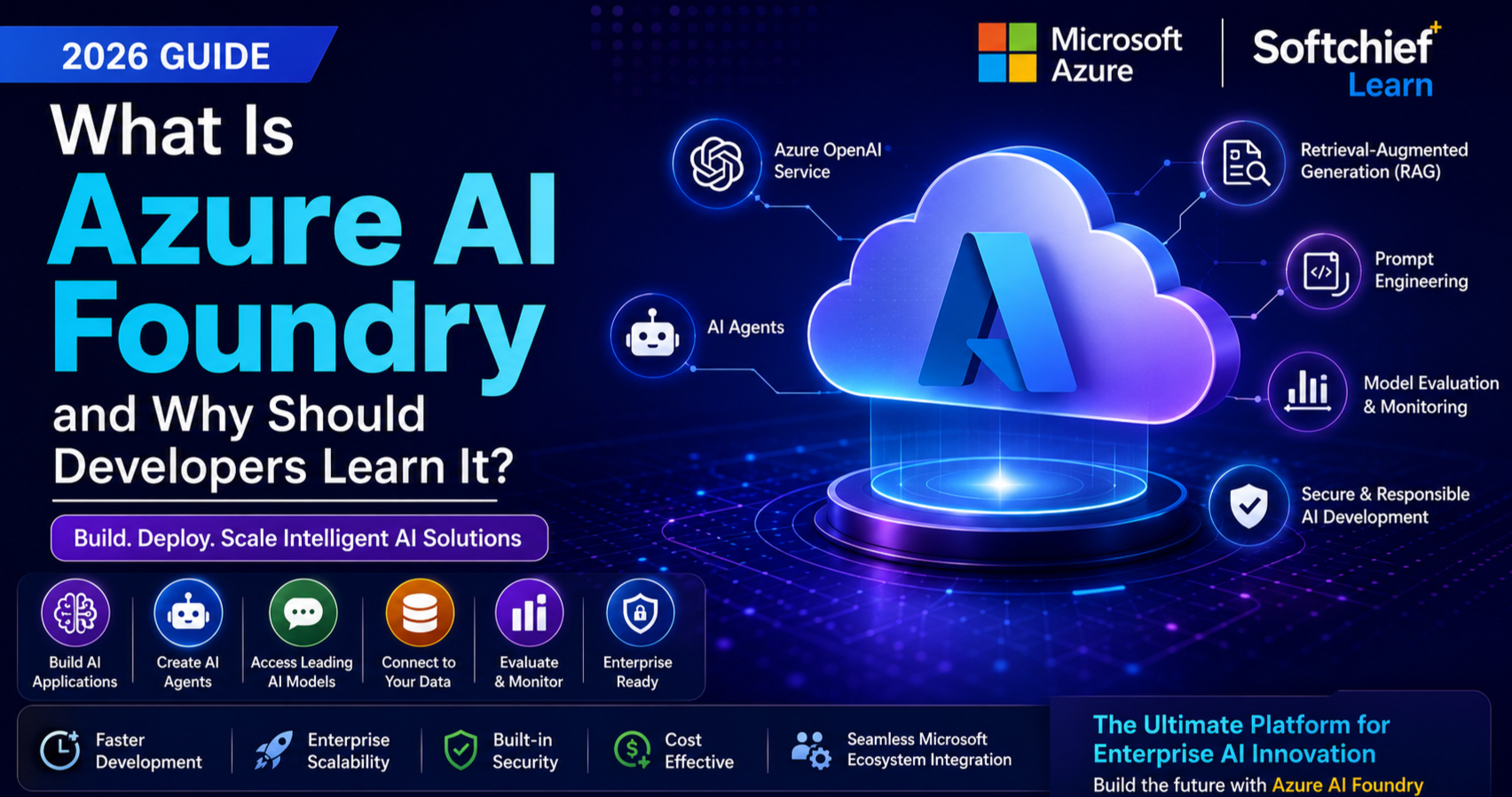
Azure AI Foundry provides developers with everything they need to build enterprise-ready AI solutions, from selecting foundation models and creating AI agents to implementing Retrieval-Augmented Generation (RAG), prompt engineering and model evaluation.
In this guide, we’ll explore what Azure AI Foundry is, its key capabilities, architecture, real-world applications, benefits and why learning it can significantly enhance your career as a developer in 2026.
What Is Azure AI Foundry?
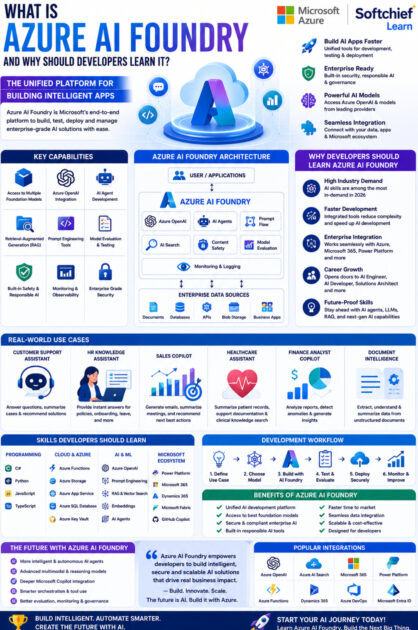
Azure AI Foundry is Microsoft’s unified platform for building, testing, deploying and managing enterprise AI applications.
It brings together a broad set of AI capabilities into a single development environment, enabling developers to:
- Build Generative AI applications
- Create AI agents
- Access large language models (LLMs)
- Develop Retrieval-Augmented Generation (RAG) solutions
- Connect AI to enterprise data
- Evaluate and monitor AI applications
- Deploy secure production-ready AI solutions
Rather than managing multiple services separately, Azure AI Foundry provides a streamlined workspace for the entire AI application lifecycle.
Why Microsoft Created Azure AI Foundry
Building enterprise AI solutions traditionally required developers to configure multiple Azure services independently.
For example:
- Azure OpenAI
- Azure AI Search
- Azure AI Content Safety
- Azure AI Vision
- Azure Storage
- Azure Functions
- Azure Machine Learning
- Azure Monitor
Managing these components individually could be complex and time-consuming.
Azure AI Foundry brings these capabilities together into a unified platform, making AI development faster, more secure and easier to manage.
Key Features of Azure AI Foundry
1. Access to Multiple Foundation Models
Azure AI Foundry provides access to a wide range of foundation models from Microsoft and other providers.
Developers can choose models based on their application requirements, including:
- Text generation
- Code generation
- Image understanding
- Document analysis
- Conversational AI
- Multimodal applications
This flexibility allows teams to evaluate and select the most suitable model for each business scenario.
2. Azure OpenAI Integration
Azure AI Foundry integrates seamlessly with Azure OpenAI, allowing developers to build applications that can:
- Generate content
- Answer questions
- Summarise documents
- Translate languages
- Analyse text
- Assist developers with coding
- Create intelligent business assistants
This integration supports secure, enterprise-grade AI experiences.
3. AI Agent Development
One of the most significant capabilities of Azure AI Foundry is the ability to build intelligent AI agents.
Unlike traditional chatbots, AI agents can:
- Understand business goals
- Execute multiple tasks
- Access enterprise systems
- Use external tools
- Make contextual decisions
- Complete complex workflows
Examples include:
- Customer service agents
- HR assistants
- Sales assistants
- IT helpdesk agents
- Finance automation agents
4. Retrieval-Augmented Generation (RAG)
Enterprise AI applications often require access to private organisational knowledge.
Azure AI Foundry supports Retrieval-Augmented Generation (RAG), enabling AI applications to:
- Search enterprise documents
- Retrieve relevant information
- Generate context-aware responses
- Reduce hallucinations
- Provide more accurate answers
RAG is widely used for knowledge assistants, internal search and customer support solutions.
5. Prompt Engineering Tools
High-quality AI responses depend on well-designed prompts.
Azure AI Foundry provides tools for:
- Prompt creation
- Prompt testing
- Prompt comparison
- Prompt optimisation
- Version management
Developers can experiment with different prompt designs to improve AI performance.
6. Model Evaluation
Before deploying AI applications, developers need to measure quality and reliability.
Azure AI Foundry includes evaluation tools for assessing:
- Accuracy
- Relevance
- Safety
- Groundedness
- Consistency
- Response quality
This helps ensure AI applications meet enterprise standards.
7. Built-In Safety and Responsible AI
Responsible AI is essential for enterprise adoption.
Azure AI Foundry includes capabilities such as:
- Content filtering
- Harm detection
- Prompt injection mitigation
- Data protection
- Governance tools
- Usage monitoring
These features help organisations build AI solutions that are secure, compliant and trustworthy.
Azure AI Foundry Architecture
A typical Azure AI Foundry solution includes:
User
   │
   ▼
Application
   │
   ▼
Azure AI Foundry
   │
   ├── Azure OpenAI
   ├── AI Agents
   ├── Prompt Flow
   ├── AI Search
   ├── Content Safety
   ├── Model Evaluation
   └── Monitoring
   │
   ▼
Enterprise Data Sources
This architecture centralises AI development while allowing seamless integration with enterprise systems and data.
Why Developers Should Learn Azure AI Foundry
High Industry Demand
Businesses across industries are investing heavily in AI-powered solutions.
Developers with Azure AI Foundry skills are increasingly sought after for roles involving enterprise AI, automation and cloud application development.
Faster AI Development
Azure AI Foundry reduces the complexity of building AI applications by providing integrated tools for development, testing and deployment.
Developers can focus on solving business problems rather than configuring infrastructure.
Enterprise Integration
Azure AI Foundry integrates with:
- Microsoft 365
- Dynamics 365
- Power Platform
- Azure Functions
- Azure App Service
- Azure SQL Database
- Microsoft Fabric
- Microsoft Entra ID
This makes it ideal for organisations already using Microsoft technologies.
Career Growth
Learning Azure AI Foundry can open opportunities in roles such as:
- AI Developer
- Azure AI Engineer
- Cloud Solutions Developer
- AI Solutions Architect
- Power Platform Developer
- Generative AI Engineer
- Machine Learning Engineer
- Enterprise Software Developer
As AI adoption grows, these skills are becoming increasingly valuable.
Real-World Use Cases
Customer Support Assistant
A customer support application uses Azure AI Foundry to:
- Answer customer questions
- Summarise support cases
- Recommend solutions
- Escalate complex issues
Support teams resolve requests more efficiently while improving customer satisfaction.
HR Knowledge Assistant
Employees ask questions such as:
- What is our leave policy?
- How do I submit expenses?
- Where can I find onboarding documents?
The AI retrieves relevant information from internal knowledge bases and provides accurate responses.
Sales Copilot
Sales teams use AI to:
- Generate follow-up emails
- Summarise customer meetings
- Recommend next actions
- Prepare sales proposals
This reduces administrative work and helps teams focus on building customer relationships.
Healthcare Assistant
Healthcare organisations use Azure AI Foundry to:
- Summarise patient records
- Assist with documentation
- Search clinical knowledge
- Support administrative workflows
Medical staff save time while improving operational efficiency.
Skills Developers Should Learn
To make the most of Azure AI Foundry, developers should build expertise in:
Programming Languages
- C#
- Python
- JavaScript
- TypeScript
Cloud Technologies
- Microsoft Azure
- Azure Functions
- Azure Storage
- Azure App Service
- Azure SQL Database
AI Technologies
- Azure OpenAI
- Prompt Engineering
- Retrieval-Augmented Generation (RAG)
- AI Agents
- Vector Search
- Embeddings
- Responsible AI
Microsoft Ecosystem
- Power Platform
- Dynamics 365
- Microsoft 365
- Microsoft Fabric
- GitHub Copilot
These complementary skills enable developers to build end-to-end AI solutions.
Best Practices
When working with Azure AI Foundry:
- Start with a clear business problem before selecting models.
- Design and test prompts iteratively.
- Secure enterprise data using Microsoft Entra ID and Azure Key Vault.
- Use RAG to improve response accuracy with organisational knowledge.
- Continuously evaluate AI outputs for quality and safety.
- Monitor model performance and user feedback after deployment.
- Apply responsible AI principles throughout the development lifecycle.
Future of Azure AI Foundry
Microsoft continues to expand Azure AI Foundry with new capabilities.
Future developments are expected to include:
- More autonomous AI agents.
- Improved multimodal AI support.
- Enhanced agent orchestration.
- Advanced reasoning models.
- Greater integration with Microsoft Copilot.
- Simplified enterprise AI deployment.
- Richer monitoring and governance features.
These innovations will make Azure AI Foundry an even more powerful platform for enterprise AI development.
Conclusion
Azure AI Foundry represents Microsoft’s vision for the future of enterprise AI development. By bringing together foundation models, AI agents, Retrieval-Augmented Generation, prompt engineering, model evaluation and responsible AI tools into a unified platform, it enables developers to build intelligent applications more efficiently and securely.
For developers, learning Azure AI Foundry is more than adding another technology to their skill set—it’s an investment in the future of software development. As organisations increasingly adopt AI to automate processes, enhance customer experiences and drive innovation, professionals with expertise in Azure AI Foundry will be well positioned to lead the next generation of enterprise application development.
Whether you’re a C# developer, Azure engineer, Power Platform professional or cloud architect, mastering Azure AI Foundry can help you create scalable, secure and intelligent solutions that meet the evolving needs of businesses in 2026 and beyond.