Power Platform vs C# Full Stack: Which Career Path Should You Choose in 2026?
Introduction
The demand for Microsoft technologies has grown significantly over the past few years. Organizations worldwide are accelerating digital transformation, creating opportunities for professionals with expertise in Microsoft’s ecosystem. Two of the most popular career paths are Microsoft Power Platform Developer and C# Full Stack Developer.
While both careers offer excellent salaries and long-term growth, they serve different business needs and require different skill sets.
If you’re a student, fresher, or software professional planning your next career move, this comprehensive guide will help you understand the differences and decide which path aligns with your goals.
What is Microsoft Power Platform?
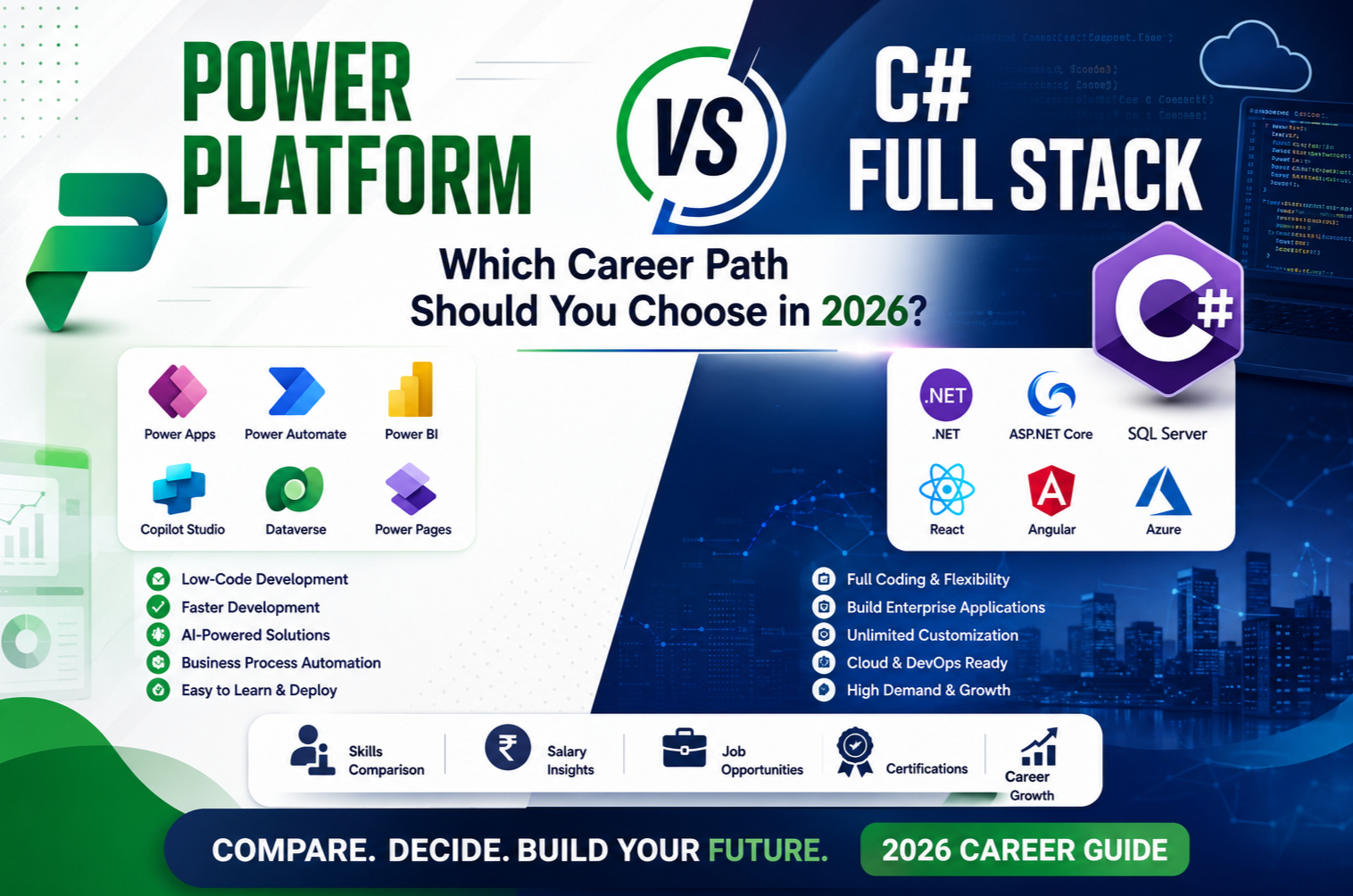
Microsoft Power Platform is a collection of low-code/no-code tools designed to help businesses automate processes, build applications, analyze data, and create AI-powered solutions without extensive coding.
The platform includes:
- Microsoft Power Apps
- Microsoft Power Automate
- Microsoft Power BI
- Microsoft Copilot Studio
- Microsoft Dataverse
- Power Pages
Power Platform enables organizations to develop business applications quickly while reducing development time and cost.
What is C# Full Stack Development?
C# Full Stack Development involves building complete web applications using Microsoft’s development technologies.
A Full Stack Developer typically works with:
- C#
- .NET
- ASP.NET Core
- Entity Framework Core
- SQL Server
- HTML
- CSS
- JavaScript
- React or Angular
- REST APIs
- Azure
Unlike Power Platform, Full Stack Development requires strong programming knowledge and software engineering principles.
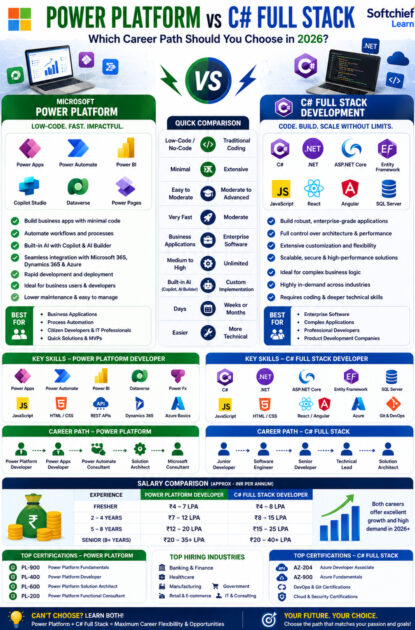
Power Platform vs C# Full Stack: Quick Comparison
| Feature | Power Platform | C# Full Stack |
|---|---|---|
| Development Style | Low-Code / No-Code | Traditional Coding |
| Coding Required | Minimal | Extensive |
| Learning Curve | Easy to Moderate | Moderate to Advanced |
| Development Speed | Very Fast | Moderate |
| Best For | Business Applications | Enterprise Software |
| Customization | Medium to High | Unlimited |
| Target Audience | Business Users & Developers | Professional Software Developers |
| AI Integration | Built-in | Custom Implementation |
| Deployment Time | Days | Weeks or Months |
| Maintenance | Easier | More Technical |
Understanding Power Platform
Power Platform focuses on solving business problems rapidly.
Instead of writing thousands of lines of code, developers configure workflows, connect data sources, and build applications using drag-and-drop components.
Typical projects include:
- Leave Management Systems
- Expense Approval Apps
- Employee Portals
- CRM Customization
- Inventory Tracking
- HR Applications
- Approval Workflows
- Customer Service Automation
Development time is significantly shorter compared to traditional software development.
Understanding C# Full Stack Development
C# Full Stack Development is ideal for building highly customized software from scratch.
Developers create:
- Enterprise Web Applications
- E-commerce Platforms
- Banking Systems
- ERP Software
- SaaS Applications
- Healthcare Platforms
- Educational Portals
- Cloud Applications
Full Stack Developers have complete control over architecture, performance, security, and scalability.
Skills Required for Power Platform Developer
To become a successful Power Platform Developer, you should learn:
Core Skills
- Power Apps
- Power Automate
- Dataverse
- Power Pages
- Power Fx
- Microsoft Copilot Studio
- AI Builder
Supporting Skills
- JavaScript
- HTML
- CSS
- REST APIs
- Dynamics 365
- Azure Basics
- SharePoint Integration
- SQL
Although Power Platform is low-code, knowledge of JavaScript and APIs significantly improves career opportunities.
Skills Required for C# Full Stack Developer
A Full Stack Developer should master:
Backend
- C#
- .NET
- ASP.NET Core
- Entity Framework
- SQL Server
Frontend
- HTML
- CSS
- JavaScript
- React
- Angular
Additional Skills
- Azure
- Git
- Docker
- Microservices
- REST APIs
- Authentication
- Cloud Deployment
This path involves much deeper programming concepts than Power Platform.
Learning Curve Comparison
Power Platform
Learning Power Platform is relatively easier because:
- Less coding
- Visual development
- Ready-made connectors
- Built-in templates
- AI-assisted development
A beginner can become productive within 3 to 6 months with consistent practice.
C# Full Stack
Learning C# Full Stack requires understanding:
- Programming fundamentals
- Object-Oriented Programming
- Data Structures
- Database Design
- API Development
- Frontend Frameworks
- Cloud Deployment
Most learners require 8 to 15 months to become job-ready depending on prior experience.
Development Speed
Power Platform dramatically reduces development time.
Example:
An approval application that takes 3–4 weeks in C# can often be developed in 2–5 days using Power Platform.
However, highly customized applications may still require traditional development.
Salary Comparison
(Approximate salaries vary by location, company, and experience.)
| Experience | Power Platform Developer | C# Full Stack Developer |
|---|---|---|
| Fresher | ₹4–7 LPA | ₹4–8 LPA |
| 2–4 Years | ₹7–12 LPA | ₹8–15 LPA |
| 5–8 Years | ₹12–20 LPA | ₹15–25 LPA |
| Senior | ₹20–35+ LPA | ₹20–40+ LPA |
Professionals with expertise in Azure, AI, and Dynamics 365 can command even higher compensation in both domains.
Job Opportunities
Power Platform Roles
- Power Platform Developer
- Power Apps Developer
- Power Automate Consultant
- Dynamics 365 Developer
- Functional Consultant
- Solution Architect
- Microsoft Consultant
Industries hiring include:
- Banking
- Healthcare
- Manufacturing
- Retail
- Government
- Consulting
- Education
C# Full Stack Roles
- Software Engineer
- .NET Developer
- Backend Developer
- Full Stack Developer
- Senior Software Engineer
- Technical Lead
- Solution Architect
Hiring companies include startups, product companies, IT services, and global enterprises.
Certifications
Power Platform Certifications
Recommended Microsoft certifications include:
- PL-900: Microsoft Power Platform Fundamentals
- PL-400: Microsoft Power Platform Developer
- PL-600: Microsoft Power Platform Solution Architect
- PL-200: Functional Consultant
C# Full Stack Certifications
While there isn’t a single mandatory Microsoft certification for Full Stack Development, these credentials can strengthen your profile:
- AZ-204: Azure Developer Associate
- AZ-900: Azure Fundamentals
- Git and DevOps certifications
- Cloud-related certifications
Real-world projects and coding skills remain the most important factors for employers.
Which One Has Better Future?
Both careers are expected to experience strong demand through 2030.
Power Platform is growing because:
- Businesses need faster application development.
- Low-code adoption continues to increase.
- AI-powered automation is becoming mainstream.
- Microsoft is investing heavily in Copilot and Power Platform.
C# Full Stack remains essential because:
- Complex enterprise applications still require traditional development.
- Large-scale systems demand custom coding.
- Cloud-native applications rely on experienced software engineers.
- Product companies continue hiring skilled .NET developers.
Rather than replacing each other, these technologies increasingly work together.
Can You Learn Both?
Absolutely.
Many successful Microsoft professionals combine both skill sets.
A modern Microsoft developer often uses:
- Power Apps for rapid application development
- Power Automate for workflow automation
- C# APIs for advanced business logic
- Azure Functions for backend processing
- Dataverse as the data platform
- Dynamics 365 integrations
- Microsoft Copilot for AI-powered experiences
Professionals who understand both low-code and traditional development are highly valued because they can choose the most appropriate technology for each business requirement.
Which One Should You Choose?
Choose Power Platform if you:
- Want to start your IT career quickly.
- Prefer low-code development.
- Enjoy solving business process challenges.
- Want to work with Microsoft business applications.
- Are interested in Dynamics 365, automation, and AI-powered business solutions.
Choose C# Full Stack if you:
- Enjoy programming and software engineering.
- Want to build applications from scratch.
- Are interested in backend architecture and web development.
- Prefer product development and highly customized solutions.
- Want strong long-term technical depth.
For many professionals, learning Power Platform first provides a faster entry into the Microsoft ecosystem. Adding C# Full Stack later expands opportunities into advanced development, custom integrations, and enterprise architecture.
Frequently Asked Questions (FAQs)
Is Power Platform replacing C# developers?
No. Power Platform complements traditional development rather than replacing it. Complex applications, custom APIs, and enterprise systems still require C# developers.
Which is easier to learn?
Power Platform is generally easier because it uses low-code tools and visual development. C# Full Stack requires a stronger programming foundation.
Which offers a higher salary?
Both offer competitive salaries. Compensation depends more on your experience, project exposure, Azure knowledge, and ability to solve business problems than on the technology alone.
Can I switch from C# to Power Platform?
Yes. Many .NET developers transition into Power Platform development because their programming background helps them build advanced solutions and integrations.
Should freshers choose Power Platform or C# Full Stack?
If your goal is to become job-ready quickly, Power Platform is an excellent starting point. If you enjoy coding and want to build software from the ground up, C# Full Stack is a rewarding long-term path. Learning both sequentially can provide the greatest career flexibility.
Final Thoughts
Power Platform and C# Full Stack are not competing technologies—they are complementary pillars of the Microsoft ecosystem. Power Platform enables rapid application development and business automation, while C# Full Stack provides the flexibility to build sophisticated, scalable software solutions.
As organizations increasingly adopt hybrid development strategies, professionals who understand both low-code platforms and traditional coding are positioned to deliver greater value. Whether you begin with Power Platform for a faster entry into the industry or dive into C# Full Stack for deeper engineering expertise, continuous learning and hands-on projects will be the key to long-term success.