AI Agent Data Access Governance: Control What Agents Can See and Do
Introduction
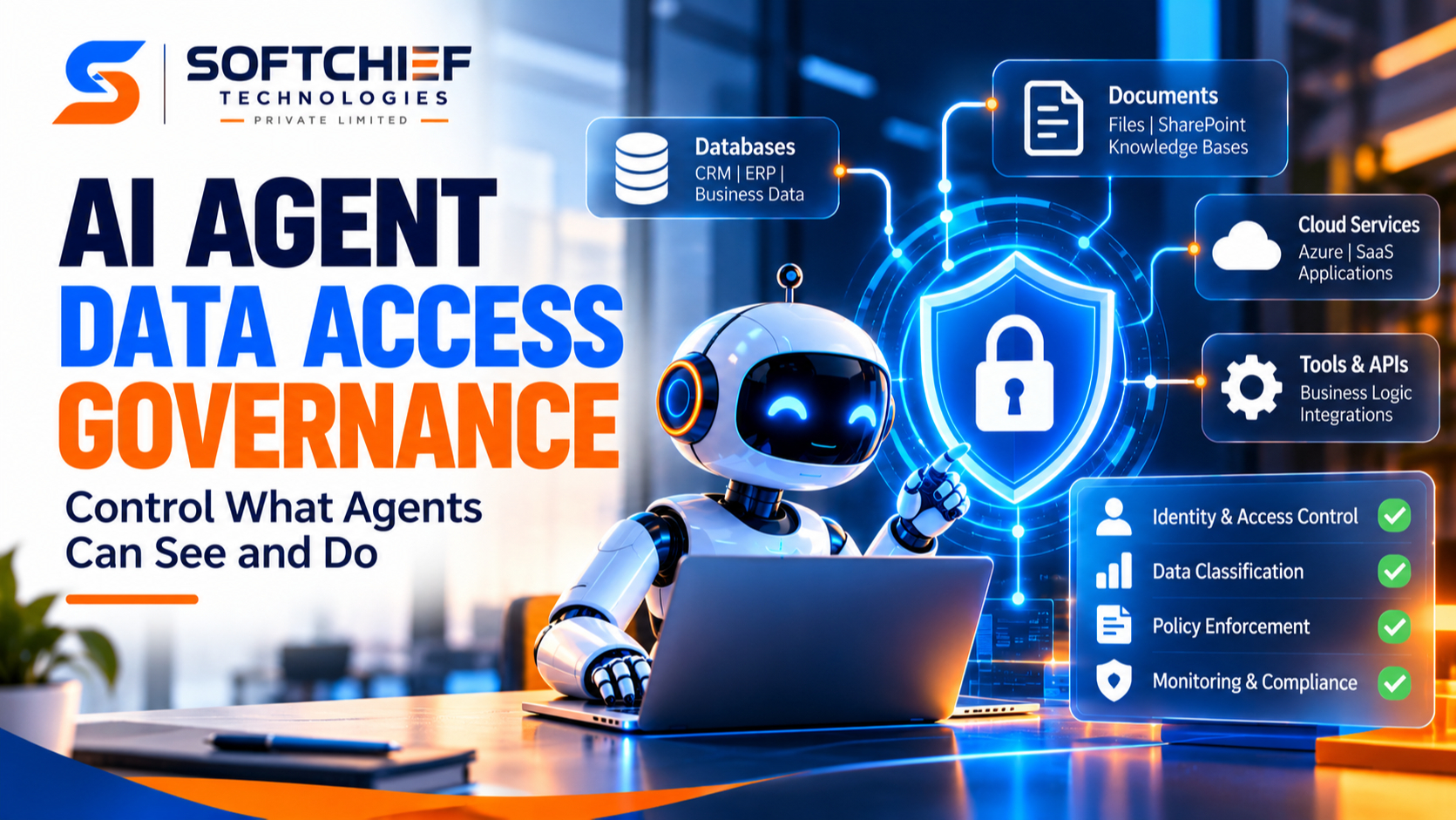
An AI agent can read a support ticket, search company files, and update a customer record in one workflow. That reach makes AI agent data access governance more than a question of which data an agent can see. It must also control what the agent can do with that data.
Broad permissions can expose sensitive records or trigger changes no one intended. Unclear ownership can also make it harder to trace who approved an action or investigate an incident. With clear limits, agents can still handle useful work without receiving access to every system.
Good governance combines distinct identities, least privilege, data-aware authorization, monitoring, and regular reviews. Treat it as an ongoing part of operating agents: their tasks, tools, and data sources can change over time.
Define what AI agent data access governance must control
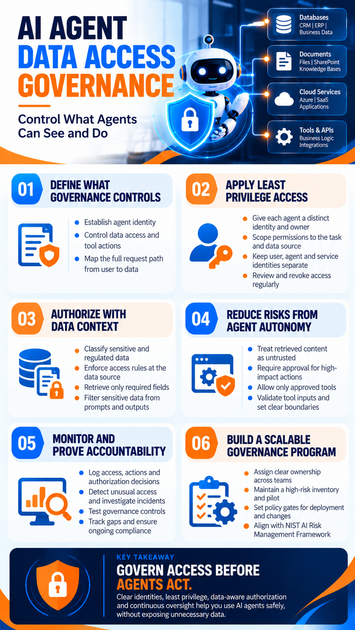
Policies need to cover the agent’s identity, the information it can retrieve, and the actions its tools can perform. They should also account for the full request path, not only the model.
Treat each agent as a distinct identity
Give each agent a named owner and distinct credentials. Apply the same care to sub-agents, service accounts, and connected tools, so teams can tell which identity made a request or change. Shared identities blur accountability and make access reviews and incident investigations harder.
Govern data access and tool actions together
An agent that can read a file has different access from one that can edit or delete it. Sending a message, changing a record, and invoking an API also carry distinct risks. Set permissions for each action, rather than treating all tool access as equivalent.
Map the full path from request to data
A request may pass through a user interface, an agent, a model, a connector, and a data source. Each point can affect whose identity applies and where a policy is checked. Map this chain, then enforce authorization at the connector and the system holding the data.
Apply least privilege across agent identities and tools
Set permissions during setup, then keep them narrow as tasks change. NIST’s SP 800-207 zero-trust guidance focuses access decisions on users, assets, and resources rather than network location alone.
Scope permissions to the task and data source
An agent that summarizes product details may need read access to one catalog, not a whole database. Separate read, write, and administrative permissions, and grant only the access required for the task. Broad “just in case” access increases the amount an agent could expose or change.
Keep user, agent, and service identities distinct
Make clear whether an agent acts as itself, through a service identity, or on a user’s behalf. When supported, delegated access and short-lived credentials can limit exposure if a credential is misused. Store secrets in approved systems; never embed them in prompts or code.
Review and revoke access throughout the agent lifecycle
Require approval before deployment and review permissions on a set schedule. Check the owner, purpose, data scope, and active connectors each time. Remove access promptly when an agent retires, changes roles, or no longer needs a source.
Make authorization sensitive to data context
A valid identity does not automatically make every request appropriate. Access rules can also consider the data’s sensitivity, the user’s permissions, the task’s purpose, and the risk of the requested action.
Classify data before connecting it to agents
Identify public, confidential, sensitive, and regulated data before connecting a source. Use labels and existing data-loss prevention rules to set which agents may retrieve each class. This gives owners a clear basis for approving or denying a new connection.
Enforce policy at the data source
Apply access rules in the system that stores the data, not only in the agent’s instructions. Connectors should respect inherited user permissions and check policy when each request reaches the source. Prompts can guide behavior, but they cannot enforce access rights.
Limit what reaches prompts, context, and outputs
Retrieve only the fields needed for the task; a summary may not need full account details. Filter sensitive information before adding it to the agent’s context, then check responses before delivery. A user should not see data they could not access in the source system.
Reduce risks from agent autonomy and connected tools
Correct permissions alone cannot prevent every risky action. The OWASP guidance on excessive agency describes how excess tool features, permissions, or autonomy can turn unexpected model output into harmful action.
Treat external and retrieved instructions as untrusted
Documents, email, and web pages may contain text that tries to steer an agent. Keep retrieved content separate from trusted instructions, and validate each requested action against policy. Content found during a search must never grant new access or change the agent’s permissions.
Require approval for high-impact actions
Set confirmation steps for actions such as bulk edits, external sharing, or financial transactions. Match review to the possible impact: a routine draft may need no approval, while a payment or broad data change should wait for an authorized person. Record who approved it.
Constrain tool use with explicit boundaries
Allow only approved tools, then restrict each tool’s parameters and functions. Set volume limits and validate destinations, recipients, and record ranges before calls run. An agent that can send a message may not need the ability to send to any address.
Monitor access, prove accountability, and improve controls
Governance continues after launch. Logs, alerts, and recurring tests help teams catch access drift and update controls as agents and data sources change.
Log decisions and actions with enough context
Record the agent and user identities, data source, requested action, authorization result, tool call, and approval when relevant. Protect logs with access controls and a retention period that fits privacy and business needs. These records help teams explain what happened.
Detect unusual access and investigate incidents
Alert on unexpected data sources, permission changes, unusual access volume, and sensitive actions. If an agent behaves unexpectedly, pause it, revoke its credentials, preserve relevant logs, and assess which data it reached. A clear response plan can reduce further exposure.
Test governance controls and track gaps
Before launch and on a recurring schedule, test permissions, connector behavior, approval steps, and data exposure. Track stale permissions, agents without current reviews, policy exceptions, and open findings. Use those gaps to set priorities for the next review.
Build a governance program that scales with agent use
A shared process helps security, data, IT, legal, and business teams make consistent decisions. The NIST AI Risk Management Framework offers a structure for organizing ongoing risk work through its Govern, Map, Measure, and Manage functions.
Assign clear ownership across teams
Name an owner for every agent. Agent owners maintain its purpose and workflow; data owners approve source access; security and platform teams set controls; and business approvers review high-impact actions. Clear ownership supports reviews, exceptions, and retirement.
Start with a high-risk inventory and pilot
Catalog agents, identities, tools, data sources, and business purposes. Prioritize agents that handle sensitive data or can take consequential actions, then test controls in a limited pilot. Fix gaps before adding more agents or connectors.
Set policy gates for deployment and change
Require a named owner, documented purpose, approved data scope, tested controls, and review date before deployment. Apply the same gate when teams add a connector, change permissions, or alter a major workflow. Keep the evidence with the agent’s record.
Key takeaways: govern access before agents act
Effective AI agent data access governance joins distinct identities with least privilege, data-aware authorization, bounded tools, and ongoing oversight. It helps teams preserve useful automation while limiting unnecessary access and high-impact mistakes.
Start by listing your agents, mapping their data and tool access, and narrowing each permission to the task. Add approval for consequential actions, then monitor results and review access on a schedule.