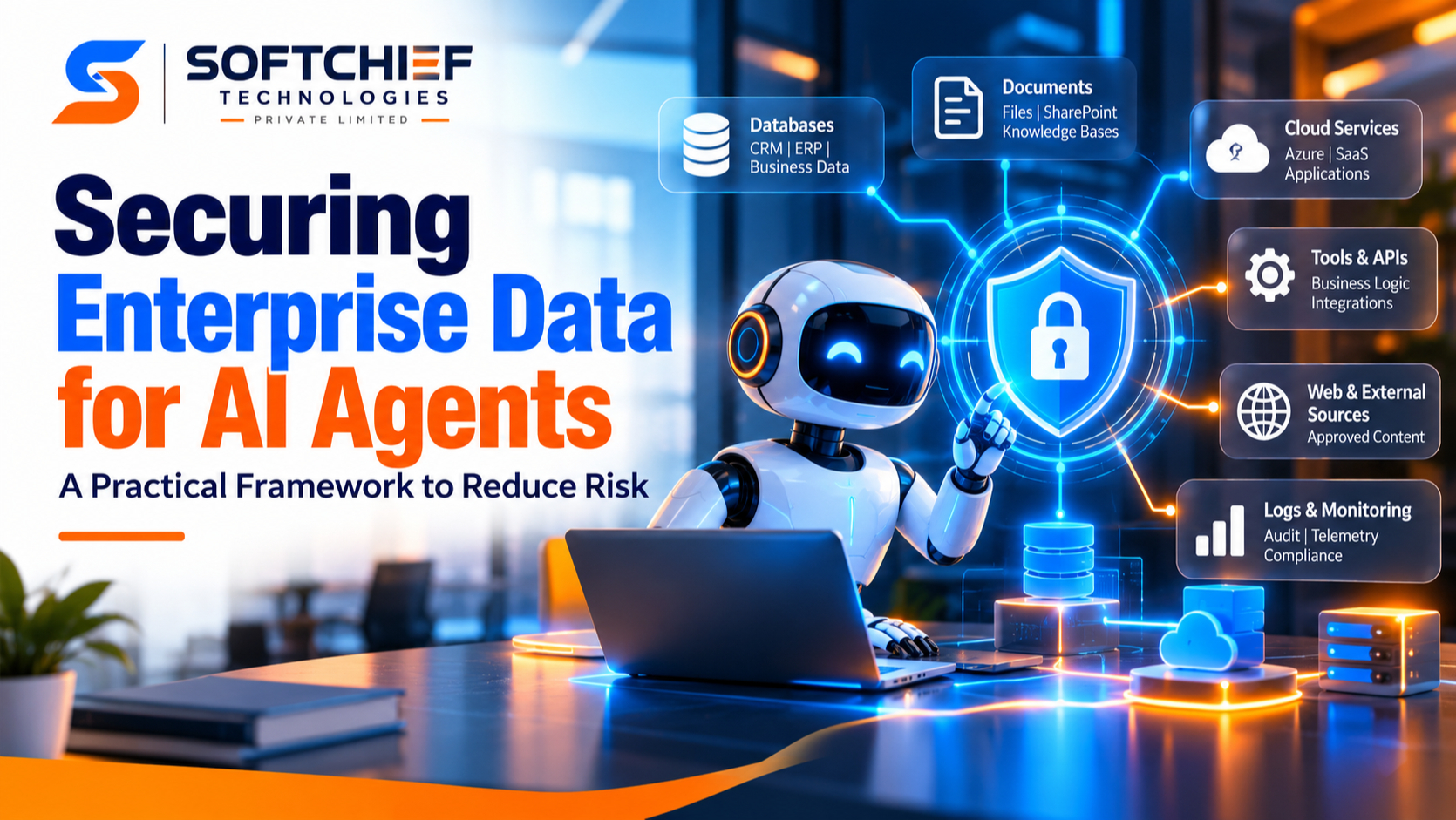
Securing Enterprise Data for AI Agents: A Practical Framework to Reduce Risk
Introduction
An AI agent can find a contract, summarize its terms, and start a follow-up task in minutes. Securing enterprise data for AI agents means keeping that speed without exposing private records or granting access the agent doesn’t need.
Unlike a basic chatbot, an agent can retrieve data, use connected tools, and complete several steps with limited input. Each step creates another chance for sensitive information to reach the wrong user, system, or service.
A practical security plan starts with mapping data flows and setting clear access rules. It also limits sensitive context, constrains agent actions, and prepares teams to monitor and respond to problems.
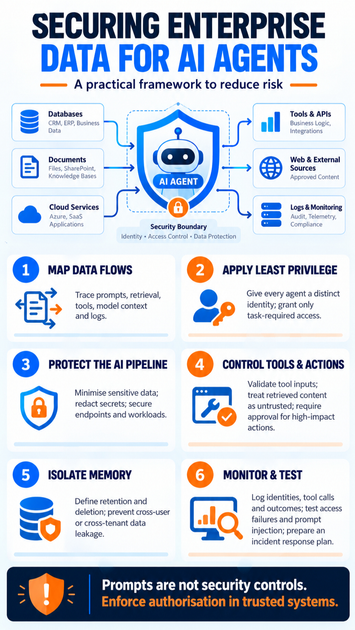
Map data flows to secure enterprise data for AI agents
An agent’s reach depends on more than its model. Data may pass through prompts, search systems, model context, tools, logs, and other applications, so map the full workflow before deployment.
Trace each step in the agent workflow
Follow a request from the user’s prompt through retrieval, model processing, tool calls, and the final response. At each step, record what information the system handles and where it sends it.
Check whether prompts, retrieved documents, and tool results are copied into logs or stored for later use. If an external model provider processes the request, include that boundary in the data map and review its retention settings.
Classify sensitive data and high-impact actions
Identify the records an agent might access, including personal details, financial data, credentials, intellectual property, and regulated information. Classification helps teams apply stricter rules to the data that could cause the greatest harm if exposed.
Also separate read-only tasks from actions that change business records. Looking up an invoice carries different risk from approving payment, changing a customer account, or sending an email with confidential details.
Model agent-specific threats before launch
Threat-model each agent’s tools, data sources, users, and connected services. Consider excessive permissions, prompt injection, unsafe tool use, data disclosure, and a compromised integration.
The OWASP Top 10 for LLM Applications names risks such as sensitive information disclosure and excessive agency. Use it to guide reviews, then assess the specific ways your own systems and workflows could fail.
Secure enterprise data for AI agents with least privilege
An agent should have only the access its task requires. Strong identity and authorization controls help limit the damage from mistakes, misuse, or a compromised tool.
Give each agent a distinct identity
Treat each agent as a managed identity with a named owner, rather than hiding it behind a shared service account. A distinct identity helps teams see which agent accessed a resource and who is responsible for its use.
Store credentials in an approved secret-management system, rotate them as needed, and use short-lived credentials when supported. Keep development, test, and production identities separate so experiments can’t inherit live access.
Limit permissions for tools and data
Scope access by user, task, dataset, and action. An agent that searches support tickets may not need permission to export the full customer database or edit account settings.
Give tools narrow functions, such as reading one record or drafting a message without sending it. Require human approval for sensitive or hard-to-reverse actions, including payments, bulk changes, and external disclosure.
Keep retrieval tied to the user’s rights
Search and retrieval systems should check the user’s permissions when they fetch content. If a user can’t open a document directly, the agent shouldn’t be able to quote or summarize it for them.
Don’t rely on prompt instructions to enforce access rules. Apply authorization in the retrieval layer and check permissions again before the agent uses data in a tool call.
Protect enterprise data throughout the AI pipeline
Security controls need to cover data before, during, and after model processing. They should apply to internal systems as well as outside model providers and integration services.
Minimize and filter data before use
Retrieve only the information needed to complete the request. Redact personal details or secrets when the task doesn’t require them, and block sensitive fields from entering prompts or routine logs.
Set clear limits on how each dataset may be used. A system that summarizes a support case, for example, may need the issue and resolution but not the customer’s payment credentials.
Secure model boundaries, workloads, and secrets
Use approved model endpoints and protect data in transit and at rest. Review provider terms for data use, retention, and deletion before sending enterprise information to an external service.
The NIST AI Risk Management Framework’s Generative AI Profile offers a structure for organizing AI risk work. Pair that governance with network controls, separate agent workloads, and restricted outbound connections. Keep API keys out of prompts, code, and agent memory.
Defend against manipulation and unsafe agent actions
Agents may read content written by people outside your organization, then use that content while choosing what to do. Model instructions alone can’t prevent malicious text or unsafe tool calls from causing harm.
Treat retrieved content as untrusted input
Indirect prompt injection occurs when instructions hidden in a document, webpage, or tool response try to change an agent’s behavior. Treat retrieved text as data, not as a command, and screen sources where practical.
Limit retrieval to trusted sources for sensitive tasks. Keep the agent’s instructions separate from retrieved content, and don’t let document text override access rules or tool policies.
Validate actions and control agent memory
Allowlist the tools an agent can call, validate each request against a strict schema, and check it against policy before execution. Require a person to approve actions such as sending confidential files, changing records, or initiating a payment.
Review what the agent stores in memory, why it stores it, and how long it keeps it. Set deletion rules and isolate memory by user or tenant so one person’s information can’t surface in another person’s session.
Monitor agent access and prove controls work
Written policies matter only if they hold during real use. Logging and repeat testing help teams spot failures, investigate events, and check whether safeguards still work after changes.
Log access and actions without excess detail
Record the agent and user identities, tool calls, resources accessed, authorization results, and action outcomes. These details help investigators reconstruct events without storing every sensitive value the agent handled.
Limit log access and set retention periods that match business and legal needs. Redact secrets and personal information from logs where possible.
Test for leaks and permission failures
Before launch, test whether users can retrieve records they shouldn’t see, whether data crosses between users, and whether tools accept unauthorized actions. Include prompt-injection tests and checks for excessive permissions.
Repeat these tests after changes to prompts, models, tools, or data sources. Run adversarial tests in a controlled environment so teams can find weak points without risking live records.
Prepare a response plan for agent incidents
Define who can suspend an agent, revoke its credentials, preserve evidence, and notify affected teams. Practice the steps so responders can act quickly when an agent exposes data or makes an unauthorized change.
In 2023, Bloomberg reported that Samsung employees had uploaded sensitive code to ChatGPT. That incident involved employee use of a generative AI service, not an autonomous agent, but it shows how quickly company data can cross a boundary without clear controls.
Conclusion: Make secure access the foundation of enterprise AI agents
Securing enterprise data for AI agents takes more than choosing a safe model. Map how data moves, give each agent a distinct identity, enforce least privilege, and limit the context and actions available to it.
Then monitor access, test controls, and prepare teams to respond when something goes wrong. Build these practices into governance and engineering from the start, and review them as agents and workflows change.