From Developer Skills to Enterprise Solutions: Build Software That Delivers Business Impact

Introduction
A feature can pass every test and still fail the people who depend on it. Moving from developer skills to enterprise solutions means building software an organization can trust, scale, secure, and maintain.
That shift asks you to look beyond code. Technical choices affect customer needs, business goals, daily operations, security risks, budgets, and the limits of existing systems.
You can bridge the gap by defining useful outcomes, designing for real conditions, and staying involved after release. These habits turn individual expertise into solutions that support lasting business results.
Connect developer skills to business outcomes
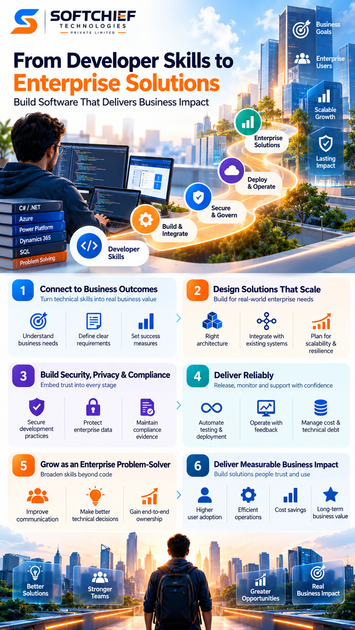
Technical skills create more value when they address a clear business need. A faster process may save staff time, while a safer sign-in flow can reduce risk and make life easier for customers. Start by agreeing on the problem before debating the tools.
Translate business problems into technical requirements
Ask who faces the problem, how often it occurs, and what happens when it does. Then clarify constraints such as budget, timelines, data rules, and systems the solution must use.
Discovery questions make vague goals easier to test: “Which task takes too long?” “Who needs access?” “What would a successful result look like?” Turn the answers into requirements that a team can check, such as completing a task in fewer steps or giving a named user role access to one function.
Choose success measures before technology
Set outcome measures before choosing a language, platform, or vendor. Track signs such as user adoption, task completion, service reliability, cost per transaction, and time saved.
Code volume and feature counts show activity, not value. If a new workflow saves each support agent five minutes per case, measure time saved and check whether users adopt it. These measures help teams judge whether the solution solved the original problem.
Build collaboration into development
Bring product, design, security, operations, and business teams into planning early. Each group sees different needs: users may need a simpler screen, security may require stronger access checks, and operations may flag a system limit.
Use plain language, show working drafts, and ask for feedback before the design hardens. Record key choices and their reasons so later teams can understand the trade-offs without repeating old debates.
Design enterprise solutions that scale
Enterprise software must work across teams, systems, and changing demand. Start with the smallest design that meets the real need, then make growth and failure needs clear. A familiar tool can be a better fit than a complex new platform.
Start with architecture that fits the actual need
Break work into clear modules, define how they share data, and set limits between systems. APIs can help teams connect services, but every new boundary adds work to build, test, and support.
A single application can be easier to manage when the product is small and parts change together. Distributed services may help when teams need separate release cycles or distinct scaling needs, but they add network and data risks. Choose based on a stated need, not fashion.
Plan for integration and legacy environments
Most enterprise products must connect to existing identity tools, databases, and business systems. Document owners, data flows, access rules, and system limits before the build depends on them.
Check integration assumptions early with a working test, especially around identity and data consistency. When replacing an old system, move one workflow or group at a time, compare results, and keep a safe path back while the new flow proves itself.
Make scalability and resilience explicit
Estimate normal and peak demand, then decide what should happen if a service or network fails. Teams also need clear recovery goals: how quickly service should return and how much data loss is acceptable.
Netflix’s engineering post on prioritized load shedding describes protecting key viewing requests during system stress. The lesson is to identify essential work and define what the system can pause when capacity drops. Test those choices before an outage forces them.
Build security, privacy, and compliance into delivery
Trust depends on choices made during design and coding, not only on a final review. Teams can reduce risk without slowing every task by building clear checks into their normal work. Match the level of review to the data, users, and harm a failure could cause.
Apply secure development practices from the start
Use threat modeling to ask what could go wrong, who might misuse a feature, and what data needs protection. Review code, check third-party packages, keep secrets out of source files, and make secure settings the default.
The NIST Secure Software Development Framework (SSDF) offers practices for preparing teams, protecting software, producing secure releases, and responding to flaws. Treat it as a guide to adapt for your risks, not a one-size-fits-all checklist.
Protect enterprise data and user privacy
Classify data by sensitivity before deciding where it can go and who can see it. Give each user or service only the access it needs, encrypt sensitive data, and set rules for how long records stay.
Collect only the information needed for the task. Check your organization’s policies and the laws that apply to your users and data; a rule that fits one project may not fit another.
Make compliance evidence part of the workflow
Keep requirements, approvals, and test results tied to each release. Automated checks can flag common issues, while audit logs help show who accessed a system and when.
The NIST Cybersecurity Framework 2.0 can help teams organize risk work and set priorities. A framework can guide the work, but it does not prove that a product meets every rule. Keep evidence current and confirm obligations with the right experts.
Deliver enterprise solutions reliably
A working prototype becomes an enterprise service when teams can release it, observe it, and support it. Reliable delivery comes from repeatable checks and clear ownership, not a final rush to production.
Automate testing and deployment
Use unit tests for small parts, integration tests for connected systems, and end-to-end tests for key user tasks. Add performance checks where speed or capacity matters, then run repeatable checks in continuous integration.
Keep release steps visible and limit risky changes with staged rollouts or feature flags. Watch each release for errors and user impact so the team can stop or roll back when results slip.
Operate software with feedback and clear ownership
Name a team that owns each service, including alerts, fixes, and user feedback. Monitor key signals such as error rates and response times, and make logs useful without exposing private data.
Service-level objectives set clear reliability goals for users and teams. When an incident occurs, focus on restoring service, sharing updates, and learning what to change. A blameless review can turn a failure into better tests, alerts, or design.
Manage cost and technical debt over time
Review infrastructure use, support needs, and technical debt alongside product plans. The FinOps Foundation’s framework promotes shared cost ownership among engineering, finance, and business teams.
Tie cloud costs to products or services so teams can spot waste and judge the price of new features. Track debt with clear examples, such as slow releases or repeated support work, and plan fixes with product owners instead of leaving cleanup for later.
Grow from individual contributor to enterprise problem-solver
Enterprise work depends on judgment and communication as much as code. Developers who understand the full service can help teams make better decisions and avoid costly surprises.
Strengthen communication and technical decision-making
Write short design proposals that state the problem, options, risks, and recommended choice. Use decision records to capture what the team chose and why, including what could change that choice later.
When speaking with nontechnical partners, explain the trade-offs in terms of time, cost, user impact, and risk. Be clear about uncertainty so leaders can make informed choices before a decision becomes hard to change.
Develop skills through end-to-end ownership
Join discovery, implementation, release, operations, and follow-up. Owning one bounded workflow or service gives you practice with the full set of trade-offs without requiring a team-wide redesign.
Ask users how the workflow performs after release, then use the feedback to guide the next change. This builds a stronger sense of how technical decisions affect the people and teams who rely on the service.
Learn from documented enterprise engineering examples
Read engineering blogs, architecture notes, and published case studies from companies with problems like yours. Netflix’s reliability work offers ideas, but its scale and business needs differ from those of most organizations.
Compare each example with your own team size, risk level, systems, and budget. Borrow a useful principle, test it on a small scale, and keep it only if it improves your service.
Conclusion: Turn developer skills into measurable enterprise impact
The path from code to business value starts with a well-defined problem and useful success measures. It continues through sound architecture, built-in security, automated delivery, clear ownership, and ongoing cost and reliability checks.
Choose one active project and improve one part of that path. You might clarify a user need, automate a test, set a reliability goal, or make service costs visible. Measure what changes, share the result, and use it to guide the next improvement.