From Business Requirement to Technical Solution: A Practical Path from Need to Delivery
Introduction
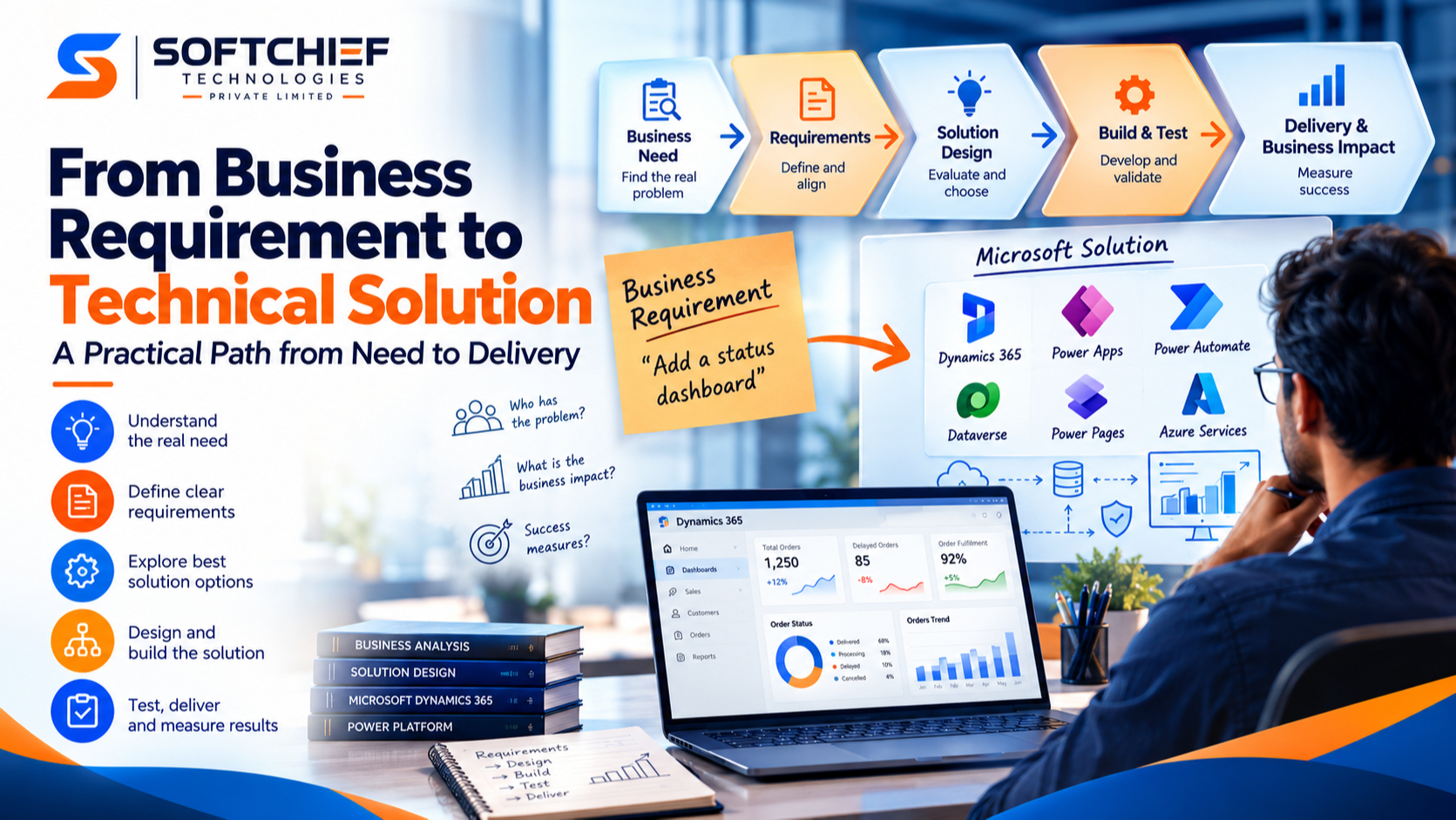
A request for a new feature can sound clear: “Add a status dashboard.” But the real need may be to help staff spot delayed orders before customers call. Moving from business requirement to technical solution means finding that need, agreeing on how to measure success, and choosing an approach that addresses it.
Teams often skip this work. They pick a tool before checking assumptions, or write requirements that people interpret in different ways. The result can be costly rework or a system that works as designed but misses the business goal. A clear path connects discovery, requirements analysis, solution design, testing, and stakeholder alignment.
Start with the business result behind the request
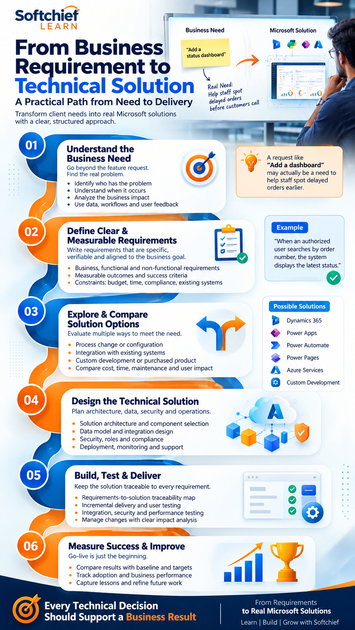
Identify the problem behind the request
Before accepting a proposed feature, ask who has the problem, when it occurs, and what it affects. A request for a dashboard, for instance, may point to slow access to order updates. Look for evidence in workflow observations, service records, support calls, or user feedback, and record what you find.
This step helps you separate the outcome from a suggested fix. A business need might be to help staff find delayed orders sooner; a dashboard is only one possible response. Keeping those ideas apart lets the team assess other ways to solve the same problem.
Define measurable outcomes and constraints
Choose measures that show whether the business problem has improved. Depending on the need, these could include processing time, error rates, service levels, or user adoption. Record a baseline before work begins, then agree on a target and when you’ll review it. Don’t set figures without evidence.
Capture constraints at the same time. Budget, delivery dates, legal or policy rules, and limits on staff or existing systems can shape what’s feasible. Include day-to-day support needs, too, such as who handles access issues or fixes data errors.
Align stakeholders on what success means
Identify the people who approve the work, use the solution, support it, and depend on its results. Their priorities may differ: staff may want fewer steps, while operations needs a clear record of each change. Bring those needs into the same discussion before the team locks in a plan.
Write down the agreed outcome, measures, constraints, and open questions. Name who can make decisions when priorities conflict. This record gives business and technical teams a shared point of reference as the work moves forward.
From Business Requirement to Technical Solution: Write testable requirements
Choose discovery methods that reveal real needs
Use interviews to hear how people describe the problem, and workshops to compare views across teams. Watching a real task can reveal workarounds that people may forget to mention. Document reviews and support data help show what the current process requires and where trouble appears.
Choose each method based on the question you need to answer. If the team needs to understand why staff repeat an entry, observe the workflow and review records. If the question is which of two policy needs takes priority, bring the decision-makers together.
Separate business, functional, and non-functional requirements
Business requirements describe the result the organization needs. Functional requirements state what the system must do, such as show an order’s status to an authorized user. Non-functional requirements describe how well it must work, including security, speed, accessibility, and reliability.
Keep the three kinds distinct so a desired outcome doesn’t become a feature by default. NASA’s systems engineering guidance calls for requirements that are clear, feasible, traceable, and verifiable. That same guidance says requirements should state what is needed, not dictate how to build it.
Make requirements specific and verifiable
Replace vague words such as “fast” or “easy” with a clear condition and expected behavior. For example: “When an authorized staff member searches by order number, the system displays the latest status.” Add acceptance criteria that explain how a tester will confirm the behavior.
Give each requirement an owner and ask the people who will use or support the solution to review it. Check that each statement is clear, fits the agreed business need, and can be tested. If a draft relies on an unconfirmed assumption, record who will check it and when.
From Business Requirement to Technical Solution: Compare feasible options
Explore solution options before choosing technology
Compare more than one way to meet the need. The answer could be a process change, a setting in an existing system, an integration, custom development, or a purchased product. A software build may be unnecessary if a small workflow change solves the main problem.
Assess each option against the agreed requirements, cost, delivery time, and long-term upkeep. Include the effort to train users and support the solution after launch. Record why the team chose one option and what it gives up.
Design for architecture, data, security, and operations
Once an option looks feasible, define what sits inside the solution and what remains part of other systems. Map the key data flows and connections, and decide which roles can view or change sensitive information. Consider privacy, accessibility, recovery after a failure, and system monitoring.
Include operational needs in the design. The team needs to know how the solution will be deployed, supported, and updated. List assumptions and dependencies, such as access to a data source or a change to another team’s system, and confirm them before they disrupt delivery.
Make trade-offs and risks visible
A design choice can affect cost, speed, safety, or ease of support. Record the options considered, the reason for the choice, and any limits the team accepts. An architecture decision record is one useful way to capture this information.
Track risks and unresolved questions with an owner and a next action. A risk log can help the team see which assumptions need an early test. Making trade-offs visible helps decision-makers understand what a change in scope could mean.
Keep the technical solution traceable to every requirement
Build a requirements-to-solution traceability map
Link each business requirement to the functional or non-functional requirement that supports it. Then connect those requirements to design parts, delivery tasks, acceptance criteria, and test results. The map can be a spreadsheet or a feature in a work-tracking tool; the key is keeping it current.
Trace links in both directions. A business need with no design or test link may be missed, while a technical feature with no business link may not be needed. The Government Accountability Office’s 2026 report on Census Bureau IT modernization describes how gaps between a requirements plan and low-level work can make it harder to show that requirements are consistently documented and tied to the solution.
Plan delivery in increments
Rank requirements by business value, risk, and dependency. Where it fits, release a minimum set of useful functions first, then add more after users have tested the core workflow. A small release can also help test high-risk assumptions before the team commits to a larger design.
Set a clear purpose for each increment. Pick an early test that can answer a key question, such as whether the needed data is available or whether staff can complete a task with the proposed screen. Use what you learn to update the plan and requirements.
Manage change without losing the business objective
When someone requests a change, assess its impact on the outcome, scope, cost, schedule, tests, and related systems. Record who approved the change and which requirement or design version it affects. Share the decision with the people who build, test, use, or support the solution.
A change may be valid, but it can also shift attention away from the original need. Revisit the agreed measures when a major assumption or priority changes. This keeps decisions tied to the business result rather than to a growing list of requested features.
Check delivery against the business result after launch
Test against requirements and real workflows
Test each requirement against its acceptance criteria. Integration tests check whether connected systems exchange data as expected; security and performance tests check relevant quality needs. User acceptance testing lets people try real tasks and confirm that the solution supports their work.
Keep the distinction between verification and validation in view. Verification asks whether the solution meets its stated requirements; validation asks whether it serves its intended use. Plan both, and keep evidence such as test results and user feedback linked to the relevant requirements.
Monitor adoption and business performance
Go-live is a delivery milestone, not proof of business success. Compare post-launch measures with the verified baseline and agreed targets. Review adoption signals and user feedback alongside incidents, support requests, and system performance.
If the solution is available but few people use it, find out why before adding features. Users may need training, or the new process may not fit the way work happens. Use evidence from the first weeks and months to decide what to adjust.
Feed lessons into future requirements work
Capture issues, gains, and lessons while the details are fresh. Ask users and support staff which parts worked, where errors occurred, and what took longer than expected. Keep the findings with the project records so the next team can use them.
Use the evidence to refine the solution or shape future work. A change should address a known gap or support a clear outcome. This turns launch feedback into useful input for the next round of requirements analysis.
Conclusion: Connect every technical decision to a business result
A reliable path from business requirement to technical solution starts with the outcome, not the requested feature. Teams discover and confirm needs, write clear requirements, compare feasible options, and connect each requirement to design and test evidence. After launch, they measure results against a verified baseline and learn from real use.
Keep stakeholders aligned, make assumptions and trade-offs clear, and judge success by outcomes rather than delivery alone. Before approving the next feature, ask the team to show which business need it supports, how it will be tested, and what result will prove it helped.