Copilot Studio: How to Design Topic Routing When Users Ask Multiple Questions in One Conversation
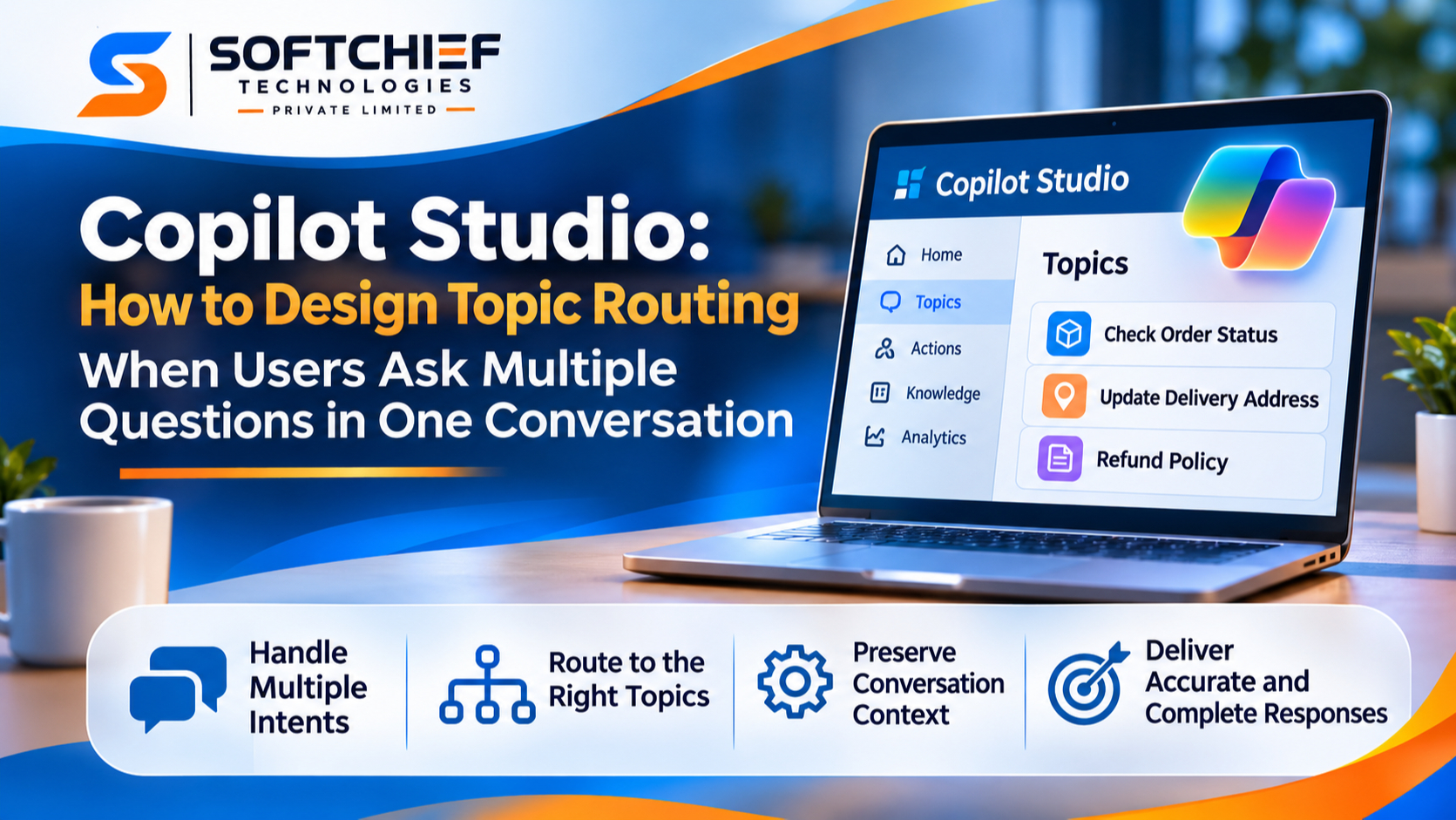
Copilot Studio topic routing is an important part of designing intelligent conversational agents that can understand and handle multiple user questions in a single conversation. When customers combine different business requests, such as checking order status, updating delivery information and understanding refund policies, the agent must identify each intent, select the appropriate topic and maintain conversation context. Microsoft Copilot Studio provides topic-based orchestration and generative AI capabilities to help developers build these intelligent conversational experiences.
Introduction: Copilot Studio Topic Routing: Managing Multiple User Intents
Imagine that an organization has deployed a customer service agent using Microsoft Copilot Studio.
A customer starts a conversation with the following message:
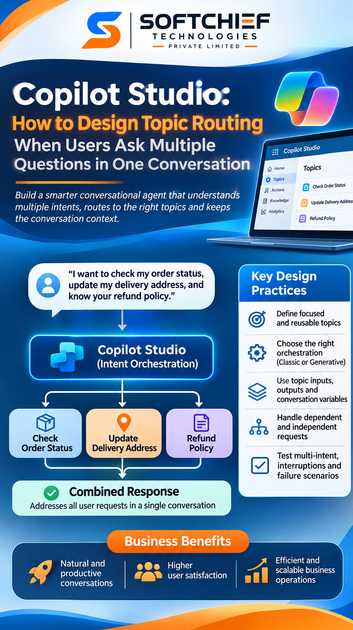
“I want to check my order status, update my delivery address, and understand your refund policy.”
From a business perspective, this is one customer conversation. However, technically, it contains three different requirements:
- Retrieve the current order status.
- Update the delivery address.
- Retrieve and explain the refund policy.
Each requirement may involve a different business process, data source, authorization requirement and backend operation.
A basic conversational agent might recognize only the first request and respond with the order status. Another implementation might ask the customer to repeat the remaining questions individually. A poorly structured agent might even route the user to an unrelated topic because multiple topics have overlapping trigger phrases.
These problems become more significant when an agent is deployed across enterprise applications where users expect conversations to be natural, contextual and capable of handling multiple business requirements.
This is where topic routing becomes an important part of Copilot Studio solution architecture.
Microsoft Copilot Studio provides topic-based conversation design, natural language understanding, conversation variables, topic redirection and generative orchestration to help developers manage different user intents.
However, the implementation approach depends on the orchestration model being used.
In this article, we will examine how to design an enterprise-ready topic routing architecture that can identify multiple user intents, select the appropriate conversation capabilities, maintain context and execute business operations in a controlled manner.
We will use a realistic order management scenario to understand the architecture, implementation, configuration, testing and production considerations.
What we will cover
- Why multiple-intent routing is difficult in conversational agents.
- Understanding topics and orchestration in Copilot Studio.
- Classic orchestration versus generative orchestration.
- Designing a multi-intent conversation architecture.
- Handling multiple questions using generative orchestration.
- Building reusable topics and managing topic inputs and outputs.
- Preserving conversation context using variables.
- Managing interruptions and topic switching.
- Handling dependencies between business operations.
- Testing routing accuracy and handling failures.
- Production architecture and best practices.
The objective is to design an agent that does more than recognize a question. It should understand the user’s business requirements and coordinate the appropriate capabilities to address them.
1. Understanding the Multi-Intent Problem
Before designing the solution, let’s understand what happens when users ask multiple questions in one conversation.
Consider these three customer messages.
Scenario A: Multiple independent questions
“I want to check my order status and know your return policy.”
The agent needs to retrieve order information and answer a policy-related question.
These two requests are independent. The return policy does not depend on the order status.
Scenario B: Multiple dependent operations
“Check my order status and if it hasn’t shipped yet, change the delivery address.”
This request contains a dependency.
The agent must first retrieve the order status. It can update the delivery address only if the order meets the organization’s business rules.
Scenario C: Multiple requests with missing information
“Check my order, update the address and tell me when it will arrive.”
The agent needs additional information, such as an order number or authenticated customer identity.
It must collect the missing information without losing the other requests.
These scenarios demonstrate that multiple-intent handling is not simply about triggering multiple topics.
It requires understanding the relationship between user requests.
Different types of user intents
| Intent type | Example | Required behavior |
|---|---|---|
| Informational | What is your refund policy? | Retrieve relevant knowledge |
| Data retrieval | Where is my order? | Call an order lookup operation |
| Business transaction | Change my delivery address | Execute an authorized update |
| Dependent request | If my order has not shipped, change the address | Evaluate a condition before executing |
| Clarification | Check my order | Collect the missing order identifier |
| Contextual follow-up | Can you also cancel it? | Understand the previous order context |
An enterprise agent should distinguish these scenarios instead of treating every message as an isolated question.
2. Understanding Topic Routing in Microsoft Copilot Studio
A topic represents a specific conversation capability or business scenario in Copilot Studio.
For example, an order management agent might contain the following topics:
| Topic | Responsibility |
|---|---|
| Check Order Status | Retrieve order information |
| Update Delivery Address | Validate and update delivery information |
| Refund Policy | Explain refund eligibility and policy |
| Cancel Order | Process cancellation requests |
| Track Shipment | Retrieve shipment information |
| Customer Verification | Validate customer identity |
| Escalate to Support | Transfer unresolved cases |
Topics can be triggered through user utterances or called through explicit redirection from another topic.
A topic can contain several node types, including:
- Trigger nodes.
- Question nodes.
- Message nodes.
- Condition nodes.
- Variable management nodes.
- Tool nodes.
- Redirect nodes.
- End nodes.
For example, a Check Order Status topic might collect an order number, call a backend operation and return the order details.
The important design principle is to keep each topic focused on a clearly defined business capability.
A topic should not become an unnecessarily large conversation containing every possible customer requirement.
Topic descriptions and trigger phrases
In a topic-driven design, the trigger configuration helps Copilot Studio recognize the appropriate topic from the user’s message.
For example:
Topic: Check Order Status
Possible trigger phrases:
- Where is my order?
- Check my order status.
- Has my order been shipped?
- Track my purchase.
- I want to know my delivery status.
Topic: Update Delivery Address
Possible trigger phrases:
- Change my delivery address.
- Update my shipping address.
- I entered the wrong address.
- Can I change where my order is delivered?
Topic: Refund Policy
Possible trigger phrases:
- What is your refund policy?
- Can I return a product?
- How long does a refund take?
- What are the refund conditions?
These trigger phrases should represent the actual language customers use.
Avoid creating multiple topics with nearly identical trigger phrases. Overlapping intent definitions make routing less predictable.
Microsoft recommends creating focused topics, avoiding unnecessary overlap and using clarification or disambiguation when the agent cannot confidently determine the intended topic.
Reference: Microsoft – Follow topic authoring best practices.
3. Classic Orchestration vs Generative Orchestration
Effective Copilot Studio topic routing allows an agent to identify different user requirements and coordinate the appropriate topics, tools and knowledge sources.
This is one of the most important architectural decisions when designing multi-intent conversations.
Copilot Studio supports different orchestration approaches, and developers should understand their differences before building the solution.
Classic orchestration
In classic orchestration, topics are primarily selected through natural language understanding and configured trigger phrases.
When a user message matches multiple topics, the Multiple Topics Matched system topic can present the matching choices to the user.
For example:
User:
“I want to check my order and update my address.”
If the utterance matches multiple topics, the agent may need to disambiguate the request rather than automatically executing both business processes.
The developer must design the conversation flow to manage these scenarios.
Common implementation techniques include:
- Creating a dedicated entry-point or disambiguation topic.
- Collecting multiple requirements.
- Using condition nodes.
- Redirecting to reusable child topics.
- Passing values through topic inputs and outputs.
- Returning to the originating conversation after a child topic completes.
Classic orchestration is useful when business processes require explicit, predictable conversation paths.
However, it can become difficult to maintain if developers create a large number of overlapping topics and manually implement every possible combination.
Generative orchestration
Generative orchestration uses an LLM-driven planning layer to interpret user intent and select suitable topics, tools, knowledge sources and other available capabilities.
Instead of depending exclusively on predefined trigger phrase matching, the orchestrator evaluates the descriptions and available inputs and outputs of the configured components.
Consider the same request:
“I want to check my order status, update my delivery address, and understand your refund policy.”
A generative orchestrator can identify the three requirements and attempt to fulfil them using the appropriate available capabilities.
It may:
- Select the order lookup capability.
- Select the address update capability.
- Retrieve refund policy information.
- Coordinate the required sequence.
- Generate a combined response using the available results.
The important point is that generative orchestration can plan across multiple topics, tools and knowledge sources.
However, developers must still define the capabilities correctly, establish the necessary input and output contracts, configure security and test the actual execution behavior.
Architectural comparison
| Capability | Classic orchestration | Generative orchestration |
|---|---|---|
| Topic selection | Trigger phrases and NLU | Topic descriptions and LLM planning |
| Multiple intents | Often requires explicit disambiguation and flow design | Can plan across multiple relevant capabilities |
| Topic execution | Explicitly designed conversation paths | Orchestrator selects suitable capabilities |
| Tool invocation | Typically configured inside topics | Can select available tools based on descriptions |
| Missing information | Question nodes and variables | Can generate questions for missing inputs |
| Conversation control | More explicitly scripted | More dynamically planned |
| Best suited for | Deterministic conversation flows | Flexible, multi-step conversational workflows |
A common mistake is to assume that adding more trigger phrases automatically solves multi-intent routing.
It does not.
The architecture must match the orchestration model.
Architecture recommendation: Use classic orchestration when the conversation must follow carefully controlled, predefined paths. Consider generative orchestration when the agent must interpret multiple requests and dynamically coordinate several business capabilities.
Reference: Microsoft – Orchestrate agent behavior with generative AI.
4. Designing the Enterprise Architecture
Let’s design an order management agent that supports three major capabilities:
- Order status retrieval.
- Delivery address updates.
- Refund policy information.
The solution should separate conversation management from business processing.
Logical architecture
                 CUSTOMER
                    |
                    |
          Multiple Questions in
             One Message
                    |
                    v
          COPILOT STUDIO AGENT
                    |
                    v
           INTENT ORCHESTRATION
                    |
          +---------+----------+
          |         |          |
          v         v          v
       Order     Address     Refund
       Status    Update      Policy
       Topic     Topic       Knowledge
          |         |          |
          v         v          v
       Order     Address     Knowledge
       Lookup    Update      Retrieval
       Flow      Flow        |
          |         |          |
          v         v          |
          +---------+----------+
                    |
                    v
           BUSINESS VALIDATION
                    |
                    v
            BACKEND SYSTEMS
                    |
          +---------+----------+
          |                    |
          v                    v
       Order Database     Customer Data
          |                    |
          +---------+----------+
                    |
                    v
            RESPONSE ASSEMBLY
                    |
                    v
             CUSTOMER RESPONSE
This architecture separates the responsibilities of the agent and the backend.
Copilot Studio manages conversational intent, topic selection and interaction.
Power Automate or another configured tool performs the required business operations.
The backend remains responsible for validating and enforcing business rules.
Why this separation matters
Imagine that the organization changes its delivery address validation rules.
If the business logic is implemented independently in several conversation topics, developers may need to update multiple locations.
Instead, the address update operation should be implemented in a reusable backend capability.
The agent can invoke that capability whenever the relevant business requirement is identified.
This reduces duplication and makes the architecture easier to maintain.
5. Implementing the Multi-Intent Solution
Let’s walk through the implementation.
We will use a sample customer message:
“I want to check order ORD-1045, change its delivery address to Hyderabad, and know your refund policy.”
Assume the agent has access to:
- An Order Lookup capability.
- An Update Delivery Address capability.
- A Refund Policy knowledge source.
Step 1: Create focused topics
In Copilot Studio:
- Open the required agent.
- Navigate to Topics.
- Select Add a topic.
- Create the required business topics.
- Configure appropriate trigger phrases when using classic orchestration.
- Provide clear topic descriptions.
- Add the required conversation nodes.
- Save and test each topic.
Create the following capabilities:
Check Order Status
Responsibility: Retrieve order details using an order identifier.
Update Delivery Address
Responsibility: Validate the order and update the delivery address if the business rules allow it.
Refund Policy
Responsibility: Retrieve approved refund policy information.
Customer Verification
Responsibility: Ensure that the customer is authorized to access or modify the requested order.
Keep these responsibilities separate.
Step 2: Define topic inputs and outputs
Reusable topics should have clearly defined input and output parameters.
For example:
Check Order Status
Input:
OrderId: TextOutputs:
OrderStatus: Text
ShipmentStatus: Text
ExpectedDeliveryDate: DateTime
CanUpdateAddress: Boolean
Update Delivery Address
Inputs:
OrderId: Text
NewDeliveryAddress: Text
CustomerVerified: Boolean
Outputs:
UpdateSuccessful: Boolean
UpdateMessage: Text
Refund Policy
Input:
ProductCategory: TextOutput:
RefundPolicyInformation: TextThese are illustrative interface contracts. Configure the actual data types and topic parameters according to the operations available in your agent.
Why are inputs and outputs important?
Because topic routing should not depend on hidden assumptions about what another topic has collected.
Explicit inputs make dependencies visible and make reusable capabilities easier to test.
Copilot Studio supports topic input and output parameters, and generative orchestration can use conversation context to populate topic inputs where applicable.
Reference: Microsoft – Create and edit topics.
Step 3: Configure the order lookup operation
The order lookup capability should retrieve the required information from an authorized backend.
For example, a Power Automate flow might receive:
{
  "orderId": "ORD-1045"
}
The flow can:
- Validate the order identifier.
- Verify the caller’s authorization.
- Retrieve the corresponding order record.
- Determine the current shipment status.
- Evaluate whether address modification is allowed.
- Return the required information.
Example response:
{
  "orderId": "ORD-1045",
  "orderStatus": "Processing",
  "shipmentStatus": "Not Shipped",
  "canUpdateAddress": true,
  "expectedDeliveryDate": "2026-11-27"
}
The values are sample data, not live order information.
The important architectural point is that the backend determines whether an address update is allowed.
The agent should not independently assume that every order can be modified.
Step 4: Configure the address update operation
The address update capability should receive the order identifier and the new address.
Example input:
{
  "orderId": "ORD-1045",
  "newDeliveryAddress": "Hyderabad"
}
Before updating the record, the backend should validate:
- Whether the order exists.
- Whether the authenticated customer owns the order.
- Whether the order is eligible for address modification.
- Whether the new address contains the required information.
- Whether the update is permitted under business rules.
The backend should return a structured result.
Example:
{
  "success": true,
  "message": "Delivery address updated successfully"
}
For an actual implementation, use a complete address structure rather than a city name alone.
Also consider idempotency and duplicate requests when the operation can be retried.
Step 5: Configure refund policy knowledge
Not every customer request needs a transactional tool.
The refund policy request is informational.
It can be handled through an approved knowledge source containing the organization’s refund rules.
The knowledge content should be authoritative and maintained by the business.
The agent should distinguish between:
- Explaining the refund policy.
- Checking whether a particular order qualifies for a refund.
- Initiating an actual refund transaction.
These are three different capabilities.
Do not let a general policy answer automatically authorize a financial transaction.
6. Handling Multiple Intents with Generative Orchestration
For this scenario, generative orchestration provides an approach for coordinating multiple capabilities from a single user request.
The agent needs well-defined descriptions for each available topic and tool.
For example:
Check Order Status – Description
“Use this capability when a customer wants to retrieve the current status of an existing order. Requires an authorized order identifier. Returns order status, shipment status, expected delivery information and whether an address update is permitted.”
Update Delivery Address – Description
“Use this capability when an authenticated customer requests a delivery address change. Requires an order identifier, a complete new address and verified customer context. The backend determines whether the order is eligible for modification.”
Refund Policy – Description
“Use this capability when a customer asks about refund eligibility, return conditions, refund timelines or the organization’s approved refund policy. Retrieve information from the configured refund policy knowledge source.”
These descriptions are important because the orchestrator needs to understand what each capability does and when it should be selected.
A vague description such as “Handles orders” is not sufficient.
It does not explain:
- When the capability should be used.
- What information it requires.
- What result it produces.
- What business conditions apply.
Configure agent instructions
The agent instructions should explain the intended behavior.
Example:
You are an order management assistant.

Your responsibilities include:

1. Retrieve order information using the
   approved order lookup capability.

2. Update delivery addresses only after
   customer authorization and backend validation.

3. Answer refund policy questions using
   approved knowledge sources.

4. When the customer asks multiple independent
   questions, attempt to address each request.

5. Execute dependent operations only after
   the required preceding operation succeeds.

6. Never assume that an order is eligible
   for modification.

7. Ask for missing information when required.

8. Do not claim that an operation succeeded
   unless the backend confirms success.

9. If an operation fails, communicate the
   failure clearly and offer an appropriate
   next step.

10. Preserve relevant conversation context
    when handling follow-up questions.
These instructions establish business expectations.
They do not replace tool permissions, backend authorization or transactional validation.
The orchestrator must still operate within the capabilities and access permissions configured for the agent.
Expected orchestration behavior
For the original customer message:
“I want to check order ORD-1045, change its delivery address to Hyderabad, and know your refund policy.”
The orchestrator should identify:
| Request | Selected capability | Dependency |
|---|---|---|
| Check order status | Order Lookup | None |
| Update address | Address Update | Order lookup and authorization |
| Explain refund policy | Refund Policy | None |
A suitable execution plan is:
- Retrieve order details.
- Determine whether the address can be updated.
- If permitted and all required information is available, invoke the address update operation.
- Retrieve the relevant refund policy.
- Present the results clearly.
The refund policy lookup is independent of the order lookup and address update.
The address update is dependent on the order lookup result.
This distinction is essential when designing multi-intent business workflows.
Important: Generative orchestration can plan across multiple capabilities, but it should not be treated as a guarantee of a particular execution order or transactional outcome. Define explicit dependencies in tool inputs, business logic and backend validation. Test the actual orchestration behavior in the target agent.
7. Managing Conversation Context Using Variables
One of the most important challenges in multi-intent conversations is maintaining context.
Consider the following interaction:
Customer:
“Check my order ORD-1045.”
Agent:
“Your order is currently being processed.”
Customer:
“Can you change the delivery address to Hyderabad?”
The second message does not contain the order identifier.
The agent needs to understand that the customer is referring to ORD-1045.
This is where conversation variables and topic parameters become useful.
Example variable design
| Variable | Purpose |
|---|---|
| OrderId | Stores the current order identifier |
| CustomerId | Stores the authenticated customer context |
| OrderStatus | Stores the retrieved order status |
| CanUpdateAddress | Stores the backend eligibility result |
| NewDeliveryAddress | Stores the requested address |
| AddressUpdateStatus | Stores the update result |
Variables can be used to pass information between conversation steps and reusable topics.
For example:
OrderId = "ORD-1045"

OrderStatus = "Processing"

CanUpdateAddress = true

NewDeliveryAddress = "Hyderabad"
The address update topic can use the existing order context instead of asking the customer for the same information again.
However, context management must be deliberate.
A variable should not be assumed to be valid simply because it contains a value.
The agent must consider:
- Whether the value belongs to the current customer.
- Whether the value is still relevant.
- Whether the user has changed their request.
- Whether the backend has returned updated information.
- Whether the value should be cleared or overwritten.
Handling corrections
Suppose the customer says:
“Actually, I meant order ORD-1048.”
The agent must update the order context.
It should not continue using the previous order identifier.
Use variable management and explicit validation to ensure that corrected values replace earlier values where required.
For sensitive or transactional data, revalidate against the backend instead of relying only on conversation history.
8. Managing Interruptions and Topic Switching
A real customer conversation is rarely a perfectly structured sequence.
Consider this interaction:
Agent:
“Please provide your order number.”
Customer:
“Before that, can you explain your refund policy?”
The customer has changed the subject while the agent is waiting for an answer.
If the agent is not configured correctly, it might interpret the refund question as an invalid order number.
Copilot Studio provides interruption behavior for question nodes.
Developers can configure whether users can switch to another topic while responding to a question.
Depending on the configuration, the user may be allowed to switch to another topic or only to selected topics.
This is particularly important when building multi-intent conversations.
Recommended interruption design
For informational questions:
Allow appropriate topic switching so that customers can ask related questions without restarting the conversation.
For transactional questions:
Carefully configure interruption behavior when collecting critical information.
For example, if the agent is collecting a payment confirmation or another sensitive business input, the interruption behavior should be designed and tested according to the business process.
Example
Customer:
“Check my order ORD-1045.”
Agent:
“Your order is being processed. Would you like to update the address?”
Customer:
“What is the refund policy?”
Agent:
“Here is the refund policy information…”
Customer:
“Okay, now update the address to Hyderabad.”
The agent should retain the relevant order context, verify that it is still valid and continue with the address update.
This requires correct conversation state management, topic design and backend validation.
Reference: Microsoft – Ask a question and configure interruption behavior.
9. Managing Dependencies Between Multiple Business Operations
This is where conversational architecture becomes more than intent recognition.
Consider the following request:
“Check whether my order has shipped. If it hasn’t shipped, update my delivery address.”
The agent must not execute both operations blindly.
It must first retrieve the order information.
Then it must evaluate the result.
Recommended business flow
Customer Request
       |
       v
Identify Order
       |
       v
Retrieve Order Status
       |
       v
Evaluate Shipment Status
       |
       +----------------------+
       |                      |
       v                      v
Not Shipped                Shipped
       |                      |
       v                      v
Check Address            Do Not Update
Eligibility              Address
       |                      |
       v                      v
Update Address           Explain Restriction
       |
       v
Return Result
Business rules
| Condition | Agent behavior |
|---|---|
| Order not found | Ask for a valid order identifier |
| Customer not authorized | Deny access |
| Order not shipped and eligible | Proceed with address update |
| Order already shipped | Explain that address modification is unavailable under the applicable rules |
| Backend unavailable | Report that the operation could not be completed |
| Address validation failed | Request a corrected address |
The actual rules must come from the organization’s order management system.
Why should business rules stay in the backend?
Suppose the company introduces a new rule:
“Delivery addresses can only be changed within 30 minutes of order placement.”
If this rule exists only in the Copilot Studio instructions, it can become difficult to maintain consistently across multiple applications.
Instead, the backend should enforce the rule.
The agent can explain the outcome, but the backend remains the authority for transaction eligibility.
This is a critical design principle for enterprise agents.
10. Handling Failures Without Losing the Conversation
Multi-intent conversations introduce another challenge: partial success.
Imagine that the customer asks for three things:
- Check order status.
- Update delivery address.
- Explain refund policy.
The order lookup succeeds.
The refund policy information is retrieved successfully.
However, the address update operation fails because the backend is temporarily unavailable.
The agent should not report that the entire conversation failed.
It should communicate the results individually.
Recommended response structure
“Here is the update on your requests:
Order status: Your order ORD-1045 is currently being processed.
Delivery address: I couldn’t complete the address update because the order service is temporarily unavailable. Your existing address has not been changed.
Refund policy: Your order is subject to the applicable refund policy. Returns and refunds depend on the eligibility conditions defined by the organization.
Would you like me to retry the address update?”
This response is better than a generic error message.
It tells the customer:
- Which operations succeeded.
- Which operation failed.
- Whether any data was changed.
- What action can be taken next.
Production implementation considerations
For transactional operations, consider:
- Structured success and failure responses.
- Correlation identifiers.
- Retry policies for transient errors.
- Idempotency controls for operations that may be repeated.
- Appropriate timeout handling.
- Backend transaction validation.
- Audit logging for sensitive operations.
Do not automatically retry every failed business operation.
For example, a request to update a delivery address should not be repeated blindly if the original operation may already have completed but the response was lost.
The backend should support safe retry behavior.
11. Testing Multi-Intent Routing in Copilot Studio
Testing only individual topics is not sufficient.
A topic may work correctly when tested independently but behave unexpectedly when multiple intents appear in the same message.
Testing should cover individual intents, combinations, interruptions, dependencies and failure conditions.
Test scenario 1: Multiple independent requests
Input:
“I want to check my order status and know your refund policy.”
Expected behavior:
- Order lookup capability is selected.
- Refund policy information is retrieved.
- Both requests are addressed.
Test scenario 2: Dependent business operations
Input:
“Check my order and change my address if it has not shipped.”
Expected behavior:
- Order status is retrieved first.
- Eligibility is evaluated.
- Address update runs only when permitted.
- The customer receives an accurate result.
Test scenario 3: Missing information
Input:
“I want to change my delivery address.”
Expected behavior:
- The agent identifies the missing order context.
- It requests the required information.
- It does not invoke the update operation with incomplete data.
Test scenario 4: Topic interruption
Input sequence:
- Check my order.
- What is your refund policy?
- Now update my delivery address.
Expected behavior:
- The agent answers the refund question.
- It preserves valid order context.
- It revalidates the order before the address update.
Test scenario 5: Ambiguous request
Input:
“I need help with my order.”
Expected behavior:
- The agent requests clarification.
- It does not guess whether the customer wants order tracking, cancellation, address modification or a refund.
Test scenario 6: Partial failure
Input:
“Check my order, change my address and explain the refund policy.”
Simulate a backend failure in the address update operation.
Expected behavior:
- Order information is still returned.
- Refund information is still provided.
- Address update failure is communicated accurately.
- No false success message is generated.
Test matrix
| Test Area | Validation |
|---|---|
| Intent recognition | Correct capability selection |
| Multiple intents | All requested tasks addressed |
| Topic inputs | Required parameters populated |
| Context preservation | Correct values reused |
| Topic switching | Interruptions handled |
| Dependency management | Correct execution sequence |
| Authorization | Unauthorized operations rejected |
| Error handling | Partial failures handled |
| Response quality | Clear and complete response |
Use the Copilot Studio test pane to validate conversations and review the agent’s behavior.
For generative orchestration, test different phrasings of the same request and examine which topics, tools and knowledge sources are selected.
Do not rely on a single successful test conversation.
12. Monitoring and Improving Routing Accuracy
A production agent should be monitored continuously.
The objective is not only to measure how many conversations the agent handles.
We need to understand whether it selects the correct capabilities and completes the requested business operations.
Monitor the following areas:
Intent and routing metrics
- Correct topic selection.
- Incorrect topic selection.
- Multiple Topics Matched frequency.
- Unrecognized user requests.
- Clarification frequency.
- Topic switching behavior.
Business operation metrics
- Successful order lookups.
- Successful address updates.
- Failed transactions.
- Backend response time.
- Authorization failures.
- Retry frequency.
Conversation quality metrics
- Unresolved conversations.
- Repeated questions.
- User abandonment.
- Escalations to human support.
- Customer satisfaction feedback.
Continuous improvement process
Conversation Analytics
        |
        v
Identify Routing Problems
        |
        v
Review Conversation Transcripts
        |
        v
Improve Topic Descriptions
        |
        v
Improve Inputs and Outputs
        |
        v
Refine Agent Instructions
        |
        v
Run Regression Tests
        |
        v
Publish Updated Agent
When a routing problem is identified, do not immediately add more trigger phrases.
First investigate whether the problem comes from:
- Overlapping topic descriptions.
- Incomplete topic inputs.
- Missing capabilities.
- Ambiguous user language.
- Incorrect conversation state.
- Poorly defined tool descriptions.
- Missing business validation.
This approach addresses the underlying architectural problem instead of adding unnecessary complexity.
13. Common Design Mistakes in Multi-Intent Copilot Studio Agents
Mistake 1: Creating a separate topic for every possible sentence
Users can express the same intent in hundreds of ways.
Creating a separate topic for each sentence results in unnecessary topic duplication.
Better approach: Create focused topics based on business capabilities, not individual sentence variations.
Mistake 2: Assuming multiple trigger phrases solve multiple intents
Trigger phrases help identify intent, but they do not automatically coordinate multiple independent business processes.
Better approach: Choose the appropriate orchestration model and design the necessary multi-intent handling.
Mistake 3: Building one large topic for every business process
A large topic containing order lookup, address updates, refunds, cancellation and customer verification becomes difficult to maintain.
Better approach: Use small, reusable topics with clearly defined responsibilities.
Mistake 4: Not defining topic inputs and outputs
If topics rely on implicit conversation context, information can be lost or incorrectly reused.
Better approach: Define explicit inputs, outputs and data contracts.
Mistake 5: Allowing the agent to assume business eligibility
The agent should not assume that an order can be cancelled, refunded or modified.
Better approach: Let the backend enforce business rules and return the authoritative result.
Mistake 6: Ignoring conversation interruptions
Users frequently change subjects while answering a question.
Better approach: Configure interruption behavior and test the resulting conversation state.
Mistake 7: Returning one generic response for multiple operations
A single generic message hides partial failures and makes it difficult for users to understand what happened.
Better approach: Assemble the final response using the individual results of each operation.
Mistake 8: Treating generative orchestration as a replacement for architecture
Generative orchestration helps select and coordinate capabilities, but it does not eliminate the need for security, authorization, input validation, business rules and testing.
Better approach: Combine flexible orchestration with explicit contracts and deterministic backend enforcement.
14. Production Architecture Recommendations
When moving a multi-intent agent into production, consider the following architectural practices.
Security and identity
Use appropriate authentication and authorization for customer-specific operations. Do not trust an order identifier supplied by a user without verifying ownership or access permissions.
Reusable capabilities
Design topics and tools around business responsibilities. Reuse common capabilities instead of duplicating business logic.
Data contracts
Define required inputs, output structures and failure responses for every transactional capability.
Business validation
Enforce eligibility and transactional rules in the backend.
Observability
Use appropriate Copilot Studio analytics, Power Platform monitoring capabilities and backend telemetry to investigate routing and execution failures.
Conversation state
Preserve relevant context, but revalidate sensitive or transactional information before performing operations.
Governance
Manage agent changes through appropriate development, testing and production environments. Apply solution management and controlled deployment practices.
Responsible AI
Provide accurate, relevant responses. Do not allow the agent to invent transaction results, policy conditions or business information when an authoritative source is unavailable.
15. Final Architecture Recommendation
For an enterprise customer service agent that must handle multiple questions in a single conversation, the recommended design is to separate intent interpretation, capability execution and business validation.
| Architecture Component | Responsibility |
|---|---|
| Copilot Studio Agent | Conversational interaction |
| Orchestration Layer | Intent interpretation and capability selection |
| Business Topics | Reusable conversation capabilities |
| Topic Inputs and Outputs | Information exchange |
| Conversation Variables | Context management |
| Power Automate / Tools | Business operation execution |
| Knowledge Sources | Approved informational content |
| Backend Systems | Business rules and transactional validation |
| Monitoring | Routing and operational analysis |
The choice between classic and generative orchestration should be based on the application’s requirements.
For a highly controlled process with predefined steps, classic orchestration may be appropriate.
For an agent that must interpret multiple intents and dynamically coordinate topics, tools and knowledge, generative orchestration is worth evaluating.
In either case, the agent should have clearly defined capabilities, reliable context management, secure backend operations and a comprehensive testing strategy.
Conclusion
Mastering Copilot Studio topic routing helps developers build enterprise conversational agents that can manage multiple requests while maintaining accurate and consistent responses.
Designing topic routing in Microsoft Copilot Studio becomes more challenging when users ask multiple questions in one conversation.
A successful enterprise agent must do more than recognize individual trigger phrases. It must identify the user’s requirements, understand dependencies, select the appropriate capabilities, preserve relevant context and communicate the outcome accurately.
Copilot Studio provides the building blocks to implement this architecture through topics, variables, topic inputs and outputs, redirects, interruption handling and generative orchestration.
However, the quality of the final solution depends on the architecture behind those capabilities.
The most important principles are:
- Design topics around business capabilities.
- Avoid overlapping and unnecessarily duplicated topic definitions.
- Select the orchestration model based on business requirements.
- Define clear inputs and outputs for reusable capabilities.
- Preserve conversation context carefully.
- Handle dependent operations through explicit business validation.
- Enforce authorization in the backend.
- Test multiple intents, interruptions and partial failures.
- Monitor real conversations and continuously improve routing accuracy.
For Power Platform developers and Copilot Studio solution architects, mastering these design principles is essential when building conversational agents that can support real enterprise business processes.
A well-designed conversational agent should not force users to think in terms of topics. It should understand their business requirements and coordinate the right capabilities to address them.
Want to develop practical skills in Microsoft Copilot Studio, Power Platform and AI agent development? Explore Softchief Learn’s live training programs designed for freshers and working professionals.
Explore upcoming live technical webinars covering Microsoft Copilot Studio, Power Platform, Azure and enterprise AI solutions. Learn from practical demonstrations and expert-led technical sessions.