How Businesses Are Using AI Agents to Replace Manual Operations
Introduction
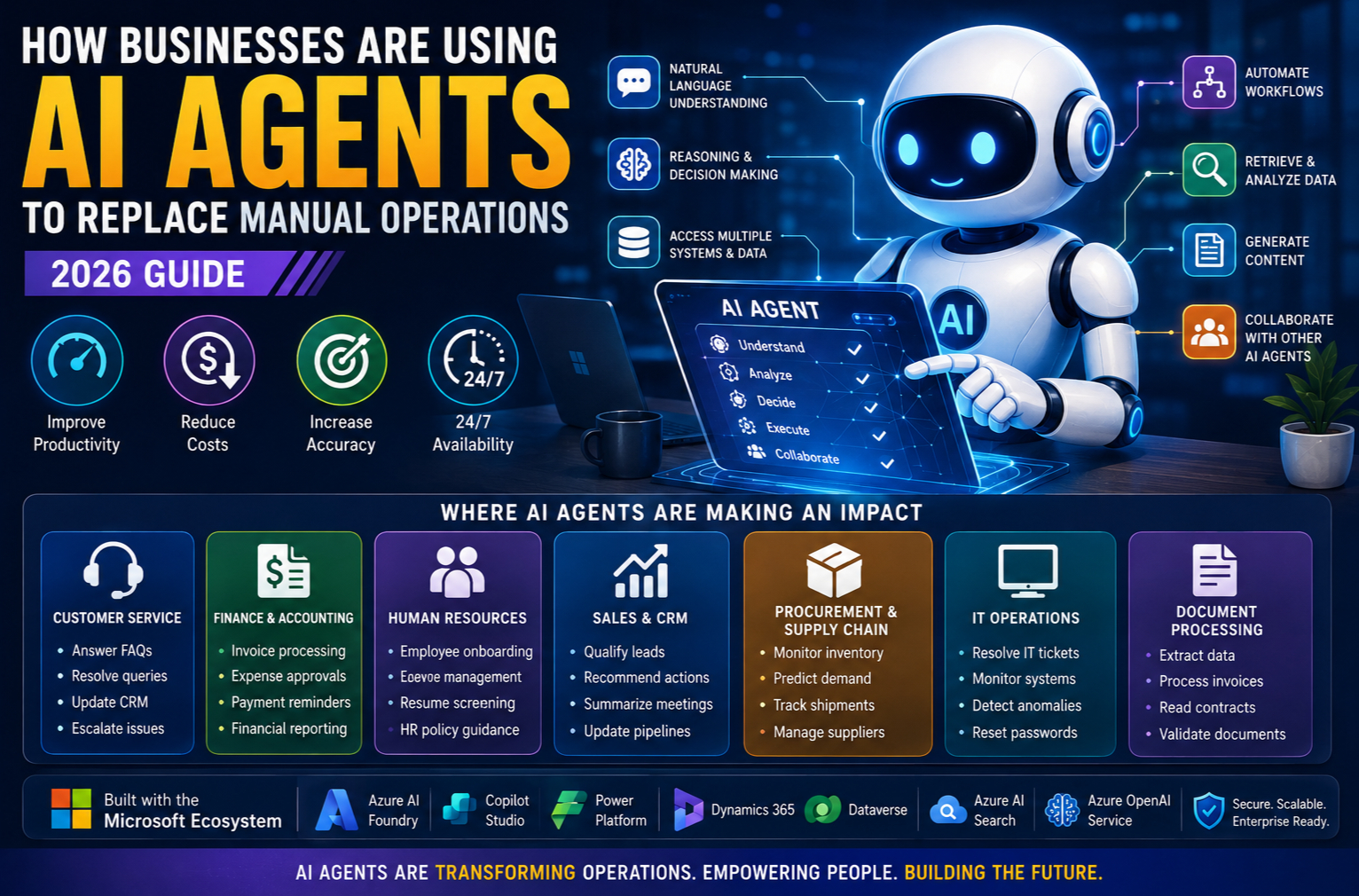
Artificial Intelligence has evolved far beyond simple chatbots and virtual assistants. In 2026, businesses are deploying AI agents that can analyse information, make decisions, collaborate with other systems and execute business tasks with minimal human intervention. These intelligent agents are transforming the way organisations operate by replacing repetitive manual processes with autonomous, AI-driven workflows.
From customer support and finance to human resources, sales, healthcare and manufacturing, AI agents are helping organisations improve efficiency, reduce operational costs and deliver faster, more accurate services. Rather than replacing human expertise, AI agents enable employees to focus on strategic, creative and high-value activities while routine work is handled automatically.
This comprehensive guide explores how businesses are using AI agents, the Microsoft technologies behind them and why they are becoming a cornerstone of enterprise digital transformation.
What Are AI Agents?
AI agents are intelligent software systems capable of understanding goals, analysing information, making decisions and performing tasks on behalf of users or organisations.
Unlike traditional automation, which follows predefined rules, AI agents can:
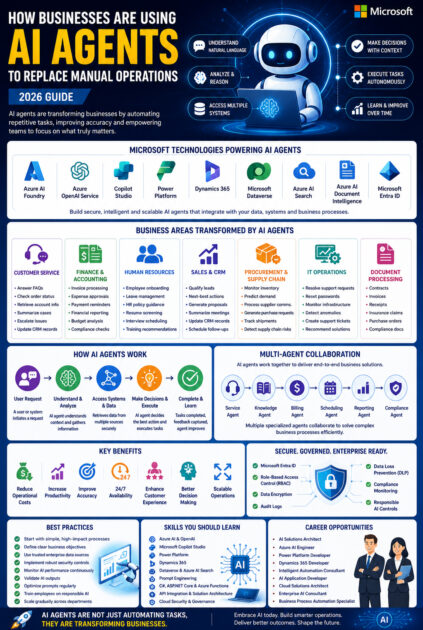
- Understand natural language
- Reason using context
- Access multiple systems
- Retrieve business information
- Generate content
- Trigger workflows
- Collaborate with other AI agents
- Learn from feedback and organisational knowledge
These capabilities make AI agents suitable for complex business operations that previously required significant human effort.
Why Businesses Are Adopting AI Agents
Organisations face increasing pressure to improve productivity while reducing operational costs and maintaining high service standards.
AI agents help by:
- Eliminating repetitive manual tasks
- Reducing processing times
- Improving decision-making
- Minimising human error
- Providing 24/7 availability
- Enhancing customer experiences
- Increasing operational scalability
- Supporting digital transformation initiatives
As AI technologies mature, businesses are moving from simple automation to intelligent, autonomous operations.
Microsoft Technologies Powering AI Agents
Microsoft provides a comprehensive ecosystem for building enterprise AI agents.
Key technologies include:
- Azure AI Foundry
- Azure OpenAI Service
- Microsoft Copilot Studio
- Power Platform
- Dynamics 365
- Microsoft Dataverse
- Azure AI Search
- Azure AI Document Intelligence
- Azure Functions
- Semantic Kernel
- Microsoft Entra ID
Together, these technologies enable organisations to build secure, scalable and enterprise-ready AI solutions.
Customer Service Automation
Customer service is one of the most common areas where AI agents deliver measurable value.
AI agents can:
- Answer frequently asked questions
- Retrieve customer account information
- Check order status
- Generate personalised responses
- Summarise support cases
- Escalate complex issues to human agents
- Update CRM records automatically
This reduces response times while allowing support teams to focus on high-priority customer interactions.
Finance and Accounting
Finance departments use AI agents to automate:
- Invoice processing
- Expense approvals
- Payment reminders
- Financial report generation
- Budget analysis
- Purchase order validation
- Compliance checks
AI-powered document processing significantly reduces manual data entry and improves accuracy.
Human Resources
HR teams are deploying AI agents for:
- Employee onboarding
- Leave management
- HR policy guidance
- Resume screening
- Interview scheduling
- Training recommendations
- Employee self-service
This streamlines administrative processes and enhances the employee experience.
Sales and CRM Operations
AI agents improve sales productivity by:
- Qualifying leads
- Recommending next-best actions
- Generating proposals
- Summarising meetings
- Updating Dynamics 365 records
- Scheduling follow-ups
- Analysing customer interactions
Sales professionals spend less time on administration and more time building customer relationships.
Procurement and Supply Chain
Organisations use AI agents to:
- Monitor inventory
- Predict demand
- Process supplier communications
- Generate purchase requests
- Track shipments
- Detect supply chain risks
- Recommend stock replenishment
These capabilities improve operational efficiency and reduce supply chain disruptions.
IT Operations
IT departments leverage AI agents to:
- Resolve common support requests
- Reset passwords
- Monitor infrastructure
- Detect system anomalies
- Generate incident summaries
- Create support tickets
- Recommend troubleshooting steps
AI agents reduce service desk workloads while improving response times.
Document Processing
One of the biggest productivity gains comes from automating document management.
AI agents can process:
- Contracts
- Invoices
- Receipts
- Insurance claims
- Purchase orders
- Medical forms
- Compliance documents
Using Azure AI Document Intelligence, relevant information is extracted automatically and integrated into business systems.
Intelligent Workflow Automation
AI agents work seamlessly with Power Automate to execute business processes.
Examples include:
- Approving requests
- Routing tasks
- Sending notifications
- Updating databases
- Creating reports
- Triggering follow-up actions
Unlike traditional workflows, AI agents can interpret context before deciding how to proceed.
Multi-Agent Collaboration
Modern enterprises increasingly deploy multiple AI agents working together.
A customer support workflow may involve:
- A customer service agent receiving the enquiry.
- A knowledge agent retrieving documentation.
- A billing agent checking account status.
- A scheduling agent booking appointments.
- A reporting agent creating summaries.
- A compliance agent validating business rules.
This collaborative model enables organisations to automate complex business processes more effectively than using a single AI assistant.
Integration with Dynamics 365
Dynamics 365 serves as a valuable source of business data for AI agents.
AI agents can:
- Retrieve customer information
- Update CRM records
- Analyse sales pipelines
- Recommend opportunities
- Support customer service teams
- Generate business insights
This integration enhances productivity while maintaining a unified customer view.
Security and Governance
Enterprise AI requires robust governance and security.
Microsoft provides:
- Microsoft Entra ID authentication
- Role-Based Access Control (RBAC)
- Azure Key Vault
- Data encryption
- Audit logs
- Data Loss Prevention (DLP)
- Compliance monitoring
- Responsible AI controls
These features help organisations deploy AI agents securely while protecting sensitive information.
Benefits of AI Agents
Businesses implementing AI agents commonly experience:
- Reduced operational costs
- Increased productivity
- Faster service delivery
- Improved customer satisfaction
- Better decision-making
- Enhanced employee experiences
- Greater scalability
- Higher process accuracy
These benefits make AI agents an important part of long-term business strategies.
Challenges to Consider
Successful AI adoption also requires careful planning.
Organisations should address:
- Data quality
- AI governance
- Prompt optimisation
- User training
- Security controls
- Regulatory compliance
- Change management
- Human oversight
Keeping people involved in critical business decisions remains an important best practice.
Best Practices for Implementation
When introducing AI agents:
- Start with repetitive, high-volume processes.
- Define clear business objectives.
- Use trusted enterprise data sources.
- Implement robust security controls.
- Monitor AI performance continuously.
- Validate AI-generated outputs.
- Optimise prompts regularly.
- Train employees on responsible AI usage.
- Scale gradually across departments.
These practices improve adoption and long-term success.
Skills You Should Learn
Professionals interested in enterprise AI should develop expertise in:
- Azure AI Foundry
- Azure OpenAI Service
- Microsoft Copilot Studio
- Power Platform
- Dynamics 365
- Microsoft Dataverse
- Azure AI Search
- Azure AI Document Intelligence
- Prompt Engineering
- Semantic Kernel
- C#
- ASP.NET Core
- Azure Functions
- REST APIs
- Solution Architecture
- Cloud Security
These skills are increasingly valuable as businesses expand their AI initiatives.
Career Opportunities
Demand for AI professionals continues to grow rapidly.
Popular roles include:
- AI Solutions Architect
- Azure AI Engineer
- Power Platform Developer
- Dynamics 365 Developer
- Intelligent Automation Consultant
- AI Application Developer
- Cloud Solutions Architect
- Enterprise AI Consultant
- Business Process Automation Specialist
Professionals with expertise in Microsoft’s AI ecosystem are well positioned for future career growth.
Future Trends
The future of enterprise AI will include:
- Autonomous AI agents
- Multi-agent collaboration
- Hyperautomation
- Conversational business applications
- AI-driven decision support
- Predictive business operations
- Intelligent enterprise search
- Human-AI collaboration
These trends will continue reshaping how organisations operate and compete.
Conclusion
AI agents are fundamentally changing the way businesses operate by replacing repetitive manual tasks with intelligent, autonomous workflows. Rather than simply automating predefined actions, modern AI agents can understand context, access enterprise data, collaborate with other systems and support better business decisions across departments.
Microsoft’s ecosystem—including Azure AI Foundry, Azure OpenAI Service, Copilot Studio, Power Platform and Dynamics 365—provides organisations with a secure and scalable foundation for deploying enterprise AI agents. These technologies enable businesses to improve productivity, reduce costs and deliver better customer and employee experiences while maintaining governance and security.
As AI adoption accelerates, organisations that embrace AI agents strategically will be better equipped to innovate, scale and remain competitive. For developers, consultants and business professionals, learning how to design, implement and manage AI agents is becoming an essential skill for the future of enterprise technology.