Microsoft Business Applications Roadmap: What to Expect Beyond 2026 (Future Outlook Guide)
Introduction
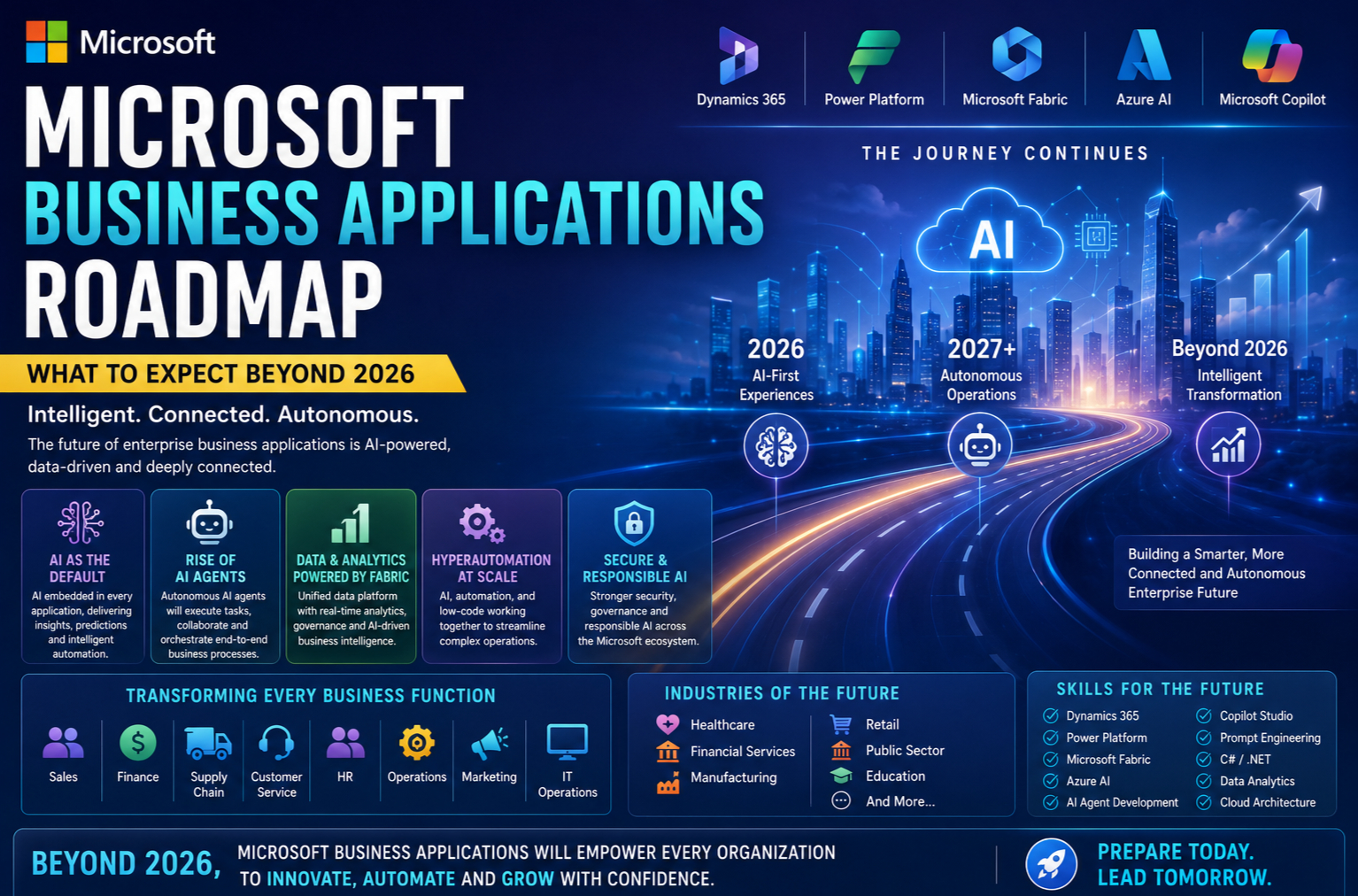
The world of business technology is evolving at an unprecedented pace. Artificial Intelligence (AI), cloud computing, intelligent automation and data-driven decision-making are redefining how organisations operate. Microsoft continues to lead this transformation through its comprehensive Business Applications ecosystem, which includes Dynamics 365, Power Platform, Microsoft Copilot, Microsoft Fabric and Azure AI.
As businesses prepare for the next generation of enterprise software, understanding Microsoft’s long-term roadmap becomes increasingly important. While exact product features and release timelines will continue to evolve, the broader direction is clear: more AI, deeper automation, better integration and increasingly autonomous business processes.
In this guide, we explore the major trends expected to shape Microsoft Business Applications beyond 2026 and how organisations can prepare for the future.
The Evolution of Microsoft Business Applications
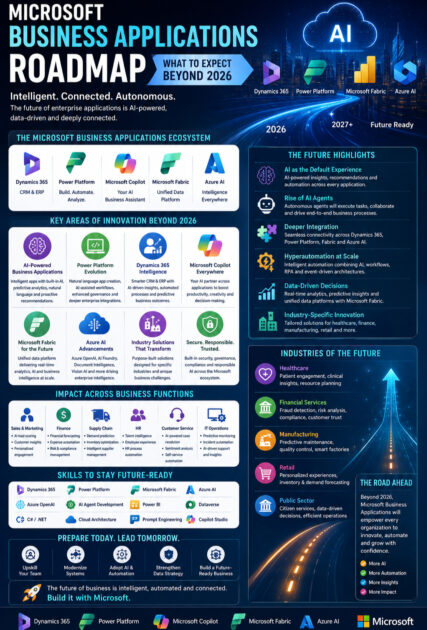
Microsoft Business Applications have evolved from traditional CRM and ERP systems into intelligent platforms capable of supporting every aspect of modern business operations.
Today, the ecosystem includes:
- Dynamics 365 Customer Engagement (CE)
- Dynamics 365 Finance
- Dynamics 365 Supply Chain Management
- Dynamics 365 Business Central
- Power Apps
- Power Automate
- Power BI
- Microsoft Copilot Studio
- Microsoft Dataverse
- Microsoft Fabric
- Azure AI services
Rather than functioning as separate products, these technologies increasingly operate as a unified business platform.
AI Will Become the Default Experience
One of the most significant trends is that AI will no longer be an optional feature—it will become a standard part of every business application.
Future applications are expected to include:
- AI-generated insights
- Predictive recommendations
- Intelligent document processing
- Automated report creation
- Natural language interfaces
- AI-assisted decision support
- Proactive notifications
- Context-aware automation
Users will increasingly interact with software through conversational AI rather than traditional menus and forms.
The Rise of AI Agents
AI agents are expected to become central to Microsoft’s business application strategy.
Instead of assisting users with isolated tasks, future AI agents will:
- Execute end-to-end business processes
- Collaborate with other AI agents
- Access enterprise knowledge securely
- Trigger workflows automatically
- Monitor business operations
- Recommend business actions
- Learn from organisational data
- Support human decision-making
Businesses are likely to deploy specialised AI agents across departments such as sales, finance, HR, customer service and operations.
Dynamics 365 Will Become More Intelligent
Future versions of Dynamics 365 are expected to provide deeper AI integration across all modules.
Potential advancements include:
- Automated opportunity management
- Predictive customer engagement
- AI-generated sales strategies
- Intelligent case resolution
- Financial forecasting
- Automated procurement recommendations
- Supply chain optimisation
- Enhanced customer insights
These capabilities will help organisations make faster, more informed business decisions.
Power Platform Will Expand Citizen Development
Power Platform is expected to make application development even more accessible.
Future enhancements may include:
- Natural language app creation
- AI-assisted workflow generation
- Automatic data modelling
- Intelligent UI design recommendations
- Enhanced governance tools
- Greater integration with enterprise systems
- Advanced AI connectors
- Improved developer collaboration
The gap between professional developers and citizen developers is expected to narrow significantly.
Microsoft Copilot Will Become a Business Assistant
Microsoft Copilot is evolving from a productivity tool into an intelligent business assistant.
Future capabilities may include:
- Cross-application reasoning
- Meeting preparation
- Business process orchestration
- Project management assistance
- Executive reporting
- Knowledge discovery
- Workflow automation
- Personal productivity optimisation
Copilot is expected to become a central interface for interacting with Microsoft Business Applications.
Microsoft Fabric Will Power Enterprise Analytics
Data will remain at the heart of digital transformation.
Microsoft Fabric is expected to expand through:
- AI-assisted data engineering
- Real-time business intelligence
- Unified enterprise data platforms
- Automated analytics
- Predictive dashboards
- Intelligent reporting
- Enhanced governance
- Better integration with Dynamics 365 and Power BI
Businesses will increasingly rely on Fabric to transform operational data into strategic insights.
Azure AI Will Drive Enterprise Intelligence
Azure AI services are expected to become more deeply integrated across Microsoft’s ecosystem.
Areas of growth include:
- Azure OpenAI
- Azure AI Foundry
- Azure AI Search
- Document Intelligence
- Vision AI
- Speech AI
- Language AI
- Responsible AI capabilities
These services will provide the intelligence behind future business applications.
Hyperautomation Will Accelerate
Businesses are moving beyond isolated automation towards hyperautomation—where AI, workflows and enterprise systems work together seamlessly.
Future automation initiatives are expected to combine:
- Power Automate
- AI agents
- Dynamics 365
- Azure AI
- Microsoft Fabric
- Robotic Process Automation (RPA)
- Event-driven architectures
This integrated approach will automate increasingly complex business processes.
Industry-Specific Business Applications
Microsoft is expected to continue expanding industry-focused solutions.
Sectors likely to benefit include:
Healthcare
- Patient engagement
- Clinical documentation
- Healthcare analytics
- Resource planning
Financial Services
- Fraud detection
- Risk analysis
- Regulatory compliance
- Customer engagement
Manufacturing
- Predictive maintenance
- Supply chain optimisation
- Quality management
- Smart factories
Retail
- Personalised customer experiences
- Inventory optimisation
- Demand forecasting
- Omnichannel commerce
Industry-specific AI capabilities will help organisations address unique operational challenges.
Security and Responsible AI
As AI adoption grows, governance will become even more important.
Future Microsoft Business Applications are expected to strengthen:
- Microsoft Entra ID integration
- Role-Based Access Control (RBAC)
- Data Loss Prevention (DLP)
- Microsoft Purview governance
- Responsible AI monitoring
- Compliance management
- Data privacy controls
- AI transparency
Security and trust will remain key priorities for enterprise customers.
Skills Professionals Should Learn
To prepare for the future, IT professionals should develop expertise in:
- Dynamics 365
- Power Platform
- Microsoft Fabric
- Azure AI
- Azure OpenAI Service
- Azure AI Foundry
- Microsoft Copilot Studio
- AI Agent Development
- Prompt Engineering
- Microsoft Dataverse
- Power BI
- Azure
- C#
- ASP.NET Core
- REST APIs
- Cloud Architecture
- Solution Design
- Data Analytics
Combining business application knowledge with AI and cloud skills will create significant career opportunities.
Career Opportunities Beyond 2026
Demand for Microsoft professionals is expected to continue growing.
Emerging roles include:
- AI Solutions Architect
- Copilot Developer
- Power Platform Solution Architect
- Dynamics 365 AI Consultant
- Microsoft Fabric Engineer
- Azure AI Engineer
- Enterprise Automation Consultant
- Intelligent Business Applications Developer
- AI Governance Specialist
Professionals who understand both business processes and AI technologies will be especially valuable.
How Businesses Can Prepare
Organisations looking to stay ahead should:
- Invest in employee upskilling.
- Modernise legacy systems.
- Adopt cloud-native architectures.
- Strengthen data governance.
- Explore AI-powered automation.
- Build reusable digital platforms.
- Encourage low-code development.
- Establish responsible AI policies.
- Continuously evaluate emerging Microsoft technologies.
Early preparation will help businesses maximise future innovation opportunities.
Future Trends to Watch
Beyond 2026, expect continued progress in:
- Autonomous AI agents
- Multi-agent collaboration
- Conversational enterprise applications
- Predictive business operations
- AI-assisted software development
- Unified business data platforms
- Hyperautomation
- Intelligent enterprise search
- Human-AI collaboration
- Sustainable cloud technologies
These trends are expected to shape the next generation of enterprise software.
Conclusion
Microsoft Business Applications are evolving into an intelligent, connected ecosystem where AI, cloud computing, automation and analytics work together to transform how organisations operate. Beyond 2026, businesses can expect more autonomous workflows, smarter decision support, deeper integration between applications and increasingly powerful AI capabilities embedded across the Microsoft platform.
Technologies such as Dynamics 365, Power Platform, Microsoft Fabric, Azure AI and Microsoft Copilot will continue to play a central role in helping organisations improve productivity, enhance customer experiences and drive innovation. At the same time, organisations that invest in cloud adoption, data governance and employee upskilling will be better positioned to take advantage of these advancements.
For developers, consultants, business analysts and IT leaders, understanding Microsoft’s long-term direction is more than a technical exercise—it is an opportunity to build future-ready skills that will remain highly valuable as enterprise technology continues to evolve.