Microsoft Technologies vs Java Full Stack: Which Career Path Should You Choose?
Introduction
Software development continues to be one of the most rewarding career paths, but choosing the right technology stack can be challenging. Two of the strongest contenders in the enterprise software world are the Microsoft Technology Stack and Java Full Stack Development.
Both ecosystems power millions of applications worldwide and are trusted by enterprises, financial institutions, healthcare organizations, government agencies, and technology companies. They offer excellent salaries, global career opportunities, and long-term growth.
If you’re wondering whether to choose Microsoft Technologies or Java Full Stack in 2026, this comprehensive comparison will help you understand the differences and make an informed career decision.
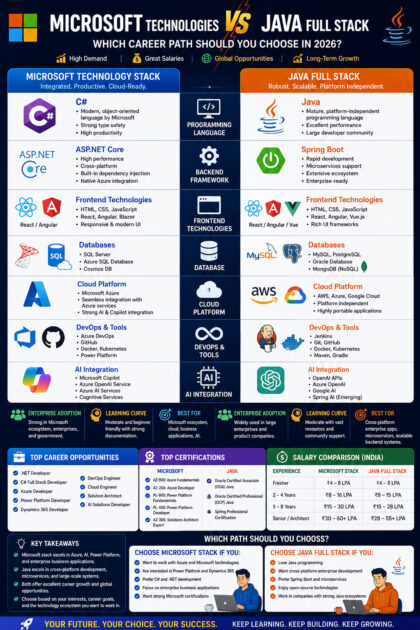
What is the Microsoft Technology Stack?
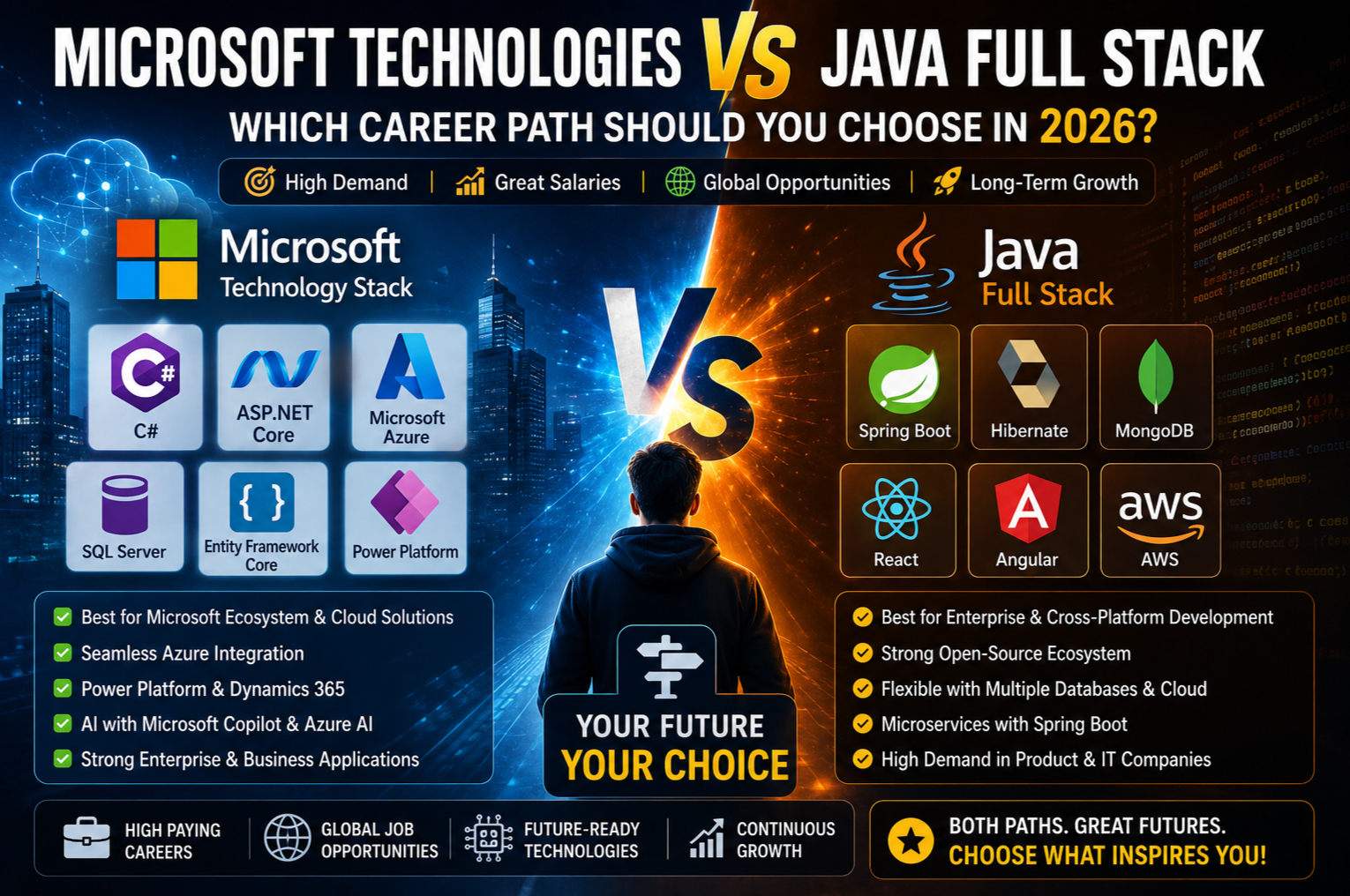
The Microsoft Technology Stack is a comprehensive ecosystem for building enterprise applications, cloud solutions, business applications, APIs, AI-powered systems, and modern web applications.
A typical Microsoft Full Stack Developer works with:
- C#
- .NET
- ASP.NET Core
- Entity Framework Core
- SQL Server
- HTML
- CSS
- JavaScript
- React or Angular
- Microsoft Azure
- Azure DevOps
- GitHub
- Power Platform
- Dynamics 365
- Microsoft Copilot
Microsoft technologies are widely used in enterprise software development and cloud-first digital transformation projects.
What is Java Full Stack Development?
Java Full Stack Development involves building complete web applications using Java for the backend and modern frontend technologies for the user interface.
A Java Full Stack Developer typically works with:
Backend
- Java
- Spring Boot
- Spring MVC
- Spring Security
- Hibernate
- REST APIs
Frontend
- HTML
- CSS
- JavaScript
- React
- Angular
- Vue.js (optional)
Database
- MySQL
- PostgreSQL
- Oracle
- MongoDB
Cloud & DevOps
- AWS
- Azure
- Docker
- Kubernetes
- Jenkins
- Git
Java remains one of the most widely adopted enterprise programming languages globally.
Microsoft vs Java Full Stack: Quick Comparison
| Feature | Microsoft Stack | Java Full Stack |
|---|---|---|
| Primary Language | C# | Java |
| Backend Framework | ASP.NET Core | Spring Boot |
| ORM | Entity Framework Core | Hibernate |
| Database | SQL Server, Azure SQL | MySQL, PostgreSQL, Oracle |
| Cloud Platform | Microsoft Azure | AWS, Azure, GCP |
| Enterprise Adoption | Excellent | Excellent |
| Learning Curve | Moderate | Moderate |
| Official Certifications | Microsoft Certifications | Oracle Java Certifications |
| AI Integration | Native Azure AI & Copilot | API-Based Integrations |
| Best For | Microsoft Enterprise Ecosystem | Enterprise & Cross-Platform Development |
Technology Stack Comparison
Microsoft Stack
Backend
- C#
- .NET
- ASP.NET Core
- Entity Framework Core
Frontend
- HTML
- CSS
- JavaScript
- React
- Angular
- Blazor
Database
- SQL Server
- Azure SQL
- Cosmos DB
Cloud
- Microsoft Azure
Additional Technologies
- Azure DevOps
- Power Platform
- Dynamics 365
- Docker
- Kubernetes
- Microsoft Copilot
Java Full Stack
Backend
- Java
- Spring Boot
- Spring MVC
- Spring Security
- Hibernate
Frontend
- HTML
- CSS
- JavaScript
- React
- Angular
Database
- MySQL
- PostgreSQL
- Oracle Database
- MongoDB
Cloud
- AWS
- Azure
- Google Cloud Platform
Additional Technologies
- Maven
- Gradle
- Jenkins
- Docker
- Kubernetes
Programming Language Comparison
Microsoft (C#)
C# is a modern, object-oriented programming language developed by Microsoft.
Key advantages:
- Strong type safety
- Clean syntax
- Excellent Visual Studio support
- High productivity
- Deep Azure integration
- Enterprise-grade performance
Java
Java is one of the most mature and widely used enterprise programming languages.
Key advantages:
- Platform independence
- Strong enterprise ecosystem
- Excellent performance
- Extensive open-source libraries
- Large developer community
Both languages are excellent for enterprise software development, and the choice often depends on organizational preferences and project requirements.
Framework Comparison
ASP.NET Core
Microsoft’s backend framework provides:
- High performance
- Cross-platform development
- Built-in dependency injection
- Strong security
- Cloud-native architecture
- Minimal APIs
- Native Azure integration
Spring Boot
Java’s leading backend framework offers:
- Rapid application development
- Microservices support
- Enterprise security
- Extensive ecosystem
- Dependency injection
- Large open-source community
Both frameworks are highly capable and widely used for enterprise applications.
Cloud Integration
Microsoft Stack
Optimized for Azure services such as:
- Azure App Service
- Azure Functions
- Azure SQL Database
- Azure Kubernetes Service
- Azure AI Services
- Azure DevOps
- Azure OpenAI Service
Java Full Stack
Commonly deployed on:
- AWS
- Azure
- Google Cloud Platform
Java applications are highly portable and can run across multiple cloud providers with ease.
Database Comparison
Microsoft
Frequently used databases:
- SQL Server
- Azure SQL Database
- Cosmos DB
These are ideal for enterprise applications with complex transactional requirements.
Java
Popular database choices include:
- MySQL
- PostgreSQL
- Oracle Database
- MongoDB
Java’s flexibility allows developers to work with a wide range of relational and NoSQL databases.
Artificial Intelligence Integration
Microsoft Ecosystem
Microsoft has integrated AI deeply into its platform.
Developers can leverage:
- Microsoft Copilot
- Azure OpenAI Service
- Azure AI Services
- Cognitive Services
- AI Search
These capabilities simplify the development of enterprise AI solutions.
Java Ecosystem
Java applications typically integrate AI through APIs and frameworks such as:
- OpenAI APIs
- Azure OpenAI
- Google AI
- Anthropic APIs
- TensorFlow Java
- Spring AI
Java remains a strong choice for AI-enabled enterprise applications.
Enterprise Adoption
Microsoft Stack
Commonly used in:
- Banking
- Government
- Healthcare
- Manufacturing
- Insurance
- Retail
- Microsoft Partner Ecosystem
- Enterprise Consulting
Java Full Stack
Widely adopted in:
- Banking
- Telecommunications
- E-commerce
- Airlines
- Insurance
- Financial Services
- Large Product Companies
Both ecosystems dominate enterprise software development across different industries.
Career Opportunities
Microsoft Careers
Popular roles include:
- C# Full Stack Developer
- .NET Developer
- Azure Developer
- Azure Administrator
- Power Platform Developer
- Dynamics 365 Developer
- DevOps Engineer
- Cloud Engineer
- Solution Architect
Java Careers
Popular roles include:
- Java Full Stack Developer
- Spring Boot Developer
- Backend Developer
- Software Engineer
- Microservices Developer
- Java Architect
- Cloud Developer
Both career paths offer excellent global opportunities in consulting firms, product companies, and multinational organizations.
Certifications
Microsoft Certifications
Recommended certifications:
- AZ-900: Azure Fundamentals
- AZ-204: Azure Developer Associate
- AZ-104: Azure Administrator Associate
- PL-900: Power Platform Fundamentals
- PL-400: Power Platform Developer
- AZ-305: Azure Solutions Architect Expert
Java Certifications
Recommended certifications:
- Oracle Certified Professional (OCP) Java
- Oracle Certified Associate (OCA) Java
- Spring Professional Certification
Certifications can strengthen your resume, but employers also place significant value on practical project experience.
Salary Comparison
(Approximate salaries vary based on location, employer, and experience.)
| Experience | Microsoft Stack | Java Full Stack |
|---|---|---|
| Fresher | ₹4–8 LPA | ₹4–8 LPA |
| 2–4 Years | ₹8–16 LPA | ₹8–15 LPA |
| 5–8 Years | ₹15–30 LPA | ₹15–28 LPA |
| Senior / Architect | ₹30–60+ LPA | ₹28–55+ LPA |
Professionals with cloud, DevOps, AI, and architecture expertise often command premium compensation in both ecosystems.
Which Stack is Better for Freshers?
Choose the Microsoft Stack if you:
- Want to work with Azure cloud technologies.
- Are interested in Power Platform or Dynamics 365.
- Enjoy C# and .NET development.
- Prefer enterprise business applications.
- Want globally recognized Microsoft certifications.
Choose Java Full Stack if you:
- Prefer Java programming.
- Want to work on cross-platform enterprise applications.
- Are interested in Spring Boot and microservices.
- Enjoy open-source technologies.
- Plan to work in organizations with large Java ecosystems.
Can You Learn Both?
Yes.
Many software engineers build careers that combine knowledge of both ecosystems.
For example, developers may:
- Build microservices in Java.
- Develop enterprise APIs in ASP.NET Core.
- Use React for frontend development.
- Deploy applications to Azure.
- Integrate AI services from Azure OpenAI.
- Use Docker and Kubernetes for containerized deployments.
Understanding multiple enterprise technologies broadens your career opportunities and makes you more adaptable to changing business needs.
Conclusion
Microsoft Technologies and Java Full Stack are both powerful enterprise development ecosystems with long-term career potential.
The Microsoft ecosystem stands out for its seamless integration with Azure, Power Platform, Dynamics 365, AI services, and enterprise productivity tools, making it an excellent choice for professionals seeking careers in cloud computing and Microsoft’s business application landscape.
Java Full Stack remains a cornerstone of enterprise software development, particularly for organizations building large-scale, platform-independent applications using Spring Boot and modern cloud architectures.
Rather than viewing these technologies as competitors, it’s helpful to recognize that both solve enterprise challenges in different ways. By mastering strong programming fundamentals, cloud computing, DevOps practices, and modern frontend frameworks such as React, you can build a versatile skill set that remains valuable regardless of the technology stack you choose.