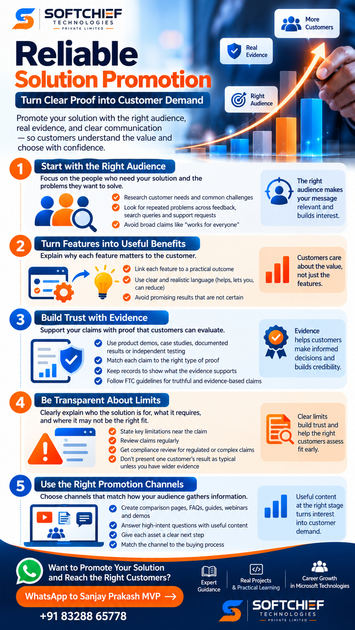
Reliable Solution Promotion: Turn Clear Proof into Customer Demand

Introuction
A bold promise can win a glance, but customers need more before they trust a solution. Reliable solution promotion shows who the offer helps, what it can do, and what supports those claims. It makes the value clear without asking people to take a leap of faith.
That approach starts with customer needs and plain language. It also depends on evidence that fits each claim, channels suited to the buying process, and honest answers to concerns. Use these principles to promote a solution in a way that earns interest and helps people make informed choices.
Reliable Solution Promotion Starts with the Right Audience
A strong solution promotion strategy connects a specific group’s needs with useful outcomes. Broad claims such as “works for everyone” give buyers little reason to see themselves in the offer. Focus your solution marketing on the people most likely to benefit and the problem they want to solve.
Find the problem and the people facing it
Research what customers need, what they use now, and what could stop them from buying. Interviews, support questions, search terms, sales calls, and customer feedback can reveal repeated problems. Look for specific details: a task that takes too long, a common point of failure, or a change customers want but struggle to make.
Don’t treat one person’s comment as proof of a wider trend. Compare feedback across customer groups and check whether the same need appears in search queries or support records. This gives you a stronger basis for choosing whom to reach and what to say.
Turn features into useful benefits
A feature describes what a solution includes; a benefit explains why that detail matters to the customer. For example, a shared project dashboard lets a team see task status in one place. That may help staff spot delays sooner, but it doesn’t guarantee that every project will finish on time.
Link each feature to a practical change customers can understand. Use precise words such as “helps,” “lets you,” or “can reduce” when outcomes depend on how people use the solution. Avoid suggesting that a result is certain when it isn’t.
Write a clear positioning statement
A useful positioning statement names the audience, the problem, the solution, its distinct strength, and the proof behind that strength. For example: “For small clinics managing appointment reminders, our service sends messages from one shared system, with setup support and documented delivery logs.” This tells readers who it’s for and what they can inspect.
Keep the wording direct. Replace internal terms and broad claims with details a customer can picture. If the sentence needs several lines of explanation, narrow the audience or clarify the main benefit.
Build Trust with Evidence Customers Can Evaluate
Evidence helps customers judge whether a solution fits their needs. The FTC’s advertising and marketing guidance says advertising claims must be truthful, not misleading, and evidence-based. The type of proof you need depends on the claim and the solution.
Match every claim to suitable proof
A product demonstration can show how a feature works. Documented results may show what happened in a real setting, while independent testing can offer a separate review. Certifications can confirm that a product meets a defined standard, but they don’t prove every performance claim.
Match proof to the point you make. A demo may support a claim about ease of use, but it doesn’t show that customers save a certain amount of time. The FTC’s advertising substantiation policy says advertisers should have a reasonable basis for objective claims before publishing them. Keep records that show what each piece of evidence supports.
Give case studies enough context
A case study should explain the customer’s starting point, the solution used, the timeframe, and the measured outcome. Name the metric and how it was measured; “faster service” is less useful than a clearly described change in response time. Include details that may have affected the result, such as staff training or a change in process.
Get permission before using a customer’s name, logo, or comments. Attribute results accurately, and don’t present one customer’s experience as a typical outcome unless you have evidence to support that message. Context lets readers see both the result and the conditions behind it.
Make limits easy to find
Customers need to know who qualifies, what the solution requires, and where it may fall short. State key limits near the claim they qualify, not in a hard-to-find section. Clear caveats can help the right buyers assess fit before they spend time or money.
Review claims before publishing and whenever the product, price, or evidence changes. For regulated products or complex claims, get a qualified compliance review. The FTC notes that extra rules may apply to some products and services.
Choose Promotion Channels That Fit the Buying Process
The best channel depends on how your audience gathers information and how much time they need to assess the solution. A simple service may need a clear landing page, while a complex product may call for a detailed demo and one-to-one discussion. Set a goal for each channel before spending time or budget on it.
Answer high-intent questions with useful content
Create comparison pages, FAQs, explainers, webinars, and practical guides around questions buyers already ask. A comparison page can explain how your solution differs from common alternatives. An FAQ can cover setup, cost, support, and fit.
Give each asset a next step that matches the reader’s interest. Someone comparing options may want to review a case study; someone closer to a decision may want to request a demo. Avoid pushing every visitor toward the same sales call.
Combine owned, earned, and paid promotion
Your website and email let you explain the offer in detail and keep key information current. Third-party reviews and media coverage can add outside perspectives, while paid campaigns can help you reach a chosen audience. Each channel has a different role, so keep claims and key facts consistent across them.
Check reviews and endorsements for accuracy and disclose relationships that could affect how readers judge them. A paid post should not look independent if it isn’t. Consistent, clear messaging helps customers compare what they hear across channels.
Make the next step clear
Use a call to action that fits the buyer’s readiness: request a demo, read a case study, start a trial, or speak with a specialist. Explain what happens after someone clicks. If a demo requires a short call first, say so.
Reduce friction by asking only for details you need at that stage. Make forms easy to complete and set clear expectations for follow-up. A simple next step helps an interested customer continue without pressure.
Turn Interest into Confidence and Action
Promotion continues after someone first hears about a solution. Prospects may need to check fit, compare costs, and understand what adoption involves. Helpful information can answer those questions before a buyer commits.
Answer objections with specific information
Common concerns include price, setup time, compatibility, support, and risk. Answer them directly on your site, in product documents, or during a sales discussion. If compatibility depends on a certain system or plan, name that condition instead of saying “works with most tools.”
Use clear details wherever possible. Explain what support includes, what the buyer must provide, and what could add cost. Vague reassurances often leave a careful buyer with the same questions.
Show the solution in a realistic setting
A demo, trial, consultation, or sample workflow can help people assess fit. Use a scenario that reflects real tasks and normal setup, not a perfect case that hides effort or limits. Let prospects ask questions and try the parts that matter to them.
Set expectations before a trial begins. Explain its length, included features, and any data or setup needed. A realistic test gives buyers useful information and reduces surprises later.
Keep marketing and sales in sync
Customers should hear the same product description, price, and expectations from every team. Give marketing and sales shared materials that cover approved claims, current features, proof, and common questions. Set a clear owner for updates when details change.
This also helps staff avoid promises the product can’t meet. Review sales feedback and support issues with the teams that write promotional content. Repeated questions may show where the website or message needs more detail.
Measure Reliable Solution Promotion and Improve It
Measure whether promotion reaches suitable prospects and leads to sound customer outcomes. A large number of clicks may mean little if few visitors fit the offer or stay after signing up. Choose measures that connect activity with both sales and customer experience.
Track measures tied to customer and business outcomes
Depending on your model, track qualified leads, conversion rates, acquisition costs, retention, refunds, or customer satisfaction. Pair activity measures, such as page visits, with signs of fit and lasting value. Compare results with your own goals and past performance rather than treating one outside benchmark as universal.
Make sure teams define each measure in the same way. For example, agree on what makes a lead qualified before comparing campaigns. Clear definitions make the results easier to use.
Test messages and channels with care
Change one major factor at a time when practical, such as the headline, audience, or call to action. Decide in advance what result would count as a useful improvement and how long you’ll measure it. Record the test, its limits, and what you learned.
A test may show that one message works better for one audience, not every buyer. Use the finding to refine the audience, format, or channel, then keep checking results. Small, well-recorded tests make it easier to learn without guessing.
Keep claims and proof current
Review figures, testimonials, product features, prices, and terms on a regular schedule. Remove content that no longer reflects the offer, and check that each case study still has the right context. Update proof when the solution or market changes.
A simple review process can prevent an outdated claim from spreading across ads, sales decks, and web pages. Keep a record of who approved each update and when. This helps teams share accurate information.
Conclusion: Promote the Promise You Can Prove
Reliable solution promotion begins with a clear audience and a real customer need. Explain the value in plain words, support claims with relevant proof, choose channels that suit the buying process, and keep improving with useful measures. When you make limits and next steps clear, people can decide whether the solution fits.
Review one key claim today: identify the proof behind it, check that the proof matches the wording, and make the next step easy to understand. That’s how promotion earns attention by helping customers judge the solution for themselves.