
Azure vs AWS: Which Cloud Platform Should You Learn in 2026?
Introduction
Cloud computing has become the foundation of modern digital transformation. From startups to Fortune 500 companies, organizations are moving applications, databases, artificial intelligence workloads, and enterprise systems to the cloud.
Two platforms dominate the global cloud market:
- Microsoft Azure
- Amazon Web Services (AWS)
Both platforms offer hundreds of cloud services, global infrastructure, enterprise-grade security, and outstanding career opportunities. However, they differ in ecosystem, target audience, service offerings, and learning paths.
If you’re a student, IT professional, software developer, or system administrator wondering whether to learn Azure or AWS, this comprehensive guide will help you make the right decision.
What is Microsoft Azure?
Microsoft Azure is Microsoft’s cloud computing platform that provides over 200 cloud services for building, deploying, and managing applications through Microsoft’s global network of data centers.
Azure is deeply integrated with Microsoft’s enterprise ecosystem, making it a preferred choice for organizations already using Windows Server, Microsoft 365, Active Directory, SQL Server, Dynamics 365, and Power Platform.
Popular Azure Services
- Azure Virtual Machines
- Azure App Service
- Azure Functions
- Azure Kubernetes Service (AKS)
- Azure Storage
- Azure SQL Database
- Microsoft Entra ID
- Azure DevOps
- Azure AI Services
- Azure OpenAI Service
Azure is particularly strong in enterprise environments and hybrid cloud solutions.
What is AWS?
Amazon Web Services (AWS) is the world’s first major public cloud platform and remains one of the largest cloud service providers globally.
AWS offers more than 250 cloud services across computing, storage, networking, databases, AI, analytics, security, and IoT.
Its flexibility, scalability, and global infrastructure have made it the cloud platform of choice for many startups, SaaS companies, and large enterprises.
Popular AWS Services
- Amazon EC2
- Amazon S3
- AWS Lambda
- Amazon RDS
- Amazon ECS
- Amazon EKS
- Amazon CloudFront
- Amazon VPC
- AWS IAM
- Amazon SageMaker
AWS is known for its extensive service portfolio and mature cloud ecosystem.
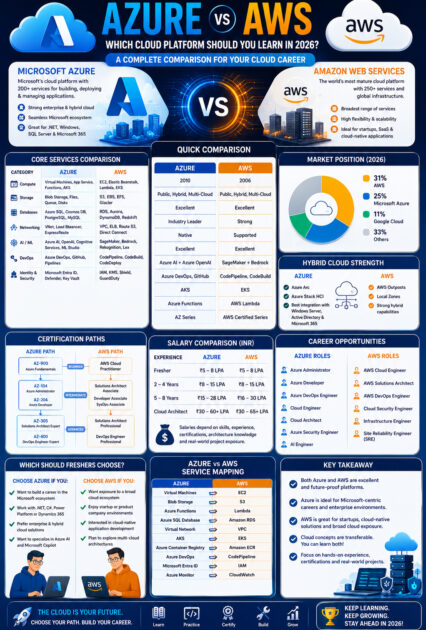
Azure vs AWS: Quick Comparison
| Feature | Microsoft Azure | Amazon Web Services (AWS) |
|---|---|---|
| Launch Year | 2010 | 2006 |
| Cloud Type | Public, Hybrid, Multi-Cloud | Public, Hybrid, Multi-Cloud |
| Enterprise Adoption | Excellent | Excellent |
| Hybrid Cloud | Industry Leader | Strong |
| Windows Integration | Native | Supported |
| Linux Support | Excellent | Excellent |
| AI & Machine Learning | Azure AI + Azure OpenAI | SageMaker + Bedrock |
| DevOps | Azure DevOps, GitHub | CodePipeline, CodeBuild |
| Container Platform | AKS | EKS |
| Serverless | Azure Functions | AWS Lambda |
| Certifications | AZ Series | AWS Certified Series |
Market Position
Azure and AWS continue to lead the cloud computing industry, with Google Cloud also holding a significant share.
Microsoft Azure is preferred by:
- Enterprises
- Government organizations
- Financial institutions
- Healthcare providers
- Manufacturing companies
- Microsoft-centric organizations
AWS is widely adopted by:
- Startups
- SaaS companies
- E-commerce businesses
- Technology firms
- Media companies
- Global enterprises
Both platforms are experiencing sustained growth, making either a strong choice for long-term career development.
Core Services Comparison
Compute
Azure
- Azure Virtual Machines
- Azure App Service
- Azure Functions
- AKS
AWS
- Amazon EC2
- AWS Elastic Beanstalk
- AWS Lambda
- Amazon EKS
Both platforms provide highly scalable compute services.
Storage
Azure
- Blob Storage
- Files
- Queue Storage
- Managed Disks
AWS
- Amazon S3
- EBS
- EFS
- Glacier
Both platforms offer secure and highly durable storage solutions.
Databases
Azure
- Azure SQL Database
- Cosmos DB
- PostgreSQL
- MySQL
- SQL Managed Instance
AWS
- Amazon RDS
- Aurora
- DynamoDB
- Redshift
Both ecosystems support relational and NoSQL databases.
Networking
Azure
- Virtual Network
- Load Balancer
- VPN Gateway
- ExpressRoute
- Front Door
AWS
- VPC
- Elastic Load Balancer
- Route 53
- Direct Connect
- CloudFront
Both provide enterprise-grade networking capabilities.
Artificial Intelligence
Azure
- Azure AI Services
- Azure OpenAI Service
- Cognitive Services
- Machine Learning Studio
- AI Search
AWS
- Amazon Bedrock
- SageMaker
- Rekognition
- Lex
- Comprehend
- Textract
Both are investing heavily in AI, though Azure benefits from Microsoft’s strategic partnership with OpenAI and seamless integration with Microsoft Copilot.
Hybrid Cloud Comparison
One of Azure’s biggest strengths is hybrid cloud.
Organizations can easily integrate:
- Windows Server
- Active Directory
- On-premises SQL Server
- Microsoft 365
- Azure Arc
- Azure Stack HCI
AWS also offers hybrid solutions such as AWS Outposts and Local Zones, but Azure is often considered the preferred choice for enterprises with existing Microsoft infrastructure.
Learning Curve
Azure
Azure is often easier for professionals already familiar with:
- Windows Server
- Active Directory
- C#
- .NET
- SQL Server
- Microsoft 365
- Power Platform
- Dynamics 365
The interface and services align closely with the Microsoft ecosystem.
AWS
AWS offers extensive flexibility but has a broader range of services and naming conventions, which may present a steeper initial learning curve.
However, once foundational concepts are mastered, AWS skills are highly transferable across cloud environments.
Programming Languages
Both cloud platforms support virtually every major programming language.
Azure
- C#
- .NET
- Java
- Python
- JavaScript
- Node.js
- Go
AWS
- Python
- Java
- JavaScript
- Node.js
- Go
- C#
- PHP
- Ruby
Programming language support should not be a deciding factor, as both ecosystems are language-agnostic.
DevOps Comparison
Azure DevOps Ecosystem
- Azure DevOps
- GitHub
- Azure Pipelines
- Azure Repos
- Azure Boards
AWS DevOps Ecosystem
- CodePipeline
- CodeBuild
- CodeDeploy
- CodeCommit
- CloudFormation
Both platforms integrate well with modern CI/CD workflows.
Security
Both Azure and AWS offer enterprise-grade security features.
Azure
- Microsoft Entra ID
- Microsoft Defender for Cloud
- Azure Key Vault
- Microsoft Sentinel
AWS
- AWS IAM
- AWS KMS
- AWS Shield
- AWS WAF
- Amazon GuardDuty
Security capabilities on both platforms are robust, with differences largely reflecting each vendor’s ecosystem.
Certifications
Microsoft Azure Certifications
Recommended learning path:
Beginner
- AZ-900: Azure Fundamentals
Intermediate
- AZ-104: Azure Administrator
- AZ-204: Azure Developer
Advanced
- AZ-305: Azure Solutions Architect Expert
- AZ-400: DevOps Engineer Expert
AWS Certifications
Recommended learning path:
Beginner
- AWS Certified Cloud Practitioner
Intermediate
- AWS Certified Solutions Architect – Associate
- AWS Certified Developer – Associate
- AWS Certified SysOps Administrator – Associate
Advanced
- AWS Certified Solutions Architect – Professional
- AWS Certified DevOps Engineer – Professional
Career Opportunities
Azure Roles
- Azure Administrator
- Azure Developer
- Azure DevOps Engineer
- Cloud Engineer
- Cloud Architect
- Azure Security Engineer
- AI Engineer
AWS Roles
- AWS Cloud Engineer
- AWS Solutions Architect
- AWS DevOps Engineer
- Cloud Security Engineer
- Infrastructure Engineer
- Site Reliability Engineer (SRE)
Both ecosystems provide excellent global career opportunities across consulting firms, product companies, startups, and multinational enterprises.
Salary Comparison
(Approximate salaries vary by country, company, and experience.)
| Experience | Azure | AWS |
|---|---|---|
| Fresher | ₹5–8 LPA | ₹5–8 LPA |
| 2–4 Years | ₹8–15 LPA | ₹8–16 LPA |
| 5–8 Years | ₹15–28 LPA | ₹16–30 LPA |
| Cloud Architect | ₹30–60+ LPA | ₹30–65+ LPA |
Salaries depend more on practical experience, certifications, architecture skills, automation expertise, and project exposure than on the platform itself.
Azure vs AWS Service Mapping
| Azure | AWS |
|---|---|
| Virtual Machines | EC2 |
| Blob Storage | S3 |
| Azure Functions | Lambda |
| Azure SQL Database | Amazon RDS |
| Virtual Network | VPC |
| Azure Kubernetes Service (AKS) | Amazon EKS |
| Azure Container Registry | Amazon ECR |
| Azure DevOps | CodePipeline |
| Microsoft Entra ID | IAM |
| Azure Monitor | CloudWatch |
Understanding these equivalent services makes it easier to transition between cloud platforms.
Which Platform Should Freshers Choose?
Choose Microsoft Azure if you:
- Want to build a career in the Microsoft ecosystem.
- Plan to work with C#, .NET, Power Platform, or Dynamics 365.
- Are interested in enterprise cloud solutions.
- Want to specialize in Azure AI and Microsoft Copilot.
- Aim to work with organizations using Microsoft technologies.
Choose AWS if you:
- Want exposure to a broad cloud ecosystem.
- Enjoy working in startup or product company environments.
- Are interested in cloud-native application development.
- Plan to explore multi-cloud architectures.
Can You Learn Both?
Absolutely.
Many cloud professionals begin with one platform and later expand their expertise to the other.
Cloud concepts such as:
- Virtual Machines
- Networking
- Storage
- Containers
- Kubernetes
- Serverless Computing
- Security
- DevOps
- Monitoring
are transferable across Azure and AWS. Learning one platform makes it significantly easier to understand the other.
Conclusion
Azure and AWS are both industry-leading cloud platforms that offer exceptional career opportunities and continue to shape the future of enterprise technology.
Azure stands out for its deep integration with Microsoft’s ecosystem, making it an ideal choice for professionals working with .NET, Power Platform, Dynamics 365, Microsoft 365, and enterprise hybrid cloud environments. AWS excels with its extensive service portfolio, mature cloud infrastructure, and widespread adoption across startups and technology companies.
Ultimately, the right choice depends on your career aspirations, existing technical background, and the industries you want to work in. Whichever platform you choose, gaining hands-on experience, earning relevant certifications, and building real-world cloud projects will be the key to long-term success.