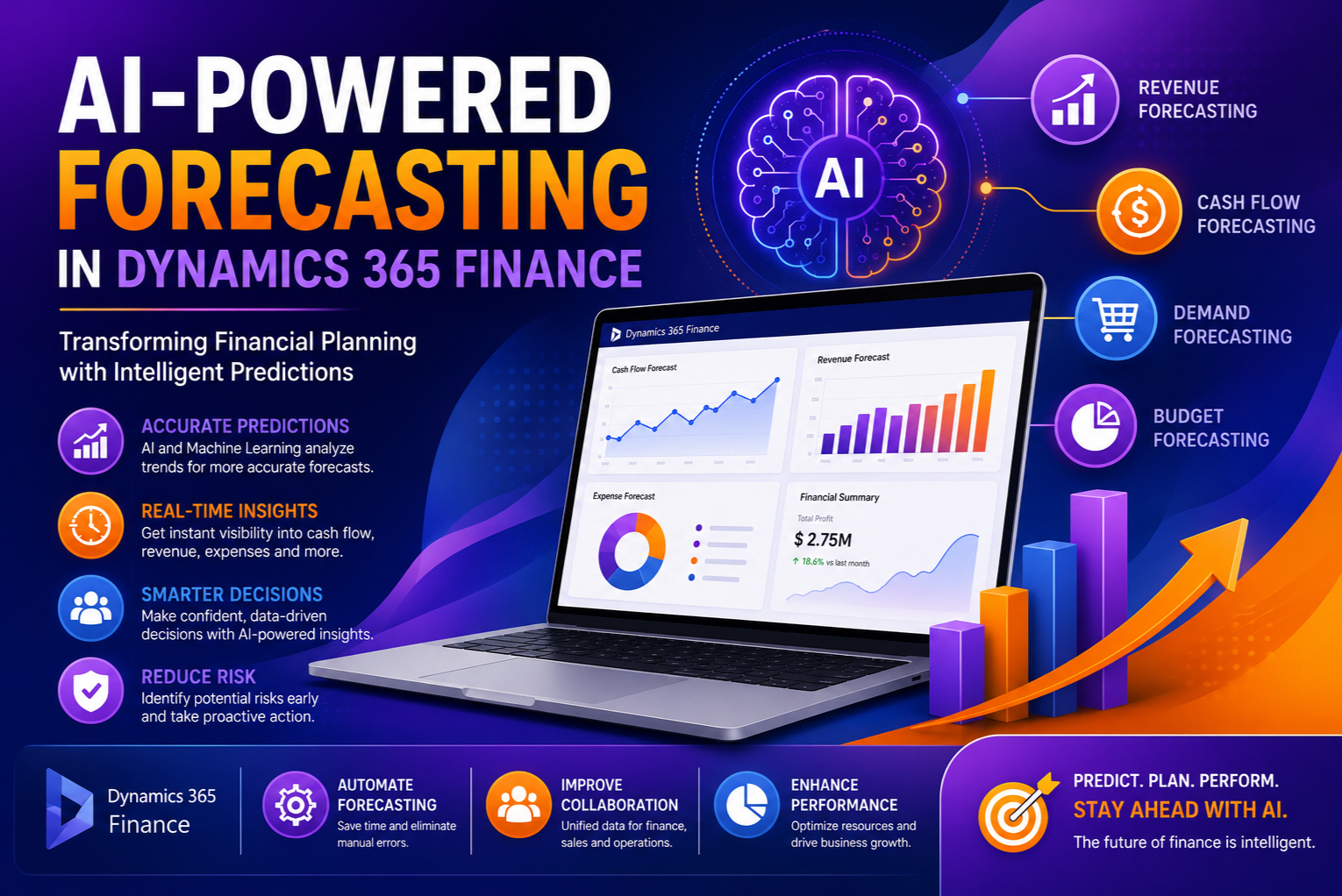
AI-Powered Forecasting in Dynamics 365 Finance: Transforming Financial Planning with Intelligent Predictions
Introduction
In today’s rapidly evolving business landscape, financial leaders are expected to make accurate decisions faster than ever before. Traditional forecasting methods based on spreadsheets, historical averages and manual assumptions are no longer sufficient for handling volatile markets, changing customer demands and global economic uncertainty.
This is where Microsoft Dynamics 365 Finance is redefining enterprise financial management through Artificial Intelligence (AI) and Machine Learning (ML).
AI-powered forecasting enables finance teams to predict future revenue, cash flow, expenses, inventory demand and financial risks with greater accuracy by analysing millions of data points in real time. Instead of relying solely on historical trends, organizations can now leverage intelligent algorithms that continuously learn from business transactions and external data to deliver more reliable forecasts.
Whether you are a CFO, Finance Manager, Dynamics 365 Consultant or ERP professional, understanding AI-powered forecasting in Dynamics 365 Finance is becoming an essential skill in the era of intelligent business applications.
In this comprehensive guide, we’ll explore how AI forecasting works, its key capabilities, business benefits, implementation best practices and why it is transforming modern financial management.
What is AI-Powered Forecasting in Dynamics 365 Finance?
AI-powered forecasting is the use of Artificial Intelligence, Machine Learning, and predictive analytics to estimate future business outcomes based on historical financial data, operational activities and market trends.
Instead of manually creating forecasts every month, Dynamics 365 Finance automatically analyses patterns across:
- Sales history
- Purchase transactions
- Customer payments
- Vendor payments
- Inventory movement
- Seasonal trends
- Business growth patterns
- Financial performance
- Budget history
- Cash flow
The system continuously improves its predictions as more data becomes available, making forecasting increasingly accurate over time.
Why Traditional Financial Forecasting Falls Short
Many organisations still rely on spreadsheets for financial planning. While spreadsheets are familiar, they have significant limitations.
Common challenges include:
- Manual data entry errors
- Time-consuming calculations
- Outdated information
- Limited collaboration
- Difficulty analysing large datasets
- Inconsistent forecasting models
- Lack of real-time insights
- Poor scalability
These limitations often lead to inaccurate forecasts, delayed decisions and increased financial risk.
AI eliminates many of these challenges by automating data analysis and generating intelligent predictions based on real-time information.
How AI Works in Dynamics 365 Finance
AI in Dynamics 365 Finance combines multiple Microsoft technologies, including:
- Microsoft Dataverse
- Azure AI Services
- Machine Learning Models
- Microsoft Copilot
- Power BI
- Dynamics 365 Finance Analytics
- Microsoft Fabric
- Azure Synapse Analytics
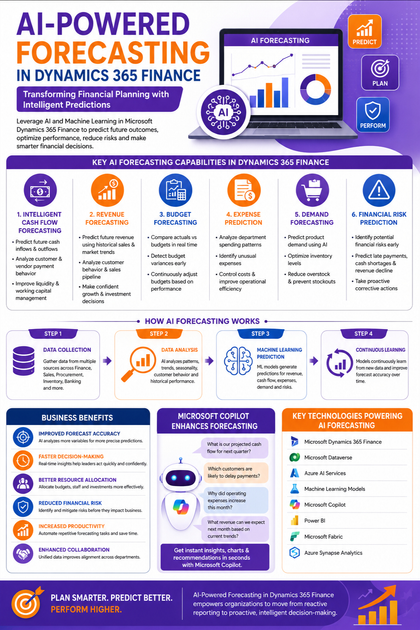
The process generally follows these steps:
Step 1: Data Collection
The system gathers financial and operational data from multiple sources.
Examples include:
- General Ledger
- Accounts Payable
- Accounts Receivable
- Inventory
- Procurement
- Sales Orders
- Production Orders
- Banking transactions
Step 2: Data Analysis
AI identifies:
- Trends
- Seasonal variations
- Customer behaviour
- Spending patterns
- Payment cycles
- Revenue growth
- Expense fluctuations
Step 3: Machine Learning Prediction
Machine learning models compare current data with historical patterns to generate future predictions.
Examples include:
- Revenue forecasts
- Cash flow projections
- Budget variance
- Inventory demand
- Financial risks
Step 4: Continuous Learning
Unlike static reports, AI continuously improves its forecasting models as new transactions and business conditions emerge.
Key AI Forecasting Features in Dynamics 365 Finance
1. Intelligent Cash Flow Forecasting
Cash flow is one of the most critical financial indicators.
AI analyses:
- Customer payment behaviour
- Vendor payment schedules
- Outstanding invoices
- Purchase commitments
- Seasonal sales
- Historical payment delays
The system predicts future cash availability, helping finance teams maintain liquidity and avoid cash shortages.
Benefits
- Better working capital management
- Improved payment planning
- Reduced financial risk
- Increased liquidity visibility
2. Revenue Forecasting
AI predicts future revenue using:
- Historical sales
- Customer purchasing behaviour
- Market demand
- Sales pipeline
- Recurring income
- Seasonal variations
This enables management to make informed investment and expansion decisions.
3. Budget Forecasting
Traditional budgeting often becomes outdated shortly after approval.
AI continuously compares:
- Actual expenses
- Planned budgets
- Department spending
- Revenue performance
- Operational costs
Finance leaders can proactively adjust budgets based on changing business conditions.
4. Expense Prediction
AI identifies spending trends across departments.
Examples include:
- Marketing expenses
- Operational costs
- Employee expenses
- Procurement spending
- Manufacturing costs
The system highlights unusual spending patterns before they become major issues.
5. Demand Forecasting
Inventory forecasting is another powerful AI capability.
AI predicts:
- Product demand
- Seasonal sales
- Inventory shortages
- Overstock situations
- Supplier requirements
This helps organizations optimize inventory levels while reducing storage costs.
6. Financial Risk Prediction
AI can identify potential financial risks, including:
- Late-paying customers
- High-risk vendors
- Budget overruns
- Revenue decline
- Cash shortages
- Profitability concerns
Finance teams can take corrective action before issues escalate.
Microsoft Copilot and AI Forecasting
Microsoft Copilot enhances Dynamics 365 Finance by making forecasting more accessible through natural language interactions.
Instead of manually building reports, users can ask questions such as:
- What is our projected cash flow for next quarter?
- Which customers are likely to delay payments?
- Why did operating expenses increase this month?
- Which business units are exceeding their budgets?
- What revenue can we expect next month based on current trends?
Copilot analyses enterprise data and delivers contextual insights, charts and recommendations in seconds, empowering finance professionals to focus on strategic decision-making rather than manual analysis.
Business Benefits of AI-Powered Forecasting
Organisations adopting AI forecasting in Dynamics 365 Finance experience numerous advantages.
Improved Forecast Accuracy
AI analyses significantly more variables than traditional forecasting methods, resulting in more reliable predictions.
Faster Decision-Making
Executives receive real-time financial insights instead of waiting days or weeks for manually prepared reports.
Better Resource Allocation
Forecasts help organizations allocate budgets, staff and investments more effectively.
Reduced Financial Risk
Early detection of potential cash flow issues, overspending and declining revenue enables proactive intervention.
Increased Productivity
Automation reduces repetitive forecasting tasks, allowing finance teams to focus on analysis and business strategy.
Enhanced Collaboration
Finance, sales, procurement and operations teams work from the same data, improving cross-functional planning and alignment.
Real-World Business Scenario
Consider a multinational retail company operating across multiple countries.
Before implementing Dynamics 365 Finance, the finance team spent nearly two weeks each month consolidating spreadsheets from different regions.
Challenges included:
- Delayed financial reports
- Inconsistent forecasting
- Manual errors
- Limited visibility into cash flow
- Difficulty responding to market changes
After adopting AI-powered forecasting in Dynamics 365 Finance:
- Cash flow forecasting became automated.
- Revenue projections updated daily.
- Inventory demand predictions improved procurement planning.
- Budget variances were detected earlier.
- Executives gained real-time dashboards for informed decision-making.
The organisation reduced forecasting time from days to hours while significantly improving forecast accuracy.
Best Practices for Implementing AI Forecasting
Maintain High-Quality Data
AI models are only as effective as the data they analyse.
Ensure:
- Accurate financial records
- Consistent master data
- Clean customer information
- Reliable transaction history
Standardise Financial Processes
Consistent accounting and operational processes improve forecasting accuracy across departments.
Integrate Business Systems
Connect Dynamics 365 Finance with:
- Dynamics 365 Sales
- Supply Chain Management
- Power BI
- Microsoft Fabric
- Azure Data Lake
- Banking systems
- Payroll applications
Integrated data provides AI with a more complete picture of business performance.
Review Forecasts Regularly
AI provides recommendations, but finance professionals should continuously validate forecasts against business realities and emerging market conditions.
Train Finance Teams
Equip users with skills in:
- AI fundamentals
- Predictive analytics
- Microsoft Copilot
- Power BI
- Financial reporting
- Dynamics 365 Finance
A well-trained team maximises the value of intelligent forecasting.
Common Challenges
While AI forecasting offers significant benefits, organisations may encounter challenges such as:
- Poor data quality
- Resistance to change
- Legacy system integration
- Limited AI knowledge
- Inconsistent financial processes
- Governance and compliance requirements
Addressing these challenges through strong planning, training and governance is essential for successful adoption.
Future of AI Forecasting in Dynamics 365 Finance
Microsoft continues to invest heavily in AI capabilities across the Dynamics 365 ecosystem.
Emerging innovations include:
- Autonomous finance agents
- AI-generated financial narratives
- Scenario-based forecasting
- Predictive anomaly detection
- Conversational financial analytics
- Generative AI for budgeting
- Self-optimising financial models
- Deeper integration with Microsoft Fabric and Azure AI
As these technologies mature, finance departments will increasingly shift from reactive reporting to proactive, predictive and prescriptive decision-making.
Skills Every Finance Professional Should Learn
To excel in the AI-driven finance landscape, professionals should build expertise in:
- Microsoft Dynamics 365 Finance
- Financial Management
- Budget Planning
- Cash Flow Management
- Predictive Analytics
- Microsoft Copilot
- Power BI
- Microsoft Fabric
- Azure AI Services
- Machine Learning Fundamentals
- Data Analysis
- Financial Reporting
- Business Intelligence
- ERP Implementation
These skills position professionals to lead digital transformation initiatives within modern finance organisations.
Conclusion
AI-powered forecasting in Dynamics 365 Finance is transforming the way organisations plan, budget and manage financial performance. By combining Artificial Intelligence, Machine Learning, predictive analytics and Microsoft Copilot, businesses can move beyond static spreadsheets and manual assumptions to make faster, data-driven decisions.
From intelligent cash flow forecasting and revenue prediction to budget optimisation and financial risk analysis, Dynamics 365 Finance empowers organisations with real-time insights that improve agility, profitability and resilience.
As AI continues to evolve, organisations that embrace intelligent forecasting today will be better prepared to navigate uncertainty, seize growth opportunities and build a more strategic finance function.
Whether you are beginning your Dynamics 365 journey or modernising an enterprise ERP environment, mastering AI-powered forecasting is a valuable step toward becoming a future-ready finance professional.