Functional Consultant vs Technical Consultant: Which IT Career Path Should You Choose in 2026?
Introduction
The enterprise IT industry offers a wide range of career opportunities, but one of the most common questions among fresh graduates and professional entering the Microsoft ecosystem is:
“Should I become a Functional Consultant or a Technical Consultant?”
Whether you’re interested in Microsoft Dynamics 365, Power Platform, Azure, Business Central, or Finance & Operations, understanding the difference between these two roles is essential before choosing your learning path.
While both Functional and Technical Consultants work on the same business solutions, their responsibilities, skill sets, and day-to-day work are quite different.
This guide provides an in-depth comparison of Functional Consultants and Technical Consultants, helping you choose the career path that best matches your interests and strengths.
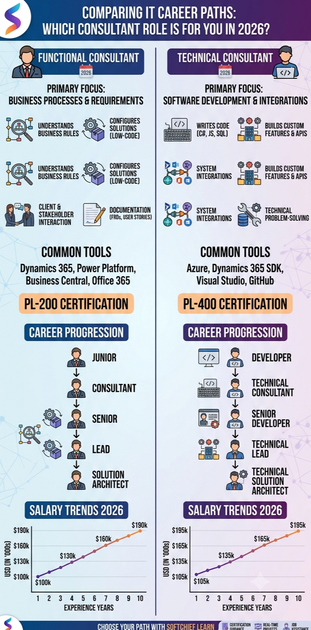
What is a Functional Consultant?
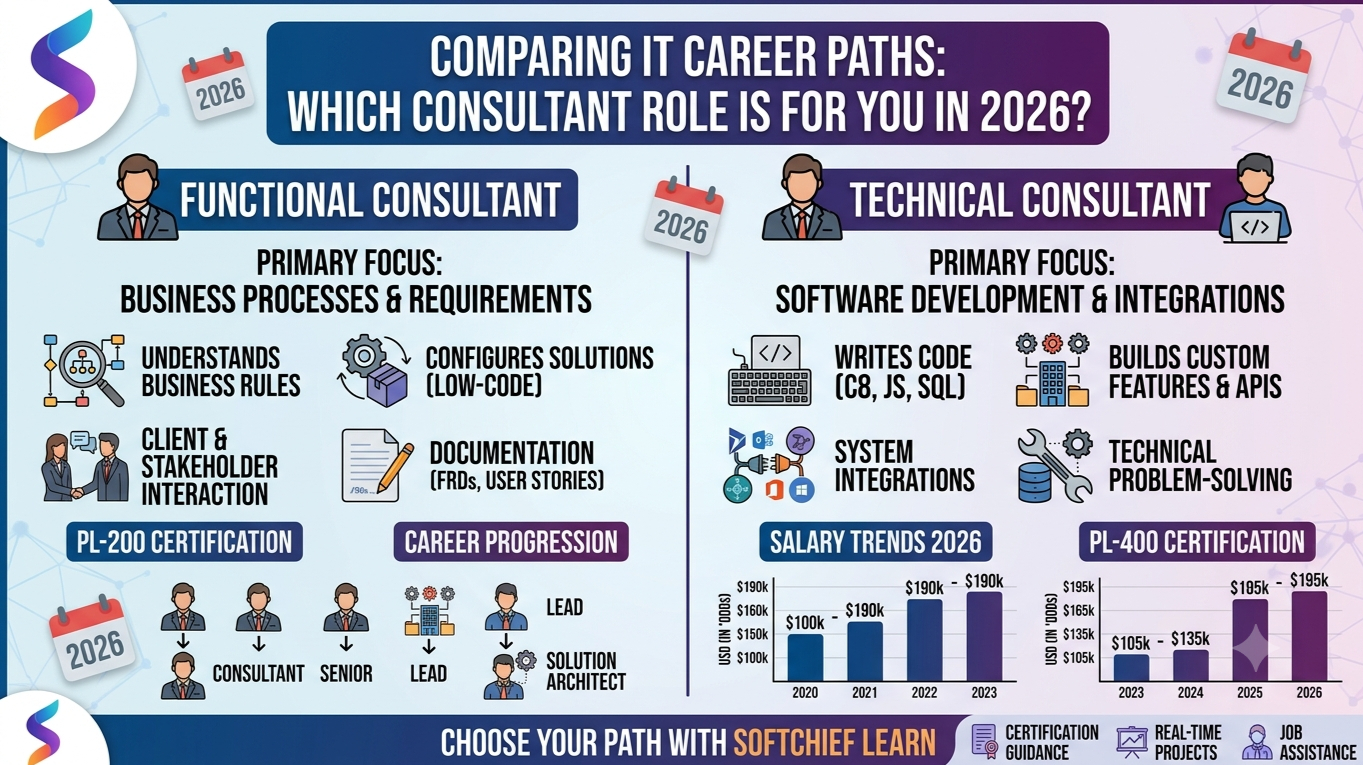
A Functional Consultant focuses on understanding business processes, gathering customer requirements, configuring applications, and ensuring that technology aligns with business goals.
Rather than writing code, Functional Consultants work closely with business users to translate business needs into software solutions.
They act as the bridge between business stakeholders and technical teams.
Responsibilities of a Functional Consultant
Typical responsibilities include:
- Gathering business requirements
- Conducting client workshops
- Configuring applications
- Designing business processes
- Preparing Functional Requirement Documents (FRDs)
- Creating User Stories
- Testing solutions
- Conducting User Acceptance Testing (UAT)
- Training end users
- Supporting production deployments
What is a Technical Consultant?
A Technical Consultant designs, develops, customizes, and integrates enterprise applications using programming languages, APIs, cloud services, and development frameworks.
Technical Consultants convert business requirements into working software solutions.
They focus on coding, integrations, automation, and system architecture.
Responsibilities of a Technical Consultant
Typical responsibilities include:
- Custom application development
- Writing code
- Creating APIs
- System integrations
- Database development
- Performance optimization
- Troubleshooting
- Security implementation
- Deployments
- Solution customization
Functional Consultant vs Technical Consultant: Quick Comparison
| Feature | Functional Consultant | Technical Consultant |
|---|---|---|
| Primary Focus | Business Processes | Software Development |
| Coding Required | Minimal | Extensive |
| Client Interaction | Very High | Moderate |
| Business Analysis | Excellent | Moderate |
| System Configuration | High | Moderate |
| Custom Development | Limited | Extensive |
| Integrations | Basic Understanding | Advanced |
| Problem Solving | Business-Oriented | Technical |
| Documentation | Functional | Technical |
| Best For | Business Professionals | Developers |
Understanding the Core Difference
The easiest way to understand these roles is:
Functional Consultants define what the business needs.
Technical Consultants build how the solution works.
For example:
A company wants an automated leave approval process.
Functional Consultant
- Understands business rules
- Designs the workflow
- Defines approval hierarchy
- Configures standard features
- Creates functional documentation
Technical Consultant
- Develops custom components
- Writes code if required
- Integrates external systems
- Creates APIs
- Extends platform functionality
Together, they deliver a complete solution.
Skills Required
Functional Consultant Skills
Successful Functional Consultants typically possess:
Business Process Knowledge
Understanding of:
- Sales
- Customer Service
- Finance
- HR
- Supply Chain
- Operations
Communication Skills
Functional Consultants spend significant time communicating with:
- Clients
- Business users
- Developers
- Project Managers
- Testers
Strong communication is essential.
Documentation Skills
They prepare:
- Functional Requirement Documents (FRDs)
- User Stories
- Process Flows
- Test Cases
- Training Manuals
Configuration Skills
They configure applications without extensive coding.
Examples include:
- Security Roles
- Forms
- Business Rules
- Workflows
- Approval Processes
Technical Consultant Skills
Technical Consultants require strong technical expertise.
Programming Languages
Common languages include:
- C#
- JavaScript
- SQL
- Power Fx
- HTML
- CSS
Development Tools
Professionals commonly use:
- Visual Studio
- Visual Studio Code
- Git
- Azure DevOps
- Postman
Integration Skills
Technical Consultants build integrations using:
- REST APIs
- Webhooks
- Azure Functions
- Logic Apps
- Service Bus
Database Skills
Knowledge of:
- SQL Server
- Microsoft Dataverse
- Azure SQL
Technology Comparison
Functional Consultants Commonly Work With
- Dynamics 365 CE
- Dynamics 365 Finance
- Dynamics 365 Supply Chain Management
- Business Central
- Power Apps
- Power Automate
- Microsoft 365
- Power BI (basic reporting)
Technical Consultants Commonly Work With
- Dynamics 365 SDK
- Power Platform
- Azure
- C#
- JavaScript
- PCF Controls
- Plug-ins
- Custom APIs
- Dataverse
- SQL Server
- Azure DevOps
Typical Daily Activities
Functional Consultant
A typical day may include:
- Client meetings
- Requirement gathering
- Configuring applications
- Testing business processes
- Preparing documentation
- Conducting user training
- Supporting implementation teams
Technical Consultant
A typical day may include:
- Writing code
- Debugging applications
- Developing integrations
- Building APIs
- Reviewing pull requests
- Deploying solutions
- Troubleshooting technical issues
Certifications
Functional Consultant Certifications
Popular Microsoft certifications include:
Dynamics 365
- MB-910: Dynamics 365 Fundamentals (CRM)
- MB-920: Dynamics 365 Fundamentals (ERP)
Power Platform
- PL-900: Power Platform Fundamentals
- PL-200: Power Platform Functional Consultant
Technical Consultant Certifications
Recommended certifications include:
- PL-400: Microsoft Power Platform Developer Associate
- AZ-204: Azure Developer Associate
- AZ-900: Azure Fundamentals
- PL-900: Power Platform Fundamentals
These certifications validate role-specific skills and improve career prospects.
Career Opportunities
Functional Consultant Roles
Popular positions include:
- Functional Consultant
- Business Analyst
- Dynamics 365 Functional Consultant
- Power Platform Functional Consultant
- ERP Consultant
- CRM Consultant
- Solution Consultant
- Product Consultant
Technical Consultant Roles
Popular positions include:
- Technical Consultant
- Power Platform Developer
- Dynamics 365 Developer
- Azure Developer
- Software Engineer
- Integration Developer
- Solution Architect
- Technical Lead
Both career paths offer strong opportunities across consulting firms, IT services, and enterprise organizations.
Salary Comparison
(Approximate salaries vary based on experience, location, employer, and specialization.)
| Experience | Functional Consultant | Technical Consultant |
|---|---|---|
| Fresher | ₹4–7 LPA | ₹5–8 LPA |
| 2–4 Years | ₹7–14 LPA | ₹8–16 LPA |
| 5–8 Years | ₹14–25 LPA | ₹15–30 LPA |
| Senior Consultant / Architect | ₹28–50+ LPA | ₹30–60+ LPA |
Technical Consultants often command slightly higher salaries due to specialized development skills. However, experienced Functional Consultants with deep industry expertise and consulting experience are equally valuable and can reach similar compensation levels.
Which Career is Easier?
For individuals with a business, commerce, finance, management, or operations background, the Functional Consultant path is often easier to start because it emphasizes business processes and solution configuration.
For individuals with programming experience or an engineering background, the Technical Consultant path is usually a better fit because it focuses on software development and system customization.
Neither role is inherently easier—success depends on your interests, strengths, and willingness to learn.
Which Career Has Better Growth?
Both career paths offer excellent long-term growth.
Functional Consultant Growth
Typical progression:
- Associate Consultant
- Functional Consultant
- Senior Consultant
- Lead Consultant
- Solution Architect
- Practice Manager
Technical Consultant Growth
Typical progression:
- Junior Developer
- Technical Consultant
- Senior Developer
- Technical Lead
- Solution Architect
- Enterprise Architect
Professionals who combine technical knowledge with business understanding often progress into Solution Architect and leadership roles.
Can One Become the Other?
Yes.
Many Technical Consultants later transition into Solution Architecture or consulting roles that require business expertise.
Similarly, Functional Consultants often expand into technical areas by learning:
- Power Apps
- Power Automate
- Dataverse
- JavaScript
- Azure
- Low-code development
The Microsoft ecosystem encourages continuous learning, making career transitions possible with the right training and experience.
Which Career Path Should You Choose?
Choose Functional Consulting if you:
- Enjoy solving business problems.
- Like interacting with clients and stakeholders.
- Prefer configuration over coding.
- Have strong communication and analytical skills.
- Are interested in business process optimization.
Choose Technical Consulting if you:
- Enjoy programming and software development.
- Like building applications and integrations.
- Are interested in cloud technologies.
- Want to work with APIs, databases, and automation.
- Prefer hands-on technical problem-solving.
Why Microsoft Professionals Should Understand Both
Modern enterprise projects require close collaboration between Functional and Technical Consultants.
The most successful professionals understand both perspectives.
For example:
A Dynamics 365 implementation may involve:
- Functional Consultants gathering requirements.
- Technical Consultants developing custom features.
- Power Platform Developers building applications.
- Azure Developers creating integrations.
- Solution Architects designing the overall system.
Having knowledge of both business processes and technical implementation makes you a more versatile and valuable professional.
How Softchief Learn Prepares You for Both Roles
At Softchief Learn, we offer specialized training paths for both aspiring Functional Consultants and Technical Consultants.
Functional Training Includes
- Dynamics 365 CE Functional
- Dynamics 365 Finance & Operations Functional
- Business Central Functional
- Power Platform Functional
- Business Process Analysis
- Requirement Gathering
- UAT & Documentation
Technical Training Includes
- Dynamics 365 CE Development
- Power Platform Development
- Azure Development
- C# Full Stack Development
- Dataverse
- JavaScript
- Power Automate
- API Integrations
Additional Career Support
- Live Instructor-Led Sessions
- Real-Time Industry Projects
- Microsoft Certification Guidance
- Resume Building
- Mock Interviews
- Placement Assistance
- Lifetime Access to Recordings
- Career Mentorship
Whether your goal is to become a Functional Consultant, Technical Consultant, or eventually a Solution Architect, our programs are designed to build the skills employers seek.
Conclusion
Choosing between a Functional Consultant and a Technical Consultant career isn’t about finding the “better” role—it’s about selecting the path that aligns with your strengths and career aspirations.
Functional Consultants play a vital role in understanding business needs, configuring enterprise applications, and ensuring technology delivers value to organizations. Technical Consultants bring those solutions to life by building customizations, integrations, and scalable software using modern development tools.
As Microsoft continues to expand its ecosystem through Dynamics 365, Power Platform, Azure, and Copilot, the demand for both Functional and Technical Consultants continues to grow. Organizations increasingly seek professionals who can collaborate across business and technology, making cross-functional knowledge a significant career advantage.
Whether you’re just starting your IT journey or planning a career transition, investing in the right training, certifications, and practical experience will help you build a rewarding and future-ready consulting career.