Enterprise AI Handoff Patterns: Move Work Safely Across Teams and Systems
Introduction
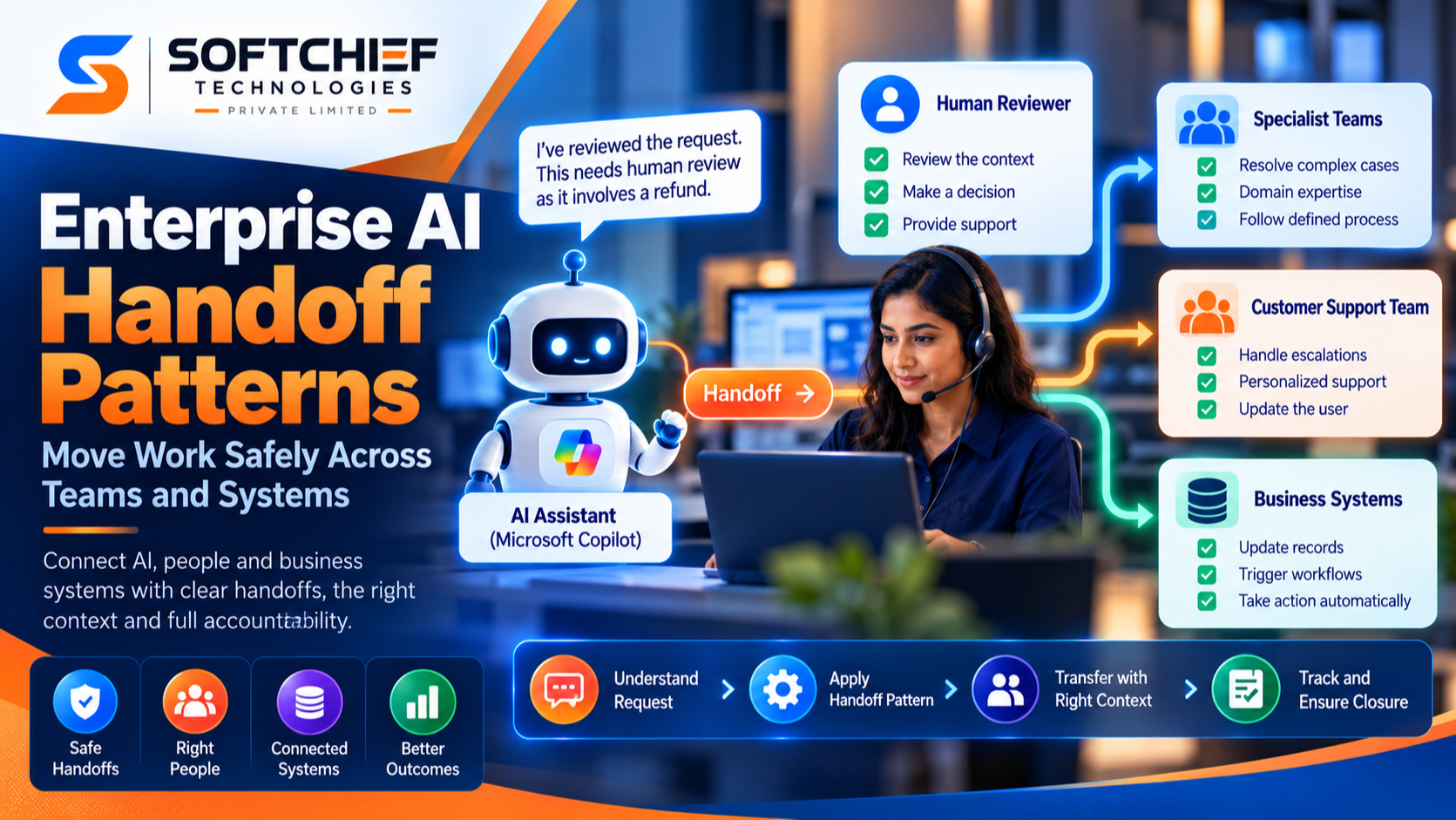
An enterprise AI handoff pattern determines what happens when an AI can’t finish a task alone. It may need a person to review a decision, a specialist team to resolve a case, another agent to handle a subtask, or a business system to take action.
When that transfer is unclear, useful details can get lost. Work may stall, repeat, or leave the user unsure who owns the next step. Good handoffs make the next action clear, carry the right context, and keep responsibility with the right person or system. Here’s how to choose and build patterns that do that.
Design Enterprise AI Handoff Patterns Around the Work
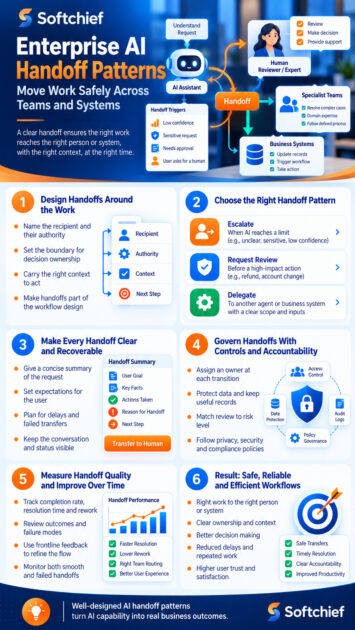
A handoff is a planned transfer of a task, conversation, or decision from one party to another. It should be part of the workflow design, not an improvised response to a model limit. Define the trigger, the recipient, and what the recipient must do next.
Name the recipient and their authority
A handoff might go to a human reviewer, a specialist team, another AI agent, or a software system. Name the recipient clearly, along with the authority they have: an agent might gather facts, while a manager approves a refund. Vague routing such as “send for review” can leave a case stuck between teams.
Set the boundary for decision ownership
Use task risk, reversibility, and business impact to decide what AI can do alone. An agent might draft a routine reply, but a person may need to approve a message that affects a customer’s rights or finances. For difficult-to-reverse actions, keep a named person responsible for the final decision.
Carry the context needed to act
Give the recipient the user’s goal, relevant conversation history, supporting evidence, actions already taken, and unresolved questions. Include a suggested next step when it helps, but don’t present the AI’s suggestion as a decision. Share only what the recipient needs, especially when a case includes sensitive data.
Choose an Enterprise AI Handoff Pattern for the Decision
Different handoff patterns address different needs. Escalation routes work the AI can’t safely complete; approval pauses a task until a person agrees; delegation sends a defined task to another agent or system. A single workflow can use all three, provided each has a clear trigger and expected result.
Escalate when the AI reaches a limit
Escalate when the agent lacks key information, has low confidence, finds a policy conflict, or receives a request it cannot handle. A user request for a person can also trigger escalation. Show the reason for the transfer, such as “I need a billing specialist to check this charge,” so the recipient and user understand the pause.
Request review before a high-impact action
An approval gate is useful before issuing a large refund, changing an account, sending a high-impact message, or committing a production change. Show the reviewer the proposed action, the facts behind it, and any policy that applies. Record whether the reviewer approved, changed, or rejected the proposal.
Delegate tasks to agents and systems
A delegated task needs a clear scope, required inputs, and a response format. Set rules for what happens if the result is incomplete, late, or unsuccessful, such as retrying once or routing the case to a person. Microsoft Copilot Studio’s live-agent handoff documentation describes transferring conversations, history, and relevant variables to a connected engagement hub. That documents a product capability, not proof of business results.
Make Every AI Handoff Clear and Recoverable
A transfer works only when the next party can act and the user knows what to expect. Build handoffs with useful summaries, visible status, and a plan for failure. These details reduce confusion when work moves across teams or tools.
Give recipients a concise summary
A structured summary can capture the user’s goal, key facts, completed actions, open questions, and reason for transfer. Keep it short enough to scan, and link to the full record when more detail is needed. Recipients should be able to check important claims against the source, rather than relying on a summary alone.
Set expectations for the user
Tell the user that the task is moving, who or what will respond next, and whether they need to provide anything. If a person will follow up, say where the update will arrive and what happens while they wait. When a case moves between chat, email, or a service desk, preserve a way to find its status.
Plan for delays and failed transfers
Reviewers may be unavailable, integrations may fail, or a team may reject a case because it belongs elsewhere. Define when to retry, where to queue the work, and which alternate route to use. Notify the user if the delay affects their next step, and retain the case details so they don’t have to start again.
Govern Handoffs With Controls and Accountability
Risk controls must cover the full workflow, not only the AI model. The NIST AI Risk Management Framework and its Generative AI Profile offer ways to organize risk review and oversight. They’re voluntary resources, not replacements for laws, contracts, or sector-specific rules.
Assign an owner at each transition
Name who starts, accepts, and resolves each handoff. If AI output informs a human decision, state who owns that decision and how they can challenge the output. A queue without an accountable team can turn a safe pause into a lost case.
Protect data and keep useful records
Use access controls so recipients see only the information needed for their role. Set data retention rules and avoid sending sensitive details into systems that don’t need them. Keep records of the trigger, transferred context, recipient, decision, and next action where privacy and legal rules allow.
Match review to risk
Routine, reversible tasks may need light checks and clear sampling. Actions with major financial, safety, legal, or service effects need stronger approval and a reliable record. Set rules for overrides and disagreements, including when to pause the workflow and seek a second reviewer.
Measure Handoff Quality and Improve It Over Time
A handoff count alone won’t show whether work gets resolved. Track what happens after the transfer, using consistent definitions so teams can compare results over time. Review both smooth cases and failures.
Track completion, delay, and rework
Measure acceptance rates, time to resolution, abandoned cases, reroutes, repeat contacts, and work returned for missing context. Define when the clock starts and stops, and what counts as a completed case. These measures help show where a transfer adds value and where it creates extra work.
Review outcomes and failure modes
Sample handoffs to find incorrect routing, thin summaries, needless escalation, missed escalation, and unclear ownership. Check whether the final action matched the policy and whether the user received a clear update. Use documented case studies only when primary sources verify the workflow and reported outcome.
Use frontline feedback to refine the flow
Ask recipients where context is missing and users where status updates fall short. Use that feedback to adjust triggers, routing rules, summary fields, and interface language. After a change, watch for unintended effects, such as more cases reaching the wrong team.
Conclusion
Enterprise AI handoff patterns connect AI capability with human judgment and business systems. Choose a pattern based on the task’s risk, recipient, and decision authority. Then make ownership, context, user updates, and fallback routes explicit.
A dependable handoff should lead to a timely, correct resolution, not merely record that work changed hands. Review the cases that stall or return, listen to the people who receive them, and keep improving the workflow.