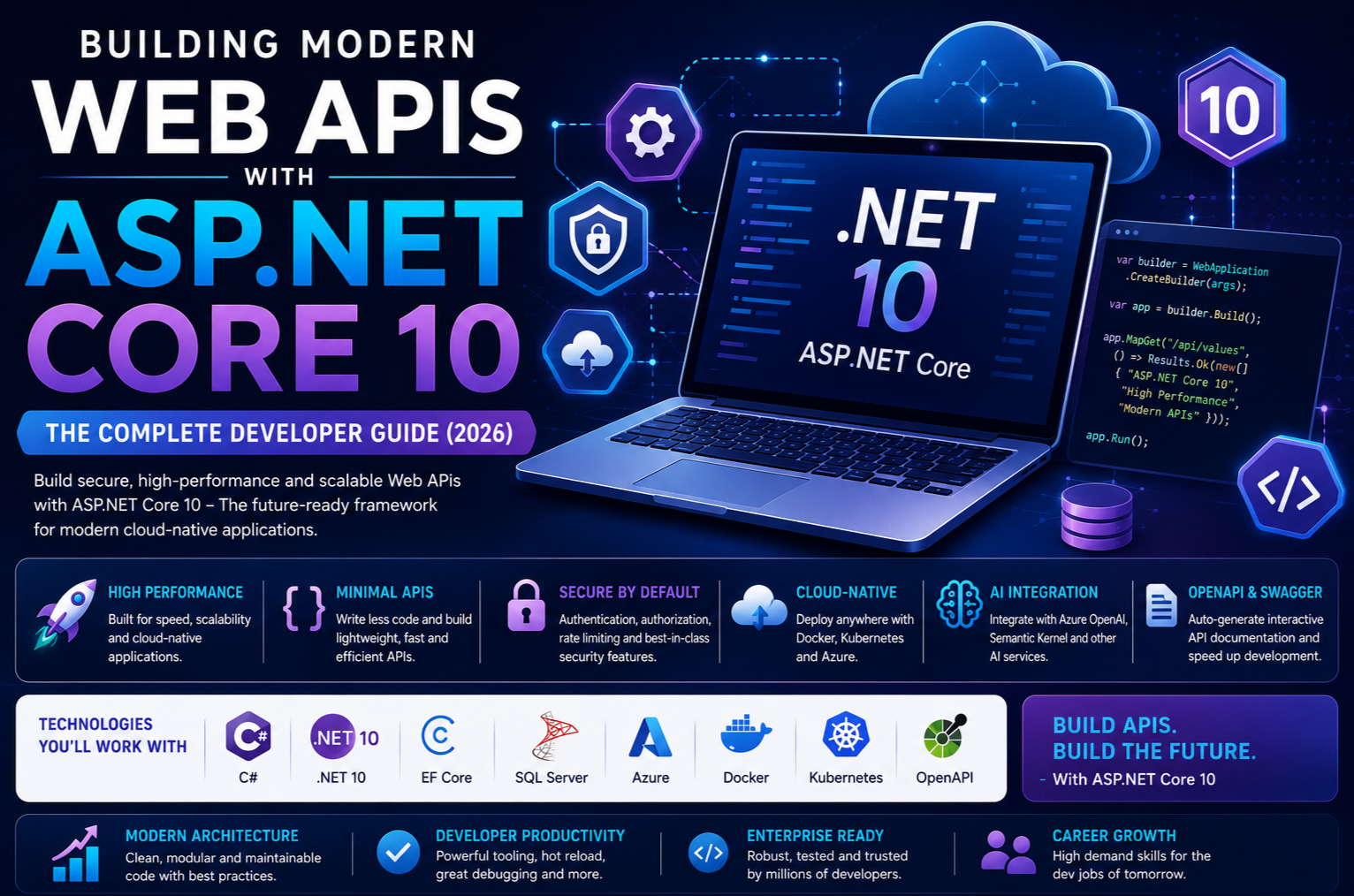
Building Modern Web APIs with ASP.NET Core 10: The Complete Developer Guide
Introduction
Modern applications no longer operate in isolation. Whether you’re building a mobile application, enterprise CRM, e-commerce platform, IoT solution or AI-powered SaaS product, Web APIs have become the backbone of modern software architecture.
Every time a mobile app retrieves user data, a website processes a payment, or an AI assistant fetches information from a business system, a Web API is working behind the scenes.
As software architectures evolve toward cloud-native, microservices, serverless computing and AI-driven applications, developers need API frameworks that are fast, secure, scalable and easy to maintain.
This is where ASP.NET Core 10 excels.
Built on the latest .NET platform, ASP.NET Core 10 provides everything developers need to create high-performance APIs with built-in support for Minimal APIs, OpenAPI, authentication, dependency injection, native cloud integration and AI-ready architectures.
In this comprehensive guide, we’ll explore how to build modern Web APIs using ASP.NET Core 10, the latest features introduced in .NET 10 and the best practices followed by enterprise development teams.
What is ASP.NET Core 10?
ASP.NET Core 10 is Microsoft’s latest cross-platform framework for building modern web applications, REST APIs, cloud services and microservices.
It runs seamlessly on:
- Windows
- Linux
- macOS
- Docker Containers
- Kubernetes
- Microsoft Azure
- AWS
- Google Cloud Platform
Unlike traditional ASP.NET Framework, ASP.NET Core 10 is lightweight, modular, open source and designed for cloud-first development.
Developers can build APIs that are:
- Extremely fast
- Cross-platform
- Secure by default
- Easy to test
- Cloud-native
- Container-ready
- AI-ready
- Enterprise scalable
Why Modern APIs Matter
Today’s businesses rely on APIs for nearly every digital interaction.
Examples include:
- Mobile banking apps
- Online shopping platforms
- Healthcare portals
- ERP systems
- Microsoft Dynamics 365 integrations
- Power Platform connectors
- AI copilots
- IoT devices
- Payment gateways
- Social media platforms
A well-designed API enables seamless communication between systems, accelerates development and supports innovation across teams.
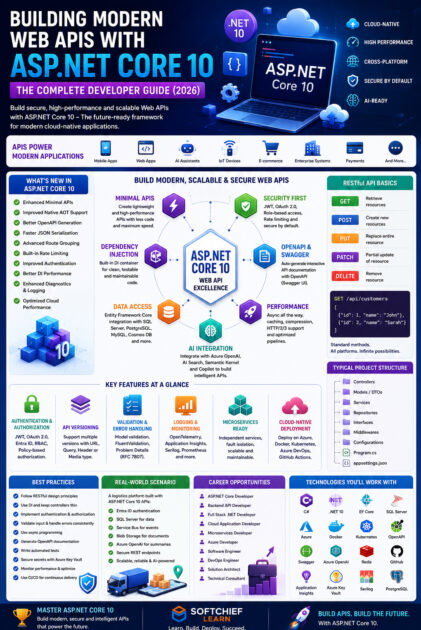
What’s New in ASP.NET Core 10?
ASP.NET Core 10 introduces several enhancements that simplify API development and improve performance.
Key improvements include:
- Enhanced Minimal APIs
- Improved Native AOT support
- Better OpenAPI generation
- Faster JSON serialization
- Advanced route grouping
- Built-in rate limiting enhancements
- Improved authentication middleware
- Better dependency injection performance
- Enhanced diagnostics and logging
- Optimized performance for cloud deployments
These updates help developers build APIs that are more maintainable and production-ready.
Understanding RESTful APIs
REST (Representational State Transfer) remains the most widely adopted architectural style for Web APIs.
A RESTful API exposes resources through standard HTTP methods:
| HTTP Method | Purpose | Example |
|---|---|---|
| GET | Retrieve data | Get all customers |
| POST | Create new resource | Add customer |
| PUT | Replace existing resource | Update customer |
| PATCH | Partial update | Update email address |
| DELETE | Remove resource | Delete customer |
Example endpoint:
GET /api/customersResponse:
[
{
"id":1,
"name":"John"
},
{
"id":2,
"name":"Sarah"
}
]
REST principles encourage simplicity, scalability and interoperability across diverse systems.
Project Structure in ASP.NET Core 10
A typical API project includes:
Controllers
Models
DTOs
Services
Repositories
Interfaces
Middlewares
Configurations
Program.cs
appsettings.json
This layered architecture promotes separation of concerns, making applications easier to maintain and test.
Minimal APIs in ASP.NET Core 10
Minimal APIs continue to evolve as one of the most efficient ways to build lightweight services.
Instead of creating multiple controller classes, developers can define endpoints directly in Program.cs.
Benefits include:
- Less boilerplate code
- Faster development
- Better performance
- Easier readability
- Excellent for microservices
- Ideal for serverless APIs
Minimal APIs are especially useful for internal services, proof-of-concept applications and high-performance microservices.
Dependency Injection
Dependency Injection (DI) is built into ASP.NET Core 10.
Instead of manually creating objects throughout the application, services are registered and injected automatically.
Benefits include:
- Loose coupling
- Easier unit testing
- Better maintainability
- Improved scalability
- Cleaner architecture
DI encourages modular design and simplifies application maintenance.
Data Access with Entity Framework Core
Most APIs interact with databases.
Entity Framework Core integrates seamlessly with ASP.NET Core 10.
Supported databases include:
- SQL Server
- PostgreSQL
- MySQL
- Oracle
- SQLite
- Azure SQL Database
- Cosmos DB
Developers can use:
- LINQ queries
- Code First
- Database First
- Migrations
- Async operations
This accelerates development while reducing the amount of manual SQL code.
Authentication and Authorization
Security is one of the most critical aspects of API development.
ASP.NET Core 10 supports multiple authentication mechanisms, including:
- JWT Bearer Tokens
- OAuth 2.0
- OpenID Connect
- Microsoft Entra ID
- Azure Active Directory B2C
- Cookie Authentication
- API Keys
Authorization can be implemented using:
- Role-Based Access Control (RBAC)
- Policy-Based Authorization
- Claims-Based Authorization
These approaches help ensure that only authenticated and authorized users can access sensitive resources.
API Versioning
As applications evolve, APIs often require changes without disrupting existing clients.
API versioning strategies include:
- URL versioning (
/api/v1/products) - Query string versioning
- Header versioning
- Media type versioning
Proper versioning allows organizations to introduce new features while maintaining backward compatibility.
OpenAPI and Swagger Documentation
Comprehensive API documentation improves developer productivity.
ASP.NET Core 10 integrates seamlessly with OpenAPI.
Benefits include:
- Interactive documentation
- Live endpoint testing
- Automatic schema generation
- Faster onboarding
- Improved collaboration
Swagger UI enables developers and testers to explore and validate APIs directly from the browser.
Validation and Error Handling
Robust APIs validate incoming requests and provide meaningful error responses.
Best practices include:
- Model validation
- Data annotations
- FluentValidation
- Global exception handling
- Standardized error responses
- Problem Details (RFC 7807)
Consistent validation improves reliability and enhances the developer experience for API consumers.
Logging and Monitoring
Production APIs require comprehensive observability.
ASP.NET Core 10 supports integration with:
- OpenTelemetry
- Azure Monitor
- Application Insights
- Serilog
- Elastic Stack
- Prometheus
- Grafana
Monitoring enables teams to track:
- Request performance
- Exceptions
- User activity
- Response times
- Dependency health
- Infrastructure metrics
Performance Optimization
ASP.NET Core is already one of the fastest web frameworks available, but additional optimizations can further improve throughput.
Recommended practices include:
- Asynchronous programming (
async/await) - Response compression
- HTTP/2 and HTTP/3 support
- Output caching
- Database indexing
- Efficient serialization
- Connection pooling
- Pagination for large datasets
These optimizations contribute to lower latency and improved scalability.
Building Secure APIs
Security should be considered throughout the development lifecycle.
Key recommendations include:
- Enforce HTTPS
- Validate all input
- Protect against SQL injection
- Use parameterized queries
- Enable CORS appropriately
- Store secrets in Azure Key Vault
- Implement rate limiting
- Configure Content Security Policy where applicable
- Rotate credentials regularly
- Apply the principle of least privilege
A security-first approach reduces the risk of data breaches and unauthorized access.
Integrating AI with ASP.NET Core 10
Modern APIs increasingly serve as gateways to AI services.
ASP.NET Core 10 integrates effectively with:
- Azure OpenAI Service
- Azure AI Foundry
- Azure AI Search
- Azure AI Document Intelligence
- Microsoft Copilot Studio
- Semantic Kernel
Example use cases include:
- AI-powered chatbots
- Document summarization
- Intelligent search
- Sentiment analysis
- Language translation
- Image recognition
- Recommendation engines
This makes ASP.NET Core 10 an excellent platform for developing intelligent business applications.
Microservices Architecture
ASP.NET Core 10 is well suited for microservices.
Each service is independently deployable and focuses on a specific business capability.
Example services:
- Customer Service
- Order Service
- Inventory Service
- Payment Service
- Notification Service
- Identity Service
Benefits include:
- Independent scaling
- Faster deployments
- Fault isolation
- Improved maintainability
- Team autonomy
Cloud-Native Deployment
ASP.NET Core 10 applications can be deployed using:
- Azure App Service
- Azure Container Apps
- Azure Kubernetes Service (AKS)
- Azure Functions
- Docker
- Kubernetes
- Azure DevOps
- GitHub Actions
Cloud-native deployments enable automatic scaling, high availability and simplified DevOps workflows.
Real-World Scenario
Imagine a logistics company building a shipment tracking platform.
The backend consists of ASP.NET Core 10 APIs that:
- Authenticate customers using Microsoft Entra ID
- Retrieve shipment data from SQL Server
- Publish events through Azure Service Bus
- Store documents in Azure Blob Storage
- Generate AI-powered delivery summaries using Azure OpenAI
- Expose secure REST endpoints to mobile and web applications
The result is a scalable, secure and intelligent platform capable of supporting thousands of concurrent users while remaining easy to extend with new features.
Best Practices for Building Enterprise APIs
To build production-ready APIs with ASP.NET Core 10:
- Follow RESTful design principles.
- Keep controllers lightweight by moving business logic to services.
- Use Dependency Injection throughout the application.
- Implement authentication and authorization from the beginning.
- Version APIs to support future enhancements.
- Validate input consistently and return standardized error responses.
- Generate OpenAPI documentation automatically.
- Adopt asynchronous programming for I/O-bound operations.
- Use structured logging and centralized monitoring.
- Write automated unit and integration tests.
- Secure secrets with Azure Key Vault.
- Apply CI/CD pipelines for automated deployments.
- Monitor performance and continuously optimize bottlenecks.
Career Opportunities
Demand for ASP.NET Core developers continues to grow as organizations modernize their software platforms.
Learning ASP.NET Core 10 prepares you for roles such as:
- ASP.NET Core Developer
- Full Stack .NET Developer
- Backend API Developer
- Azure Developer
- Cloud Application Developer
- Software Engineer
- Microservices Developer
- Solution Architect
- DevOps Engineer
- Technical Consultant
Professionals who combine ASP.NET Core expertise with Azure, Docker, Kubernetes and AI integration are particularly valuable in today’s enterprise market.
Learn ASP.NET Core 10 with Softchief Learn
At Softchief Learn, we help developers move beyond theory by focusing on practical, industry-relevant training.
Our ASP.NET Core and Microsoft development programs include:
- C# Programming from Beginner to Advanced
- ASP.NET Core 10 Web API Development
- Entity Framework Core
- ASP.NET Core MVC
- Minimal APIs
- Authentication and Identity
- Azure App Services
- Docker and Kubernetes
- Azure DevOps
- Microsoft Azure
- Azure OpenAI Integration
- Microservices Architecture
- Clean Architecture and Design Patterns
Through live instructor-led sessions, hands-on labs, real-world projects and interview preparation, learners gain the confidence to build enterprise-grade applications and advance their careers in modern software development.
Conclusion
ASP.NET Core 10 represents the next generation of web application and API development. Its combination of exceptional performance, cloud-native capabilities, built-in security, Minimal APIs, AI integration and enterprise-ready architecture makes it one of the most powerful frameworks for building modern digital solutions.
Whether you’re developing a startup application, enterprise ERP integration, AI-powered SaaS platform or scalable microservices ecosystem, ASP.NET Core 10 provides the tools and flexibility needed to succeed.
By adopting best practices, leveraging Azure’s cloud ecosystem and continuously enhancing your skills, you can build APIs that are secure, maintainable and ready to meet the demands of modern businesses.