C# Full Stack Developer Roadmap for 2026 (Complete Beginner to Advanced Guide)
Introduction
The demand for C# Full Stack Developers continues to grow as businesses increasingly rely on Microsoft technologies to build scalable, secure and AI-powered applications. From startups to multinational enterprises, organisations are looking for developers who can create complete web applications—from intuitive user interfaces to robust backend APIs and cloud-native deployments.
In 2026, being a successful C# Full Stack Developer means much more than writing backend code. Developers are expected to work with modern frontend frameworks, cloud platforms, DevOps tools, databases, AI services and low-code technologies such as Microsoft Power Platform.
If you’re planning to start a career in software development or upgrade your existing skills, this roadmap will guide you through every stage of becoming a job-ready C# Full Stack Developer.
Why Choose C# Full Stack Development in 2026?
C# remains one of the world’s most widely used programming languages for enterprise software development.
Companies choose C# because it offers:
- Excellent performance
- Cross-platform development
- Strong security features
- Large developer community
- Long-term Microsoft support
- Cloud-native capabilities
- AI integration
- Enterprise scalability
Industries using C# include:
- Banking and Finance
- Healthcare
- Manufacturing
- Education
- Retail
- Government
- Insurance
- Logistics
- Software Services
As AI and cloud adoption accelerate, C# developers with modern skills are increasingly valuable.
Roadmap Overview
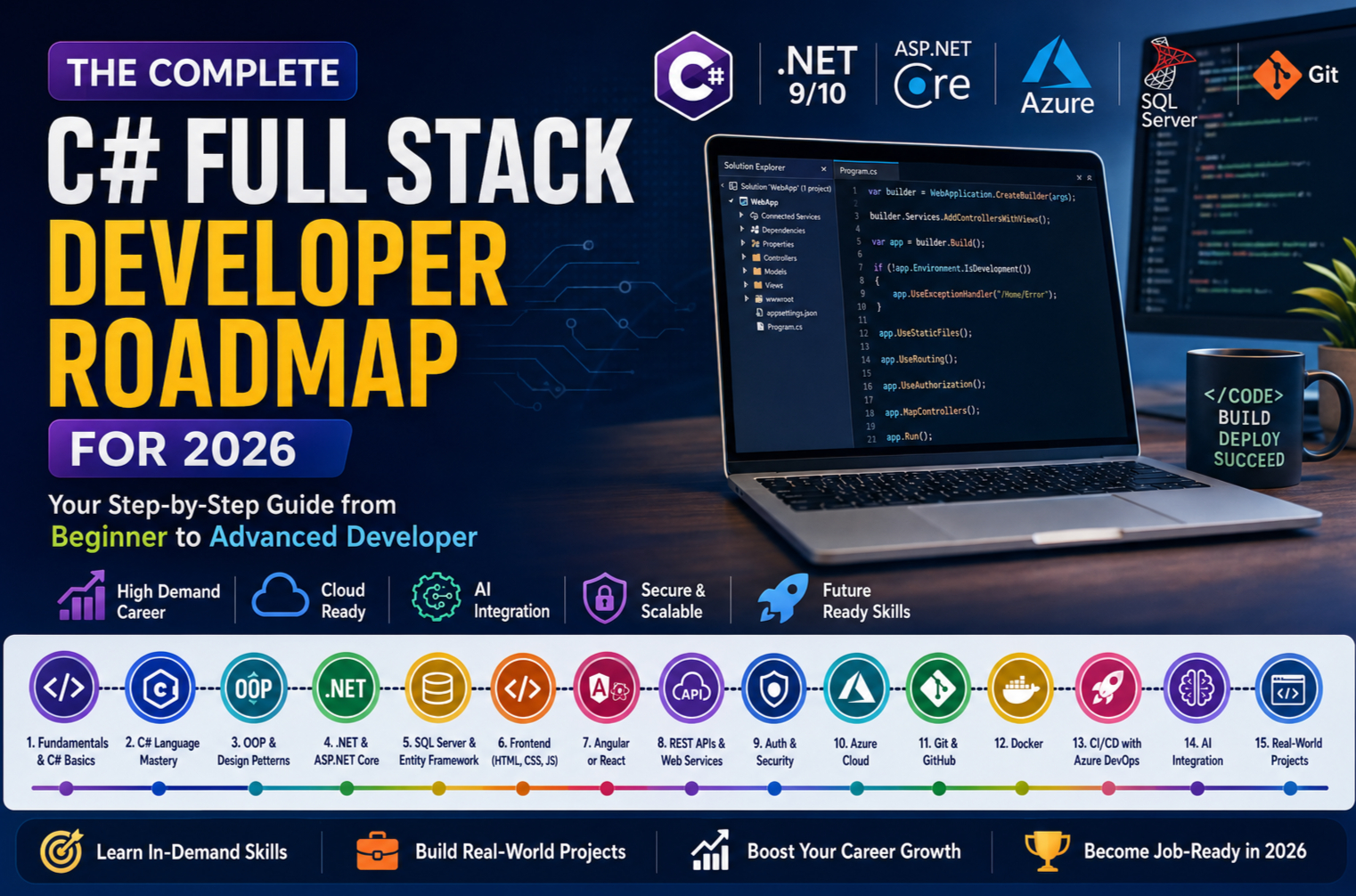
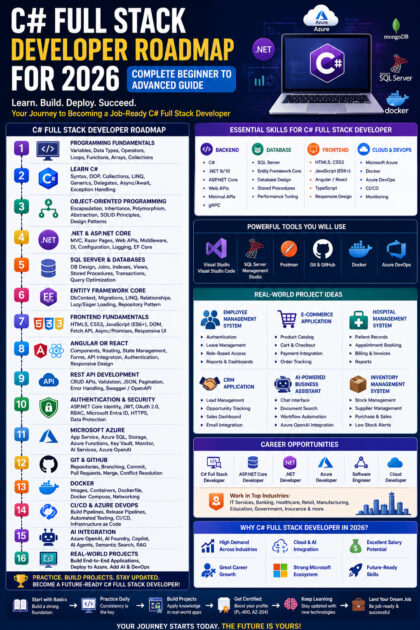
Below is a structured learning path for becoming a C# Full Stack Developer.
Programming Fundamentals
        ↓
C# Language
        ↓
Object-Oriented Programming (OOP)
        ↓
.NET & ASP.NET Core
        ↓
SQL Server & Databases
        ↓
HTML, CSS & JavaScript
        ↓
Frontend Framework (Angular or React)
        ↓
REST APIs
        ↓
Authentication & Security
        ↓
Azure Cloud
        ↓
Git & GitHub
        ↓
Docker
        ↓
CI/CD & Azure DevOps
        ↓
AI Integration
        ↓
Real-World Projects
Let’s explore each stage in detail.
Step 1: Learn Programming Fundamentals
Before learning C#, understand core programming concepts.
Topics include:
- Variables
- Data types
- Operators
- Conditional statements
- Loops
- Functions
- Arrays
- Collections
- Exception handling
- Basic algorithms
These concepts form the foundation for every programming language.
Step 2: Master C#
C# is the heart of Microsoft’s development ecosystem.
Key topics include:
Core Language Features
- Classes and Objects
- Methods
- Constructors
- Properties
- Enums
- Structs
- Interfaces
- Delegates
- Events
Advanced Features
- LINQ
- Generics
- Lambda Expressions
- Async/Await
- Dependency Injection
- Reflection
- Extension Methods
- Records
- Pattern Matching
Developing strong C# skills is essential before moving to enterprise application development.
Step 3: Understand Object-Oriented Programming (OOP)
Most enterprise applications rely heavily on OOP principles.
Learn:
- Encapsulation
- Inheritance
- Polymorphism
- Abstraction
- SOLID Principles
- Design Patterns
Understanding these concepts helps you build scalable and maintainable software.
Step 4: Learn .NET and ASP.NET Core
ASP.NET Core is Microsoft’s modern framework for web development.
Key topics include:
- MVC Architecture
- Razor Pages
- Minimal APIs
- Web APIs
- Middleware
- Dependency Injection
- Entity Framework Core
- Configuration Management
- Logging
- Exception Handling
You should be comfortable building secure RESTful APIs and web applications.
Step 5: Master SQL Server
Every business application needs reliable data storage.
Learn:
- Database Design
- Tables
- Relationships
- Primary Keys
- Foreign Keys
- Indexes
- Views
- Stored Procedures
- Functions
- Transactions
- Performance Optimisation
Practice writing SQL queries for real-world scenarios.
Step 6: Learn Entity Framework Core
Entity Framework Core simplifies database interactions.
Topics include:
- DbContext
- Migrations
- LINQ Queries
- Relationships
- Lazy Loading
- Eager Loading
- Repository Pattern
This ORM is widely used in enterprise .NET applications.
Step 7: Learn Frontend Development
A Full Stack Developer must also build responsive user interfaces.
Start with:
HTML5
- Forms
- Semantic elements
- Accessibility
- Responsive layouts
CSS3
- Flexbox
- Grid
- Animations
- Media Queries
- Responsive Design
JavaScript
- ES6+
- DOM Manipulation
- Fetch API
- Promises
- Async Programming
These technologies provide the foundation for modern frontend frameworks.
Step 8: Learn Angular or React
Modern applications use JavaScript frameworks for interactive user experiences.
Angular
Ideal for enterprise applications with structured architecture and strong TypeScript integration.
React
Popular for component-based development and flexible UI design.
Learn:
- Components
- Routing
- State Management
- API Integration
- Authentication
- Forms
- Responsive UI
Choose one framework first, then explore the other as your experience grows.
Step 9: Build REST APIs
REST APIs connect frontend applications with backend services.
Learn how to:
- Create CRUD APIs
- Handle validation
- Return JSON responses
- Implement pagination
- Manage errors
- Document APIs with OpenAPI/Swagger
APIs are central to modern application development.
Step 10: Implement Authentication and Security
Enterprise applications require robust security.
Topics include:
- ASP.NET Core Identity
- OAuth 2.0
- OpenID Connect
- JWT Authentication
- Role-Based Access Control (RBAC)
- Microsoft Entra ID
- Secure Password Storage
- HTTPS
- Data Protection
Security should be integrated from the beginning of every project.
Step 11: Learn Microsoft Azure
Cloud skills are essential for modern developers.
Focus on:
- Azure App Service
- Azure Functions
- Azure SQL Database
- Azure Storage
- Azure Key Vault
- Azure Monitor
- Application Insights
- Azure AI Services
- Azure OpenAI
Deploying applications to Azure is a highly sought-after skill.
Step 12: Learn Git and GitHub
Version control is a core developer skill.
Understand:
- Repositories
- Branching
- Pull Requests
- Merging
- Conflict Resolution
- GitHub Workflows
These practices support effective collaboration within development teams.
Step 13: Learn Docker
Containerisation simplifies application deployment.
Learn:
- Docker Images
- Docker Containers
- Docker Compose
- Environment Variables
- Container Networking
Docker enables consistent deployments across environments.
Step 14: Learn CI/CD and Azure DevOps
Modern software delivery relies on automation.
Topics include:
- Build Pipelines
- Release Pipelines
- Automated Testing
- Continuous Integration
- Continuous Deployment
- Infrastructure as Code (IaC)
These practices improve software quality and release efficiency.
Step 15: Explore AI Integration
AI is becoming an essential skill for developers.
Learn how to integrate:
- Azure OpenAI
- Azure AI Foundry
- Microsoft Copilot
- AI Agents
- Semantic Search
- Retrieval-Augmented Generation (RAG)
Understanding AI integration will help you build intelligent business applications.
Step 16: Build Real-World Projects
Employers value practical experience.
Consider building projects such as:
Employee Management System
Features:
- Authentication
- Leave Management
- Dashboards
- Reporting
- Notifications
E-Commerce Application
Features:
- Product Catalogue
- Shopping Cart
- Payments
- Order Tracking
- Inventory Management
Hospital Management System
Features:
- Patient Records
- Appointment Scheduling
- Billing
- Reporting
- Notifications
CRM Application
Features:
- Lead Management
- Opportunity Tracking
- Sales Dashboard
- Email Integration
- AI Recommendations
AI-Powered Business Assistant
Features:
- Chat Interface
- Document Search
- Workflow Automation
- Azure OpenAI Integration
- Power Automate Integration
A strong project portfolio demonstrates your technical abilities to employers.
Essential Tools Every C# Full Stack Developer Should Know
| Category | Tools |
|---|---|
| IDE | Visual Studio, Visual Studio Code |
| Programming | C#, .NET 9/10, ASP.NET Core |
| Frontend | Angular, React, HTML5, CSS3, JavaScript |
| Database | SQL Server, Azure SQL Database |
| ORM | Entity Framework Core |
| Version Control | Git, GitHub |
| Cloud | Microsoft Azure |
| DevOps | Azure DevOps, GitHub Actions |
| Containerisation | Docker |
| API Testing | Postman |
| Documentation | Swagger / OpenAPI |
| AI | Azure OpenAI, Azure AI Foundry |
Soft Skills That Matter
Technical expertise is important, but employers also value:
- Problem-solving
- Communication
- Team collaboration
- Time management
- Analytical thinking
- Adaptability
- Continuous learning
Strong soft skills contribute significantly to career growth.
Career Opportunities
After mastering this roadmap, you can pursue roles such as:
- C# Full Stack Developer
- ASP.NET Core Developer
- .NET Developer
- Azure Developer
- Software Engineer
- Backend Developer
- Cloud Application Developer
- Enterprise Application Developer
- Power Platform Developer
- AI Application Developer
These roles are in demand across industries worldwide.
Salary Potential
Compensation varies based on location, experience and organisation size.
Typical factors influencing salary include:
- Technical expertise
- Azure certifications
- AI skills
- Cloud experience
- Portfolio quality
- Communication skills
Developers with cloud and AI experience often command higher salaries than those focused solely on traditional application development.
Best Practices for Learning
To stay on track:
- Practise coding every day.
- Build projects after each major topic.
- Learn Git from the beginning.
- Read official Microsoft documentation.
- Participate in developer communities.
- Contribute to open-source projects.
- Keep up with new .NET and Azure releases.
- Continuously refine your portfolio.
Consistent practice is more valuable than trying to learn everything at once.
Future of C# Full Stack Development
The Microsoft development ecosystem continues to evolve rapidly.
Key trends shaping the future include:
- AI-assisted software development.
- Autonomous AI agents.
- Cloud-native applications.
- Serverless computing.
- Intelligent workflow automation.
- Low-code and pro-code integration.
- Advanced cybersecurity practices.
- Greater use of Azure AI Foundry and Microsoft Copilot.
Developers who combine traditional software engineering with cloud and AI expertise will be well positioned for long-term success.
Conclusion
The role of a C# Full Stack Developer has expanded far beyond backend programming. In 2026, successful developers are expected to understand frontend technologies, cloud computing, DevOps, databases, security and AI integration. By following a structured roadmap that covers C#, ASP.NET Core, SQL Server, Azure, modern JavaScript frameworks and emerging AI technologies, you can build the skills needed to create enterprise-grade applications and pursue rewarding career opportunities.
Whether you’re just starting your journey or looking to upgrade your expertise, investing in these technologies will prepare you for the next generation of software development. Stay curious, keep building real-world projects and embrace continuous learning to remain competitive in the ever-evolving Microsoft ecosystem.