C# Full Stack Developer Roadmap : From Beginner to Job Ready
Introduction
The demand for C# Full Stack Developers continues to grow as businesses build modern web applications, cloud-native solutions, enterprise software, and AI-powered business platforms. From startups to Fortune 500 companies, organizations rely on Microsoft’s technology stack to develop secure, scalable, and high-performance applications.
If you’re a B.Tech graduate, MCA student, fresher, software developer, or career switcher, learning C# Full Stack Development can open doors to roles in software engineering, cloud development, enterprise application development, and solution architecture.
However, many beginners struggle with one question:
“Where should I start, and what should I learn next?”
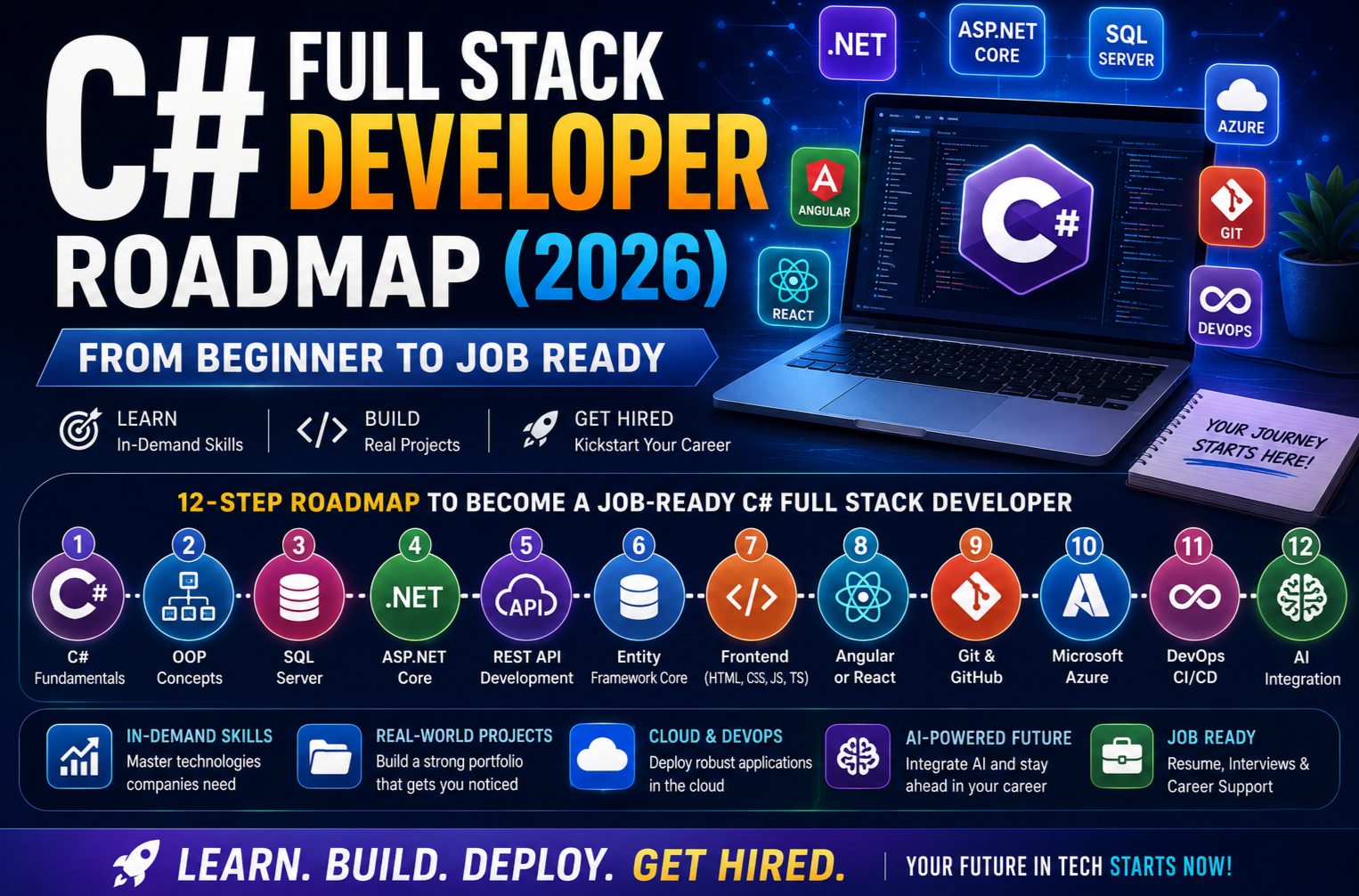
This comprehensive roadmap provides a step-by-step learning path that takes you from programming basics to becoming a job-ready C# Full Stack Developer in 2026.
Why Choose C# Full Stack Development in 2026?
Microsoft technologies continue to dominate enterprise software development. Companies across finance, healthcare, retail, manufacturing, education, logistics, and government use C# and .NET to build mission-critical applications.
Why C# Is a Great Career Choice
- Strong demand across enterprise organizations
- Excellent support for cloud-native development
- Seamless integration with Microsoft Azure
- High performance and security
- Large developer community
- Strong long-term career growth
- Widely used for AI, web, APIs, desktop, and cloud applications
The rise of AI and cloud computing has made C# even more valuable because of its close integration with Azure AI, Microsoft Copilot, and enterprise cloud services.
What Does a C# Full Stack Developer Do?
A Full Stack Developer works on both the front-end (user interface) and back-end (business logic and databases) of an application.
Typical responsibilities include:
- Designing responsive web interfaces
- Developing REST APIs
- Writing business logic
- Managing databases
- Implementing authentication and authorization
- Integrating third-party APIs
- Deploying applications to Azure
- Automating deployments using DevOps
- Monitoring application performance
- Collaborating with designers, testers, and business stakeholders
Modern Full Stack Developers are expected to understand the complete software development lifecycle.
Skills Required to Become a C# Full Stack Developer
A successful developer needs expertise across multiple technologies.
Programming
- C#
- Object-Oriented Programming (OOP)
- LINQ
- Asynchronous Programming
- Collections
- Exception Handling
- Generics
Backend Development
- .NET
- ASP.NET Core
- MVC
- Web API
- Entity Framework Core
- Dependency Injection
- Middleware
Frontend Development
Choose one modern framework:
- Angular
- React
Also learn:
- HTML5
- CSS3
- JavaScript
- TypeScript
- Bootstrap
- Responsive Design
Database
Learn:
- SQL Server
- Database Design
- Stored Procedures
- Views
- Indexes
- Joins
- Transactions
- Performance Optimization
Cloud
Modern developers should understand Azure services such as:
- Azure App Service
- Azure Functions
- Azure SQL Database
- Azure Storage
- Azure Key Vault
- Azure API Management
- Azure Monitor
DevOps
Essential tools include:
- Git
- GitHub
- Azure DevOps
- CI/CD Pipelines
- Docker
- Basic Kubernetes concepts
AI Integration
The future of Full Stack Development includes AI.
Learn:
- Azure OpenAI Service
- Azure AI Services
- Prompt Engineering
- Copilot integration
- AI-assisted development
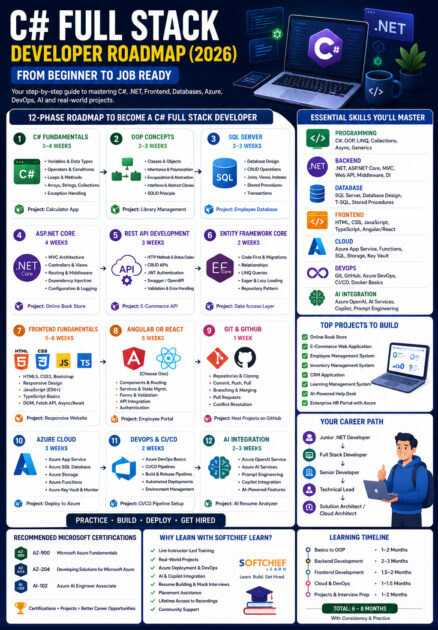
Complete C# Full Stack Developer Roadmap
Phase 1: Learn Programming Fundamentals (3–4 Weeks)
Start by mastering C# basics.
Topics
- Variables
- Data Types
- Operators
- Conditions
- Loops
- Methods
- Arrays
- Strings
- Collections
- Exception Handling
Practice
Build small console applications such as:
- Calculator
- Student Grade System
- Banking Application
- Employee Management Console
Phase 2: Master Object-Oriented Programming (2–3 Weeks)
Every .NET interview includes OOP concepts.
Learn:
- Classes
- Objects
- Inheritance
- Polymorphism
- Encapsulation
- Abstraction
- Interfaces
- Abstract Classes
- SOLID Principles
Mini Project
Library Management System
Phase 3: Learn SQL Server (2–3 Weeks)
A developer without database knowledge is incomplete.
Study:
- Database Design
- Normalization
- CRUD Operations
- Joins
- Stored Procedures
- Functions
- Transactions
- Views
- Indexes
Project
Employee Database System
Phase 4: Learn ASP.NET Core (4 Weeks)
This is the heart of backend development.
Topics:
- MVC Architecture
- Routing
- Controllers
- Razor Views
- Dependency Injection
- Middleware
- Configuration
- Logging
Project
Online Book Store
Phase 5: Build REST APIs (3 Weeks)
REST APIs power modern applications.
Learn:
- HTTP Methods
- CRUD APIs
- Authentication
- JWT
- Swagger/OpenAPI
- API Versioning
- Error Handling
- Validation
Project
E-Commerce REST API
Phase 6: Learn Entity Framework Core (2 Weeks)
Topics:
- Code First
- Database First
- Migrations
- Relationships
- LINQ
- Lazy Loading
- Eager Loading
- Repository Pattern
Phase 7: Learn Frontend Development (5–6 Weeks)
HTML
- Forms
- Semantic Elements
- Tables
- Accessibility
CSS
- Flexbox
- Grid
- Animations
- Responsive Design
JavaScript
- DOM Manipulation
- ES6+
- Fetch API
- Async/Await
TypeScript
Understand types, interfaces, classes, and modules.
Phase 8: Learn Angular or React (5 Weeks)
Choose one framework based on your interests or job market.
Topics:
- Components
- Routing
- Services
- State Management
- Forms
- API Integration
- Authentication
Project
Employee Management Portal
Phase 9: Learn Git & GitHub (1 Week)
Version control is essential for collaboration.
Learn:
- Clone
- Commit
- Push
- Pull
- Branches
- Merge
- Pull Requests
- Conflict Resolution
Host your projects on GitHub to build an online portfolio.
Phase 10: Learn Azure (3 Weeks)
Deploy your applications to the cloud.
Topics:
- Azure App Service
- Azure SQL
- Azure Storage
- Azure Functions
- Azure Key Vault
- Azure Monitor
Project
Deploy your Employee Management Portal to Azure.
Phase 11: Learn DevOps (2 Weeks)
Topics:
- Azure DevOps
- CI/CD Pipelines
- Automated Builds
- Deployment Pipelines
Automate the deployment of your applications.
Phase 12: Learn AI Integration (2–3 Weeks)
Explore:
- Azure OpenAI
- Azure AI Services
- Copilot APIs
- Prompt Engineering
Project
AI-powered Resume Analyzer or Customer Support Chatbot
Top 15 Projects Every C# Full Stack Developer Should Build
A strong portfolio is one of the best ways to stand out in interviews.
Beginner Projects
- Calculator
- Student Management System
- Library Management System
- Employee Directory
- Personal Portfolio Website
Intermediate Projects
- Inventory Management System
- Expense Tracker
- Online Book Store
- Leave Management System
- Hospital Management System
Advanced Projects
- E-Commerce Platform
- CRM Application
- Learning Management System (LMS)
- AI-powered Help Desk
- Enterprise HR Portal with Azure Integration
Document your architecture, technologies, challenges, and deployment process for each project.
Recommended Microsoft Certifications
While practical experience should be your priority, certifications can strengthen your profile.
Beginner
- AZ-900: Microsoft Azure Fundamentals
Developer
- AZ-204: Developing Solutions for Microsoft Azure
AI
- AI-102: Designing and Implementing an Azure AI Solution
These certifications complement your development skills and demonstrate commitment to continuous learning.
Common Interview Questions
Prepare for questions such as:
C#
- Difference between
refandout - Value type vs Reference type
- Delegates vs Events
- Async vs Await
- Garbage Collection
ASP.NET Core
- Explain Middleware
- Dependency Injection
- Authentication vs Authorization
- MVC Architecture
- Routing
SQL
- Joins
- Indexes
- Normalization
- Stored Procedures
- Transactions
Frontend
- Virtual DOM
- Component Lifecycle
- State Management
- Responsive Design
Azure
- App Service
- Azure Functions
- Storage
- Deployment
- CI/CD
Interviewers also expect you to discuss projects you’ve built and the decisions you made during development.
Soft Skills That Employers Value
Technical skills are only part of the equation.
Develop:
- Problem-solving
- Communication
- Teamwork
- Time management
- Analytical thinking
- Adaptability
- Documentation skills
These skills help you succeed in collaborative development environments.
Career Path
Your journey doesn’t stop at becoming a Full Stack Developer.
Entry-Level
- Junior .NET Developer
- C# Developer
- Full Stack Developer
- Software Engineer
Mid-Level
- Senior Full Stack Developer
- Technical Consultant
- Backend Lead
- Cloud Developer
Advanced
- Solution Architect
- Technical Architect
- Engineering Manager
- Azure Solution Architect
- AI Solutions Developer
As you gain experience, you can specialize in cloud architecture, AI integration, or enterprise solution design.
Common Mistakes Beginners Make
Avoid these common pitfalls:
- Learning too many frameworks at once.
- Ignoring database fundamentals.
- Skipping Git and version control.
- Building only tutorial-based projects.
- Avoiding deployment to Azure.
- Neglecting testing and debugging.
- Focusing only on theory instead of practice.
Consistent hands-on development is the key to becoming job-ready.
Learning Timeline
A focused learner can follow this approximate timeline:
| Phase | Duration |
|---|---|
| C# Fundamentals | 1 Month |
| OOP & SQL | 1 Month |
| ASP.NET Core & APIs | 2 Months |
| Frontend (Angular/React) | 1.5 Months |
| Azure & DevOps | 1 Month |
| Projects & Interview Preparation | 1–2 Months |
Total Estimated Time: 6–8 months with consistent learning and project work.
Why Learn C# Full Stack Development with Softchief Learn?
At Softchief Learn, our Full Stack Development program is designed to prepare learners for enterprise software development roles.
What You’ll Learn
- Live instructor-led classes
- C# and .NET fundamentals
- ASP.NET Core and Web API
- SQL Server and Entity Framework Core
- Angular or React
- Azure cloud deployment
- Git and Azure DevOps
- AI integration with Azure OpenAI
- Real-world enterprise projects
- Resume building
- Mock interviews
- Placement assistance
- Lifetime access to recordings
- Community support
- Updated curriculum aligned with the latest Microsoft technologies
Our focus is on helping you build production-ready applications and develop the skills employers expect.
Conclusion
C# Full Stack Development remains one of the most rewarding career paths in the Microsoft ecosystem. With the growing adoption of cloud computing, AI, and enterprise digital transformation, skilled .NET developers continue to be in high demand.
The key to success is not learning every technology at once but following a structured roadmap. Build a strong foundation in C#, master backend development with ASP.NET Core, develop modern front-end skills, understand databases, embrace cloud technologies like Azure, and create meaningful real-world projects.
Stay curious, practice consistently, and keep refining your portfolio. With dedication and the right learning path, you can become a confident, job-ready C# Full Stack Developer in 2026 and build a successful long-term career.