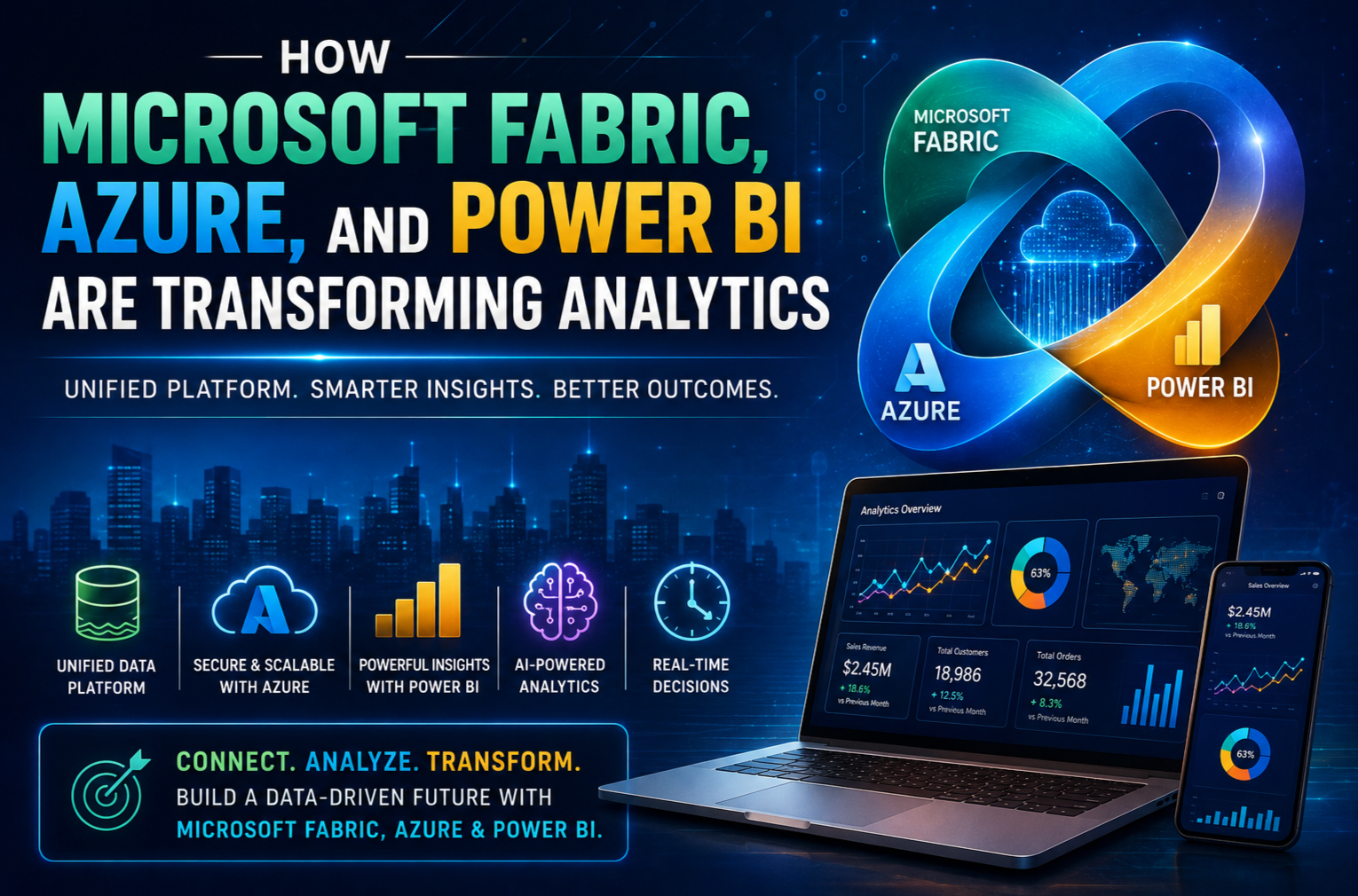
How Microsoft Fabric, Azure, and Power BI Are Transforming Analytics
Introduction
Data has become one of the most valuable assets for modern organisations. However, collecting data alone is no longer enough—businesses need the ability to process, analyse and transform that data into meaningful insights quickly and securely.
In 2026, Microsoft Fabric, Microsoft Azure and Power BI have emerged as one of the most powerful analytics ecosystems available. Together, they provide organisations with a unified platform for data engineering, data integration, real-time analytics, business intelligence and Artificial Intelligence (AI).
From small businesses to global enterprises, organisations are leveraging these Microsoft technologies to make faster decisions, improve operational efficiency and gain a competitive advantage through data-driven strategies.
In this guide, we’ll explore how Microsoft Fabric, Azure and Power BI work together to transform modern analytics and why these technologies are becoming essential skills for data professionals and developers.
What is Microsoft Fabric?
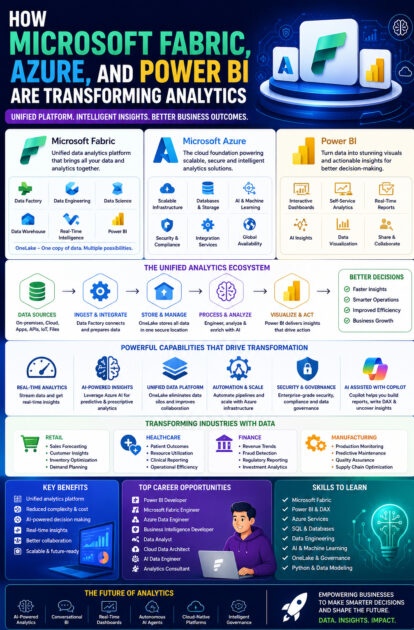
Microsoft Fabric is Microsoft’s unified data analytics platform that combines multiple data services into a single Software-as-a-Service (SaaS) solution.
Instead of using separate tools for data integration, warehousing, engineering and business intelligence, Microsoft Fabric brings everything together in one environment.
Key components include:
- Data Factory
- Data Engineering
- Data Science
- Data Warehouse
- Real-Time Intelligence
- OneLake
- Power BI
- AI-powered analytics
This unified approach simplifies enterprise data management and reduces complexity.
What is Microsoft Azure?
Microsoft Azure is a comprehensive cloud platform that provides infrastructure, storage, databases, networking, AI services and analytics tools.
Azure enables organisations to:
- Store massive amounts of data
- Process data at scale
- Build cloud-native applications
- Integrate Artificial Intelligence
- Secure enterprise workloads
- Automate infrastructure
- Support real-time analytics
Azure serves as the cloud foundation for many Microsoft Fabric workloads.
What is Power BI?
Power BI is Microsoft’s business intelligence and data visualisation platform.
It enables users to:
- Build interactive dashboards
- Create analytical reports
- Visualise business trends
- Monitor KPIs
- Share insights across organisations
- Analyse data from multiple sources
Power BI has become one of the world’s most widely used business intelligence tools due to its ease of use and deep integration with Microsoft technologies.
Why These Three Technologies Work Better Together
Each platform plays a unique role in the analytics ecosystem.
| Technology | Primary Purpose |
|---|---|
| Microsoft Fabric | Unified analytics platform |
| Azure | Cloud infrastructure and AI services |
| Power BI | Business intelligence and data visualisation |
Together they create an end-to-end analytics solution that supports the complete data lifecycle—from data ingestion to executive dashboards.
OneLake: The Foundation of Microsoft Fabric
OneLake acts as the central data lake for Microsoft Fabric.
Benefits include:
- Single copy of enterprise data
- Reduced data duplication
- Simplified governance
- Better collaboration
- Faster analytics
- Unified storage
Rather than maintaining multiple disconnected data repositories, organisations can work from a central source of truth.
Real-Time Analytics
Businesses increasingly require real-time insights.
Microsoft Fabric supports:
- Streaming data
- Event processing
- Live dashboards
- IoT analytics
- Operational monitoring
- Predictive analytics
Power BI can display these insights instantly, helping decision-makers respond to changing business conditions.
AI-Powered Analytics
Artificial Intelligence has become a core component of analytics.
Azure AI services enable organisations to:
- Predict customer behaviour
- Detect fraud
- Analyse customer sentiment
- Forecast demand
- Summarise reports
- Generate business insights
- Build conversational analytics
By integrating Azure AI with Microsoft Fabric and Power BI, businesses can move beyond descriptive analytics to predictive and prescriptive decision-making.
Data Integration Made Easy
Microsoft Fabric simplifies data integration from hundreds of sources.
Common data sources include:
- SQL Server
- Azure SQL Database
- Dynamics 365
- Microsoft Dataverse
- Excel
- SharePoint
- SAP
- Salesforce
- Oracle
- REST APIs
- CSV files
- IoT devices
This flexibility enables organisations to consolidate data without building complex integration pipelines.
Data Engineering
Data engineers use Microsoft Fabric to:
- Build data pipelines
- Transform raw data
- Clean datasets
- Automate data movement
- Manage large-scale data processing
These capabilities improve data quality before it reaches analysts and business users.
Enterprise Data Warehousing
Fabric includes a modern cloud-native data warehouse that supports:
- Large-scale analytics
- Structured reporting
- Historical analysis
- Enterprise BI
- Financial reporting
- Operational reporting
The warehouse integrates seamlessly with Power BI dashboards.
Business Intelligence with Power BI
Power BI enables organisations to create dashboards for:
- Sales performance
- Customer service
- Marketing campaigns
- Inventory management
- Financial reporting
- HR analytics
- Manufacturing operations
- Executive decision-making
Interactive reports empower users to explore data without requiring advanced technical skills.
Azure AI and Microsoft Fabric
Azure AI enhances analytics with advanced intelligence.
Capabilities include:
- Natural language querying
- AI-generated reports
- Intelligent dashboards
- Predictive forecasting
- Machine learning models
- Document analysis
- Image analysis
- Chat-based analytics
Users can ask questions in natural language and receive meaningful business insights.
Microsoft Copilot for Analytics
Microsoft Copilot is transforming how users interact with data.
Copilot assists users by:
- Generating Power BI reports
- Writing DAX formulas
- Explaining trends
- Creating visualisations
- Summarising datasets
- Recommending insights
This significantly reduces the learning curve for business users.
Security and Governance
Enterprise analytics requires strong security controls.
Microsoft provides:
- Microsoft Entra ID authentication
- Role-Based Access Control (RBAC)
- Data encryption
- Data Loss Prevention (DLP)
- Row-Level Security (RLS)
- Compliance monitoring
- Audit logs
- Data governance
These features help organisations protect sensitive business information while maintaining regulatory compliance.
Industry Use Cases
Retail
Retailers use Fabric and Power BI for:
- Sales forecasting
- Customer segmentation
- Inventory optimisation
- Demand planning
- Marketing analytics
Healthcare
Healthcare organisations analyse:
- Patient outcomes
- Resource utilisation
- Appointment scheduling
- Clinical reporting
- Operational efficiency
Finance
Financial institutions monitor:
- Revenue trends
- Budget performance
- Fraud detection
- Regulatory reporting
- Investment analytics
Manufacturing
Manufacturers use analytics for:
- Production monitoring
- Predictive maintenance
- Supply chain optimisation
- Quality assurance
- Equipment performance
Benefits for Enterprises
Businesses adopting Microsoft Fabric, Azure and Power BI benefit from:
- Faster decision-making
- Unified analytics platform
- Reduced infrastructure complexity
- AI-powered insights
- Improved collaboration
- Better governance
- Lower operational costs
- Real-time reporting
- Enhanced scalability
These advantages support digital transformation initiatives across industries.
Skills You Should Learn
Professionals interested in analytics should develop expertise in:
- Microsoft Fabric
- Power BI
- Azure
- Azure SQL Database
- Azure Data Factory
- OneLake
- Microsoft Fabric Data Warehouse
- Azure AI
- Azure OpenAI
- Data Engineering
- Data Modelling
- DAX
- Power Query
- SQL
- Python
- Microsoft Dataverse
- Data Governance
These skills are highly valued in today’s analytics job market.
Career Opportunities
Demand for Microsoft analytics professionals continues to grow.
Popular roles include:
- Power BI Developer
- Microsoft Fabric Engineer
- Azure Data Engineer
- Business Intelligence Developer
- Data Analyst
- Analytics Consultant
- Cloud Data Architect
- AI Data Engineer
- Data Platform Engineer
Professionals with experience across Fabric, Azure and Power BI are increasingly sought after by enterprises undergoing digital transformation.
Best Practices
When building enterprise analytics solutions:
- Design a unified data architecture.
- Implement proper governance.
- Secure sensitive data.
- Optimise Power BI models.
- Build reusable data pipelines.
- Monitor performance continuously.
- Use AI responsibly.
- Document data sources.
- Train business users effectively.
These practices improve scalability, maintainability and user adoption.
Future Trends
The future of analytics will include:
- Autonomous AI agents
- Conversational business intelligence
- Predictive decision-making
- Real-time enterprise dashboards
- Intelligent data governance
- AI-assisted data engineering
- Self-service analytics
- Cloud-native data platforms
Microsoft Fabric, Azure and Power BI are expected to remain central to these innovations.
Conclusion
Microsoft Fabric, Azure and Power BI are redefining enterprise analytics by providing a unified platform that combines cloud infrastructure, intelligent data processing, AI-powered insights and interactive visualisation. Together, they eliminate many of the complexities traditionally associated with enterprise data management while enabling organisations to make faster and more informed decisions.
Whether you’re a data analyst, Power BI developer, Azure engineer or business intelligence consultant, mastering these technologies will prepare you for the future of analytics. As businesses continue to invest in cloud computing, artificial intelligence and real-time decision-making, professionals with expertise in Microsoft’s analytics ecosystem will be well positioned to drive innovation and deliver measurable business value.