Dynamics 365 vs SAP: Which ERP & Business Applications Platform Should You Learn in 2026?
Introduction
Enterprise Resource Planning (ERP) and Customer Relationship Management (CRM) systems have become the backbone of modern businesses. Companies rely on these platforms to manage finance, sales, customer service, supply chains, manufacturing, human resources, and business operations.
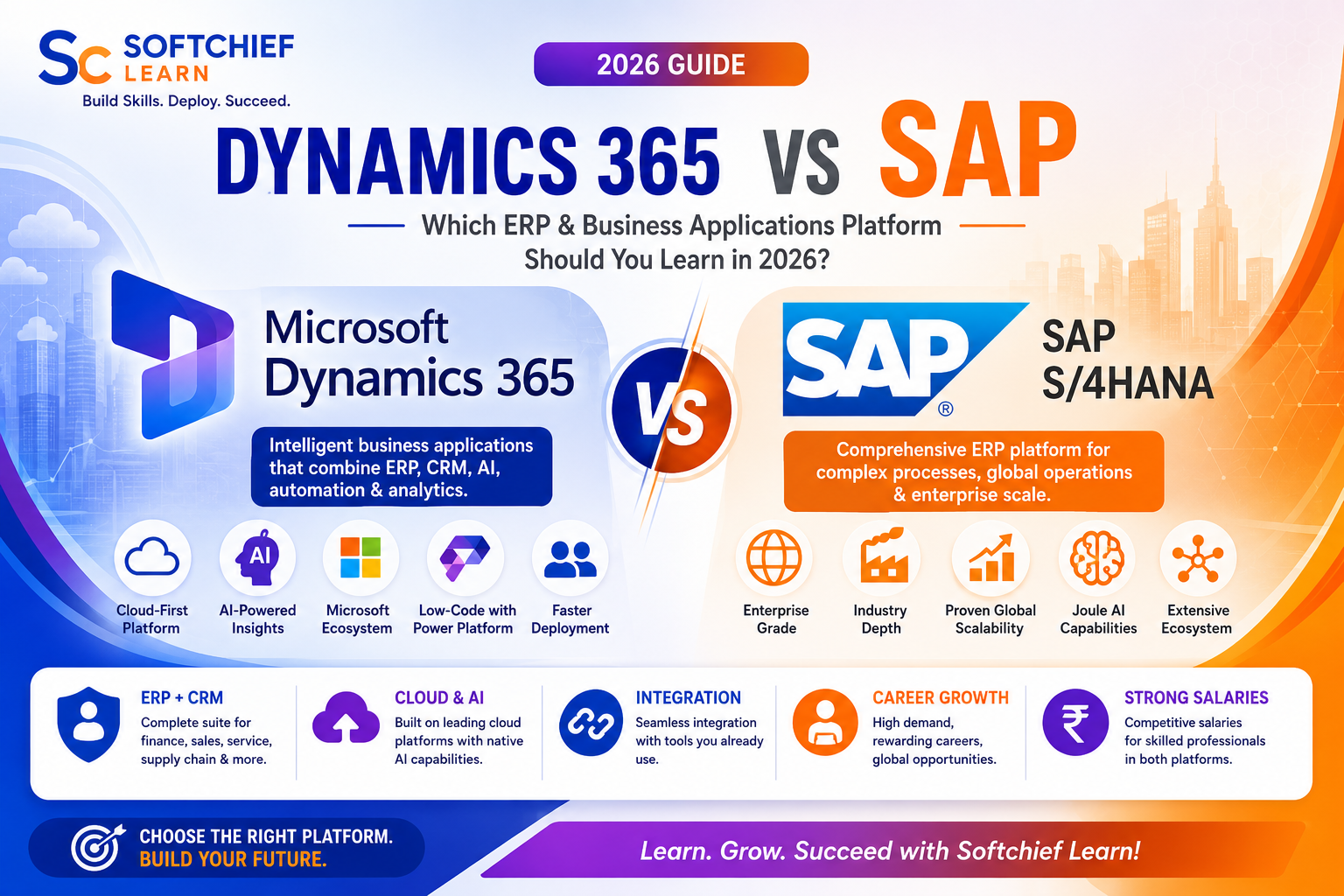
Among the global leaders in this space are Microsoft Dynamics 365 and SAP. Both platforms help organizations streamline operations, improve productivity, and drive digital transformation, but they differ in architecture, ecosystem, implementation approach, and career opportunities.
If you’re considering a career in enterprise applications, this guide will help you compare Microsoft Dynamics 365 and SAP from technical, business, and career perspectives.
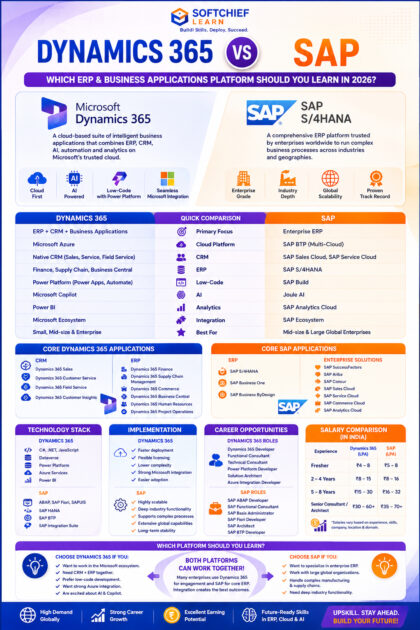
What is Microsoft Dynamics 365?
Microsoft Dynamics 365 is Microsoft’s cloud-based suite of intelligent business applications that combines ERP, CRM, AI, automation, and analytics into a single platform.
Dynamics 365 integrates seamlessly with Microsoft products such as:
- Microsoft Azure
- Microsoft 365
- Power Platform
- Microsoft Teams
- Power BI
- Copilot
- Dataverse
It is designed for organizations looking for flexible, scalable, and cloud-first business applications.
Core Dynamics 365 Applications
CRM Applications
- Dynamics 365 Sales
- Dynamics 365 Customer Service
- Dynamics 365 Field Service
- Dynamics 365 Customer Insights
ERP Applications
- Dynamics 365 Finance
- Dynamics 365 Supply Chain Management
- Dynamics 365 Commerce
- Dynamics 365 Human Resources
- Dynamics 365 Business Central
- Dynamics 365 Project Operations
What is SAP?
SAP is one of the world’s largest enterprise software companies and is best known for its comprehensive ERP solutions used by large organizations worldwide.
Modern SAP solutions are built around SAP S/4HANA, a next-generation ERP platform that integrates finance, manufacturing, logistics, procurement, analytics, AI, and business processes.
SAP also offers numerous cloud solutions covering customer experience, HR, procurement, analytics, and supply chain management.
Major SAP Products
ERP
- SAP S/4HANA
- SAP Business One
- SAP Business ByDesign
Customer Experience
- SAP Sales Cloud
- SAP Service Cloud
- SAP Commerce Cloud
Other Enterprise Solutions
- SAP SuccessFactors
- SAP Ariba
- SAP Concur
- SAP Analytics Cloud
- SAP Business Technology Platform (BTP)
Dynamics 365 vs SAP: Quick Comparison
| Feature | Microsoft Dynamics 365 | SAP |
|---|---|---|
| Primary Focus | ERP + CRM + Business Applications | Enterprise ERP |
| Cloud Platform | Microsoft Azure | SAP BTP + Multi-Cloud |
| CRM | Native | SAP Sales Cloud |
| ERP | Finance, SCM, BC | SAP S/4HANA |
| Low-Code Development | Power Platform | SAP Build |
| AI | Microsoft Copilot | Joule AI |
| Analytics | Power BI | SAP Analytics Cloud |
| Integration | Microsoft Ecosystem | SAP Ecosystem |
| Best For | Small, Mid-size & Enterprise Organizations | Mid-size & Large Global Enterprises |
Understanding the Core Difference
Although both platforms offer ERP and CRM capabilities, they are optimized for different business environments.
Microsoft Dynamics 365
Best suited for:
- Cloud-first organizations
- Microsoft ecosystem users
- Flexible implementations
- Low-code customization
- AI-assisted productivity
- Rapid deployment
SAP
Best suited for:
- Large multinational enterprises
- Complex manufacturing
- Global supply chains
- Industry-specific ERP processes
- Highly customized enterprise implementations
Product Portfolio Comparison
Microsoft Dynamics 365
Business applications include:
- Sales
- Customer Service
- Field Service
- Finance
- Supply Chain Management
- Business Central
- Commerce
- Human Resources
- Customer Insights
- Project Operations
SAP
Enterprise applications include:
- SAP S/4HANA
- SAP SuccessFactors
- SAP Ariba
- SAP Concur
- SAP Sales Cloud
- SAP Service Cloud
- SAP Commerce Cloud
- SAP Business One
- SAP Analytics Cloud
Technology Stack Comparison
Microsoft Dynamics 365 Technologies
Professionals commonly work with:
- C#
- .NET
- JavaScript
- Power Platform
- Dataverse
- Azure Functions
- SQL Server
- Power BI
- Power Automate
- Power Apps
- Copilot Studio
SAP Technologies
Professionals commonly work with:
- ABAP
- SAP Fiori
- SAPUI5
- CDS Views
- SAP HANA
- SAP Build
- Java
- JavaScript
- SAP Integration Suite
- SAP BTP
Customization and Development
Dynamics 365 Development
Developers customize solutions using:
- C#
- JavaScript
- Power Apps
- Power Automate
- Plug-ins
- Custom APIs
- PCF Controls
- Dataverse
- Azure Services
Customization is generally faster due to Microsoft’s low-code ecosystem.
SAP Development
Developers customize solutions using:
- ABAP
- SAP Fiori
- SAPUI5
- BTP Extensions
- CDS Views
- SAP Build
SAP offers deep customization capabilities, particularly for complex enterprise scenarios.
Cloud and AI Integration
Microsoft Dynamics 365
Native integration with:
- Microsoft Azure
- Microsoft Copilot
- Azure OpenAI Service
- Azure AI Services
- Microsoft Fabric
- Power Platform
AI features include:
- Sales Copilot
- Customer Service Copilot
- Intelligent forecasting
- Automated workflows
- AI-generated insights
SAP
Integrated with:
- SAP Business Technology Platform
- SAP Analytics Cloud
- Joule AI
- SAP Build
- SAP Integration Suite
AI capabilities include:
- Intelligent automation
- Predictive analytics
- AI-assisted business processes
- Enterprise copilots
Business Intelligence
Microsoft
Organizations use:
- Power BI
- Microsoft Fabric
- Excel
- Azure Synapse Analytics
SAP
Organizations use:
- SAP Analytics Cloud
- SAP BusinessObjects
- Embedded Analytics
Both ecosystems provide enterprise-grade reporting and analytics.
Implementation
Dynamics 365
Advantages:
- Faster deployment
- Flexible licensing
- Lower implementation complexity
- Strong Microsoft ecosystem integration
- Easier adoption for Microsoft users
SAP
Advantages:
- Highly scalable
- Deep industry functionality
- Extensive global capabilities
- Strong support for complex business processes
SAP implementations often require more time and specialized expertise due to the platform’s breadth.
Career Opportunities
Microsoft Dynamics 365 Careers
Popular roles include:
- Dynamics 365 CE Developer
- Dynamics 365 Finance Consultant
- Business Central Consultant
- Functional Consultant
- Technical Consultant
- Power Platform Developer
- Solution Architect
- Azure Integration Developer
SAP Careers
Popular roles include:
- SAP ABAP Developer
- SAP Functional Consultant
- SAP Basis Administrator
- SAP HANA Consultant
- SAP Fiori Developer
- SAP Architect
- SAP BTP Developer
Both ecosystems offer strong opportunities across consulting firms, system integrators, and enterprise organizations.
Certifications
Microsoft Certifications
Recommended learning path:
Beginner
- MB-910: Dynamics 365 Fundamentals (CRM)
- MB-920: Dynamics 365 Fundamentals (ERP)
Intermediate
- PL-200: Power Platform Functional Consultant
- PL-400: Power Platform Developer
Advanced
- Role-based Dynamics 365 certifications
- Azure certifications (AZ-204, AZ-305)
SAP Certifications
Popular certifications include:
- SAP Certified Associate – SAP S/4HANA
- SAP Certified Development Associate – ABAP
- SAP Certified Associate – SAP Fiori
- SAP Certified Associate – SAP BTP
Both certification paths are highly valued by employers.
Salary Comparison
(Approximate salaries vary depending on experience, location, specialization, and employer.)
| Experience | Dynamics 365 | SAP |
|---|---|---|
| Fresher | ₹4–8 LPA | ₹5–8 LPA |
| 2–4 Years | ₹8–15 LPA | ₹8–16 LPA |
| 5–8 Years | ₹15–30 LPA | ₹16–32 LPA |
| Senior Consultant / Architect | ₹30–60+ LPA | ₹35–70+ LPA |
Professionals with expertise in cloud platforms, AI, integrations, and enterprise architecture command the highest salaries in both ecosystems.
Which Platform Should You Learn?
Choose Microsoft Dynamics 365 if you:
- Want to work in the Microsoft ecosystem.
- Are interested in CRM and ERP together.
- Enjoy low-code development with Power Platform.
- Plan to build AI-powered business applications.
- Want strong Azure integration.
Choose SAP if you:
- Want to specialize in enterprise ERP.
- Enjoy large-scale manufacturing and supply chain systems.
- Are interested in complex global implementations.
- Plan to work in industries with extensive SAP adoption.
Can You Learn Both?
Yes.
Many multinational organizations use Microsoft and SAP together.
For example:
- SAP manages core ERP operations.
- Dynamics 365 Sales handles customer engagement.
- Power BI analyzes SAP data.
- Power Automate integrates SAP with Microsoft 365.
- Azure AI enhances business intelligence.
Professionals who understand both ecosystems are valuable for enterprise integration and digital transformation projects.
Why Dynamics 365 is Growing Rapidly
Several factors are driving the rapid adoption of Microsoft Dynamics 365:
- Seamless integration with Microsoft 365 and Teams.
- Built-in low-code capabilities through Power Platform.
- Native AI experiences powered by Microsoft Copilot.
- Flexible cloud deployment on Azure.
- Strong integration with Power BI and Microsoft Fabric.
- Lower complexity for many mid-sized organizations.
- Frequent feature updates and innovation.
These strengths make Dynamics 365 an increasingly attractive choice for organizations modernizing their business applications.
Conclusion
Microsoft Dynamics 365 and SAP are two of the world’s leading enterprise business platforms, each serving organizations with powerful ERP, CRM, analytics, AI, and automation capabilities.
Dynamics 365 stands out for its modern cloud-first architecture, deep integration with Azure, Microsoft 365, Power Platform, and Copilot, making it an excellent choice for organizations seeking agility, low-code development, and AI-powered business applications. SAP continues to lead in highly complex enterprise environments, particularly in manufacturing, logistics, and large-scale global operations.
The best platform depends on your career goals and the industries you want to serve. For professionals looking to build expertise in Microsoft’s rapidly expanding ecosystem—including Dynamics 365, Power Platform, Azure, and AI—Dynamics 365 offers a future-ready career path with strong global demand. Those specializing in large-scale ERP implementations and complex enterprise processes may find SAP to be an equally rewarding choice.