How AI Coding Agents Are Changing C# Development Forever
Introduction
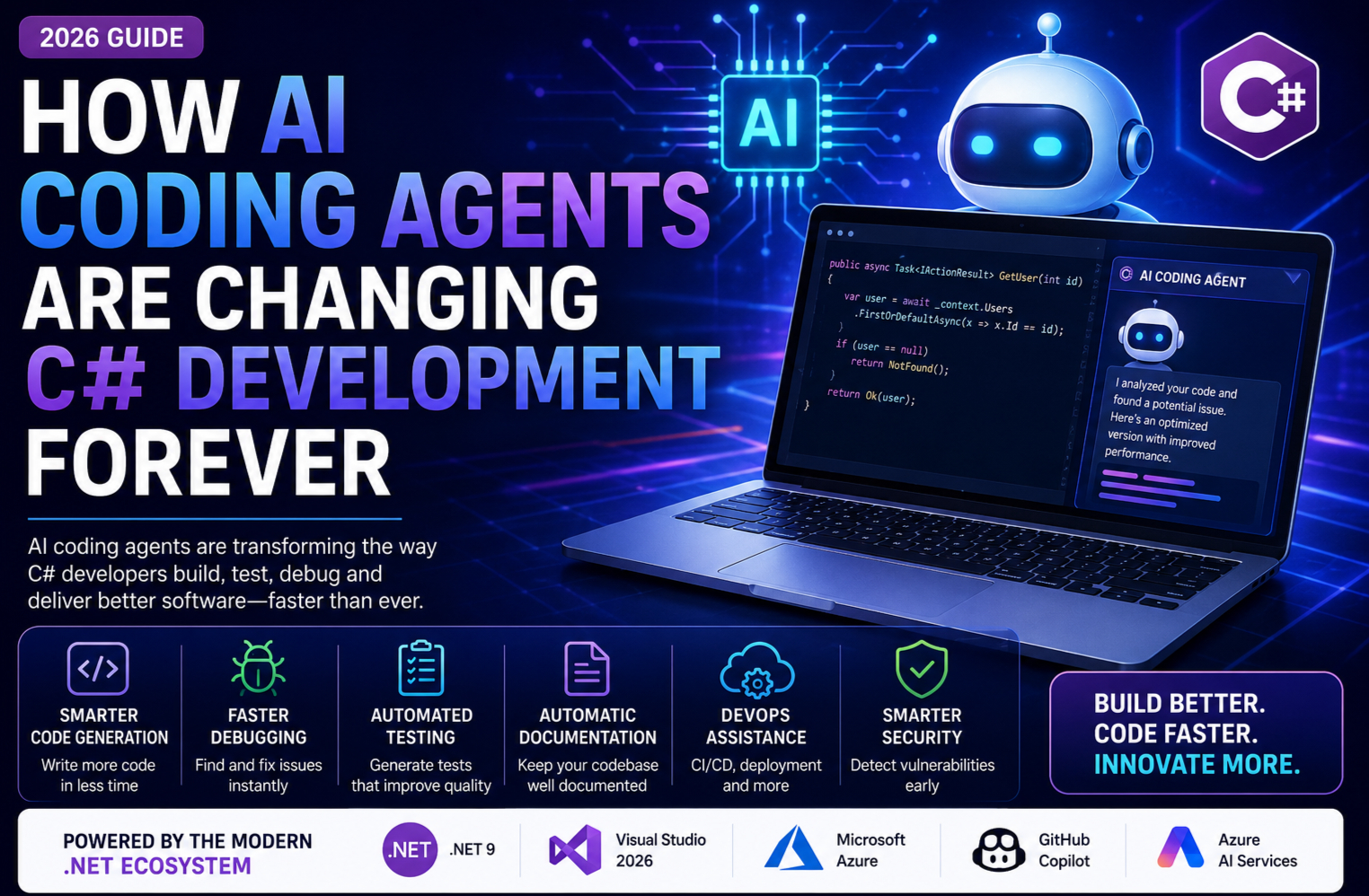
Artificial Intelligence has moved far beyond simple code completion. In 2026, AI coding agents have become intelligent development partners capable of writing code, reviewing pull requests, debugging applications, generating tests, optimising performance and even assisting with software architecture.
For C# developers, this transformation is especially significant. The modern .NET ecosystem now integrates seamlessly with AI-powered development tools, enabling developers to build enterprise-grade applications faster while maintaining high standards of quality and security.
Whether you’re an aspiring C# developer, an experienced .NET professional or an organisation modernising its software development process, understanding AI coding agents is no longer optional—it’s becoming an essential skill for the future of software engineering.
What Are AI Coding Agents?
AI coding agents are advanced AI systems designed to assist developers throughout the software development lifecycle. Unlike traditional code autocomplete tools, these agents can understand project context, analyse multiple files, execute complex development tasks and collaborate with developers to solve problems.
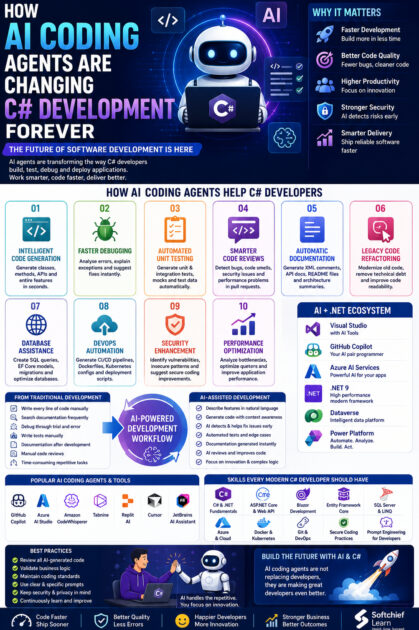
Modern AI coding agents can:
- Generate complete C# classes and methods
- Refactor legacy code
- Detect bugs before deployment
- Explain complex codebases
- Create unit and integration tests
- Generate API documentation
- Optimise SQL queries
- Review pull requests
- Suggest security improvements
- Automate repetitive development tasks
Rather than replacing developers, AI coding agents enhance productivity by handling routine work, allowing engineers to focus on architecture, business logic and innovation.
Why AI Coding Agents Matter for C# Developers
The .NET ecosystem has evolved into one of the most AI-friendly development platforms. With improvements in .NET 9, Visual Studio, GitHub Copilot and Azure AI services, developers can integrate AI into nearly every stage of development.
Benefits include:
- Faster application development
- Reduced coding errors
- Improved code quality
- Better documentation
- Accelerated testing
- Smarter debugging
- Higher developer productivity
- Faster onboarding for new team members
Teams using AI-assisted workflows can spend more time solving business problems and less time writing repetitive boilerplate code.
The Evolution of C# Development
Traditional Development Workflow
Previously, developers typically:
- Wrote every line of code manually
- Searched documentation frequently
- Debugged issues by trial and error
- Created unit tests manually
- Wrote documentation after development
- Reviewed code manually
- Spent significant time on repetitive tasks
This process was effective but often time-consuming.
AI-Assisted Development Workflow
With AI coding agents, developers can now:
- Describe a feature in natural language
- Generate production-ready code
- Receive architecture suggestions
- Identify bugs automatically
- Generate comprehensive test cases
- Produce documentation instantly
- Optimise performance recommendations
- Automate repetitive refactoring
This significantly shortens development cycles while improving overall quality.
Key Areas Where AI Coding Agents Are Transforming C# Development
1. Intelligent Code Generation
AI agents can generate:
- ASP.NET Core APIs
- MVC applications
- Blazor components
- Entity Framework models
- LINQ queries
- Authentication modules
- Background services
- Microservice templates
Instead of starting from scratch, developers can focus on refining and extending AI-generated code.
2. Faster Debugging
Debugging is one of the most time-consuming aspects of software development.
AI coding agents can:
- Analyse stack traces
- Explain exceptions
- Suggest fixes
- Detect null reference issues
- Identify performance bottlenecks
- Recommend code improvements
This reduces troubleshooting time and helps developers resolve issues more efficiently.
3. Automated Unit Testing
Writing tests is essential but often overlooked due to time constraints.
AI agents can automatically generate:
- Unit tests
- Integration tests
- Mock objects
- Test data
- Edge case scenarios
- Performance test suggestions
This improves application reliability while reducing manual effort.
4. Smarter Code Reviews
AI can review pull requests and highlight:
- Code smells
- Security vulnerabilities
- Performance concerns
- Naming inconsistencies
- Logic errors
- Duplicate code
- Maintainability issues
Developers receive immediate feedback before human reviewers begin their review process.
5. Automatic Documentation
Maintaining documentation is often neglected.
AI coding agents can generate:
- XML comments
- API documentation
- README files
- Architecture summaries
- Method descriptions
- Deployment guides
- User documentation
Well-documented codebases become easier to maintain and onboard new developers.
6. Refactoring Legacy Applications
Many organisations continue to maintain large .NET Framework applications.
AI agents can assist by:
- Modernising outdated syntax
- Replacing deprecated APIs
- Improving naming conventions
- Simplifying complex methods
- Reducing technical debt
- Preparing applications for migration to modern .NET
This makes legacy modernisation projects faster and less risky.
AI Coding Agents and ASP.NET Core
ASP.NET Core development benefits significantly from AI assistance.
AI agents can help create:
- REST APIs
- Minimal APIs
- Authentication systems
- JWT security
- Middleware
- Dependency injection
- Logging
- Validation
- Swagger documentation
Developers can deliver secure and scalable APIs in less time.
AI and Blazor Development
Blazor applications also benefit from AI-assisted development.
Tasks include:
- Building Razor components
- Creating responsive layouts
- Form validation
- State management
- SignalR integration
- API consumption
- Error handling
- UI optimisation
AI helps accelerate both frontend and backend development within the .NET ecosystem.
AI in Database Development
Database-related tasks can be streamlined with AI.
Examples include:
- SQL query generation
- Entity Framework configurations
- Migration scripts
- Database optimisation
- Index recommendations
- LINQ query improvements
- Stored procedure generation
This reduces common database development challenges.
AI for DevOps and Deployment
AI coding agents also support DevOps workflows by helping developers:
- Generate CI/CD pipelines
- Configure deployment scripts
- Create Dockerfiles
- Build Kubernetes manifests
- Validate infrastructure configurations
- Automate release notes
- Analyse deployment failures
This enables faster and more reliable software delivery.
Security Improvements with AI
Security is a critical aspect of enterprise software development.
AI coding agents can identify:
- SQL injection risks
- Cross-site scripting (XSS)
- Cross-site request forgery (CSRF)
- Authentication weaknesses
- Hardcoded secrets
- Insecure API endpoints
- Vulnerable dependencies
While human review remains essential, AI provides an additional layer of protection during development.
AI Coding Agents in Enterprise Development
Large organisations are adopting AI coding agents to improve productivity across development teams.
Common enterprise use cases include:
- Accelerating feature development
- Modernising legacy systems
- Improving code consistency
- Reducing onboarding time
- Increasing test coverage
- Enhancing documentation
- Supporting distributed development teams
These benefits contribute to faster delivery and improved software quality.
Skills Every Modern C# Developer Should Learn
To work effectively with AI coding agents, developers should continue strengthening their core technical skills.
Recommended areas include:
- C#
- .NET 9
- ASP.NET Core
- Blazor
- Entity Framework Core
- LINQ
- SQL Server
- Azure
- REST APIs
- Microservices
- Git
- Azure DevOps
- Docker
- Kubernetes
- Cloud-native architecture
- Secure coding practices
- Prompt engineering for developers
Developers who combine strong programming fundamentals with effective AI collaboration will be well positioned for future opportunities.
Best Practices for Using AI Coding Agents
AI is most effective when used responsibly.
Follow these best practices:
- Review all AI-generated code before committing.
- Validate business logic carefully.
- Maintain coding standards.
- Write meaningful prompts with clear requirements.
- Keep security and privacy in mind.
- Use automated testing to verify generated code.
- Continue learning core programming concepts rather than relying solely on AI.
AI should enhance developer expertise, not replace critical thinking.
The Future of C# Development
The future of software development is increasingly collaborative, with developers and AI working together.
Over the next few years, AI coding agents are expected to:
- Assist with software architecture decisions
- Generate complete application modules
- Predict production issues before deployment
- Optimise cloud infrastructure
- Improve software maintenance
- Support multilingual development teams
- Enhance accessibility and compliance checks
Developers who embrace these tools while maintaining strong engineering fundamentals will be better equipped to build reliable, scalable and innovative applications.
Conclusion
AI coding agents are reshaping the way C# applications are designed, developed and maintained. They reduce repetitive work, improve code quality, accelerate testing and help developers focus on solving real business problems instead of routine implementation tasks.
However, successful software development still depends on human expertise. Architecture, domain knowledge, security, performance tuning and strategic decision-making remain responsibilities that require experienced developers.
Rather than replacing C# professionals, AI coding agents are becoming trusted collaborators that amplify productivity and enable teams to deliver better software faster. By learning how to work effectively alongside AI, developers can stay competitive in an industry that continues to evolve at an unprecedented pace.