Manufacturing Execution with Dynamics 365 Finance & Operations: Transforming Modern Manufacturing Operations
Introduction
Manufacturing organisations today operate in a highly competitive environment where efficiency, quality and speed directly impact business success. Customers expect faster delivery, customised products and consistent quality while manufacturers must control costs, optimise resources and respond quickly to market changes.
Traditional manufacturing systems often struggle to provide real-time visibility into shop floor activities. Production teams may rely on disconnected systems, manual data entry and delayed reporting, making it difficult to identify bottlenecks and improve operational performance.
This is where Manufacturing Execution in Microsoft Dynamics 365 Finance & Operations (Dynamics 365 Finance & Operations) plays a critical role.
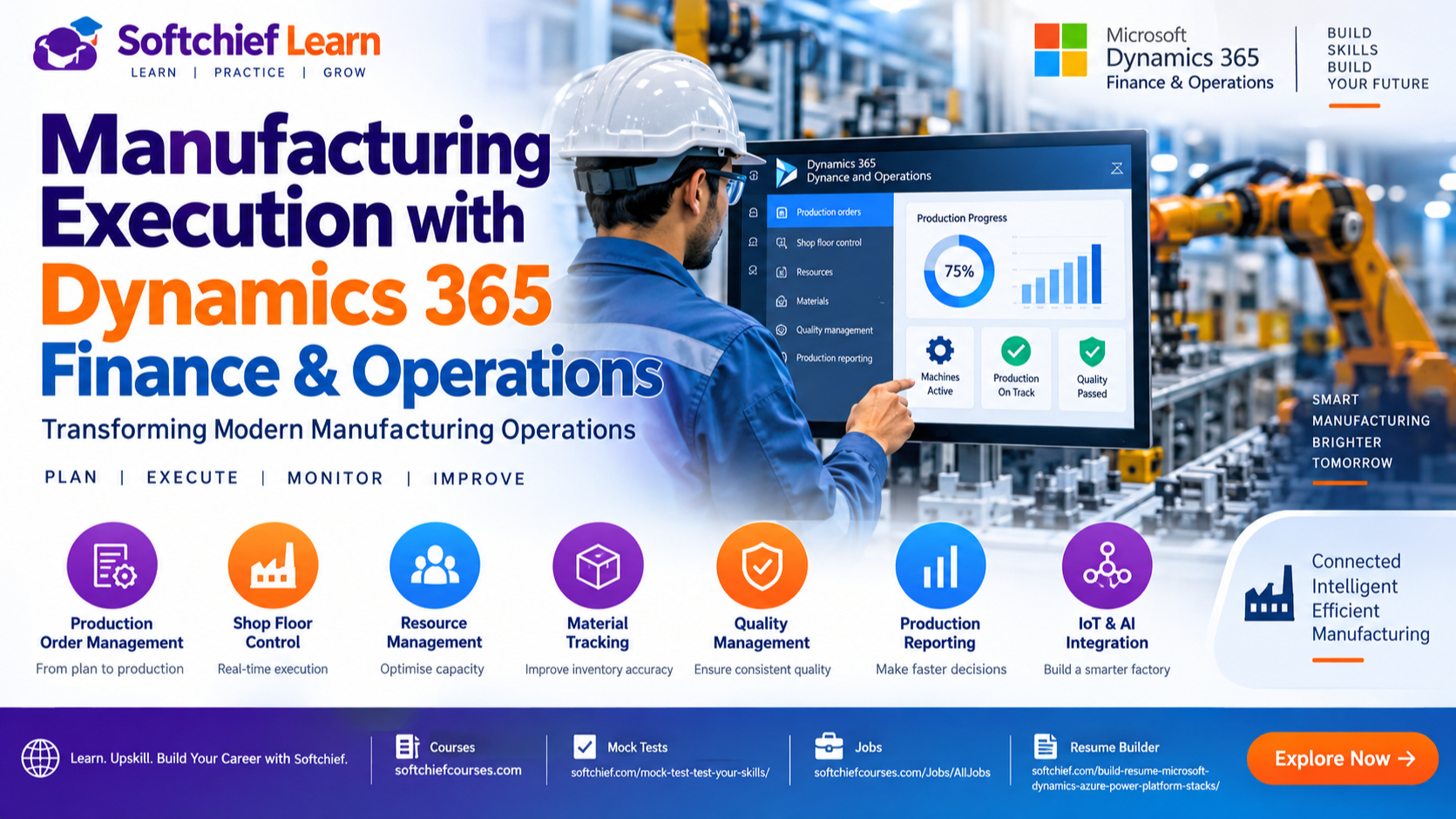
Manufacturing Execution capabilities in Dynamics 365 Finance & Operations connect production planning, shop floor operations, workforce management and business processes into a unified platform. It enables manufacturers to monitor production activities in real time, improve resource utilisation and achieve operational excellence.
This comprehensive guide explores:
- What Manufacturing Execution means
- How Dynamics 365 Finance & Operations supports shop floor management
- Key manufacturing execution capabilities
- Benefits for modern manufacturers
- Real-world use cases
- Implementation best practices
What is Manufacturing Execution?
Manufacturing Execution refers to the processes and technologies used to monitor, manage and control manufacturing activities on the shop floor.
It focuses on converting production plans into actual manufacturing operations.
Manufacturing Execution helps organisations manage:
- Production orders
- Machine operations
- Labour activities
- Material consumption
- Quality inspections
- Production reporting
- Manufacturing performance
A Manufacturing Execution System (MES) traditionally works between Enterprise Resource Planning (ERP) systems and shop floor equipment.
Dynamics 365 Finance & Operations brings many MES capabilities directly into the ERP ecosystem, reducing complexity and improving visibility.
Understanding Manufacturing in Dynamics 365 Finance & Operations
Microsoft Dynamics 365 Finance & Operations is an enterprise ERP platform designed for large and complex organisations.
Its manufacturing capabilities support:
- Discrete manufacturing
- Process manufacturing
- Lean manufacturing
- Mixed-mode manufacturing
The platform connects manufacturing operations with:
- Finance
- Supply chain
- Inventory
- Procurement
- Warehouse management
- Sales
This creates a complete digital manufacturing ecosystem.
Why Manufacturing Execution is Important
Manufacturers face several operational challenges:
Lack of Real-Time Production Visibility
Many organisations struggle to answer:
- What is currently being produced?
- Which machines are available?
- Are production orders delayed?
- How much material has been consumed?
Manufacturing Execution provides real-time operational insights.
Production Inefficiencies
Common problems include:
- Machine downtime
- Poor resource utilisation
- Production delays
- Excessive manual processes
Manufacturing execution helps identify and eliminate inefficiencies.
Quality Management Challenges
Manufacturers must maintain strict quality standards.
Without integrated execution systems, quality issues may be identified too late.
Dynamics 365 enables:
- Quality inspections
- Non-conformance tracking
- Corrective actions
- Quality reporting
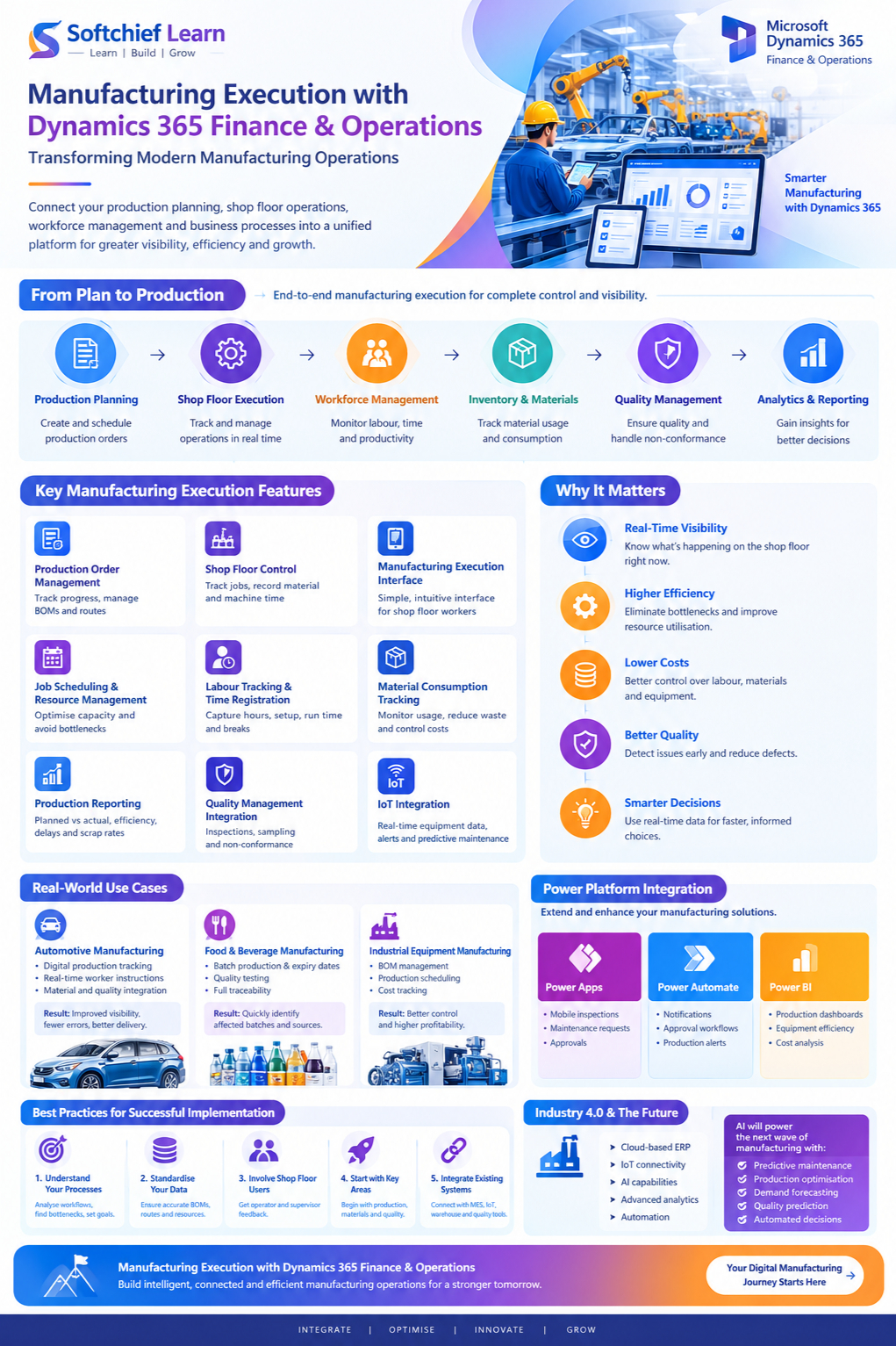
Key Manufacturing Execution Features in Dynamics 365 Finance & Operations
1. Production Order Management
Production orders are the foundation of manufacturing operations.
Dynamics 365 Finance & Operations enables organisations to:
- Create production orders
- Schedule production activities
- Track production status
- Report progress
- Complete manufacturing processes
Production orders connect:
- Products
- Bills of materials (BOM)
- Routes
- Resources
- Materials
Example:
A manufacturing company receives a customer order for 1,000 electronic devices.
Dynamics 365 automatically supports:
- Production planning
- Material requirements
- Resource allocation
- Shop floor execution
2. Shop Floor Control
Shop Floor Control enables workers and supervisors to interact directly with production processes.
Employees can:
- Start production jobs
- Report completed quantities
- Record material consumption
- Register machine time
- Report issues
This reduces manual paperwork and improves production accuracy.
3. Manufacturing Execution Interface
Dynamics 365 provides a dedicated interface for shop floor workers.
Workers can access:
- Assigned jobs
- Production instructions
- Task lists
- Time registration
- Production feedback
The interface improves usability by providing only the information required for daily operations.
4. Job Scheduling and Resource Management
Effective scheduling is critical for manufacturing efficiency.
Dynamics 365 Finance & Operations helps organisations optimise:
- Machine capacity
- Labour availability
- Production sequences
- Delivery timelines
Manufacturers can analyse:
- Resource utilisation
- Production bottlenecks
- Capacity constraints
5. Labour Tracking and Time Registration
Accurate labour tracking helps manufacturers understand production costs.
Workers can record:
- Working hours
- Setup time
- Run time
- Breaks
- Indirect activities
This information supports:
- Cost calculation
- Productivity analysis
- Workforce planning
6. Material Consumption Tracking
Manufacturing execution provides visibility into material usage.
Organisations can track:
- Raw material consumption
- Component usage
- Scrap quantities
- Inventory adjustments
Benefits include:
- Improved inventory accuracy
- Reduced waste
- Better cost control
7. Production Reporting
Real-time production reporting helps managers monitor operational performance.
Key metrics include:
- Planned versus actual production
- Completed quantities
- Production delays
- Resource efficiency
- Scrap rates
Managers can make faster decisions using accurate operational data.
8. Quality Management Integration
Quality is a critical component of manufacturing execution.
Dynamics 365 supports quality processes such as:
- Quality orders
- Inspection processes
- Sampling plans
- Non-conformance management
Example:
A food manufacturer can automatically trigger quality checks when receiving raw materials or completing production batches.
9. IoT Integration for Smart Manufacturing
Modern manufacturing increasingly relies on connected devices and IoT technologies.
Dynamics 365 can integrate with IoT solutions to capture:
- Machine performance data
- Equipment status
- Production measurements
- Sensor information
Example:
A factory machine detects abnormal temperature levels.
The system can:
- Generate an alert
- Create a maintenance request
- Prevent production downtime
Manufacturing Execution Scenarios in Dynamics 365
Scenario 1: Automotive Manufacturing
An automotive manufacturer produces thousands of vehicle components daily.
Challenges:
- Complex production schedules
- Multiple suppliers
- Strict quality requirements
Using Dynamics 365 Manufacturing Execution:
- Production orders are tracked digitally
- Workers receive real-time instructions
- Material consumption is recorded automatically
- Quality checks are integrated
Results:
- Improved production visibility
- Reduced errors
- Better delivery performance
Scenario 2: Food and Beverage Manufacturing
A food manufacturer requires strict batch tracking.
Dynamics 365 helps manage:
- Batch production
- Expiry dates
- Quality testing
- Material traceability
If a quality issue occurs, the organisation can quickly identify:
- Affected batches
- Raw materials used
- Distribution locations
Scenario 3: Industrial Equipment Manufacturing
A machinery manufacturer manages complex products with multiple components.
Dynamics 365 supports:
- Bill of materials management
- Production scheduling
- Resource planning
- Cost tracking
This improves manufacturing control and profitability.
Benefits of Manufacturing Execution with Dynamics 365 Finance & Operations
1. Real-Time Operational Visibility
Manufacturers gain immediate insights into:
- Production progress
- Machine performance
- Workforce activities
- Material usage
2. Improved Production Efficiency
By identifying bottlenecks and inefficiencies, organisations can improve:
- Throughput
- Resource utilisation
- Production speed
3. Reduced Manufacturing Costs
Better control over:
- Labour
- Materials
- Equipment usage
helps reduce operational expenses.
4. Better Quality Control
Integrated quality management helps manufacturers:
- Detect issues earlier
- Reduce defects
- Improve customer satisfaction
5. Improved Decision-Making
Real-time data enables managers to make informed decisions quickly.
Manufacturing Execution and Power Platform Integration
Dynamics 365 Finance & Operations works closely with Microsoft Power Platform.
Organisations can extend manufacturing solutions using:
Power Apps
Create custom applications for:
- Mobile inspections
- Maintenance requests
- Production approvals
Power Automate
Automate:
- Notifications
- Approval workflows
- Production alerts
Power BI
Create dashboards for:
- Production performance
- Equipment efficiency
- Cost analysis
Best Practices for Implementing Manufacturing Execution
1. Understand Manufacturing Processes First
Before implementation:
- Analyse current workflows
- Identify bottlenecks
- Define improvement goals
Technology should support business processes.
2. Standardise Manufacturing Data
Ensure accurate:
- Bills of materials
- Routes
- Work centres
- Resource information
Poor master data affects execution accuracy.
3. Involve Shop Floor Users
Successful adoption requires involving:
- Operators
- Supervisors
- Production managers
User feedback improves system usability.
4. Start with Key Manufacturing Areas
Avoid implementing everything at once.
Begin with:
- Production tracking
- Material consumption
- Quality processes
Then expand gradually.
5. Integrate with Existing Systems
Connect Dynamics 365 with:
- MES platforms
- IoT devices
- Warehouse systems
- Quality solutions
for complete operational visibility.
Manufacturing Execution and Industry 4.0
Industry 4.0 focuses on creating intelligent, connected factories.
Dynamics 365 Finance & Operations supports Industry 4.0 initiatives through:
- Cloud-based ERP
- IoT connectivity
- AI capabilities
- Advanced analytics
- Automation
Future manufacturing environments will become:
- More connected
- More predictive
- More automated
Manufacturing execution provides the foundation for this transformation.
The Future of Manufacturing Execution with AI
Artificial intelligence will continue transforming manufacturing operations.
AI capabilities can help with:
- Predictive maintenance
- Production optimisation
- Demand forecasting
- Quality prediction
- Automated decision-making
Manufacturers will increasingly use AI-driven insights to improve efficiency and reduce downtime.
Conclusion
Manufacturing Execution with Dynamics 365 Finance & Operations enables organisations to transform traditional manufacturing operations into intelligent, connected and efficient production environments.
By integrating production planning, shop floor execution, quality management, inventory control and analytics, Dynamics 365 provides manufacturers with complete visibility and control over their operations.
For organisations looking to adopt smart manufacturing practices, improve operational efficiency and prepare for Industry 4.0, Dynamics 365 Finance & Operations Manufacturing Execution provides a powerful foundation for digital transformation.