Production API Reliability: Build Services Customers Can Trust
Introduction
A slow or unavailable production API can stop a checkout, delay a shipment, or break another service. Customers feel the impact in their work, so API reliability affects trust and revenue as well as infrastructure metrics.
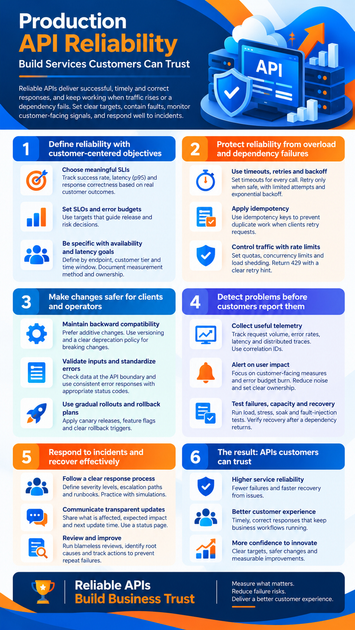
Reliable APIs deliver successful, timely, correct responses and keep working when traffic rises or a dependency fails. Teams can improve reliability by setting clear targets, containing faults, watching customer-facing signals, and responding well to incidents.
The practices below help you find weak points before they affect customers, reduce common failure risks, and recover with less confusion. Set targets using your own service data; performance claims only matter when they match what your customers experience.
Define production API reliability with customer-centered objectives
A useful reliability target describes what customers can do, not just whether a server responds. Tie each measure to a real API outcome and give teams a shared way to assess it.
Choose SLIs that reflect real API outcomes
A service-level indicator, or SLI, measures an aspect of service quality. Common API SLIs include successful request rate, latency percentiles such as p95, and response correctness. Choose measures that reflect whether a request worked as expected, rather than whether a process stayed online.
Endpoint metrics can hide workflow failures. A payment API may respond quickly while a complete checkout still fails because a later step times out. Track both individual endpoints and key customer workflows to see where the experience breaks.
Set SLOs and error budgets that guide decisions
A service-level objective, or SLO, sets a target for an SLI over a stated period. For example, a team might aim for a defined share of valid requests to succeed within a chosen latency limit each month. The target should reflect customer needs and actual service data.
An error budget is the amount of unreliability allowed by an SLO. When the budget runs low, teams can pause risky releases and focus on fixes; when service health is strong, they can take on more change. The Google SRE books and workbook explain these practices and how to apply them.
Make availability and latency targets specific
Set targets by endpoint, customer tier, and time window when needs differ. A status-check endpoint may have a different latency goal from a payment request, while a paid tier may have a distinct service commitment. State which requests count and how you handle planned maintenance or invalid input.
Document the measurement method, data source, exclusions, and owner for each target. Without clear rules, teams may report different results from the same service. Review targets as traffic, product needs, and customer workflows change.
Protect production API reliability from overload and dependency failures
A service can fail even when its own code is healthy. Traffic spikes, slow dependencies, and repeated requests can exhaust capacity, so designs need clear limits and failure paths.
Apply timeouts, bounded retries, and backoff
Set a deliberate timeout for every network call. Without one, a slow dependency can hold connections and resources until your API runs out of capacity. Choose timeouts based on the request’s needs and the time available across the full workflow.
Retry only when the error may be temporary and repeating the operation is safe. Keep attempts limited, use exponential backoff with jitter, and stop when the request’s time budget expires. Unbounded retries can multiply traffic during an outage and delay recovery.
Use idempotency and safe request handling
A client may time out after a server completes an operation but before the response arrives. If the client repeats a payment or order request, the service could create a duplicate side effect. Idempotency keys let a service recognize repeated requests and avoid repeating work.
Stripe’s public idempotency-key documentation is a useful example of this approach. Each API must define its own key scope, storage period, and response behavior. Explain those rules to clients so they know when a retry is safe.
Protect capacity with rate limits and load shedding
Use quotas and concurrency limits to keep one client or traffic surge from using all available capacity. Bound queues, too; a growing backlog can consume memory and make recovery harder. When capacity runs short, reject lower-priority work early rather than allowing every request to fail slowly.
AWS API Gateway documents configurable throttling as one way to limit request rates. Return a clear 429 response when a client exceeds a rate limit, and include a retry hint when your policy supports one. RFC 6585 defines the 429 status code for requests that exceed a limit.
Make production API changes safer for clients and operators
A code change can break a stable service without causing a server outage. Compatibility rules, input checks, and staged releases help teams catch these risks before they spread.
Preserve backward compatibility across versions
Prefer additive changes, such as introducing an optional response field, over changes that remove or redefine existing data. Clients may depend on behavior that seems minor, including field names, ordering, or how missing values appear. A change in meaning can break a client even when the response still parses.
When a breaking change is needed, publish a deprecation policy and migration timeline. Versioning can help separate old and new behavior, but it also creates more versions to support. Test changes against representative client code and real request patterns before removing an old path.
Validate inputs and standardize error responses
Validate request data at the API boundary, including types, required fields, and allowed values. Clear checks prevent bad input from causing unclear failures deeper in the system. Use consistent error bodies so clients can decide whether to fix a request, retry, or show an error.
Follow the status-code meanings in RFC 9110. Use a client error code for an invalid request and a server error code when the service cannot complete valid work. Keep error messages useful but avoid exposing secrets, internal stack details, or private data.
Roll out changes with gradual exposure and rollback plans
Canary releases and staged traffic shifts expose a change to a small share of requests before wider release. Feature flags can limit a new behavior to chosen users or routes. Watch success rate, latency, and error budgets at each stage.
Define rollback triggers before deployment, such as a rise in failed requests or a sustained latency increase. Rehearse the rollback path; a plan that has never been tested may fail when time is short. Check that database and data changes can also be reversed or handled safely.
Detect API reliability problems before customers report them
Good telemetry shows whether customers are affected and helps teams find the cause. Pair it with tests that cover both normal traffic and the failures your service may face.
Instrument requests with useful metrics and traces
Track request volume, error rate, latency distributions, and resource saturation. Break results down by endpoint and dependency so a healthy average does not hide one failing route. Distributed traces can show which service added delay to a request.
Use consistent correlation IDs to connect related logs and traces. Avoid placing passwords, tokens, payment details, or other sensitive data in telemetry. Keep logs focused on diagnosis, with access limited to people who need them.
Alert on user impact, not noisy symptoms
Alert when customer-facing measures change or an SLO is burning through its error budget too quickly. A single CPU spike may not require action if requests still work, while a rising failure rate does. Google SRE guidance recommends alerting on symptoms that need a human response.
Set alerts with clear thresholds, owners, and instructions. Reduce repeated pages for the same issue, and route urgent failures to the team that can act. Review alerts after incidents to remove noise and close gaps.
Test failure modes, capacity, and recovery
Load tests show how the API behaves at expected traffic levels; stress tests show where it starts to fail. Soak tests can reveal slow resource leaks. Fault-injection tests can check behavior when a dependency is slow, connections drop, or traffic surges.
Test recovery, not only the first error. Confirm that queues drain, retries stop, and normal service returns after a dependency recovers. Use results to adjust timeouts, capacity limits, and alerts, then repeat tests after major changes.
Respond to incidents and improve reliability over time
Even well-designed services can fail. A clear response process limits harm, helps teams share accurate information, and turns each incident into work that reduces future risk.
Establish a clear incident response process
Define severity levels, escalation paths, and decision authority before an outage. Assign roles for incident leadership, technical investigation, and communications so key tasks do not compete for attention. Keep runbooks easy to find and update them when systems change.
Practice the process with short simulations. Teams can rehearse a slow database, a failed region, or a surge in bad requests. A drill often reveals missing access, unclear ownership, or steps that no longer match the service.
Communicate status and recovery expectations
Share timely updates with customers and internal teams, even when the cause is still unknown. State what is affected, what users may experience, and when the next update will arrive. Avoid promising a recovery time until the team has evidence to support it.
A status page can give customers one reliable source of updates. Keep an incident timeline with key events, actions, and service changes. That record helps teams answer questions later and makes the final report more accurate.
Use blameless reviews to prevent repeat failures
After service returns, document the customer impact, contributing conditions, detection gaps, and response choices. A blameless review focuses on how systems and processes allowed the failure, rather than assigning fault to one person. The goal is to find changes that reduce risk.
Give each follow-up action an owner and due date. Track completion and check whether the change improved a reliability measure or removed a known weakness. If the same failure can still happen, the review is not finished.
Conclusion
Production API reliability comes from clear customer-centered SLOs, limits that contain failures, safe retries, careful releases, useful telemetry, and practiced incident response. No single tool or uptime figure can replace these habits.
Choose one critical customer workflow as your next step. Measure its current success rate and latency, identify its largest failure risk, then make one improvement you can verify. That steady work earns customer trust over time.