
How AI Agents Are Transforming Microsoft Power Apps in 2026: The Future of Intelligent Business Applications
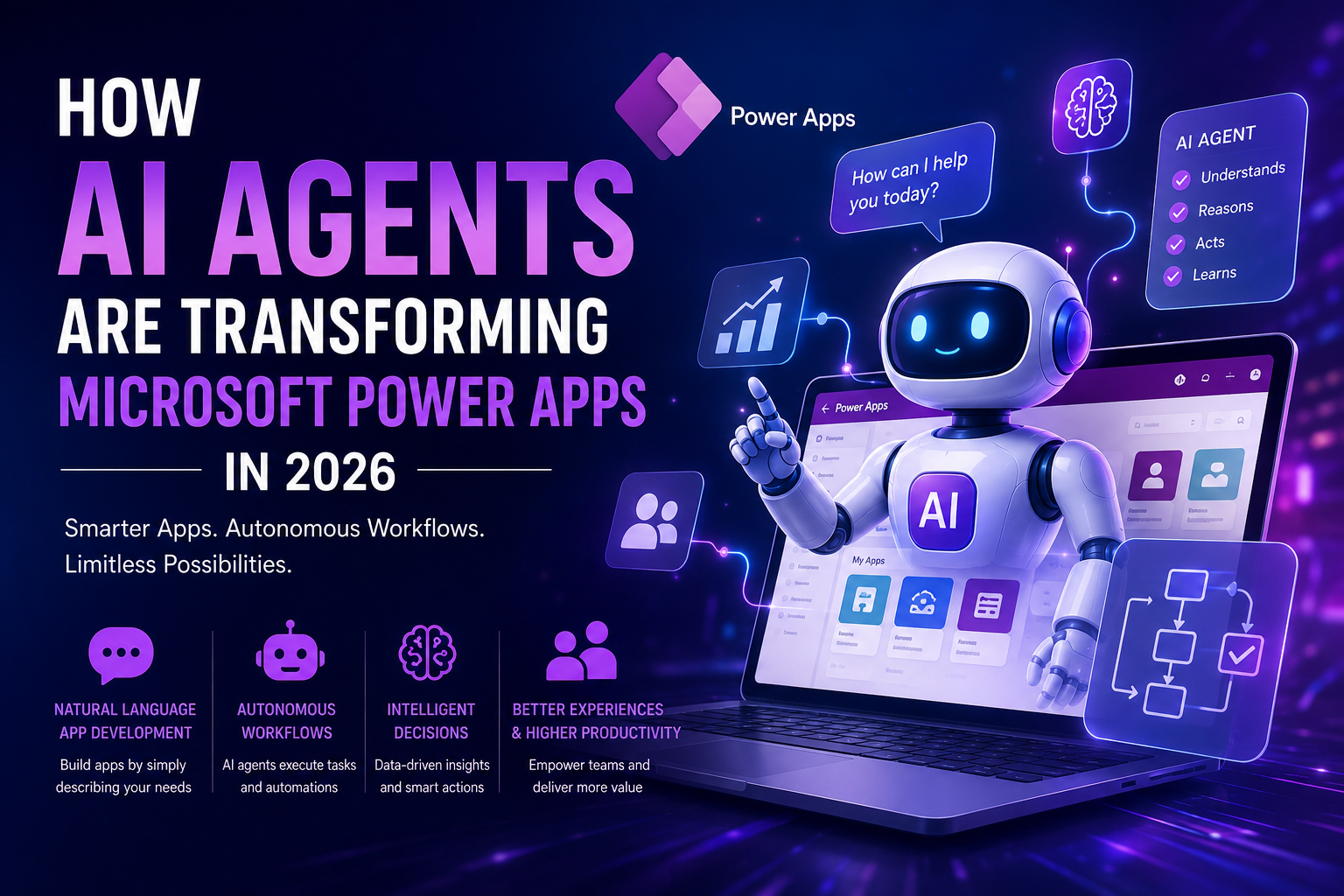
The world of business application development is undergoing a revolutionary transformation. What once required teams of software developers, months of coding, and substantial budgets can now be accomplished by business users and citizen developers using low-code platforms. In 2026, this transformation has accelerated dramatically with the introduction of AI agents into Microsoft Power Apps.
Artificial Intelligence is no longer just a feature embedded within applications—it has evolved into intelligent, autonomous agents capable of understanding business processes, making decisions, executing tasks, and continuously improving workflows. Microsoft has positioned Power Apps at the center of this revolution by integrating AI agents and Microsoft Copilot capabilities throughout the Power Platform ecosystem.
This article explores how AI agents are transforming Microsoft Power Apps in 2026, the technologies driving this shift, real-world business applications, benefits, challenges, and what organizations need to do to stay competitive.
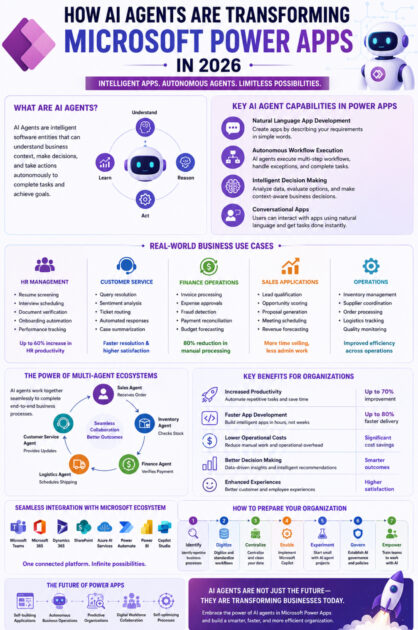
The Evolution of Microsoft Power Apps
When Microsoft introduced Power Apps, the vision was straightforward: enable anyone to build business applications without requiring traditional programming skills.
Over the years, Power Apps evolved through several major stages:
Phase 1: Traditional Low-Code Development
- Drag-and-drop interfaces
- Prebuilt connectors
- Workflow automation
- Basic business applications
Phase 2: AI-Assisted Development
- AI Builder integration
- Automated document processing
- Prediction models
- Object detection
- Natural language capabilities
Phase 3: Copilot-Powered Development
- Natural language app creation
- Automated formula generation
- Intelligent workflow suggestions
- Conversational app building
Phase 4: Agentic AI Era (2026)
Today, Power Apps has entered the age of autonomous AI agents capable of:
- Understanding business context
- Making intelligent decisions
- Performing multi-step tasks
- Interacting with enterprise systems
- Learning from historical data
- Collaborating with human employees
This represents the biggest transformation in enterprise application development since the introduction of cloud computing.
What Are AI Agents in Microsoft Power Apps?
AI agents are intelligent software entities capable of independently performing business tasks with minimal human intervention.
Unlike traditional automation tools that follow predefined rules, AI agents can:
Understand
- Human language
- Business requirements
- Organizational processes
- User intent
Reason
- Analyze multiple data sources
- Determine optimal actions
- Evaluate business outcomes
- Make contextual decisions
Act
- Execute workflows
- Trigger automations
- Update records
- Communicate with users
Learn
- Improve from interactions
- Optimize workflows
- Adapt to changing business needs
- Generate insights
Think of AI agents as digital employees that can perform repetitive and knowledge-based tasks around the clock.
Why 2026 Is a Turning Point for Power Apps
Several technological breakthroughs have converged to make AI agents practical and valuable:
1. Large Language Models (LLMs)
Modern AI models can understand complex business instructions and generate intelligent responses.
2. Microsoft Copilot Integration
Copilot now acts as the intelligence layer across the entire Microsoft ecosystem.
3. Retrieval-Augmented Generation (RAG)
AI agents can access enterprise knowledge bases and provide context-aware responses.
4. Multi-Agent Systems
Different AI agents can collaborate to solve business problems.
5. Autonomous Workflows
Agents can execute end-to-end business processes without manual intervention.
This convergence has transformed Power Apps from a low-code platform into an intelligent business operating system.
Key AI Agent Capabilities in Power Apps 2026
1. Natural Language App Development
Business users can now create applications simply by describing what they want.
For example:
“Create an employee onboarding application that collects documents, sends manager approvals, provisions IT assets, and tracks progress.”
Power Apps AI agents automatically generate:
- Data models
- User interfaces
- Business rules
- Workflows
- Integrations
- Security permissions
Development cycles that once took months can now be completed in hours.
2. Autonomous Workflow Execution
Traditional automation required detailed process mapping.
AI agents can now:
- Interpret requests
- Identify required actions
- Execute workflows
- Handle exceptions
- Escalate when necessary
Example:
An employee submits a travel request.
The AI agent automatically:
- Validates policy compliance
- Calculates expenses
- Obtains approvals
- Books travel
- Updates finance systems
- Sends notifications
All without human intervention.
3. Intelligent Decision Making
Modern AI agents are capable of contextual business decisions.
Examples include:
Finance
- Expense approval recommendations
- Fraud detection
- Invoice classification
HR
- Candidate ranking
- Employee retention prediction
- Training recommendations
Sales
- Lead scoring
- Opportunity prioritization
- Revenue forecasting
Customer Support
- Ticket routing
- Sentiment analysis
- Automated resolutions
4. Conversational Enterprise Applications
Power Apps now supports conversational interfaces powered by AI agents.
Users can ask questions such as:
- “Show overdue invoices.”
- “Approve John’s leave request.”
- “Generate a sales report for Q2.”
- “Find our top-performing customers.”
The AI agent understands context and performs the required actions.
This eliminates the need for users to learn complex interfaces.
Real-World Business Use Cases
AI-Powered HR Management
AI agents can:
- Screen resumes
- Schedule interviews
- Verify documents
- Generate offer letters
- Onboard employees
- Track performance
Organizations report HR productivity improvements exceeding 60%.
AI Customer Service Applications
Customer support agents can:
- Analyze customer sentiment
- Resolve common queries
- Escalate complex cases
- Generate summaries
- Suggest solutions
Benefits include:
- Faster response times
- Reduced support costs
- Higher customer satisfaction
AI Finance Operations
Finance teams leverage AI agents for:
- Invoice processing
- Budget forecasting
- Fraud detection
- Payment reconciliation
- Expense approvals
Many organizations have reduced manual processing by over 80%.
AI Sales Applications
Sales AI agents can:
- Qualify leads
- Analyze buyer intent
- Generate proposals
- Schedule meetings
- Forecast revenue
- Recommend actions
This enables sales teams to spend more time selling and less time on administration.
Multi-Agent Business Systems
One of the most exciting developments in 2026 is the emergence of multi-agent ecosystems.
For example:
Customer Order Process
Sales Agent
- Receives order
Inventory Agent
- Verifies stock availability
Finance Agent
- Checks payment status
Logistics Agent
- Schedules shipping
Customer Service Agent
- Provides updates
These agents collaborate automatically to complete business processes.
Integration with Microsoft Ecosystem
AI agents in Power Apps integrate seamlessly with:
- Microsoft Teams
- Microsoft 365
- Dynamics 365
- SharePoint
- Azure AI
- Microsoft Fabric
- Power BI
- Power Automate
- Copilot Studio
This creates a unified enterprise intelligence platform.
Benefits of AI Agents in Power Apps
Organizations adopting AI agents report significant advantages:
Increased Productivity
- Up to 70% reduction in manual work
Faster Application Development
- Development cycles reduced by 80%
Lower Operational Costs
- Reduced labor-intensive processes
Better Decision Making
- Real-time analytics and recommendations
Enhanced Customer Experience
- Faster responses and personalized interactions
Improved Employee Experience
- Less repetitive work and greater efficiency
Challenges Organizations Must Address
Despite the benefits, businesses face several challenges.
Governance
Organizations need clear policies around:
- AI decision making
- Data access
- Compliance
- Security
Data Quality
AI agents require:
- Clean data
- Structured information
- Reliable business rules
Change Management
Employees need training to collaborate effectively with AI systems.
Ethical Considerations
Businesses must address:
- Bias
- Transparency
- Accountability
- Privacy concerns
How Businesses Should Prepare for AI Agents
Organizations should begin by:
Step 1
Identify repetitive business processes.
Step 2
Digitize existing workflows.
Step 3
Centralize business data.
Step 4
Implement Microsoft Copilot.
Step 5
Experiment with small AI agent projects.
Step 6
Develop AI governance frameworks.
Step 7
Train employees to work alongside AI agents.
The Future of Power Apps Beyond 2026
The next phase of Power Apps may include:
- Fully autonomous business operations
- Self-building enterprise applications
- Predictive organizational management
- Cross-company AI ecosystems
- Digital workforce collaboration
- Self-optimizing business processes
Experts predict that by 2030, AI agents could handle a significant percentage of routine business operations.
Conclusion
The integration of AI agents into Microsoft Power Apps represents a paradigm shift in enterprise technology. Businesses are moving beyond automation toward intelligent, autonomous systems capable of understanding, reasoning, learning, and acting.
Organizations that embrace AI-powered Power Apps today will gain substantial advantages in productivity, efficiency, customer experience, and innovation.
The question is no longer whether AI agents will transform business applications.
The real question is:
How quickly can your organization adapt to the agentic AI revolution?
The future of enterprise software isn’t just low-code.
It’s autonomous, intelligent, and already here.