
Dynamics 365 CE vs Business Central: Which Microsoft ERP & CRM Solution Should You Learn or Implement in 2026?
Introduction
Microsoft Dynamics 365 has transformed how organizations manage customer relationships, business operations, and financial processes. Instead of offering a single business application, Microsoft provides specialized solutions tailored to different business needs.
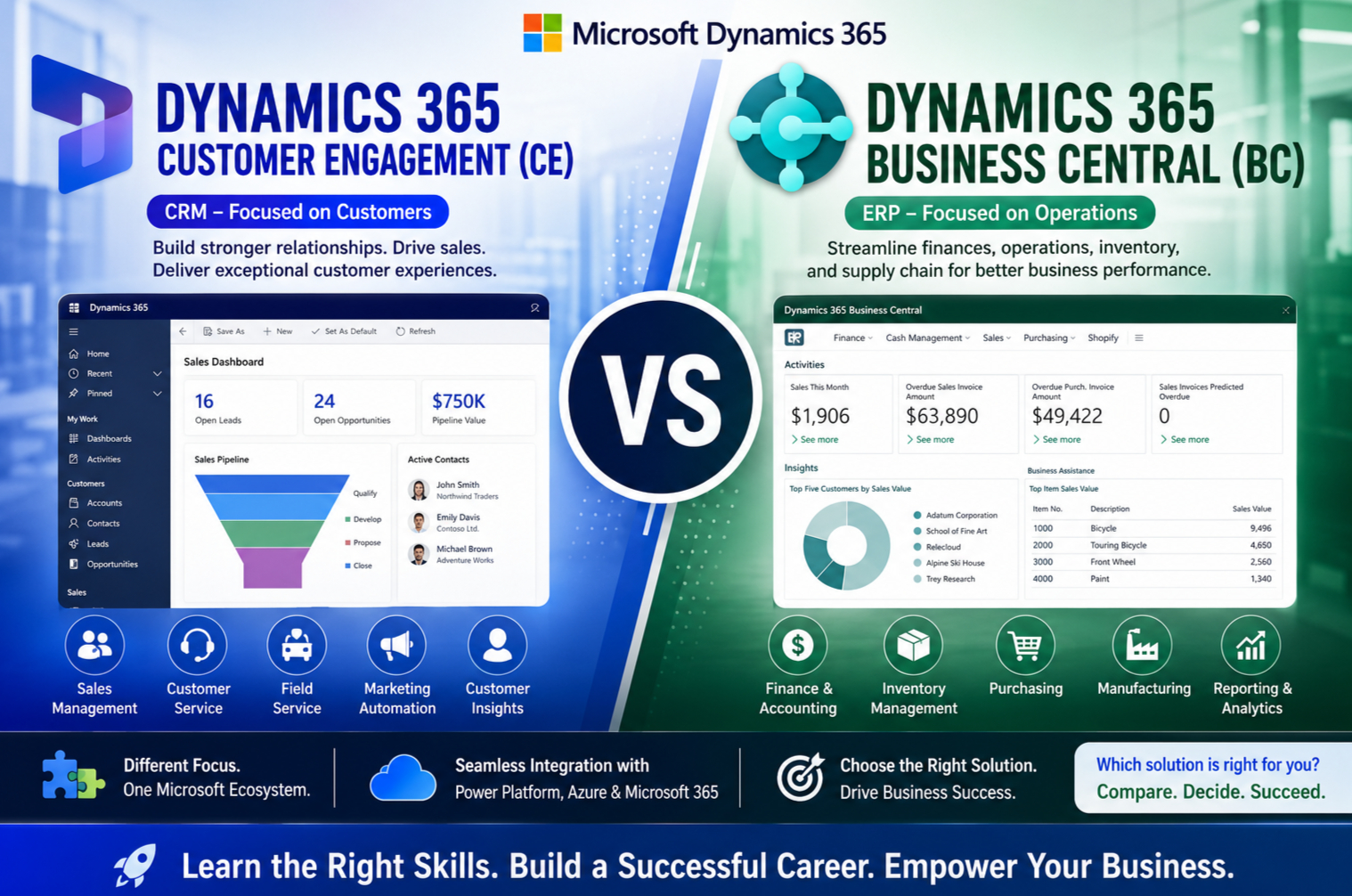
Two of the most popular applications in the Dynamics 365 ecosystem are Dynamics 365 Customer Engagement (CE) and Dynamics 365 Business Central (BC). While both are part of the Microsoft Dynamics 365 family, they serve entirely different purposes.
This often leads to questions such as:
- Is Dynamics 365 CE the same as Business Central?
- Which solution is better for businesses?
- Which platform offers better career opportunities?
- Should developers learn Dynamics 365 CE or Business Central?
In this comprehensive guide, we’ll compare both platforms from a business, technical, and career perspective.
What is Dynamics 365 Customer Engagement (CE)?
Dynamics 365 Customer Engagement (CE) is Microsoft’s cloud-based Customer Relationship Management (CRM) platform. It helps organizations manage customer interactions throughout the entire customer lifecycle—from lead generation and sales to customer service and field operations.
Dynamics 365 CE focuses on improving customer relationships, increasing sales productivity, and delivering better customer experiences.
Core Applications in Dynamics 365 CE
- Dynamics 365 Sales
- Dynamics 365 Customer Service
- Dynamics 365 Field Service
- Dynamics 365 Customer Insights
- Dynamics 365 Contact Center
- Dynamics 365 Project Operations (customer-focused scenarios)
Primary Business Functions
- Lead Management
- Opportunity Tracking
- Sales Pipeline Management
- Customer Support
- Case Management
- Field Service Scheduling
- Marketing Automation (with Dynamics 365 Customer Insights – Journeys)
- Customer Relationship Management
What is Dynamics 365 Business Central?
Dynamics 365 Business Central is Microsoft’s cloud-based Enterprise Resource Planning (ERP) solution designed primarily for small and medium-sized businesses (SMBs). It helps organizations manage finance, inventory, purchasing, sales, manufacturing, projects, warehousing, and supply chain operations from a unified platform.
Business Central focuses on internal business operations and financial management.
Core Modules in Business Central
- Finance
- Sales
- Purchasing
- Inventory Management
- Warehouse Management
- Manufacturing
- Supply Chain
- Project Management
- Service Management
- Reporting & Analytics
Primary Business Functions
- Accounting
- Financial Reporting
- Procurement
- Inventory Control
- Warehouse Operations
- Manufacturing Planning
- Vendor Management
- Business Operations
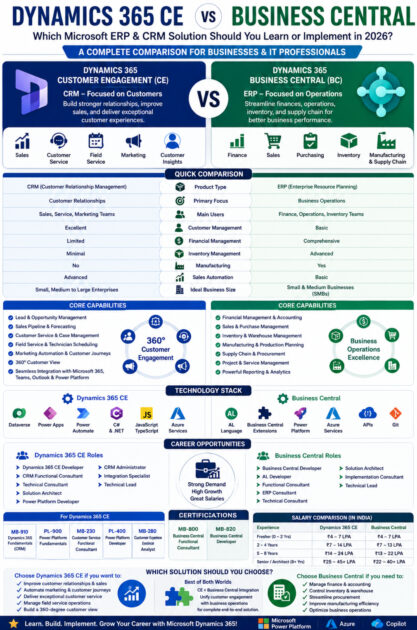
Dynamics 365 CE vs Business Central: Quick Comparison
| Feature | Dynamics 365 CE | Business Central |
|---|---|---|
| Product Type | CRM | ERP |
| Primary Focus | Customer Relationships | Business Operations |
| Main Users | Sales, Service, Marketing Teams | Finance, Operations, Inventory Teams |
| Customer Management | Excellent | Basic |
| Financial Management | Limited | Comprehensive |
| Inventory Management | Minimal | Advanced |
| Manufacturing | No | Yes |
| Supply Chain | Limited | Extensive |
| Sales Automation | Advanced | Basic |
| Accounting | No | Yes |
| Ideal Business Size | SMBs to Large Enterprises | Small & Medium Businesses |
CRM vs ERP: Understanding the Difference
One of the easiest ways to understand these platforms is by distinguishing CRM from ERP.
Dynamics 365 CE (CRM)
A CRM system helps businesses:
- Manage leads and prospects
- Track customer interactions
- Improve sales performance
- Deliver customer support
- Build long-term customer relationships
- Increase customer satisfaction
The emphasis is on customer-facing processes.
Business Central (ERP)
An ERP system helps organizations:
- Manage finances
- Track inventory
- Handle procurement
- Monitor manufacturing
- Manage warehouse operations
- Streamline supply chains
- Generate financial reports
The emphasis is on internal business operations.
Core Features Comparison
Dynamics 365 CE Features
Sales Management
- Lead qualification
- Opportunity tracking
- Sales forecasting
- Quotes and orders
- Customer engagement
Customer Service
- Case management
- SLA management
- Knowledge base
- Omnichannel support
Field Service
- Work order management
- Technician scheduling
- Resource optimization
- Mobile workforce support
Marketing
- Customer journeys
- Email campaigns
- Lead nurturing
- Event management
Business Central Features
Financial Management
- General Ledger
- Accounts Payable
- Accounts Receivable
- Budgeting
- Cash Flow Management
Inventory
- Stock tracking
- Inventory costing
- Reordering
- Warehouse locations
Purchasing
- Vendor management
- Purchase orders
- Procurement workflows
Manufacturing
- Production planning
- Bills of Materials (BOM)
- Capacity planning
- Shop floor management
Technical Comparison
Dynamics 365 CE Technology Stack
Developers typically work with:
- Microsoft Dataverse
- Model-driven Apps
- Power Apps
- Power Automate
- Power Pages
- JavaScript
- TypeScript
- C#
- .NET Plugins
- Custom Workflow Activities
- Web API
- Azure Services
- Microsoft Copilot
Business Central Technology Stack
Business Central developers primarily use:
- AL Programming Language
- Visual Studio Code
- Business Central Extensions
- APIs
- Power Platform
- Azure Services
- SQL (conceptual understanding)
- Git
- Web Services
Unlike Dynamics 365 CE, Business Central does not rely on C# plugins for customization. Instead, developers extend functionality using AL extensions, making upgrades simpler and more maintainable.
Customization Capabilities
Dynamics 365 CE
Customization options include:
- Custom Tables
- Business Rules
- Plugins
- JavaScript
- Power Automate
- PCF (PowerApps Component Framework)
- Power Apps
- Custom APIs
- Azure Functions
- Web Resources
Dynamics 365 CE offers extensive flexibility for creating tailored customer-facing solutions.
Business Central
Customization includes:
- AL Extensions
- Page Extensions
- Table Extensions
- Report Extensions
- API Integrations
- Power Automate
- Custom Business Logic
Business Central follows Microsoft’s extension-based development model, reducing the need to modify the core application and simplifying future updates.
Integration with Microsoft Ecosystem
Both platforms integrate seamlessly with Microsoft’s business technologies.
Dynamics 365 CE integrates with:
- Power Apps
- Power Automate
- Power BI
- Microsoft Teams
- Outlook
- SharePoint
- Azure
- Microsoft Copilot
- Business Central
Business Central integrates with:
- Microsoft Excel
- Outlook
- Power BI
- Power Automate
- Microsoft Teams
- Azure
- Dynamics 365 CE
- Microsoft Copilot
Together, CE and Business Central provide a unified business platform where customer-facing and operational processes work together.
Career Opportunities
Dynamics 365 CE Career Roles
- Dynamics 365 CE Developer
- CRM Functional Consultant
- Technical Consultant
- Solution Architect
- Power Platform Developer
- CRM Administrator
- Integration Specialist
- Technical Lead
Business Central Career Roles
- Business Central Developer
- AL Developer
- Functional Consultant
- ERP Consultant
- Technical Consultant
- Solution Architect
- ERP Implementation Consultant
Both domains have strong demand globally, particularly among Microsoft partners, consulting firms, and enterprises undergoing digital transformation.
Certifications
Dynamics 365 CE Certifications
Recommended Microsoft certifications include:
- MB-910: Dynamics 365 Fundamentals (CRM)
- PL-900: Microsoft Power Platform Fundamentals
- PL-400: Microsoft Power Platform Developer
- MB-230: Dynamics 365 Customer Service Functional Consultant
- MB-280: Dynamics 365 Customer Experience Analyst
Business Central Certifications
Recommended certifications include:
- MB-800: Dynamics 365 Business Central Functional Consultant
- MB-820: Dynamics 365 Business Central Developer
These certifications validate both functional and technical expertise and can significantly enhance career prospects.
Salary Comparison
(Approximate salaries vary based on country, organization, and experience.)
| Experience | Dynamics 365 CE | Business Central |
|---|---|---|
| Fresher | ₹4–7 LPA | ₹4–7 LPA |
| 2–4 Years | ₹7–14 LPA | ₹7–13 LPA |
| 5–8 Years | ₹14–24 LPA | ₹13–22 LPA |
| Senior Consultant / Architect | ₹25–45+ LPA | ₹22–40+ LPA |
Professionals with expertise in Azure, Power Platform, integrations, and industry-specific implementations often earn higher compensation.
Which Solution is Better for Businesses?
Choose Dynamics 365 CE if your organization wants to:
- Improve customer relationships
- Increase sales productivity
- Enhance customer service
- Automate sales processes
- Manage field service operations
- Build a 360-degree customer view
Choose Business Central if your organization needs to:
- Manage accounting and finance
- Control inventory
- Streamline procurement
- Improve manufacturing efficiency
- Optimize warehouse operations
- Centralize business operations
Many organizations implement both solutions together to achieve end-to-end digital transformation.
Which Career Path Should You Choose?
Choose Dynamics 365 CE if you:
- Enjoy customer-focused business applications.
- Want to work with CRM systems.
- Are interested in Power Platform, automation, and Microsoft Copilot.
- Like customizing applications using JavaScript, C#, and Dataverse.
- Want to build customer engagement solutions.
Choose Business Central if you:
- Enjoy finance and business operations.
- Want to specialize in ERP systems.
- Are interested in inventory, manufacturing, and supply chain processes.
- Like developing extensions using AL.
- Prefer working on operational and financial solutions.
For professionals seeking broader opportunities in the Microsoft ecosystem, learning both platforms—and understanding how they integrate—can provide a significant competitive advantage.
Frequently Asked Questions (FAQs)
Is Dynamics 365 CE the same as Business Central?
No. Dynamics 365 CE is a CRM solution focused on customer engagement, while Business Central is an ERP solution focused on finance and business operations.
Can Dynamics 365 CE integrate with Business Central?
Yes. Microsoft provides native integration between the two platforms, allowing businesses to synchronize customer, sales, and financial data for a unified experience.
Which platform is easier to learn?
It depends on your background. Dynamics 365 CE is often easier for those with CRM or Power Platform experience, while Business Central is more approachable for professionals with finance, accounting, or ERP backgrounds.
Which offers better career opportunities?
Both platforms offer excellent career prospects. Dynamics 365 CE has strong demand among CRM and customer engagement projects, while Business Central professionals are highly sought after for ERP implementations in small and medium-sized businesses.
Should I learn both?
If your goal is to become a Microsoft Solution Architect or Dynamics 365 Consultant, understanding both CE and Business Central—along with Power Platform and Azure—will greatly expand your expertise and career opportunities.
Final Thoughts
Dynamics 365 CE and Business Central are not competing products; they solve different business challenges. CE empowers organizations to strengthen customer relationships, improve sales performance, and deliver exceptional service. Business Central streamlines finance, operations, inventory, and supply chain management.
As Microsoft continues to unify its business applications through Power Platform, Azure, and Copilot, professionals who understand both CRM and ERP processes are becoming increasingly valuable. Whether you choose to specialize in Dynamics 365 CE, Business Central, or eventually master both, you’ll be building expertise in one of the most in-demand enterprise technology ecosystems.