How to Build Multi-Agent AI Systems Using Microsoft Technologies
Introduction
Artificial Intelligence is rapidly evolving from single AI assistants to intelligent multi-agent systems capable of collaborating, planning and executing complex business tasks. In 2026, enterprises are increasingly adopting multi-agent AI architectures to automate workflows, enhance decision-making and create autonomous business applications.
Microsoft provides one of the most comprehensive ecosystems for building enterprise AI solutions. By combining Azure AI Foundry, Azure OpenAI Service, Microsoft Copilot Studio, Semantic Kernel, .NET, Power Platform and Microsoft Azure, developers can design scalable, secure and intelligent AI systems where multiple agents work together to solve business problems.
This guide explains what multi-agent AI systems are, how Microsoft technologies support them and the best practices for building production-ready enterprise solutions.
What Are Multi-Agent AI Systems?
A multi-agent AI system consists of multiple intelligent agents, each responsible for a specific task or business capability. Rather than relying on a single AI model to handle everything, specialised agents collaborate to achieve a common objective.
For example, a customer service solution might include:
- A customer support agent that answers questions.
- A billing agent that retrieves invoice information.
- A scheduling agent that books appointments.
- A knowledge agent that searches internal documentation.
- A reporting agent that generates summaries.
- A compliance agent that validates business rules.
Each agent focuses on its area of expertise while communicating with other agents to complete complex workflows.
Why Multi-Agent AI Matters
Traditional AI assistants are effective for isolated tasks but often struggle with large, multi-step business processes.
Multi-agent systems provide:
- Better task specialisation
- Improved scalability
- Easier maintenance
- Greater flexibility
- Parallel task execution
- Enhanced reliability
- Smarter decision-making
- Reusable AI components
This modular approach aligns well with enterprise software architecture.
Microsoft’s AI Ecosystem for Multi-Agent Development
Microsoft offers a rich set of technologies that work together to support enterprise AI.
Key components include:
- Azure AI Foundry
- Azure OpenAI Service
- Microsoft Copilot Studio
- Semantic Kernel
- .NET 10
- ASP.NET Core
- Azure AI Search
- Azure AI Document Intelligence
- Azure Functions
- Azure Service Bus
- Azure Event Grid
- Microsoft Dataverse
- Power Automate
- Microsoft Entra ID
Together, these services provide everything needed to build intelligent, secure and scalable multi-agent applications.
Azure AI Foundry
Azure AI Foundry is Microsoft’s platform for building, evaluating and managing AI applications.
For multi-agent systems it provides:
- Agent orchestration
- Prompt management
- Model evaluation
- Knowledge integration
- AI lifecycle management
- Enterprise governance
AI Foundry simplifies the development and deployment of sophisticated AI solutions.
Azure OpenAI Service
Azure OpenAI powers the reasoning capabilities of AI agents.
Agents can:
- Understand natural language
- Generate responses
- Summarise documents
- Write code
- Analyse business data
- Produce recommendations
- Generate reports
Enterprise-grade security and compliance make Azure OpenAI suitable for business-critical workloads.
Semantic Kernel
Semantic Kernel is Microsoft’s open-source SDK for orchestrating AI capabilities within .NET applications.
It enables developers to:
- Coordinate multiple AI agents
- Manage prompts
- Create reusable AI skills
- Integrate external APIs
- Build planners
- Combine traditional code with AI reasoning
Semantic Kernel plays a central role in many enterprise AI architectures.
Microsoft Copilot Studio
Copilot Studio allows organisations to build conversational AI agents with minimal coding.
It supports:
- Customer support bots
- Employee assistants
- Knowledge agents
- Workflow automation
- Microsoft 365 integration
- Dynamics 365 integration
These copilots can also participate in broader multi-agent workflows.
.NET 10 and ASP.NET Core
Professional developers often use .NET 10 to build enterprise AI services.
Benefits include:
- High performance
- Strong security
- Cross-platform support
- Dependency injection
- Background processing
- REST API development
- Microservices support
ASP.NET Core acts as the foundation for exposing agent capabilities through secure APIs.
Power Platform Integration
Power Platform complements multi-agent systems by providing low-code automation.
Components include:
- Power Apps for user interfaces
- Power Automate for workflow orchestration
- Microsoft Dataverse for business data
- Power BI for analytics
This enables both citizen developers and professional developers to collaborate on AI solutions.
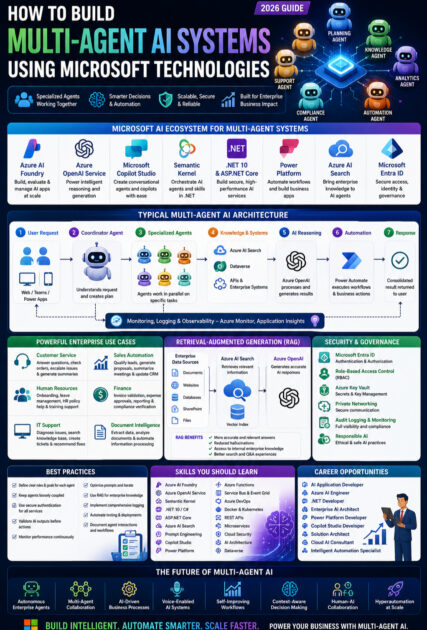
A Typical Multi-Agent Architecture
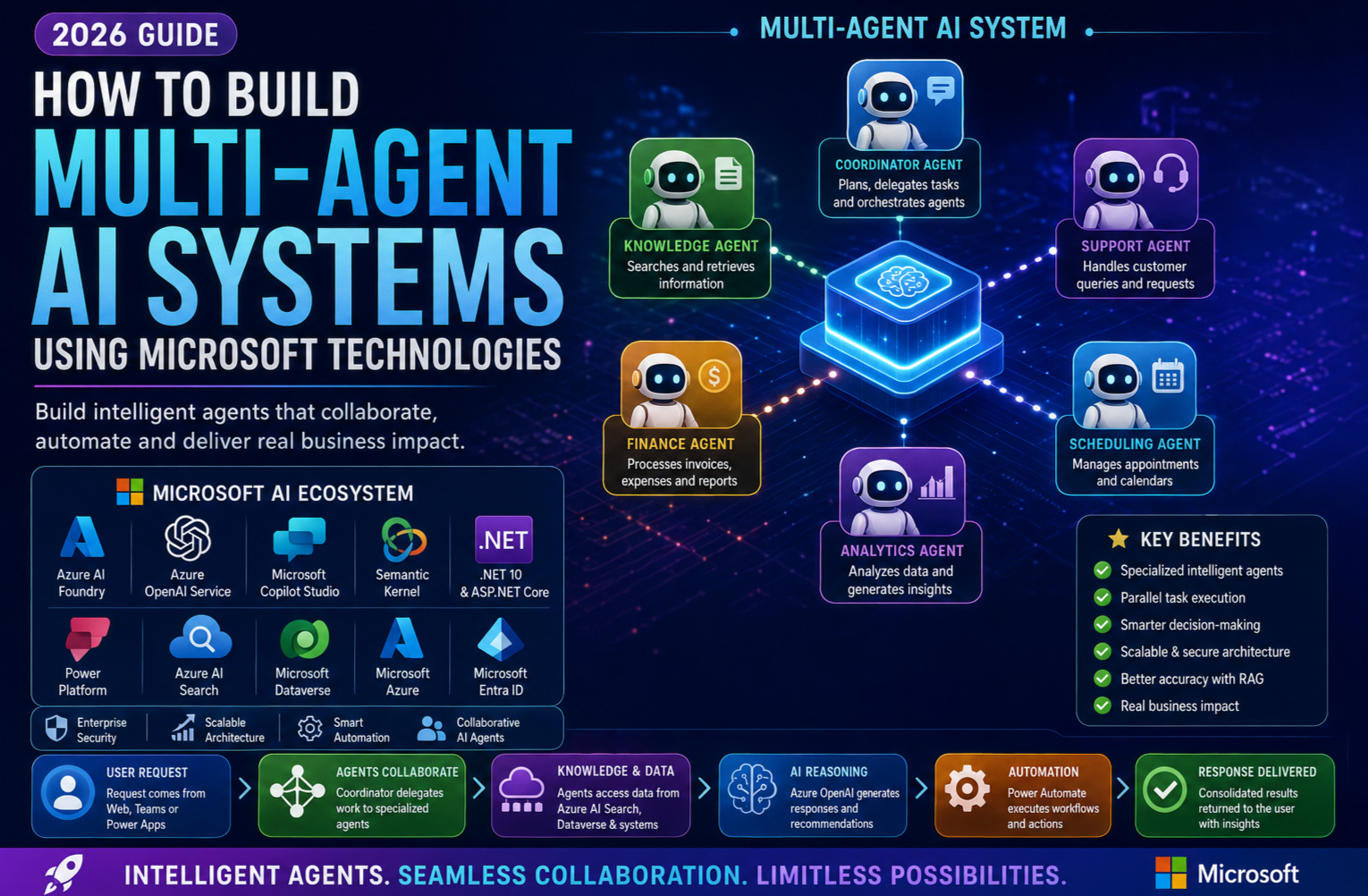
A common enterprise architecture includes:
- User submits a request through a web application, Teams or Power Apps.
- A coordinator agent analyses the request.
- The coordinator delegates tasks to specialised agents.
- Agents retrieve information from Azure AI Search, Dataverse or enterprise systems.
- Azure OpenAI generates responses and recommendations.
- Power Automate executes business workflows.
- Results are consolidated and returned to the user.
- Logs and telemetry are collected using Azure Monitor and Application Insights.
This modular architecture supports scalability, resilience and maintainability.
Common Enterprise Use Cases
Customer Service
Agents collaborate to:
- Answer customer questions
- Retrieve account details
- Check order status
- Generate support summaries
- Escalate complex cases
Sales Automation
AI agents can:
- Qualify leads
- Generate proposals
- Summarise meetings
- Recommend next actions
- Update CRM records
Human Resources
Agents assist with:
- Employee onboarding
- Leave management
- HR policy guidance
- Recruitment support
- Training recommendations
Finance
Finance teams can automate:
- Invoice validation
- Expense approvals
- Financial reporting
- Budget analysis
- Compliance verification
IT Support
Multi-agent systems can:
- Diagnose technical issues
- Search knowledge bases
- Create support tickets
- Recommend fixes
- Notify engineers
Retrieval-Augmented Generation (RAG)
Enterprise AI systems often require access to organisational knowledge.
By combining Azure AI Search with Azure OpenAI, developers can implement Retrieval-Augmented Generation (RAG).
Benefits include:
- More accurate responses
- Reduced hallucinations
- Access to internal documentation
- Improved factual grounding
- Better enterprise search experiences
RAG is a cornerstone of modern multi-agent architectures.
Security and Governance
Enterprise AI solutions must protect sensitive data.
Microsoft provides:
- Microsoft Entra ID authentication
- Role-Based Access Control (RBAC)
- Azure Key Vault
- Private networking
- Data encryption
- Audit logging
- Compliance monitoring
- Responsible AI controls
These capabilities support secure deployment across regulated industries.
Best Practices
When building multi-agent AI systems:
- Design agents with clearly defined responsibilities.
- Keep agents loosely coupled.
- Use secure authentication for all services.
- Validate AI outputs before critical actions.
- Monitor agent performance continuously.
- Optimise prompts through iterative testing.
- Use RAG instead of relying solely on model memory.
- Implement comprehensive logging.
- Automate testing and deployments.
- Document agent interactions and workflows.
Following these practices improves reliability, scalability and maintainability.
Skills You Should Learn
Developers building multi-agent AI systems should understand:
- Azure AI Foundry
- Azure OpenAI Service
- Semantic Kernel
- .NET 10
- C#
- ASP.NET Core
- Azure AI Search
- Prompt Engineering
- Power Platform
- Microsoft Copilot Studio
- Azure Functions
- Azure Service Bus
- Azure Event Grid
- Azure DevOps
- Docker
- Kubernetes
- REST APIs
- Microservices
- Cloud Security
These skills form a strong foundation for enterprise AI development.
Career Opportunities
As enterprises invest in AI, demand is growing for professionals skilled in Microsoft’s AI ecosystem.
Popular roles include:
- AI Application Developer
- Azure AI Engineer
- .NET Developer
- Enterprise AI Architect
- Power Platform Developer
- Copilot Studio Developer
- Solution Architect
- Cloud AI Consultant
- Intelligent Automation Specialist
These roles offer exciting opportunities across industries embracing AI-driven transformation.
Future Trends
The future of multi-agent AI will include:
- Autonomous enterprise agents
- Multi-agent collaboration
- AI-driven business processes
- Voice-enabled AI systems
- Self-improving workflows
- Context-aware decision-making
- Human-AI collaboration
- Hyperautomation
Microsoft continues to invest heavily in technologies that make these capabilities more accessible to organisations.
Conclusion
Multi-agent AI systems represent the next generation of enterprise software, enabling organisations to automate increasingly complex processes through collaboration between specialised AI agents. Rather than relying on a single assistant, businesses can create intelligent ecosystems where multiple agents work together to deliver accurate, efficient and context-aware outcomes.
Microsoft’s comprehensive technology stack—including Azure AI Foundry, Azure OpenAI Service, Semantic Kernel, Copilot Studio, .NET and Power Platform—provides everything developers need to build secure, scalable and enterprise-ready multi-agent applications. These technologies integrate seamlessly with existing Microsoft business platforms, making them an ideal choice for organisations already invested in the Microsoft ecosystem.
As AI continues to evolve, the ability to design and implement multi-agent systems will become a highly valuable skill. Developers who combine expertise in cloud computing, software engineering and AI orchestration will be well positioned to lead the next wave of enterprise innovation.