
How to Build a ₹10+ LPA Career in Microsoft Technologies: Skills, Certifications & Roadmap

Introduction
A ₹10+ LPA career in Microsoft technologies can begin with one strong skill, but it grows through practical work. Microsoft supports roles in Azure cloud, software development, data, AI, cybersecurity, enterprise apps, and automation.
Certifications can help you pass screening, but they don’t guarantee a ₹10+ LPA package. Employers also check projects, problem-solving, communication, technical interviews, and your ability to create business value. Salary depends on experience, location, company, role, and interview performance.
Use current job postings, LinkedIn Salary, AmbitionBox, Glassdoor, and hiring reports when checking pay. Record the source and publication date for every salary range. This Microsoft technologies career roadmap helps you choose a track, build useful skills, earn the right certification, and prove your ability.
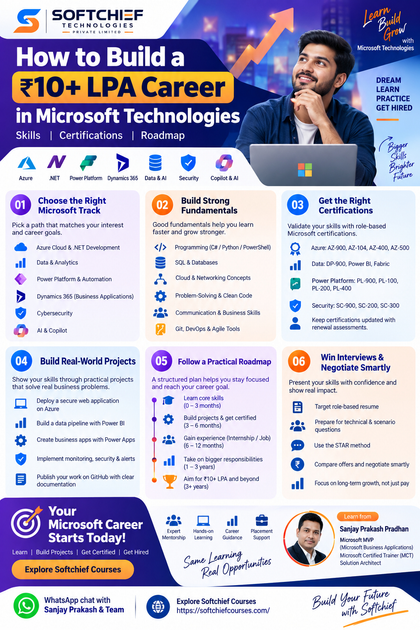
Choose the Microsoft Track With the Strongest Career Potential
Azure cloud and .NET development
Azure cloud engineers work with compute, storage, networking, identity, governance, monitoring, security, high availability, and cost control. Azure Administrator, DevOps Engineer, Site Reliability Engineer, and Cloud Architect roles also need Azure CLI, PowerShell, Git, GitHub Actions, Azure DevOps, Bicep, ARM templates, or Terraform.
A .NET developer should learn C#, object-oriented programming, ASP.NET Core, REST APIs, Entity Framework Core, SQL, testing, debugging, and software design. Azure App Service, Functions, Azure SQL, Cosmos DB, Service Bus, Key Vault, Storage, and Application Insights can make this profile stronger. Relevant credentials may include AZ-900, AZ-104, AZ-400, or AZ-305. Microsoft currently lists AZ-204 as retired, so check the latest Azure developer options before planning around it.
Data, Power Platform, and security
Data roles differ. Analysts focus on reports and decisions, data engineers build pipelines, data scientists use statistics and models, and AI developers build applications. Learn SQL, Python, data modeling, ETL or ELT, APIs, visualization, and responsible AI. Microsoft tools include Fabric, Power BI, Data Factory, Synapse, Databricks, Azure Machine Learning, and Azure OpenAI Service.
Power Apps, Power Automate, Dataverse, Power BI, and Copilot Studio support automation and business apps. Possible roles include functional consultant, Power Platform developer, business analyst, and solution architect. Security roles use Microsoft Entra ID, Defender, Sentinel, Key Vault, and Zero Trust practices. Paths may include security analyst, identity administrator, cloud security engineer, and SOC analyst.
Build a ₹10+ LPA Career in Microsoft Technologies With Strong Fundamentals
Strengthen coding and problem-solving
Choose one main language. C# fits .NET and Azure development, Python fits data, AI, and automation, PowerShell fits administration, and SQL fits nearly every technical track.
Study data structures, algorithms, error handling, debugging, testing, clean code, and basic system design. Use Git, write documentation, handle edge cases, and create reusable functions. Solve problems related to your target role instead of spending all your time on competitive programming.
Learn cloud, data, identity, and business skills
Understand DNS, HTTP, TCP/IP, firewalls, load balancing, virtualization, containers, databases, indexing, transactions, and NoSQL use cases. Learn authentication, authorization, RBAC, encryption, secrets management, and least privilege before studying advanced Azure services.
Technical work also needs requirement gathering, estimation, documentation, presentations, incident reports, and stakeholder updates. Practice explaining how a design reduced manual work, improved reliability, cut deployment time, or improved reporting. Azure Boards, Jira, Teams, pull requests, code reviews, and Agile ceremonies are common workplace tools.
Use a Microsoft Certification Roadmap to Validate Skills
Match each certification to a target role
A focused sequence is better than collecting unrelated badges:
- Cloud administration: AZ-900, AZ-104, then AZ-500 or AZ-305.
- DevOps: AZ-900, administration knowledge, then AZ-400.
- Data and analytics: DP-900 or equivalent basics, followed by Power BI, Fabric, or data engineering credentials.
- Power Platform: PL-900, then PL-100, PL-200, or PL-400.
- Security: SC-900, then SC-200, SC-300, AZ-500, or SC-100.
Review the AZ-104 certification requirements before scheduling an exam. Microsoft changes exam objectives, prerequisites, and retirement dates, so always check Microsoft Learn first.
Prepare through labs and renewal
Use Microsoft Learn modules, sandboxes, documentation, practice assessments, and exam skills outlines. Build labs in a free Azure account or approved learning environment, and monitor billing closely.
Role-based certifications need renewal. Microsoft says renewal is free through an online assessment during a six-month eligibility window, while fundamentals certifications don’t expire. Check the Microsoft certification renewal guidance through your Learn profile.
Create a Portfolio That Shows Job-Ready Skills
Build projects around real business problems
A useful project could deploy a secure web app with CI/CD, monitoring, backup, and alerts. A .NET project might use App Service, Azure SQL, Key Vault, and Application Insights. Other strong ideas include a public-data pipeline with a Power BI dashboard, an approval workflow with Power Apps and Power Automate, or a Sentinel incident-response lab.
Each project should explain the business problem, architecture, service choices, security controls, tests, cost concerns, limits, and measurable results. Public datasets and Microsoft sample data are safe choices. Never present a tutorial as production work.
Publish clear proof of work
Each GitHub repository needs a README, architecture diagram, setup steps, environment-variable guidance, screenshots, tests, and a limitations section. Add infrastructure files, SQL scripts, API documentation, notebooks, dashboards, or CI/CD settings where relevant.
Share short posts about design decisions, bugs, performance tests, and lessons learned. Use only recorded results, such as test coverage, processing volume, query time, or saved automation hours. Keep company code, credentials, customer data, and private architecture out of public repositories.
Follow a Practical Roadmap Toward ₹10+ LPA
Build skills and gain first experience
During the first phase, learn programming or scripting, SQL, networking, operating systems, Git, databases, and cloud basics. Choose one track after reading current job descriptions. Complete two projects with deployment, testing, security, monitoring, or automation, then take one matching associate-level certification.
Internships, apprenticeships, freelance work, college projects, open source, and supervised client work can provide early proof. Keep a record of interview questions and skill gaps.
Grow through scope and measurable impact
Entry roles may include Azure administrator, cloud support engineer, .NET developer, Azure developer, data analyst, Power Platform consultant, DevOps engineer, or security analyst. To reach ₹10+ LPA, aim for production ownership, incident response, architecture decisions, cloud cost work, security improvements, mentoring, and stakeholder management.
Salary growth comes from broader responsibility and scarce skills, not certificates alone. When comparing offers, check fixed pay, variable pay, bonuses, location, work model, notice period, hours, learning, and role scope. A higher package may not help if the work offers no technical growth.
Win Interviews and Negotiate the Offer
Present evidence on your resume
Use a clear target title such as Azure Developer, .NET Developer, Azure DevOps Engineer, Power Platform Developer, or Cloud Security Analyst. Write bullets with this structure: action, Microsoft technology, challenge, and verified result.
Explain every project through requirements, architecture, trade-offs, security, testing, failure points, and future improvements. Prepare for coding, SQL, PowerShell, Python, or C# tasks based on the job.
Prepare for scenarios and compensation talks
Practice Azure networking, identity, APIs, databases, CI/CD, monitoring, security, troubleshooting, and cost questions. Use the STAR method for incidents, conflict, deadlines, customer issues, and mistakes.
Check whether ₹10+ LPA means fixed annual pay or total compensation. Compare role-specific data from several current sources, then negotiate with evidence such as certifications, competing offers, production work, project results, and rare skills.
Conclusion
A ₹10+ LPA career in Microsoft technologies needs one clear specialization, strong fundamentals, realistic projects, relevant certifications, communication skills, and interview practice. Certifications open doors, while proof of work and business impact help you progress.
Choose one target role today. Find the five skills that appear most often in current job postings, create a 90-day plan, and start your first portfolio project. Review the plan against Microsoft Learn and live job descriptions as tools, exams, and hiring needs change.