Developer vs Consultant: Which Microsoft Career Path Fits You in 2026?

Introduction
A Microsoft developer and a Microsoft consultant can work on the same project, yet spend their days solving different problems. One may write code for a new app while the other works with staff to define what the app needs to do. If you’re choosing a career path, that difference matters more than the job title.
Developers tend to build and maintain technical solutions. Consultants tend to understand business needs and guide the design and use of those solutions. The roles overlap: developers can work for consulting firms, and consultants may configure or extend products themselves.
In 2026, both paths touch Microsoft cloud services, business apps, and AI-enabled tools. Comparing the daily work, skills, career factors, and work style can help you choose a path that fits your strengths.
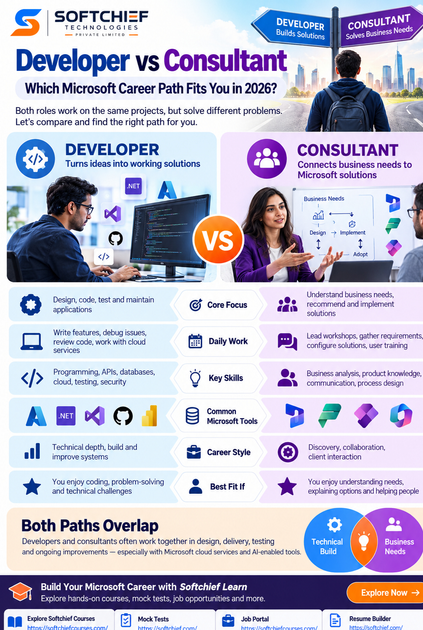
Developer vs Consultant: The core difference is what you own
Titles vary by employer, so read job descriptions closely. In practical terms, developers take greater responsibility for how a solution works, while consultants focus on how it meets a business need. Both may contribute to design, delivery, and later improvements.
Developers turn requirements into working software
Developers design, code, test, connect, and maintain applications. Depending on the role, they might use .NET, Azure, GitHub, or Microsoft Power Platform. Their work can include fixing bugs, improving speed, and making sure a system is secure and reliable.
Consultants connect business problems to Microsoft solutions
Consultants learn how a team works, gather requirements, recommend an approach, and help put it into use. They may configure Dynamics 365 or Power Platform, plan user training, and keep business and technical teams aligned. Functional consultants tend to focus on business processes and product setup; technical consultants may also handle integrations, code, and system design.
The project lifecycle shows where the paths overlap
A project may begin with discovery: what problem needs solving, and how will the team know the solution works? Consultants often guide those discussions, while developers help assess what can be built and how. During delivery, both may review designs, test changes, and respond to feedback.
Microsoft’s published customer stories, including its coverage of Toyota Motor North America and Power Platform, offer real project material to study. Look for how the business need, technical work, and user adoption fit together. That can help you see how distinct roles contribute without assuming every project follows the same pattern.
Developer vs Consultant: Your daily work depends on how you like to solve problems
Work varies by employer, product, project stage, and seniority. An in-house developer may spend more time with one product team, while a consultant may move among client teams. Neither role is free of meetings or hands-on work.
A developer’s week centers on code and quality
A developer may write features, review code, debug faults, and run automated tests. They also discuss system design with teammates and coordinate with product or platform staff. The work often allows for focused technical time, but changes still require clear communication and joint decisions.
A consultant’s week centers on discovery and delivery
A consultant may lead client workshops, map business processes, give demos, write project documents, or configure a product. Training and project meetings can take up much of the week, especially near launch. Travel and client contact depend on the company and role; some consultants work mostly online or with internal teams.
Public project stories help clarify the work
When reading a Microsoft customer story, trace the steps: the original need, the changes to the Microsoft product, and how people learned to use it. A developer’s contribution may show up in the build or integration details; a consultant’s may appear in process design, configuration, or rollout. Use the story as a source of real project context, not as a template for every job.
Developer vs Consultant: The skills you need depend on your strengths
Both careers call for curiosity, careful problem-solving, and steady learning. The difference is where you build depth: developers often go deeper into software engineering, while consultants often learn more about business processes and product use. Each path still needs technical knowledge and clear communication.
Developers need strong engineering basics
Useful skills include programming, data structures, APIs, databases, testing, version control, security, and cloud concepts. A role focused on Azure development may call for different depth than one centered on .NET or Power Platform. Technical skill matters, but so does understanding what users need and explaining design choices.
Consultants need discovery and product knowledge
Consultants need to listen well, ask clear questions, analyze requirements, and explain trade-offs. They also need to document decisions, lead discussions, and help people adjust to new ways of working. Learning a specific Microsoft area, such as Dynamics 365, Microsoft 365, Azure, or Power Platform, can help you build useful expertise.
Certifications can guide study, but projects show how you work
Microsoft Learn offers role-based certification paths and Applied Skills credentials. Check the current names, exam details, and requirements before choosing one, since offerings can change. Match a credential to the roles you want, then pair study with a project you can show or explain.
Career prospects depend on specialization and location
Neither path is always better paid or more secure. Pay and job options vary by location, industry, seniority, product expertise, and whether the employer hires for internal teams or client work. Your ability to show useful results also matters.
Compare job postings in your target market
Review current listings in the place where you plan to work. Note which tools appear, what tasks fill the role, how much experience employers ask for, and whether salary ranges are listed. Compare several developer and consultant roles rather than relying on broad assumptions about either title.
Show outcomes, not only tools or credentials
Developers can show code samples, shipped features, reliable systems, or verified improvements to a product. Consultants can describe delivery results, process changes, user adoption, or stakeholder feedback when they have permission to share those details. Keep examples specific and honest; a certificate alone won’t show how you solve a real problem.
AI and low-code tools are changing tasks, not defining a career
AI-assisted coding and low-code features can affect how teams build, test, and configure solutions. The effect depends on the product and employer, so check current Microsoft documentation and recent job postings for the tools and skills a role expects. In either path, judgment, business context, and the ability to check a tool’s output remain useful.
Choose the Microsoft career path that fits your preferred work
A good choice comes from the problems you want to solve each week, not from which title sounds more impressive. Try both kinds of work before you commit to a narrow specialty. A small project can reveal more than assumptions about the job.
Developer roles may fit you if you enjoy technical depth
You may prefer development if you like building, debugging, and improving systems, and you’re willing to spend sustained time with code. You’ll still need to understand business goals and work well with other people. Technical focus doesn’t mean working alone.
Consultant roles may fit you if you enjoy discovery and collaboration
Consulting may suit you if you like asking questions, translating needs, explaining options, and helping people adopt a new system. Technical consultants may also configure products, connect systems, or extend solutions with code. Client-facing work can bring variety, along with regular meetings and shifting priorities.
Test both paths with a short project
Use Microsoft Learn resources to build a small app or feature, then try a requirements exercise for a business process. For the first, note how you feel about coding and testing; for the second, track your interest in asking questions and shaping a solution. Compare your reactions with real entry-level job postings for both paths.
Conclusion: Choose the work you want to do every day
Developers mainly build and maintain technical solutions. Consultants mainly connect business needs to solution design and adoption, though many roles combine both. Specialization, hands-on evidence, and local job research can matter as much as the title.
Compare current Microsoft job listings, try one small build and one solution-design exercise, and talk with people doing the work. Then choose the path whose daily problems match your strengths and interests.