Reliable Event-Driven Applications: Design for Safe Recovery
Introduction
An order event can reach a shipping service in seconds, while payment checks run on their own schedule. That freedom makes event-driven applications easier to scale and change. But a queue or broker alone can’t guarantee reliable results.
Events can arrive late, more than once, out of order, or not at all. A producer may save a database change and fail before publishing its event. A consumer may complete a task, then crash before confirming it. Reliability depends on how every part of the system handles these failures.
Good design protects data, keeps key services available, and makes recovery predictable. The practices below help you set clear guarantees, replay events safely, manage backlogs, and spot trouble before it harms users.
Reliable Event-Driven Applications start with clear guarantees
Choose requirements before comparing brokers. Start with the business outcome: Can a customer be charged twice? How long can an order wait before a delay becomes a problem? Answers shape the safeguards your system needs.
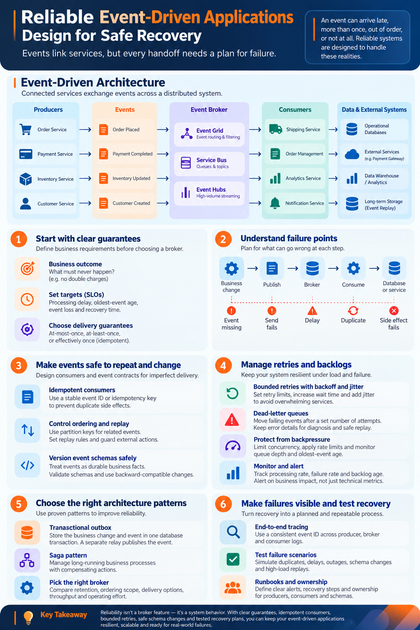
Set delivery and processing guarantees
At-most-once delivery avoids duplicates but can lose events. At-least-once delivery retries until processing succeeds, but may send the same event more than once. “Effectively once” means repeated delivery still produces one business outcome, usually through idempotent consumer logic.
A broker’s delivery setting can’t ensure exactly-once results across a database and an outside service. If a payment call succeeds but the response times out, the consumer may not know whether to try again. Design the payment operation to accept a stable idempotency key.
Find failure points in the event flow
Follow an event from creation to its final side effect. Check what happens if the producer fails before publishing, the broker delays delivery, or the consumer crashes during work.
Business change -> Publish -> Broker -> Consume -> Database or service
       |              |         |         |               |
   event missing   send fails  delay    duplicate       side effect
Set targets that reflect business impact
Set service-level objectives (SLOs) for processing delay, oldest-event age, event loss, and recovery time. For example, a team might set a target for most orders to process within one minute. Treat that as a business choice, not a universal rule.
A clear target helps teams choose safeguards and alerts. It also avoids promising perfect uptime when the useful goal is fast, correct recovery.
Make events safe to repeat and change
Consumers and event contracts decide whether retries and replays are safe. Build them to preserve the intended business result when delivery is imperfect.
Make consumers idempotent
Give each event or business operation a stable ID. A consumer can store processed IDs and skip duplicates, or use a conditional database write that applies a change only once. Keep the record and business update in the same transaction where possible.
Start with the action that must happen once, such as issuing a refund. Then protect that action with an idempotency key or a duplicate check. Don’t rely only on broker settings.
Control ordering and replay
Order matters when events change the same record. A partition key based on an order or account ID can keep related events in sequence, depending on the broker. Global ordering can limit throughput, so preserve order only where the business requires it.
Set replay rules before an incident. Use checkpoints, limit replay speed, and guard external actions such as sending email or charging a card. A replay should repair state without repeating an irreversible action.
Version event schemas safely
Treat events as durable business facts, such as OrderPlaced, rather than copies of a producer’s database row. Validate schemas and test changes against the producers and consumers that use them. Add optional fields with safe defaults when your format allows it.
Schema compatibility rules vary by format and setting. Confluent’s schema evolution guide explains backward, forward, and full compatibility, including the limits of each. Check the rules your team has set before changing a shared event.
Keep retries and backlogs from becoming outages
Retries help with brief faults, but uncontrolled retries can add load when a service is already struggling. A growing backlog can also delay useful work long after the first failure.
Use bounded retries with backoff and jitter
Set a retry limit and increase the wait between attempts. Add jitter, a small random delay, so many consumers don’t retry at the same moment. Match the policy to the error: a temporary timeout may merit another try, while invalid data needs repair.
The AWS Builders’ Library guidance on timeouts, retries, and backoff with jitter warns that retries can increase load on a failing service. Avoid immediate, unlimited retries, and don’t let every layer retry the same call.
Quarantine messages that keep failing
After a set number of attempts, move a failing event to a dead-letter queue. Keep its event ID, error details, attempt count, and relevant timestamps so the team can diagnose the cause.
A dead-letter queue needs an owner, an alert, and a safe replay process. Fix the cause first, then test the repaired event before returning it to normal processing. Otherwise, the queue becomes storage for problems no one sees.
Protect services from backpressure
Limit consumer concurrency and apply rate limits when downstream systems have fixed capacity. Scale workers carefully; more consumers won’t help if they overload a database or payment API. Track both queue depth and the age of the oldest event, since a small queue can still contain work that is too late.
For an operational view of backlog risks, consult AWS Builders’ Library’s Avoiding insurmountable queue backlogs. Set alert thresholds around the delays your business can accept.
Make failures visible and recovery testable
Good design needs signals that show where work stopped and what a responder should do next. Logging, metrics, tests, and runbooks turn recovery into planned work.
Trace events from publish to outcome
Use a consistent event ID or trace ID in producer logs, broker metadata, and consumer logs. Record publish failures, processing time, retries, duplicates, and backlog age. These signals help responders tell a slow consumer from a failed publisher.
Test failures and recovery paths
Test duplicate delivery, delayed processing, broker outages, consumer crashes, schema mismatches, and downstream timeouts. Also test replay and recovery under load. A happy-path integration test can’t show whether a consumer repeats a payment after a timeout.
Give responders clear alerts and runbooks
Alert on business impact, such as a stalled checkout flow or an aging order backlog. A useful runbook explains how to pause consumers, inspect dead-letter events, scale without flooding dependencies, and confirm that processing has recovered.
Choose architecture patterns that support reliable delivery
Select infrastructure to match your guarantees, workload, and team’s ability to operate it. No broker removes the need for safe consumers and clear ownership.
Compare brokers by the guarantees you need
Compare retention, ordering scope, delivery options, throughput, and operating effort. Check current vendor documentation for product-specific guarantees; features differ across services and configurations. Pick the simplest option that meets the system’s real needs.
Use an outbox to avoid lost events
A service that updates a database and publishes an event faces a dual-write risk. The database update may commit while publishing fails, or publishing may succeed before the database transaction rolls back.
The transactional outbox stores the business change and event in one database transaction. A separate relay publishes the saved event. The relay may publish twice if it crashes at the wrong moment, so consumers still need duplicate protection. See the transactional outbox pattern for its design and trade-offs.
Assign ownership for contracts and operations
Name owners for each producer, consumer, schema, and shared broker. Teams should know who can approve a contract change and who responds when processing stalls. Clear ownership shortens incident handoffs and makes routine checks less likely to be missed.
Conclusion
Reliable event-driven applications accept that delivery can fail, repeat, or arrive late. They protect business outcomes with clear guarantees, idempotent consumers, bounded retries, safe schema changes, and tested recovery plans.
For your next system review, check the delivery guarantee, identify the action that must happen only once, inspect the oldest-event alert, and rehearse a replay. Those steps turn reliability from a broker feature into a system behavior.