Failure Handling in Event-Driven Systems: Recover Without Losing Events
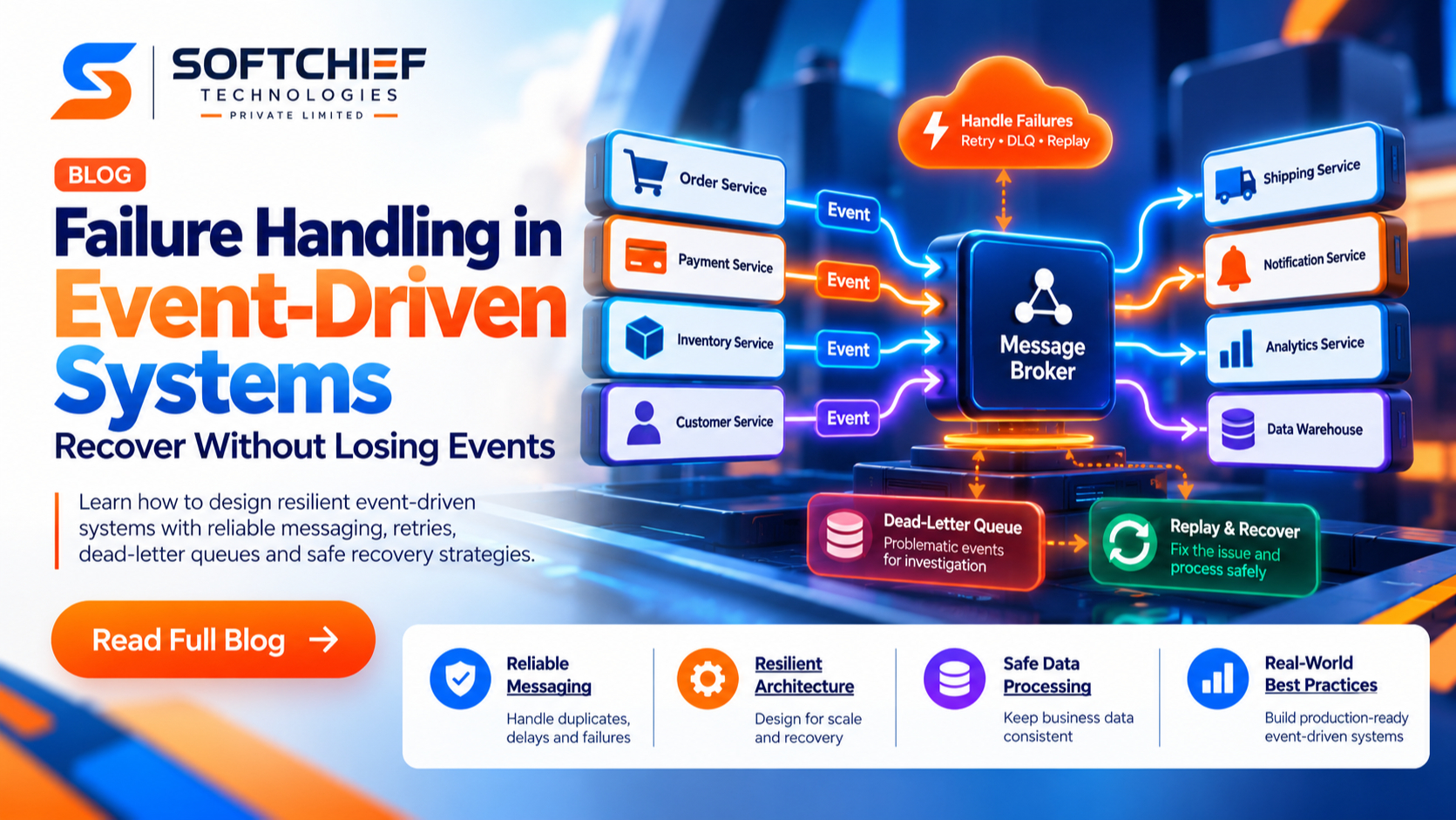
Introduction
An order event can arrive twice, show up late, or fail after a payment has already gone through. That can leave a customer with a charged card and no order confirmation, while downstream services wait for updates that never arrive.
Failure handling in event-driven systems takes more than a retry setting. Producers, brokers, consumers, and operations teams all shape what happens when something breaks. Good design makes failures visible, limits their impact, and gives teams a safe way to recover.
Failure Handling in Event-Driven Systems Starts With Delivery Guarantees
Before choosing a retry policy, define what counts as successful processing. Is it enough to write a database row, or must a payment, email, and inventory update also finish? The answer affects how you handle lost messages and duplicates.
Match delivery semantics to business impact
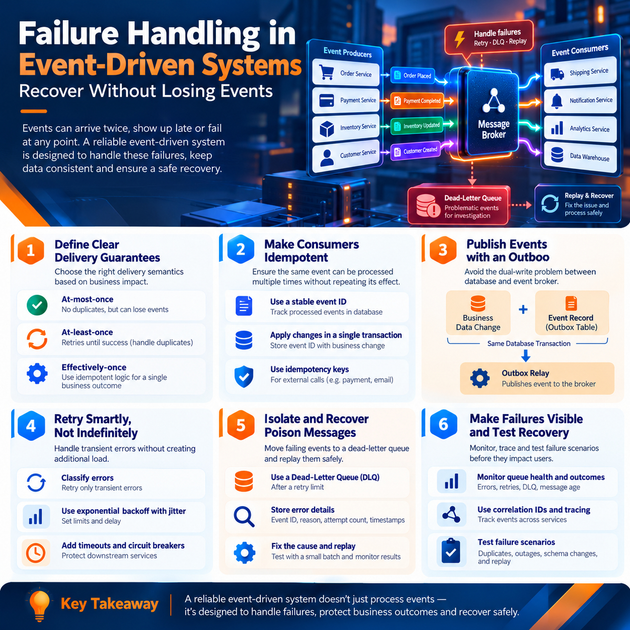
At-most-once delivery avoids duplicates but can lose a message if failure happens at the wrong moment. At-least-once delivery tries again until processing succeeds, so consumers must expect duplicates. “Exactly once” usually applies within a defined broker or transaction boundary, not automatically across every service and external action.
For example, a broker transaction may keep a message and its offset in sync. It can’t by itself guarantee that an outside payment provider charged a card only once. Apache Kafka Connect’s exactly-once documentation also notes that support depends on the connector.
Make consumers idempotent
An idempotent consumer can process the same event more than once without repeating its effect. Give each event a stable ID, then store that ID with the database change in one transaction. A repeat delivery can be recognized and skipped.
Cover external side effects too. Before charging a card or sending a request to another service, use an idempotency key if the service supports one. Acknowledging a message only once won’t prevent a duplicate charge if the consumer crashes after the charge but before the acknowledgement.
Publish events with an outbox
A service can save an order to its database and then fail before publishing the order event. The reverse can also happen: the event is published, but the database transaction fails. This dual-write problem leaves services with conflicting views.
With the transactional outbox pattern, the service saves its data change and an event record in the same database transaction. A separate relay sends the event to the broker afterward. AWS’s transactional outbox guidance describes this approach and notes that consumers still need to handle duplicates.
Retry Transient Errors Without Creating a Storm
Retries help when a problem may clear on its own, but repeated calls can add strain to a failing service. A clear policy should say which errors get another try, how long retries continue, and what happens after the limit.
Classify errors before retrying
A brief network outage or a busy dependency may recover soon, so another attempt can help. Invalid data, a missing required field, or an unsupported event version won’t improve with repeated attempts. Treat those as permanent errors and send them for review or correction.
Define error categories in code and pair each category with a response. This avoids retrying every failure in the same way and wasting time on messages that need a code or data fix.
Set limits, backoff, and jitter
Use exponential backoff to increase the wait between attempts, then set a maximum delay and attempt count. Add jitter, a small random change to the wait time, so many consumers don’t retry together after a shared outage. Set these limits around the workflow’s allowed delay and the dependency’s recovery needs.
Add timeouts and circuit breakers
A timeout stops a consumer from waiting forever on a slow service. A circuit breaker pauses calls after repeated failures, giving the service time to recover before requests resume. These controls limit pressure on dependencies, but they don’t replace durable messages, retries, or a recovery plan.
Isolate Poison Messages and Replay Them Safely
A poison message fails every time, often because its data is invalid or a consumer can’t read its schema. Leaving it on the main queue may block useful work or consume resources with repeated attempts. Move it aside with enough context to diagnose the cause.
Send exhausted messages to a dead-letter queue
A dead-letter queue (DLQ) holds messages that exceed a retry limit or can’t be processed. Amazon SQS uses a redrive policy to set the receive limit before moving a message to a DLQ. Its DLQ documentation also warns that moving messages can affect order in FIFO workflows.
Kafka Connect can log processing errors or send failed records to a configured DLQ topic. Its error-reporting guide shows that behavior depends on connector settings. A DLQ is a holding place, not a promise that every platform handles order, retention, or redelivery the same way.
Keep enough details to investigate
Store the original payload when policy allows, plus the event ID, error reason, attempt count, and timestamps. Add the trace or correlation ID so teams can follow the event across services. When payloads contain personal or sensitive data, limit access and set a retention period.
Replay only after fixing the cause
First find and fix the issue, then replay a small batch and watch the results. Idempotent consumers help prevent repeated side effects during recovery. If the event itself contains invalid data, don’t replay it unchanged; correct the source data and issue a valid event through an approved process.
Keep Business Workflows Consistent Across Services
A broker acknowledgement confirms a message was handled at one point in the flow. It doesn’t prove that the full business process completed, especially when several services and databases are involved.
Acknowledge after durable work
A consumer should acknowledge only after its required database update or other durable action succeeds. If it acknowledges first and then crashes, the message may be gone while the work remains incomplete. If it completes the work but crashes before acknowledging, the broker may redeliver the event, so idempotency still matters.
Coordinate long-running work with sagas
A saga tracks a business process across services through events or commands. If a later step fails, the workflow can run a compensating action, such as refunding a payment after inventory can’t be reserved. Compensation is a new business action, not a technical rollback that erases every earlier change.
Plan for order and schema changes
Ordering matters when later events depend on earlier state changes. Partitioning messages by an entity key can preserve order for that entity, but events may still arrive late or more than once. Use sequence numbers or version checks when consumers must detect stale updates.
Schema changes need the same care. Keep old event versions readable where possible, and check compatibility before removing or changing fields that existing consumers expect. This reduces failures when producers and consumers deploy at different times.
Make Failure Recovery Visible and Repeatable
A queue that accepts messages can still hide a broken customer workflow. Monitor both the transport layer and the result the customer expects, such as an order reaching “paid” or “shipped” status.
Monitor queue health and outcomes
Track consumer errors, retry counts, DLQ volume, message age, and processing time. Pair these with business signals, such as orders stuck in payment or inventory steps. Set alerts based on service goals and customer impact, not only on whether a queue has messages.
Trace events across services
Include a correlation ID in event metadata and pass it from producer to consumer. Distributed traces and structured logs can then connect a failed downstream action to its original event. Keep key fields consistent so teams don’t have to search several systems by hand.
Test failure paths before release
Test duplicate delivery, consumer crashes, dependency outages, malformed events, and broker interruptions. Practice DLQ replay in a safe environment and keep a runbook with recovery steps and ownership. Periodic recovery exercises reveal gaps before a production incident does.
Conclusion
Failure handling in event-driven systems depends on clear delivery expectations, idempotent consumers, bounded retries, and safe DLQ recovery. Durable processing, saga design, schema planning, and business-level monitoring help keep the full workflow consistent when a service fails.
Start with one critical workflow. Map where an event can be lost, repeated, delayed, or rejected; assign a recovery policy to each failure; then test those policies and review them with the operations team.