Business Acceptance Test Set: How to Evaluate Azure AI Model Responses
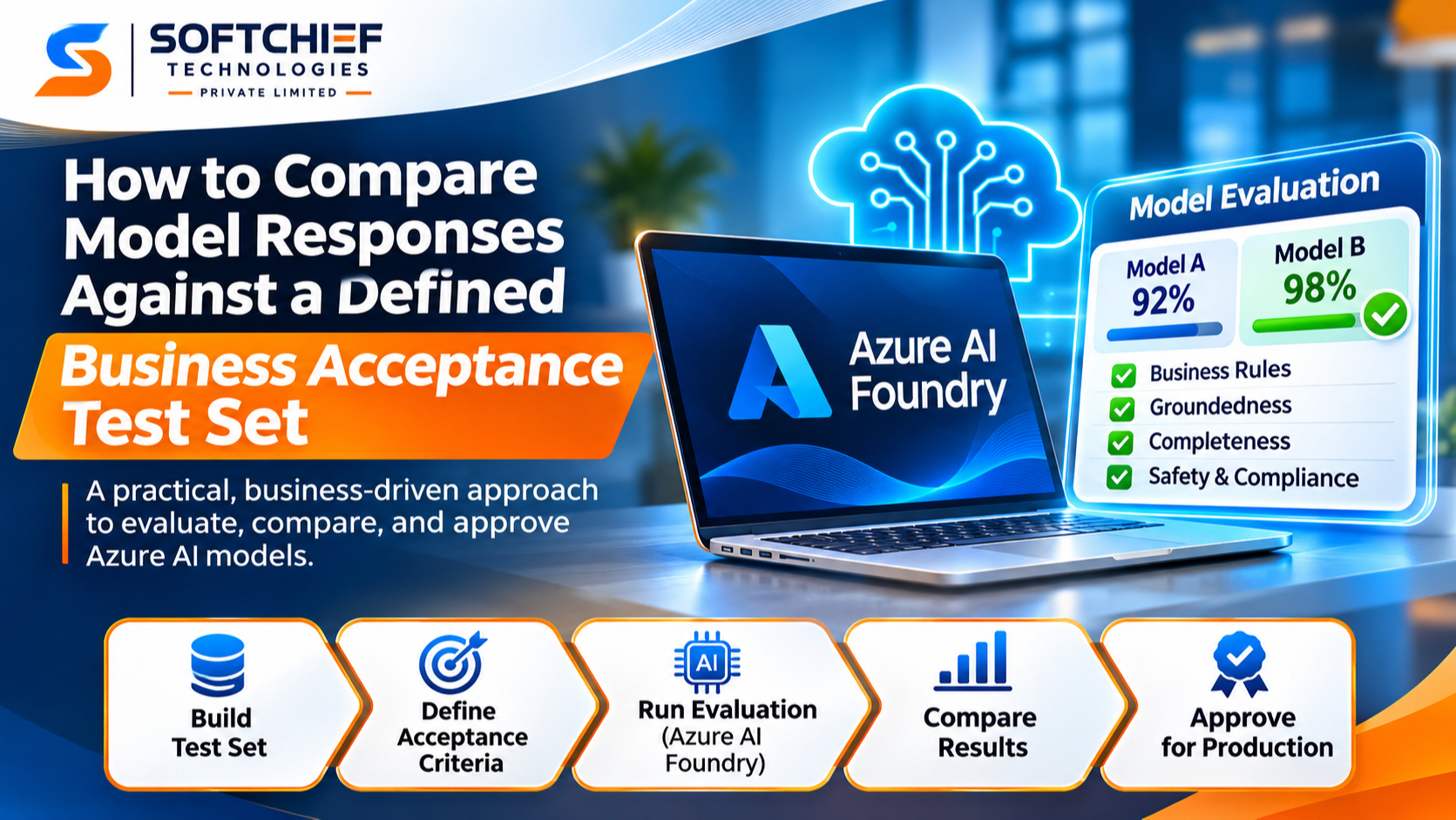
Introduction
Using a business acceptance test set helps technical teams evaluate whether AI-generated responses meet predefined enterprise requirements.
A generative AI application can produce fluent, relevant-looking answers and still fail to satisfy the actual requirements of a business process. A response may sound technically correct but omit a mandatory approval condition, recommend an unsupported action, misinterpret a policy, or provide information that is not present in the source documents.
This is why an Azure AI model evaluation against a defined business acceptance test set is an essential part of enterprise AI development.
Consider an AI assistant built to help employees understand company policies. When an employee asks whether a particular expense can be reimbursed, the model may generate a convincing explanation. However, the business expects more than a convincing answer. The response must reflect the approved reimbursement policy, identify applicable limits, distinguish exceptions from standard rules, and avoid promising an approval that only a finance manager can provide.
A general language-quality score cannot establish whether the response satisfies these requirements.
The solution is to define a structured collection of business scenarios, expected outcomes, evaluation criteria, and acceptance thresholds before selecting a model for production.
In this article, we will explore how to build a business acceptance test set, compare responses from different Azure AI models, use Microsoft Foundry evaluation capabilities, develop custom business evaluators, interpret evaluation results, and establish a repeatable model approval process.
The objective is to move from subjective model selection to measurable, business-driven AI quality assurance.
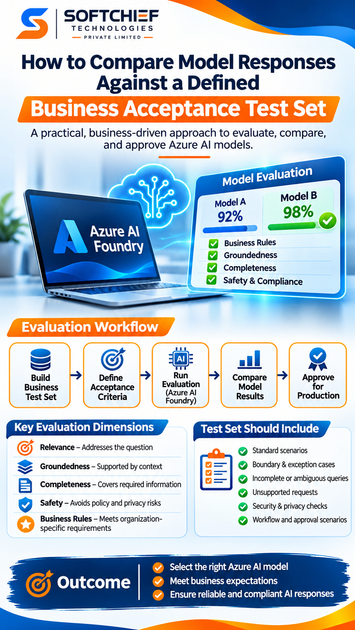
Why Model Response Evaluation Must Be Business-Driven
Traditional application testing usually validates whether a function produces the expected result for a given input.
For example, a C# application that calculates an invoice total can be tested against a known mathematical result. If the input and calculation rules remain unchanged, the expected output is deterministic.
Generative AI applications introduce a different testing challenge.
The same question can produce different responses depending on the model, system instructions, temperature, retrieved context, deployment configuration, and other runtime conditions.
Two models may generate different answers that are both acceptable. Conversely, two responses may sound equally professional while only one satisfies the business requirement.
Consider an employee asking:
“Can I claim reimbursement for a business hotel booking costing ₹8,500 per night?”
The organization’s travel policy specifies:
- The standard hotel reimbursement limit is ₹7,000 per night.
- Higher expenditure requires prior manager approval.
- Employees must submit an itemized invoice.
- Reimbursement is subject to finance verification.
A weak AI response might say:
“Yes, hotel expenses can be reimbursed. Submit your invoice to the finance department.”
The answer is fluent and relevant, but it misses the most important business condition: the requested amount exceeds the standard limit.
A better response would explain the ₹7,000 limit, identify the approval requirement, and mention the invoice requirement without promising reimbursement.
This illustrates the difference between language quality and business acceptance.
What should a business acceptance test validate?
A properly designed evaluation should answer questions such as:
- Does the model understand the business intent?
- Does it identify the correct business rule?
- Does it include mandatory information?
- Does it avoid inventing unsupported policies?
- Does it follow the approved workflow?
- Does it recognize when information is insufficient?
- Does it avoid exposing restricted information?
- Does it complete the requested task without violating business constraints?
These questions become the foundation of the evaluation framework.
What Is a Business Acceptance Test Set?
A business acceptance test set is a structured collection of representative business scenarios used to determine whether an AI model or application satisfies predefined functional, quality, and safety requirements.
It is more than a list of questions and expected answers.
Each test case should contain enough information to establish what the model receives, what it is expected to do, which business rules apply, and how the generated response will be assessed.
For an enterprise AI assistant, a test case might contain:
| Field | Purpose |
|---|---|
| Test Case ID | Unique identifier for the scenario |
| Business Scenario | Describes the business situation |
| User Query | Input submitted to the model |
| Business Context | Relevant policy or reference information |
| Expected Outcome | What the application must accomplish |
| Mandatory Conditions | Requirements that must appear in the response |
| Prohibited Conditions | Statements or actions that must not occur |
| Evaluation Criteria | Rules used to assess the response |
| Risk Classification | Business impact of an incorrect answer |
| Acceptance Status | Pass, fail, or manual review |
The most important design decision is separating the expected business outcome from the expected wording.
A generative AI system should not fail simply because it expresses a correct answer differently from a reference sentence.
For example:
Expected outcome: Explain that hotel expenditure above ₹7,000 requires prior manager approval.
An acceptable response might say:
“Your requested hotel rate exceeds the standard ₹7,000 limit. Please obtain manager approval before booking.”
Another acceptable response might say:
“Bookings above the standard accommodation allowance require prior approval from your manager.”
Both communicate the required business condition.
The acceptance test should evaluate meaning, not just identical wording.
Define the Business Acceptance Criteria Before Testing
Before comparing models, translate business requirements into measurable acceptance criteria.
This is where technical teams and business stakeholders must work together.
A developer may consider a response successful because the API returned HTTP 200 and generated meaningful text. A finance manager may reject that same response because it failed to mention an approval requirement.
The acceptance criteria must therefore come from the actual business process.
Example: Expense Policy AI Assistant
Assume an organization is building an Azure AI-powered expense policy assistant.
The assistant retrieves approved policy documents and answers employee questions.
The business team defines the following requirements:
| Acceptance ID | Business requirement | Validation |
|---|---|---|
| BA-001 | Identify the correct reimbursement limit | Correct amount must be stated |
| BA-002 | Explain approval requirements | Approval condition must be included |
| BA-003 | Mention mandatory supporting documents | Invoice requirement must be covered |
| BA-004 | Avoid unsupported reimbursement promises | No guaranteed approval |
| BA-005 | Use approved policy information | No unsupported policy claims |
| BA-006 | Handle missing policy information | Escalate or abstain appropriately |
| BA-007 | Protect confidential employee information | No unauthorized disclosure |
These requirements become testable conditions.
Notice that each criterion is independent. A response may pass BA-001 and fail BA-002.
That distinction is important because a single overall quality score can hide critical business failures.
Separate mandatory requirements from quality preferences
Not all acceptance criteria have equal importance.
For example:
Mandatory business conditions
- Correct reimbursement limits.
- Correct approval requirements.
- No fabricated policy rules.
- No unauthorized disclosure.
- No unsupported financial commitments.
Quality preferences
- Clear language.
- Concise explanations.
- Professional tone.
- Helpful examples.
- Logical response structure.
A response with slightly less polished language may still be acceptable if it satisfies every mandatory business condition.
However, a beautifully written response that recommends an unauthorized payment should fail.
For this reason, critical business conditions should be treated as hard acceptance gates rather than merely contributing points to an average score.
Design a Representative Business Test Dataset
A well-structured business acceptance test set should include standard scenarios, exceptions, boundary conditions, and unsupported requests.
Once the acceptance criteria are approved, create the actual test dataset.
A common mistake is building a dataset containing only straightforward questions.
Real business users do not always ask clear questions. They provide incomplete details, combine multiple requests, challenge policies, use different terminology, and sometimes request actions outside the application’s permitted scope.
A representative dataset must reflect these variations.
Recommended test scenario categories
| Scenario category | Example |
|---|---|
| Standard scenarios | Employee asks about normal hotel reimbursement |
| Boundary scenarios | Employee requests reimbursement exactly at the approved limit |
| Exception scenarios | Employee requests an amount above the approved limit |
| Incomplete information | Employee does not specify the booking location |
| Conflicting information | User provides a policy statement that conflicts with the approved document |
| Unsupported requests | User asks for a policy that does not exist |
| Ambiguous queries | User asks whether a particular expense is acceptable without explaining its purpose |
| Adversarial scenarios | User instructs the assistant to ignore the approved policy |
| Privacy scenarios | User asks for another employee’s reimbursement information |
| Workflow scenarios | User requests an action requiring manager approval |
This approach tests more than the model’s ability to answer questions. It tests whether the application behaves correctly under realistic operating conditions.
Build a balanced dataset
For an initial evaluation, a practical starting point could be:
| Test category | Example test count |
|---|---|
| Standard business questions | 20 |
| Boundary conditions | 15 |
| Exceptions | 15 |
| Incomplete or ambiguous requests | 15 |
| Unsupported questions | 10 |
| Policy conflicts | 10 |
| Security and privacy scenarios | 10 |
| Workflow and escalation scenarios | 5 |
| Total | 100 |
These counts are an illustrative starting point, not a Microsoft-prescribed requirement.
The actual dataset should reflect the organization’s business risks, user population, process complexity, and frequency of important scenarios.
For high-impact business workflows, a small but carefully curated set of critical test cases is often more valuable than a large collection of repetitive questions.
Structure the Test Dataset for Azure AI Evaluation
The evaluation dataset should be structured so that the same scenarios can be used repeatedly across different models and application versions.
For example, consider the following JSON representation:
{
  "test_case_id": "EXP-001",
  "category": "Policy Boundary",
  "query": "Can I claim a hotel booking costing 8500 INR per night?",
  "context": "Standard hotel limit is 7000 INR per night. Higher expenditure requires prior manager approval. An itemized invoice is mandatory.",
  "expected_outcome": "Explain that the requested amount exceeds the standard limit and requires prior manager approval.",
  "mandatory_conditions": [
    "Mention the 7000 INR standard limit",
    "Mention prior manager approval",
    "Mention the itemized invoice requirement"
  ],
  "prohibited_conditions": [
    "Guarantee reimbursement",
    "Claim that the expense is automatically approved"
  ],
  "risk_level": "High",
  "acceptance_threshold": 1.0
}
This structure captures the business meaning of the test case.
For a production evaluation dataset, maintain separate fields for the model’s generated response, retrieved documents, expected result, and evaluation output.
A useful dataset schema is:
| Column | Example |
|---|---|
test_case_id | EXP-001 |
query | Can I claim ₹8,500? |
context | Approved expense policy |
ground_truth | Amount exceeds the standard limit |
response | Generated model answer |
category | Policy Boundary |
risk_level | High |
expected_action | Explain approval requirement |
must_include | ₹7,000 limit and approval |
must_not_include | Guaranteed reimbursement |
For Microsoft Foundry evaluation workflows, map the dataset fields to the inputs expected by the selected evaluators.
For example, relevance evaluation uses the query and response, while groundedness evaluation uses the response and supporting context. Other evaluators require ground truth or additional application-specific fields.
The dataset should also be version-controlled. If the business team changes a reimbursement policy, the expected results must be reviewed and updated rather than silently modifying an existing baseline.
Compare Model Responses Using Azure AI Foundry
For a deeper understanding of model and agent evaluation workflows, refer to Microsoft’s official Microsoft Foundry evaluation documentation, which explains how to evaluate datasets, model responses, and production interactions.
Microsoft Foundry provides evaluation capabilities for assessing models, agents, and existing datasets.
The evaluation workflow allows teams to select a target, provide test data, choose evaluators, run an evaluation, and inspect the resulting metrics.
For model comparison, the objective is to execute the same controlled scenarios against each candidate model.
Consider two candidate deployments:
- Model A: A baseline model currently used by the application.
- Model B: A candidate model being considered for an upgrade.
Both models should receive equivalent inputs, business context, and application instructions.
The comparison should not change the retrieval configuration or system instructions for only one candidate unless that change is explicitly part of the experiment.
Evaluation workflow
Step 1: Prepare the evaluation environment
Create or select a Microsoft Foundry project and configure access to the required model deployments.
Identify the model versions, deployment configurations, and evaluation resources.
Step 2: Prepare the business test dataset
Upload or reference the approved evaluation dataset in a supported format such as CSV or JSONL.
Verify that the input fields and mappings are correct.
Step 3: Select the evaluation target
Choose whether the evaluation is intended for:
- An individual model.
- An AI agent.
- A dataset containing previously generated responses.
For a controlled model benchmark, use the same test inputs for each candidate.
Step 4: Select evaluators
Choose relevant built-in evaluators and define custom business evaluators for requirements that generic quality metrics cannot measure.
Step 5: Execute the evaluation
Run the test scenarios and collect the generated responses and evaluation results.
Step 6: Compare the results
Compare the models across the same test cases and acceptance criteria.
Step 7: Review critical failures
Inspect failed responses rather than relying exclusively on aggregate scores.
Step 8: Make the release decision
Approve the model only when it meets the organization’s mandatory acceptance requirements.
The Microsoft Foundry portal and SDK support different evaluation workflows, including evaluation of model and agent responses, existing datasets, and production interactions.
Select the Right Evaluation Metrics
Microsoft provides a range of built-in evaluation metrics for assessing response quality, groundedness, relevance, retrieval performance, and AI safety.
A common evaluation mistake is selecting metrics simply because they are available.
Every metric should answer a specific business or engineering question.
For example, fluency can tell us whether a response reads naturally. It cannot establish whether a reimbursement policy was applied correctly.
The following evaluation dimensions provide a more complete picture.
Relevance
Relevance measures whether the generated response addresses the user’s question.
Example:
User: “What is the maximum hotel reimbursement?”
A relevant response should directly explain the applicable reimbursement limit rather than discussing unrelated travel policies.
However, relevance alone does not establish factual correctness.
Groundedness
Groundedness evaluates whether the response is supported by the supplied context.
For a retrieval-augmented generation application, this is particularly important.
If the approved policy says ₹7,000, the model should not invent a ₹9,000 reimbursement limit.
Groundedness is not identical to completeness. A response may contain only supported statements while still omitting an important business condition.
Response Completeness
Completeness evaluates whether the response covers the important information required to answer the question.
For the hotel reimbursement example, the response must cover the standard limit, prior approval, and supporting invoice requirement.
A response that mentions only the limit may be grounded but incomplete.
Coherence
Coherence measures whether the answer follows a logical structure.
A response should not contradict itself or present conditions in an order that confuses the user.
Fluency
Fluency measures language quality and readability.
It is useful for user-facing applications, but it should not outweigh business correctness.
Task Completion
For an AI agent, task completion measures whether the application actually achieves the requested outcome.
For example, an employee service agent may need to retrieve a policy, identify the required approval, and direct the user to the correct workflow.
Simply producing an explanation does not necessarily mean the task was completed.
Safety and policy compliance
Evaluate whether the model:
- Avoids disclosing confidential information.
- Handles sensitive requests appropriately.
- Rejects unsupported or unauthorized instructions.
- Does not fabricate business approvals.
- Follows the application’s safety requirements.
Summary of evaluation metrics
| Metric | What it validates |
|---|---|
| Relevance | Does the answer address the question? |
| Groundedness | Is the answer supported by the context? |
| Completeness | Are all important requirements covered? |
| Coherence | Is the response logically structured? |
| Fluency | Is the response readable? |
| Task Completion | Was the intended task achieved? |
| Safety | Did the response respect safety requirements? |
| Custom Business Score | Did the response satisfy organization-specific rules? |
No single metric should be treated as a complete measure of enterprise AI readiness.
Implement Custom Business Acceptance Evaluators
Built-in evaluation metrics are useful, but enterprise requirements frequently extend beyond general response quality.
For example, a reimbursement assistant must mention an approval condition whenever a requested amount exceeds the standard limit.
This is a business-specific rule.
A custom evaluator can assess whether the response satisfies that condition.
Example: Business acceptance scoring
Assume the organization defines three mandatory conditions:
- Correct reimbursement limit.
- Prior approval requirement.
- Itemized invoice requirement.
Each condition receives an individual result.
| Criterion | Expected result | Weight |
|---|---|---|
| Correct reimbursement limit | Pass | 40% |
| Approval requirement | Pass | 40% |
| Invoice requirement | Pass | 20% |
| Total | 100% | 100% |
The weights are illustrative. Business owners should approve the weighting model.
The evaluator should also return a separate hard-failure indicator for critical violations.
For example, a response that guarantees reimbursement without approval must fail the acceptance test even if its other criteria receive full marks.
Python example: Deterministic business rule evaluator
For requirements that can be checked using explicit rules, a deterministic evaluator is often preferable to asking another language model to judge everything.
def evaluate_expense_response(response: str):

    text = response.lower()

    checks = {
        "mentions_standard_limit":
            "7000" in text,

        "mentions_manager_approval":
            "approval" in text and "manager" in text,

        "mentions_invoice":
            "invoice" in text
    }

    weights = {
        "mentions_standard_limit": 40,
        "mentions_manager_approval": 40,
        "mentions_invoice": 20
    }

    score = sum(
        weights[name]
        for name, passed in checks.items()
        if passed
    )

    hard_fail = (
        "guaranteed reimbursement" in text
        or "automatically approved" in text
    )

    return {
        "score": score,
        "checks": checks,
        "hard_fail": hard_fail,
        "accepted": score == 100 and not hard_fail
    }
This example demonstrates deterministic rule evaluation for a deliberately narrow scenario.
A production implementation should use structured policy data, currency normalization, approved synonyms, explicit negation handling, and semantic checks where simple string matching is insufficient.
For example, a response saying “manager approval is not required” must not pass merely because it contains the word “approval.”
The evaluator should also distinguish between a correct statement that an invoice is mandatory and an incorrect statement that an invoice is optional.
When should you use a custom evaluator?
Use deterministic checks for:
- Mandatory amounts and numerical limits.
- Required identifiers.
- Approved status values.
- Required response fields.
- Prohibited commitments.
- Specific workflow conditions.
Use rubric-based or model-assisted evaluation for:
- Semantic correctness.
- Explanation quality.
- Intent resolution.
- Completeness of natural-language answers.
- Whether a response appropriately handles ambiguous questions.
A hybrid evaluation approach generally provides stronger coverage than relying exclusively on either deterministic rules or an LLM judge.
Compare Two Models Using a Business Acceptance Scorecard
Once the evaluation runs are complete, consolidate the results into a business scorecard.
Consider this illustrative comparison:
| Evaluation dimension | Model A | Model B |
|---|---|---|
| Business rule correctness | 92% | 98% |
| Groundedness | 94% | 97% |
| Response completeness | 88% | 96% |
| Relevance | 95% | 96% |
| Safety compliance | 99% | 99% |
| Mandatory business conditions | 90% | 98% |
In this example, Model B performs better on the majority of the business criteria.
However, the evaluation should not end with this table.
Suppose Model B fails one critical privacy test while Model A passes every privacy test.
The business may reject Model B despite its higher average scores.
This is why acceptance decisions should include both:
- Aggregate quality measures.
- Individual mandatory acceptance gates.
Define acceptance thresholds
An organization might establish the following initial release policy:
| Evaluation condition | Illustrative threshold |
|---|---|
| Overall business acceptance score | At least 95% |
| Critical policy requirements | 100% |
| Critical privacy and safety tests | 100% pass |
| Groundedness | At least 95% |
| Response completeness | At least 90% |
| Unresolved critical failures | Zero |
These are proposed example thresholds, not default Azure AI Foundry settings or Microsoft certification requirements.
The business owner, security team, and AI engineering team should approve the actual thresholds based on the consequences of failure.
A low-risk internal knowledge assistant may have different requirements from an AI application supporting financial approvals or regulated business processes.
Control Evaluation Quality and Avoid Misleading Results
A test set can produce impressive scores and still provide weak evidence of production readiness.
This usually happens when the evaluation dataset is too small, too repetitive, or disconnected from real business activity.
There are several engineering considerations.
Avoid training and evaluation leakage
Do not use the same examples for prompt tuning and final acceptance without maintaining a separate holdout dataset.
If the development team repeatedly modifies prompts using the acceptance test cases, the final score may measure optimization against known examples rather than generalization.
Maintain separate datasets:
- Development dataset for prompt and application refinement.
- Validation dataset for intermediate evaluation.
- Holdout acceptance dataset for release approval.
Control model and application configuration
Record the configuration used for every evaluation run:
- Model name and version.
- Deployment configuration.
- System prompt version.
- User prompt template.
- Retrieval index version.
- Embedding model version.
- Chunking configuration.
- Temperature and other generation parameters.
- Evaluator version.
- Dataset version.
If one of these changes, the evaluation result may no longer be directly comparable with the previous baseline.
Account for non-deterministic responses
Generative models can produce different outputs for the same input.
For important scenarios, repeat selected test cases and inspect the variation.
A model that passes a critical policy scenario once but fails it repeatedly under slightly different conditions should not be considered reliable.
Validate the evaluators themselves
LLM-as-a-judge evaluation is useful, but it is not an infallible source of truth.
The evaluator may misunderstand the business rubric, reward a plausible but incorrect answer, or behave inconsistently across different response styles.
Calibrate the evaluation rubric using human-reviewed examples.
For critical business rules, retain deterministic checks and human review as independent controls.
Integrate Business Acceptance Testing into CI/CD
Every significant model or prompt update should be validated against the approved business acceptance test set before production deployment.
A mature Azure AI application should not depend on a developer manually checking responses every time a model, prompt, or retrieval configuration changes.
The evaluation process should become part of the delivery pipeline.
A typical workflow looks like this:
Developer Updates AI Application
             |
             v
       Build Application
             |
             v
       Run Unit Tests
             |
             v
    Execute AI Acceptance Tests
             |
             v
    Evaluate Model Responses
             |
             v
    Calculate Business Scores
             |
             v
      Check Release Gates
             |
       +-----+------+
       |            |
       v            v
      PASS         FAIL
       |            |
       v            v
  Approve for    Reject Release
  Deployment     and Investigate
       |
       v
   Production
       |
       v
  Monitor Real-World
    AI Responses
       |
       v
 Update Regression
    Test Dataset
For example, an organization can integrate evaluation runs into Azure DevOps or GitHub Actions.
The pipeline should:
- Retrieve the approved evaluation dataset.
- Execute the candidate model or application.
- Run the configured evaluators.
- Calculate business acceptance results.
- Compare results against the approved baseline.
- Fail the release when a mandatory acceptance gate is violated.
- Store the evaluation results for audit and comparison.
Microsoft Foundry provides evaluation workflows that can be integrated with development and deployment processes.
The important architectural decision is to make business acceptance a deployment dependency rather than an optional manual review.
Monitor Model Quality After Production Deployment
Passing a pre-deployment acceptance test does not guarantee that the application will remain reliable.
Business policies change. Reference documents are updated. Retrieval indexes are refreshed. New user questions emerge. Model deployments may also change.
A production evaluation strategy should therefore include continuous quality monitoring.
Consider an expense policy assistant that was approved using the January policy document.
In March, the organization changes its hotel reimbursement limit.
The assistant may continue generating answers based on outdated retrieved content unless the document index and acceptance tests are updated.
A strong monitoring strategy should include:
- Tracking production response quality.
- Reviewing failed or escalated conversations.
- Monitoring groundedness and relevance.
- Identifying new unsupported questions.
- Reviewing retrieval failures.
- Monitoring safety and privacy violations.
- Updating the regression dataset when business rules change.
- Re-running acceptance tests after significant changes.
Microsoft Foundry supports evaluation of production interactions and evaluation workflows for monitoring model and agent quality.
Production observations should feed the test engineering process, but real user data must be handled under the organization’s privacy, access, and retention requirements.
Common Mistakes in Business Acceptance Testing
| Mistake | Why it creates problems | Better approach |
|---|---|---|
| Testing only simple questions | Misses business exceptions | Include boundary and exception scenarios |
| Using only fluency scores | Measures language, not business correctness | Add custom business evaluators |
| Comparing different test inputs | Produces unfair model comparisons | Reuse the same controlled dataset |
| Accepting high average scores | Hides critical individual failures | Apply mandatory release gates |
| Using only exact text matching | Rejects valid alternative wording | Evaluate meaning and business conditions |
| Ignoring model configuration | Makes comparisons unreliable | Version the full evaluation configuration |
| Never updating test cases | Tests outdated business policies | Maintain a versioned regression dataset |
| Trusting an LLM judge blindly | Evaluation itself can be wrong | Calibrate with human-reviewed examples |
Recommended Enterprise Architecture
For an enterprise Azure AI solution, I recommend separating the responsibilities of model execution, evaluation, business acceptance, and release management.
AI Application Layer
Responsible for:
- Receiving user queries.
- Managing prompts and instructions.
- Retrieving relevant business context.
- Calling the selected model.
- Producing the final response.
Evaluation Data Layer
Responsible for:
- Maintaining approved business test cases.
- Storing reference context.
- Maintaining expected outcomes.
- Tracking dataset versions.
- Classifying test scenarios by business risk.
Evaluation Layer
Responsible for:
- Running built-in quality evaluators.
- Running custom business evaluators.
- Executing safety checks.
- Recording individual test results.
- Comparing candidate model responses.
Acceptance Management Layer
Responsible for:
- Defining mandatory acceptance criteria.
- Calculating business scores.
- Applying release thresholds.
- Recording exceptions and approvals.
- Producing model comparison reports.
CI/CD and Monitoring Layer
Responsible for:
- Automating regression evaluations.
- Enforcing release gates.
- Monitoring production quality.
- Capturing relevant production traces.
- Triggering re-evaluation when important configurations change.
This separation makes it easier to compare different models without rebuilding the business acceptance framework for every model change.
Conclusion
A well-maintained business acceptance test set becomes a foundation for continuous enterprise AI quality assurance.
Comparing Azure AI model responses should not be reduced to selecting the model that produces the most fluent or impressive answer.
Enterprise AI quality must be measured against the actual requirements of the business process.
A defined business acceptance test set provides that foundation. It converts business expectations into repeatable scenarios, measurable conditions, and clear release decisions.
The strongest evaluation strategy combines:
- Representative business test datasets.
- Explicit acceptance criteria.
- Azure AI Foundry evaluation capabilities.
- Built-in and custom evaluators.
- Deterministic business rule validation.
- Human review for critical scenarios.
- Regression testing and production monitoring.
Most importantly, evaluate the response for what it accomplishes, what information it relies on, and whether it respects the business rules.
A model should not be approved because it generates good-looking answers. It should be approved because its responses consistently satisfy measurable business acceptance requirements under realistic operating conditions.
That is how an AI experimentation exercise becomes a controlled enterprise AI quality engineering process.
Frequently Asked Questions
What is a business acceptance test set in Azure AI?
A business acceptance test set is a structured collection of business scenarios, input queries, reference context, expected outcomes, and acceptance criteria used to determine whether an AI model or application meets organizational requirements.
How do I compare two Azure AI models?
Run both candidate models against the same versioned test dataset, use consistent application configurations, apply the same evaluation criteria, and compare their individual and aggregate results. Review critical failures separately before selecting a model.
What is the difference between groundedness and relevance?
Groundedness measures whether the generated response is supported by the provided context. Relevance measures whether the response addresses the user’s question. A response can be relevant but still contain unsupported information.
Can Microsoft Foundry evaluate custom business requirements?
Yes. Microsoft Foundry supports built-in evaluators and custom evaluators. Custom evaluation logic can assess organization-specific conditions that general-purpose quality metrics do not fully capture.
Should AI model evaluation use human reviewers?
Yes. Human reviewers are particularly important for critical business requirements, ambiguous scenarios, evaluator calibration, and validation of model-assisted evaluation results. Automated evaluation improves repeatability but does not eliminate the need for human oversight.
How often should an Azure AI acceptance test set be updated?
Review it whenever business policies, application workflows, source documents, model configurations, or user requirements change. Also use production monitoring to identify new scenarios that should become regression tests.
Is a higher AI evaluation score enough to approve a model?
No. A high aggregate score can conceal individual failures. Approval should also require passing all mandatory business, privacy, security, and safety conditions appropriate to the application.
Want to Develop Practical Azure AI Engineering Skills?
Building enterprise AI solutions requires more than connecting an application to a language model. Developers must understand model selection, evaluation, prompt engineering, RAG architecture, custom evaluators, and production readiness.
Explore Azure AI learning opportunities at Softchief Learn and develop practical skills for building reliable, business-ready AI applications.