Certification vs Projects: What Matters More for Your IT Career?
Introduction
If you’re planning to build a successful career in Microsoft Power Platform, Dynamics 365, Azure, C# Full Stack, or any other IT domain, you’ve probably asked yourself this question:
“Should I focus on earning certifications or building real-world projects?”
It’s one of the most common debates among fresh graduates, career switchers, and even experienced professionals.
Some believe certifications are the key to getting interviews. Others argue that projects matter more because they demonstrate practical skills.
So, who is right?
The answer is simple:
Both certifications and projects are essential—but they serve different purposes.
In this comprehensive guide, we’ll explore the differences, benefits, limitations, and how to balance certifications and projects to maximize your career opportunities in 2026.
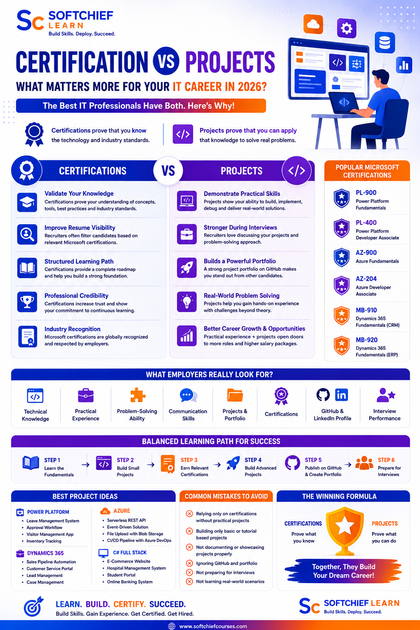
Understanding Certifications
A certification is an official credential that validates your knowledge of a specific technology or platform.
For Microsoft technologies, certifications demonstrate that you understand Microsoft’s recommended practices, architecture, tools, and services.
Examples include:
- PL-900 – Microsoft Power Platform Fundamentals
- PL-400 – Microsoft Power Platform Developer Associate
- AZ-900 – Microsoft Azure Fundamentals
- AZ-204 – Azure Developer Associate
- MB-910 – Dynamics 365 Fundamentals (CRM)
- MB-920 – Dynamics 365 Fundamentals (ERP)
Employers often view certifications as proof of commitment to continuous learning.
Understanding Projects
Projects are practical implementations where you apply your technical knowledge to solve real business problems.
Unlike certifications, projects demonstrate your ability to:
- Build applications
- Solve challenges
- Debug issues
- Design solutions
- Work with real-world scenarios
Projects showcase what you can actually do—not just what you know.
Certification vs Projects: Quick Comparison
| Feature | Certifications | Projects |
|---|---|---|
| Validate Knowledge | ✅ Yes | Partial |
| Demonstrate Practical Skills | Limited | ✅ Excellent |
| Resume Value | High | Very High |
| Interview Discussions | Moderate | Excellent |
| Portfolio Building | No | Yes |
| Employer Confidence | High | Very High |
| Learning Depth | Structured | Practical |
| Problem-Solving Skills | Limited | Strong |
| Industry Recognition | High | High |
| Career Growth | Good | Excellent |
Why Certifications Matter
Professional certifications provide structured learning and industry recognition.
1. Validate Your Skills
Microsoft certifications confirm that you’ve learned industry-standard concepts.
Recruiters often use certifications to shortlist candidates.
2. Improve Resume Visibility
Many companies filter resumes based on certifications.
For example:
- PL-400
- AZ-204
- PL-300
can improve your chances of getting shortlisted.
3. Structured Learning
Certification preparation follows a defined roadmap.
You’ll learn:
- Best practices
- Security
- Architecture
- Governance
- Integration
- Microsoft recommendations
4. Professional Credibility
Certified professionals often gain additional trust from employers and clients.
This is particularly valuable in consulting roles.
Limitations of Certifications
Although certifications are valuable, they have limitations.
Employers know that:
Passing an exam doesn’t automatically mean you can develop enterprise applications.
For example:
Someone may pass PL-400 but still struggle to:
- Build Model-Driven Apps
- Create Plug-ins
- Design Dataverse architecture
- Debug JavaScript
- Deploy solutions
This is where projects become essential.
Why Projects Matter
Projects prove your practical abilities.
When recruiters ask:
“Tell me about something you’ve built.”
They want to hear about real implementations.
Projects Demonstrate Experience
Projects show that you can:
- Design applications
- Solve business problems
- Integrate systems
- Handle errors
- Improve performance
These are the skills employers hire for.
Projects Build Confidence
Every project teaches lessons that no certification exam can fully replicate, such as:
- Handling unexpected bugs
- Managing changing requirements
- Optimizing performance
- Improving user experience
- Collaborating with others
This practical experience builds confidence and prepares you for real workplace challenges.
Projects Create a Portfolio
A portfolio is one of the strongest assets during interviews.
Examples include:
Power Platform
- Leave Management System
- Visitor Management App
- Employee Onboarding
- Expense Approval Workflow
- Inventory Management
- Help Desk Portal
Dynamics 365 CE
- Lead Management
- Sales Automation
- Customer Service Portal
- Case Management
- Marketing Automation
Azure
- Serverless API
- File Upload Solution
- Azure Functions
- Event-Driven Architecture
- CI/CD Pipeline
C# Full Stack
- E-Commerce Website
- Hospital Management
- Student Portal
- Online Banking
- Inventory Management
These projects provide tangible proof of your capabilities.
What Recruiters Actually Look For
Most recruiters evaluate candidates based on a combination of factors.
Typical areas include:
- Technical knowledge
- Practical experience
- Communication skills
- Problem-solving ability
- Certifications
- Project portfolio
- Internship experience
- GitHub profile
- LinkedIn profile
- Interview performance
No single factor guarantees a job offer.
Real Interview Scenario
Imagine two candidates applying for a Power Platform Developer role.
Candidate A
- PL-400 Certified
- No projects
- Limited practical experience
Candidate B
- PL-400 Certified
- Five complete Power Platform projects
- GitHub portfolio
- Real-world case studies
- Strong interview explanations
Who is more likely to receive the offer?
In most cases, Candidate B has a stronger advantage because they combine verified knowledge with practical implementation skills.
Employer Perspective
Employers invest in professionals who can contribute from day one.
They typically ask:
- Can this person solve business problems?
- Can they work on client projects?
- Can they adapt to real-world scenarios?
- Can they collaborate effectively?
Projects help answer these questions.
Best Projects for Microsoft Careers
Power Platform
- Leave Management System
- Approval Workflow
- Employee Directory
- Visitor Management
- CRM Extension
- Inventory Tracking
Dynamics 365 CE
- Sales Pipeline
- Customer Service Portal
- Case Management
- Opportunity Automation
- Lead Qualification
Azure
- Serverless REST API
- Azure Storage Application
- Event Grid Integration
- Azure Functions
- Azure Container Apps
C# Full Stack
- E-Commerce Portal
- Hospital Management
- HRMS
- Learning Management System
- CRM Application
Focus on solving real business problems rather than creating overly simple demo applications.
Do Certifications Increase Salary?
Yes—but certifications alone are rarely enough.
Professionals with:
- Microsoft certifications
- Strong project portfolios
- Practical experience
- Communication skills
often receive better salary offers than candidates who rely solely on certifications.
Building the Ideal Learning Path
The most effective approach is to combine structured learning with hands-on experience.
Step 1
Learn the fundamentals.
Step 2
Build small practical projects.
Step 3
Earn a Microsoft certification.
Step 4
Develop advanced, real-world applications.
Step 5
Publish projects on GitHub and create a professional portfolio.
Step 6
Prepare for technical interviews.
This sequence helps you develop both theoretical knowledge and practical expertise.
Common Mistakes Students Make
Avoid these common pitfalls:
- Collecting certifications without building projects.
- Memorizing exam questions instead of understanding concepts.
- Creating only basic “Hello World” applications.
- Not documenting projects.
- Ignoring source control platforms like GitHub.
- Skipping interview preparation.
- Assuming one certification guarantees a job.
A balanced approach leads to better long-term results.
How Softchief Learn Helps You Build Both
At Softchief Learn, we believe successful IT professionals need both industry-recognized certifications and real-world project experience.
Our training programs are designed to provide:
Microsoft Certification Guidance
We prepare students for certifications such as:
- PL-900
- PL-400
- AZ-900
- AZ-204
- MB-910
- MB-920
Real-Time Industry Projects
Students work on practical business solutions including:
- Power Apps Applications
- Power Automate Workflows
- Dynamics 365 Customizations
- Azure Cloud Projects
- C# Full Stack Applications
Career Support
Our programs also include:
- Resume Building
- GitHub Portfolio Guidance
- Mock Interviews
- Technical Interview Preparation
- Placement Assistance
- Lifetime Access to Session Recordings
- Live Mentor Support
This combination helps students build confidence and become job-ready.
Conclusion
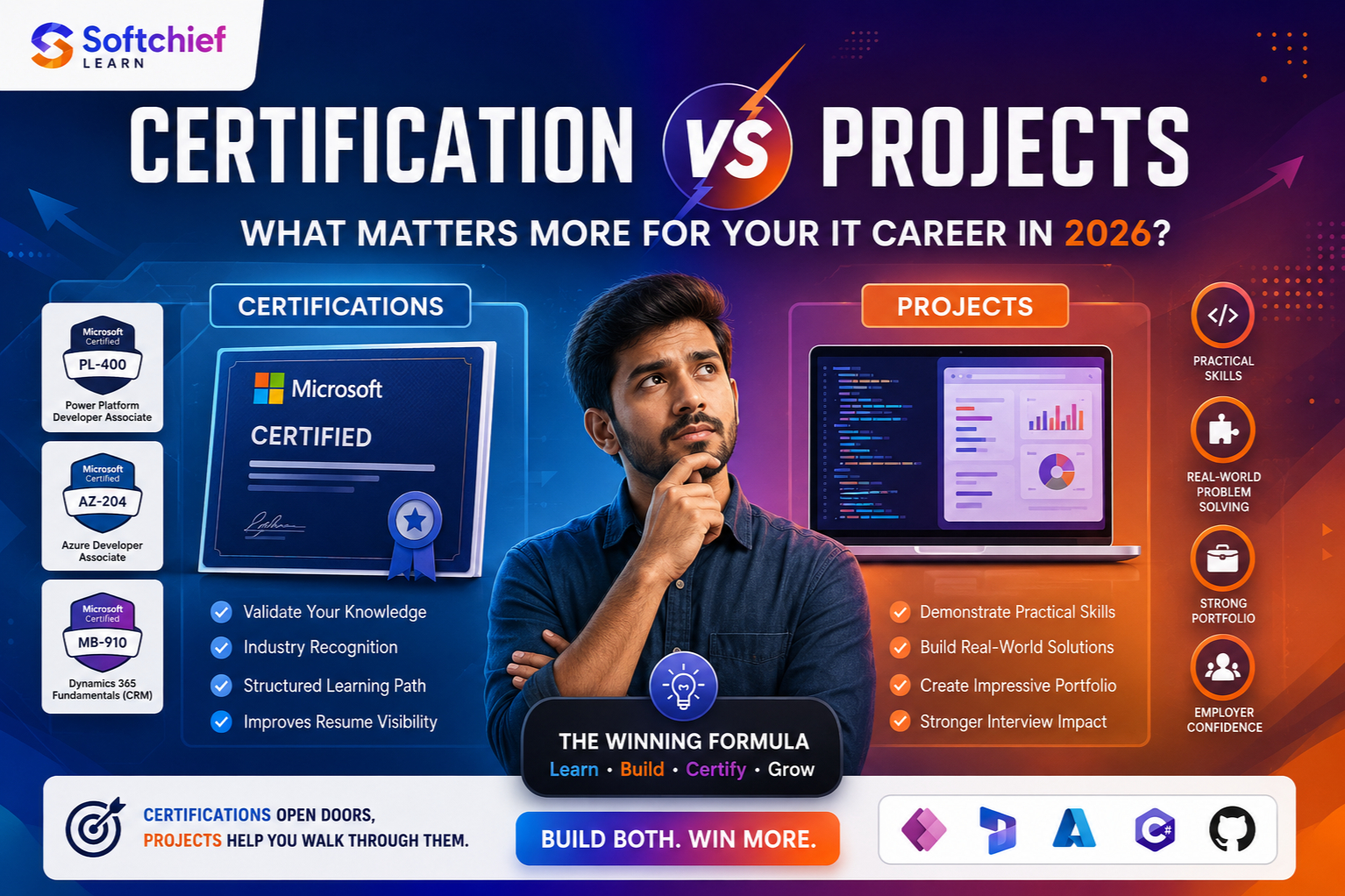
The debate between Certification vs Projects is not about choosing one over the other—it’s about understanding how they complement each other.
Certifications demonstrate that you’ve mastered industry-recognized concepts and best practices, while projects prove that you can apply that knowledge to solve real business challenges. Employers value candidates who combine both.
If your goal is to build a successful career in Microsoft Power Platform, Dynamics 365, Azure, or C# Full Stack Development, focus on a balanced learning journey:
- Learn the technology thoroughly.
- Earn relevant Microsoft certifications.
- Build meaningful real-world projects.
- Create a strong GitHub portfolio.
- Prepare for technical interviews.
- Continue learning as technologies evolve.
This combination will help you stand out in a competitive job market and position you for long-term career success.