Designing Human-in-the-Loop AI Agents for Safer, More Reliable Decisions
Introduction
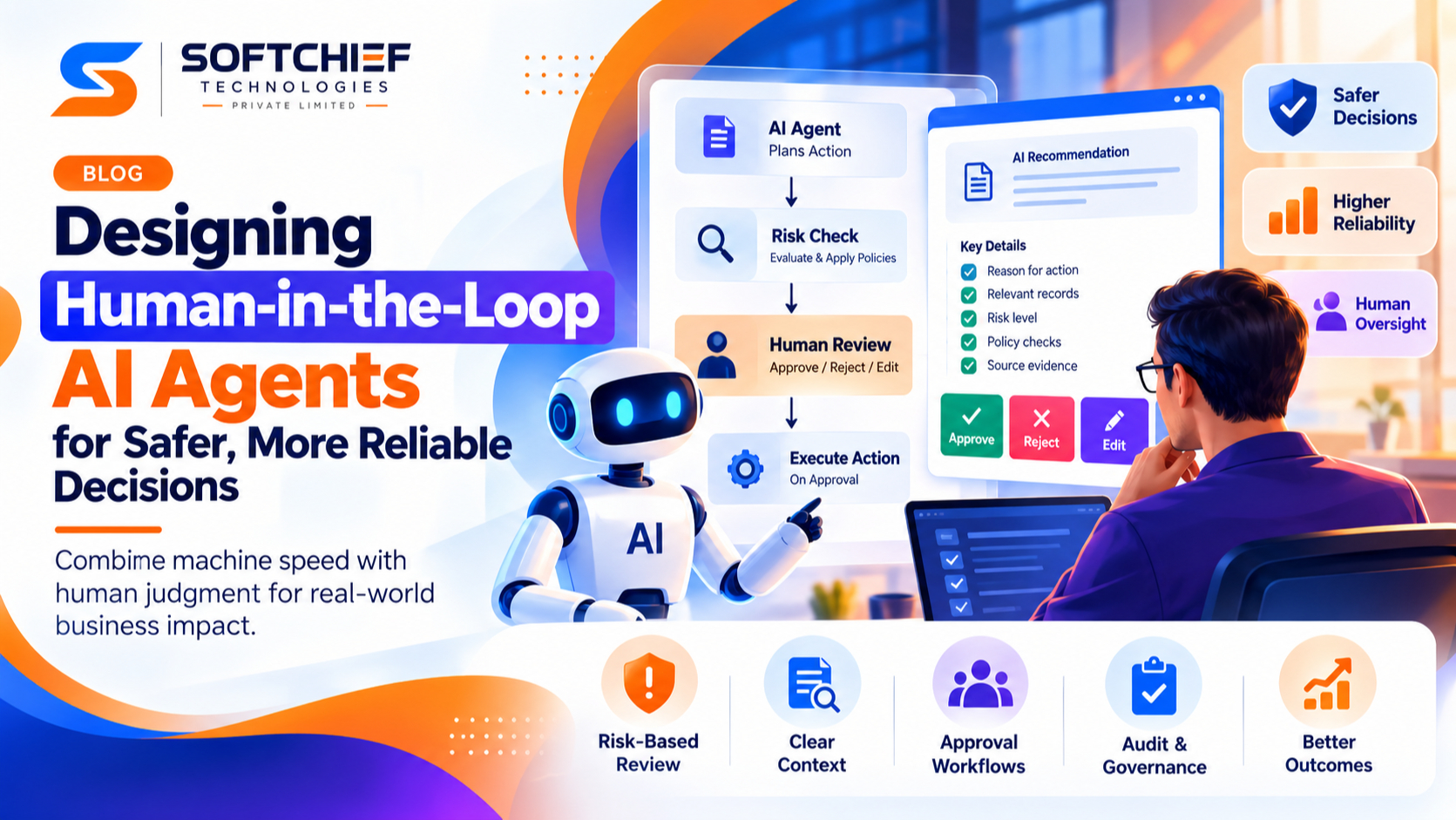
An agent can plan a refund, update an account, or send a message in seconds. If it acts on the wrong record, the damage may be hard to undo. Designing human-in-the-loop AI agents helps combine machine speed with human judgment by placing people where their decisions can change the outcome.
A human-in-the-loop AI agent sends selected decisions, actions, or exceptions to a person for review. In a human-on-the-loop setup, people monitor the agent and step in when needed, while the agent usually keeps working unless someone intervenes.
Good oversight starts before launch. Teams need to choose which actions require review, give reviewers useful context, and define what happens when no one can respond. They also need to test whether human input improves safety and results.
Designing human-in-the-loop AI agents around risk
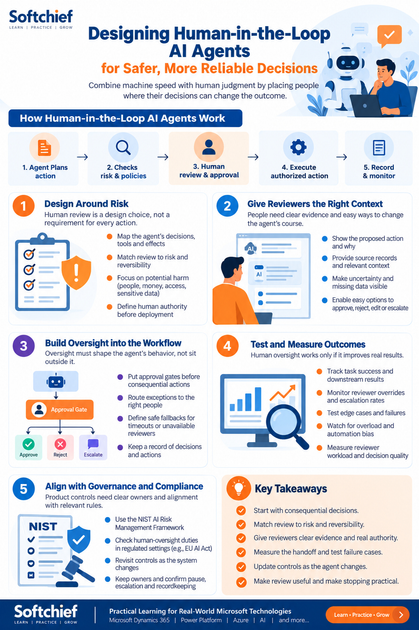
Human review is a design choice, not a requirement for every agent action. The right level depends on the possible harm, the agent’s uncertainty, and whether a person has authority to make the decision.
Map the agent’s decisions, tools, and effects
List what the agent can decide, which tools it can call, and who or what could be affected. Include ordinary steps such as searching a knowledge base, as well as actions like changing a customer record, sending an external message, or spending money.
This map helps separate information work from actions that change the world outside the model. It also reveals where one action may trigger another, such as an agent approving a refund and then updating a billing system.
Match review to risk and reversibility
A draft email is easy to edit; a sent email may be impossible to take back. A suggested code change can be checked before use, while merging it may affect users or systems. These differences should shape how much review each action needs.
Automate routine, low-risk steps when mistakes are easy to correct. Add approval gates for high-impact actions, especially when they affect people, money, access, or sensitive data. Review should focus on the potential harm, not only on how often the agent gets a task right.
Define human authority before deployment
Set clear rules for who can approve, reject, edit, pause, or escalate an action. Decide whether the agent must follow an authorized reviewer’s choice, and what happens if that choice conflicts with policy or an expert’s judgment.
Without these rules, approval can become a vague handoff with no clear owner. Assign responsibility by role, and make sure reviewers have the knowledge and authority to act on what they see.
Give reviewers context to make good decisions
A review screen can make human oversight useful or turn it into a rubber stamp. People need enough evidence to check the agent’s proposal, plus clear ways to change its course.
Show the proposed action and its basis
State what the agent plans to do and why. For a refund request, show the amount, account, relevant policy, and records the agent used. Keep the summary brief, but let reviewers open the source material.
A model’s explanation is not proof that its answer is sound. Show source records or tool results so people can verify key details themselves. If the agent’s rationale leaves out important evidence, the reviewer should be able to spot that gap.
Make uncertainty and missing data visible
Flag conflicting records, unclear requests, low confidence, and data the agent couldn’t access. Use plain terms reviewers can act on, such as “Two invoices match this request” or “The account owner could not be verified.”
Uncertainty should change the path when it could affect the result. The agent might ask for more information, send the case to a specialist, or pause before taking action. A generic confidence score alone may not tell a reviewer what needs checking.
Make intervention easy
Offer direct choices to approve, reject, edit, request more information, or escalate. Keep the stop or pause action easy to find, and show what will happen after each choice.
Avoid screens that put “Approve” in the most prominent spot or rush people with needless time limits. If a reviewer edits an action, the agent should use the revised version rather than quietly restoring its first proposal.
Build human oversight into the agent workflow
Oversight must shape the agent’s behavior, not sit outside it as a separate check. Define when the agent asks for help, how it waits, and what it does if no reviewer is available.
Put approval gates before consequential actions
Require human authorization before actions with meaningful risk, such as sending an external notice, making a payment, or changing a sensitive record. The gate should sit before the tool call, not after the action has already happened.
GitHub Copilot offers a useful reminder for code work: developers remain responsible for reviewing and testing generated code. An agent’s suggestion can speed up a task, but it shouldn’t be treated as safe to merge without checks.
Route exceptions to the right people
Send unfamiliar cases, conflicting evidence, and policy questions to a named team or role. A billing issue might go to finance; a possible privacy concern might need review by a privacy lead.
Set a safe fallback for timeouts, unclear instructions, and unavailable reviewers. In many high-risk cases, the agent should pause instead of proceeding. If it can take a safer step, such as saving a draft without sending it, define that option in advance.
Keep a record of decisions
Record the agent’s proposal, the context it used, its tool calls, human edits, approvals or rejections, and the final outcome. These details help teams investigate incidents and find weak points in a workflow.
Set privacy and retention rules before collecting this data. Keep enough information to support review without storing sensitive content longer or more widely than needed.
Test whether human review improves outcomes
Human oversight can fail if reviewers lack time, context, or power to intervene. Measure the handoff as part of the system, rather than assuming a human approval step makes an agent safe.
Track quality and downstream results
Measure task success, incorrect or harmful actions, reviewer overrides, escalation rates, time to completion, and outcomes after approval. Compare results across task types to find where review catches errors or slows work without adding value.
A high approval rate does not prove that the agent is reliable. It may mean the proposals are sound, but it may also mean reviewers are rushing or accepting suggestions without checking them.
Test edge cases and failures
Test misleading inputs, missing context, conflicting policies, tool outages, prompt injection, and unavailable reviewers. Check whether the agent pauses, asks for help, or follows its fallback rules.
Include cases where the agent’s proposal sounds plausible but relies on the wrong account or outdated information. These tests reveal whether reviewers can find the evidence that matters before an action takes place.
Watch for overload and automation bias
Too many alerts can make each one easier to miss. Repetitive approvals can also train people to trust the agent’s output without careful review, a risk known as automation bias.
Track reviewer workload and decision quality, not only queue speed. Review how often people catch consequential errors, how often they override the agent, and whether difficult cases reach someone with the right expertise.
Align oversight with governance and operating needs
Product controls need clear owners, regular checks, and alignment with the rules that apply to the use case. Legal duties depend on the system, its intended use, and the jurisdiction.
Use a framework to organize risk work
The NIST AI Risk Management Framework offers a voluntary way to organize AI risk work across governance, context mapping, measurement, and management. Teams can use it to connect product decisions with oversight roles and ongoing checks.
A framework can guide the work, but it doesn’t replace laws or domain rules. Set requirements based on the people affected and the decisions the agent can make.
Check human-oversight duties in regulated settings
Article 14 of the EU AI Act sets human-oversight requirements for high-risk AI systems. It calls for oversight that fits the system’s risks, autonomy, and use, and gives assigned people the means to understand, override, or stop the system when needed.
Don’t assume every AI agent falls under the same requirements. Assess the system’s classification and intended use, then check the relevant rules with qualified legal and subject-matter experts.
Revisit controls as the system changes
Review oversight when models, tools, permissions, data sources, or workflows change. A new tool can give an agent the ability to send messages or change records, which may call for a new approval gate.
Use incidents and near misses to update review rules and train staff. Keep an owner for each control, and confirm that pause, escalation, and recordkeeping still work after changes.
Key takeaways for designing human-in-the-loop AI agents
Start with consequential decisions, then match review to risk and reversibility. Give reviewers clear evidence and real authority to intervene. Measure the handoff, test failure cases, and update controls as the agent changes.
Conclusion
Good human-in-the-loop design keeps routine, reversible work moving while reserving human judgment for decisions that need it. Make review useful, make stopping practical, and check the results in real workflows. Before deployment, name the people responsible for each approval gate and test what happens when they can’t respond.