Dynamics 365 Finance & Operations Technical vs Functional Roles: Choose the Right Career Path
Introduction
A Dynamics 365 Finance & Operations project can fail with perfect code if the business process is wrong. It can also fail with a great process design if the system cannot support it. That is why Dynamics 365 Finance and Operations roles usually split into two main paths: business process and configuration work, or development and system architecture.
The practical choice is between becoming a D365 F&O functional consultant, a D365 F&O technical consultant, or a hybrid professional who connects both areas. These paths lead to strong ERP career opportunities across consulting firms, Microsoft partners, enterprise IT teams, and managed services providers.
Technical and functional professionals work together during discovery, design, configuration, development, testing, deployment, and support. This guide compares their responsibilities, skills, career paths, certifications, job prospects, and compensation research.
Dynamics 365 Finance and Operations roles work as one project team
What functional consultants do
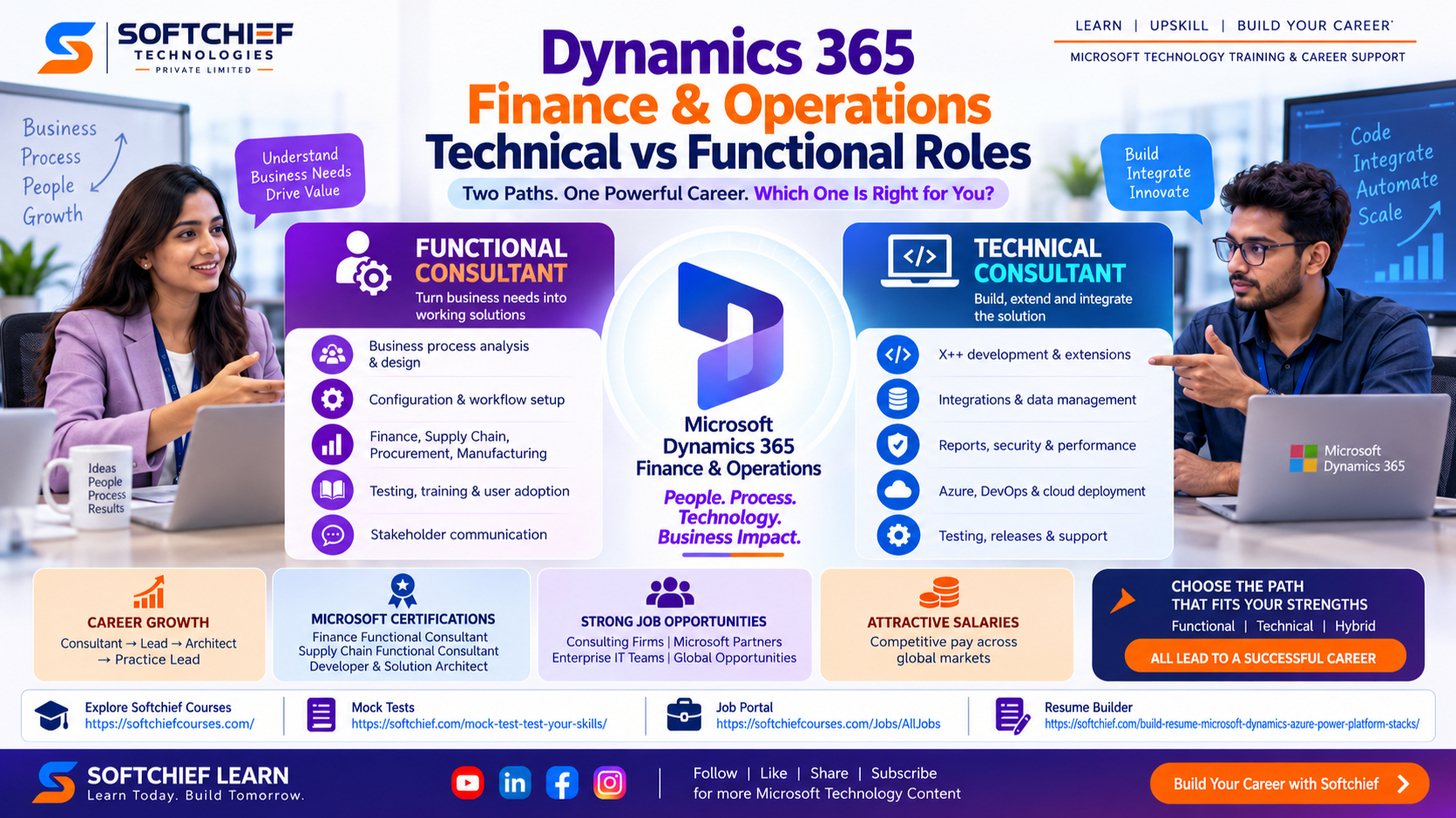
A functional consultant turns business needs into working Dynamics 365 processes. They may specialize in finance, supply chain management, procurement, manufacturing, commerce, project operations, or asset management.
Their work includes stakeholder interviews, process mapping, fit-gap analysis, configuration, workflow design, testing, training, and user support. Common titles include functional consultant, solution consultant, business analyst, module lead, finance systems analyst, and ERP product owner.
Microsoft’s Finance Functional Consultant certification focuses on translating financial requirements into processes and solutions. Its assessed areas include financial management, accounts payable, accounts receivable, budgeting, fixed assets, and credit management. The Supply Chain Management certification covers product information, inventory, warehouses, transportation, and master planning.
What technical consultants do
A technical consultant builds and maintains the technology around the solution. Their work may include X++ development, extensions, data entities, integrations, reports, security, performance testing, data migration, and release management.
Typical titles include X++ developer, technical consultant, integration developer, data migration consultant, DevOps specialist, technical architect, and solution architect. Microsoft documentation describes a development model based on Visual Studio, X++, Azure DevOps, build automation, test automation, and cloud deployment.
The boundary is useful, but it is not fixed. A functional consultant needs data and security awareness. A technical consultant needs enough process knowledge to build a system that users can trust.
Compare Dynamics 365 Finance and Operations skills
Skills for functional success
Functional professionals need strong business process knowledge. A finance consultant should understand record-to-report, procure-to-pay, order-to-cash, budgeting, fixed assets, tax, internal controls, and financial dimensions. A supply chain consultant may focus on inventory, purchasing, production control, warehouse management, and planning.
Useful skills include:
- Requirements gathering, process modeling, configuration, fit-gap analysis, test planning, training, and change management
- Workshop facilitation, documentation, stakeholder communication, and issue analysis
- Knowledge of local compliance, localization, accounting rules, and industry needs
Start with one main module. Depth in Finance or Supply Chain Management usually creates a stronger base than shallow knowledge across every module.
Skills for technical success
Technical roles require programming and platform skills. Core areas include X++, object-oriented development, Visual Studio, extensions, data entities, SQL principles, REST, OData, JSON, XML, Azure services, Power Platform integration, source control, and automated testing.
Microsoft’s Finance and Operations development documentation explains the platform’s developer tools, X++ compiler, data management features, and application lifecycle management. Technical professionals also need to understand security, error handling, monitoring, performance, deployment, and upgrade safety.
Microsoft recommends checking configuration and personalization options before writing code. Its Finance and Operations extensibility guidance explains why supported extensions, best practices, testing, and future updates matter.
Skills shared by both paths
Communication often separates a good consultant from a great one. Both roles must explain complex issues to executives, finance teams, warehouse users, developers, and project managers.
Both paths also require clear documentation, careful testing, practical problem-solving, and sound judgment. A useful self-check is to rate your business-process knowledge, technical and data literacy, and communication skills. Then choose one module or platform feature and build a small portfolio project around it.
Match daily work to each career path
A functional consultant’s implementation lifecycle
During discovery, the functional consultant interviews users and records current processes. During design, they map requirements to standard features and identify gaps. During configuration, they set up parameters, workflows, policies, financial dimensions, and other module settings.
Later, they prepare test cases, coordinate user acceptance testing, train users, support cutover, and help stabilize the system after launch. Typical deliverables include process maps, fit-gap documents, configuration workbooks, test scripts, training material, and UAT sign-off records.
A technical consultant’s implementation lifecycle
The technical consultant assesses integrations, data requirements, security, reporting, performance, and extension needs. They then create technical designs, X++ extensions, data entities, services, reports, migration packages, or integration components.
They also support code reviews, regression tests, performance checks, builds, releases, monitoring, and production fixes. Their deliverables may include technical design documents, integration specifications, data mappings, pull requests, deployment runbooks, test evidence, and support documentation.
Microsoft’s Success by Design framework places these activities across five phases: Discover, Initiate, Implement, Prepare, and Operate. The framework shows why technical and functional decisions must stay connected throughout a project.
Build a career path in Microsoft Dynamics
Functional career progression
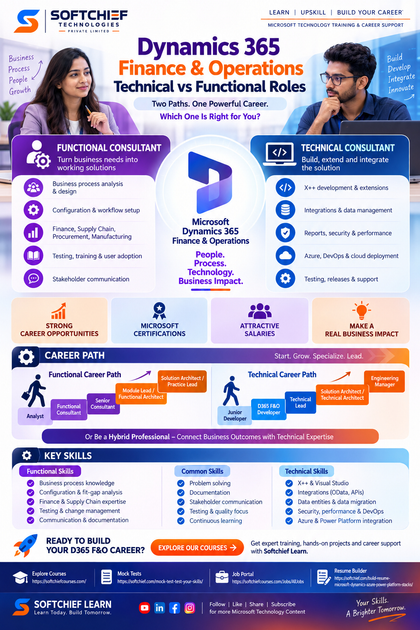
Many people start as ERP analysts, finance systems analysts, or associate consultants. With project experience, they can move into functional consultant, senior consultant, module lead, functional architect, solution architect, product owner, or practice lead roles.
Specialization can focus on finance transformation, supply chain planning, manufacturing, global localization, compliance, internal controls, or process improvement. A finance or operations background can help, especially when paired with hands-on Dynamics 365 training.
Technical career progression
Technical professionals may begin as junior developers, technical analysts, or associate consultants. Later roles include D365 F&O developer, senior developer, technical lead, integration lead, solution architect, technical architect, and engineering manager.
Common specialties include X++ extensibility, integration architecture, data migration, reporting, security, DevOps, performance, Azure, and Power Platform connections. A hybrid path can lead to roles such as techno-functional consultant, business systems architect, ERP product owner, or D365 F&O practice lead.
Current LinkedIn listings show titles across these levels, including associate consultants, senior functional consultants, technical consultants, solution architects, and module leads. Job titles vary, so compare the actual tools, deliverables, and stakeholder duties in each posting.
Weigh compensation, certifications, and job opportunities
Salary data can help, but it needs context. Glassdoor’s current page for Microsoft Dynamics 365 Finance and Operations functional consultants reports a median total pay of about $131,000, with a listed total range of $101,000 to $173,000. The estimate is based on seven submitted salaries, so location, experience, contract type, industry, and sample size can change the result.
For better research, compare several current listings on Glassdoor, Indeed, and LinkedIn. Look for repeated requirements such as Finance or Supply Chain expertise, X++, Azure DevOps, integrations, user training, and full implementation experience.
Certifications can support structured learning, but they do not replace project work. Review current Microsoft certification pages before choosing an exam because names, objectives, renewal rules, and requirements can change.
Choose the D365 F&O role that fits your strengths
Choose the functional path if you enjoy business discussions, process design, workshops, finance, supply chain, testing, and user adoption. You can learn technical concepts without making programming your main task.
Choose the technical path if you enjoy code, data, integrations, debugging, system performance, and solution design. You will need to keep learning as Microsoft’s development patterns and cloud services change.
A hybrid path gives you wider project awareness without requiring equal depth in every area. A functional consultant can add data literacy and integration knowledge. A developer can add module expertise and stronger process skills.
Conclusion
Functional professionals shape business processes, configure Dynamics 365 capabilities, and guide adoption. Technical professionals extend the platform, connect systems, manage data, and protect solution quality. Hybrid professionals connect business outcomes with technical decisions.
Choose one primary path, select a module or technical specialty, complete relevant Microsoft Learn training, and create a portfolio artifact such as a process map, configuration plan, test script, data design, or technical specification. Then compare live job postings and seek project work that puts both business and technology teams in the same room.
A successful Dynamics 365 Finance & Operations career comes from pairing platform knowledge with measurable business value.