Evaluating Enterprise AI Agents: A Framework to Prove Performance and ROI
Introduction
An AI agent can look impressive in a polished demo, then fail to finish a routine business task. It may find the right form but enter the wrong data, or give a confident answer without making the promised change.
That’s why evaluating enterprise AI agents takes more than checking answer quality. You need to measure business outcomes, reliability, security, and cost. Gartner’s June 2025 forecast says more than 40% of agentic AI projects could be canceled by the end of 2027 because of rising costs, unclear business value, or weak risk controls. That’s a forecast, not a measured outcome, but it shows why sound evaluation matters.
Define measurable outcomes for enterprise AI agents
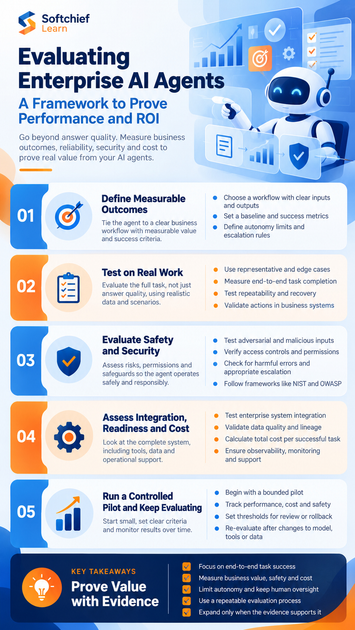
Start with the work the agent should do and the value that work should create. A clear goal gives your team a fair way to assess AI agent performance metrics and decide whether the system is ready to use.
Tie the agent to a measurable workflow
Choose a workflow with clear inputs, outputs, limits, and a business owner who can judge success. For example, an agent might review a support request, check a policy, and update a case record.
Make sure the task needs an agent. A system that plans steps or uses tools to act on information is different from a chatbot that answers questions or a fixed automation that follows the same rules every time.
Establish a baseline and success criteria
Before testing, record how the current process performs. Track completion time, cost, error rate, escalations, and user satisfaction, then set minimum standards the agent must meet.
Compare the agent with the process people use today, not only with another model. A system that beats a rival model but costs more or causes more errors may not improve the business.
Set limits on autonomy and failure
Decide which actions the agent can take on its own, which need approval, and when it must stop or ask for help. Set stricter limits when an action could affect money, legal rights, safety, or sensitive data.
Risk and reversibility should guide those limits. An agent might sort low-risk requests independently, while a refund, account closure, or record deletion requires a human review.
Test enterprise AI agents on real work
Evaluate the full task, not a single prompt and answer. A test should show whether the agent reached the intended result in the business system and followed the rules along the way.
Build a representative task and data set
Include everyday cases, edge cases, incomplete requests, unclear instructions, and realistic differences in source data. A customer request with a missing account number, for example, can reveal whether the agent asks a useful question or guesses.
Historical data can make tests realistic, but protect private information and check for data quality issues. Synthetic data may help, too. In either case, record how the test set was made and what it covers.
Measure task completion, not just answer quality
Track end-to-end success, partial completion, time to completion, correct tool use, and human intervention. Treat a plausible response as different from a verified action, such as a case record saved with the right fields.
WorkArena’s task design highlights this distinction: its checks can verify saved business data instead of relying on a confirmation screen. That’s the kind of task validation approach that can catch errors a polished demo may hide.
Test repeatability and recovery
Run the same task more than once and vary the conditions. Agents can produce different results from similar inputs, so one successful run doesn’t prove reliable performance.
Also test timeouts, failed tools, conflicting records, and interrupted workflows. Check whether the system retries safely, restores its place, or escalates without repeating an action that already went through.
Evaluate enterprise AI agent safety and security
An agent’s risk depends on what it can access and do, not only on what it says. NIST’s AI Risk Management Framework groups risk work into Govern, Map, Measure, and Manage functions; its Generative AI Profile, NIST AI 600-1, offers added guidance for generative AI risks.
Challenge the agent with adversarial inputs
Test direct attempts to override instructions, malicious directions hidden in retrieved documents, and requests for private information. The OWASP Top 10 for LLM applications is a useful reference for organizing tests, including prompt injection risks.
Check whether an attack can expose data, change a decision, or trigger an unauthorized tool call. Repeat these tests when the agent’s model, tools, or data sources change.
Verify permissions and action safeguards
Give the agent only the access it needs, following least-privilege principles. Confirm that it cannot do more than the signed-in user is allowed to do.
Test identity checks, approval gates, and audit logs. Include high-impact actions such as payments or deletions, and verify that safeguards block them unless the right person approves.
Check for harmful errors and appropriate escalation
Assess whether the agent spots uncertainty, refuses disallowed requests, and sends sensitive cases to a qualified person. A safe response may mean stopping rather than completing the task.
In Moffatt v. Air Canada, a British Columbia tribunal found the airline responsible for inaccurate information given by its customer-service chatbot. The Air Canada chatbot ruling involved a chatbot, not necessarily a tool-using agent, but it shows that businesses remain accountable for information their automated systems provide.
Assess integration, readiness, and total cost
A pilot can succeed in a test environment and still fail in daily operations. Assess the full system: model, tools, data retrieval, policies, and human review.
Test integration and data quality
Check how the agent handles real enterprise systems, APIs, access controls, and imperfect records. See whether it uses trusted sources and responds safely when records are stale, missing, or in conflict.
For workflows with compliance needs, confirm that the system preserves data lineage: where information came from and how it changed. That record can help teams check a result or investigate an error.
Calculate total cost and business value
Include model use, tool calls, infrastructure, setup, monitoring, human review, and error correction. Token charges alone won’t show what it costs to deliver useful work.
Compare total cost per successfully completed task with the baseline process. A cheaper run may still cost more overall if people must fix errors or finish incomplete work.
Validate observability and operational support
Teams need a way to inspect tool calls, failures, latency, and cost while protecting private data. Set clear ownership for incident response, system updates, rollback, and regular testing.
Agree on what to record before launch. Useful logs help teams find the cause of a failure and decide whether the agent needs a fix, tighter limits, or more human review.
Run a controlled pilot and keep evaluating
Treat evaluation as an ongoing process, not a one-time approval step. Start small, define release rules, and watch for changes in data, tools, model behavior, and business results.
Start with a bounded pilot
Limit the first deployment to a defined workflow, user group, and set of allowed actions. Use shadow mode, where the agent’s work is reviewed without acting, or require human approval before it makes changes.
Set exit criteria in advance. Expand when results meet the bar, revise the system when they don’t, and stop the pilot if risk or cost exceeds agreed limits.
Monitor performance after launch
Track task success, error severity, escalations, latency, cost, user feedback, and safety events. Set thresholds that trigger review, rollback, or added human oversight.
Look for patterns, not just single failures. A growing rate of incomplete tasks or rising review time can signal that the system no longer fits the workflow.
Re-evaluate after material changes
Repeat relevant tests whenever the model, prompts, tools, data sources, permissions, or workflow changes. Even a small update can affect whether an agent follows instructions or handles a failed tool call safely.
Keep versioned test sets and results so teams can compare performance over time. This makes it easier to spot regressions and explain why a release was approved.
Key takeaways for evaluating enterprise AI agents
A credible evaluation links business value to end-to-end task success, safety, and operational readiness. Set a baseline, test realistic workflows, limit autonomy, and measure the cost of each task the agent completes correctly.
Expand only when the evidence supports it. Build a repeatable evaluation process, keep people accountable for high-impact decisions, and use ongoing results to guide each release.