Microsoft Career Roadmap 2026: From Student to Solution Architect

Introduction
Knowing cloud terms is easy. Designing a production system that meets business goals, security rules, uptime needs, and budget limits takes much more. The Microsoft Career Roadmap 2026 should be treated as a career plan, not a list of exams.
You need Azure fundamentals, hands-on engineering, architecture skills, clear communication, and steady learning. This path can lead from student projects to cloud support, administration, platform work, solution design, and the Azure Solutions Architect Expert certification. Microsoft changes exam names, service features, and role expectations, so check Microsoft Learn and official certification pages before making exam plans.
Build the foundation that makes an Azure career possible
Learn the technical basics behind Azure
Start with networking: TCP/IP, DNS, HTTP, routing, firewalls, VPNs, private endpoints, load balancing, and hybrid links. Add Windows Server and Linux skills, including processes, permissions, storage, patching, and fault finding.
Identity knowledge matters just as much. Study Microsoft Entra ID, authentication, authorization, role-based access control, Conditional Access, and least privilege. Microsoft Entra ID documentation covers identity management, access control, logs, and administrator permissions.
You also need relational databases, NoSQL ideas, storage tiers, backups, replication, Python, PowerShell, Azure CLI, REST, JSON, Git, and infrastructure as code. Security, reliability, scaling, and cost should guide every technical choice.
Choose a practical starting point
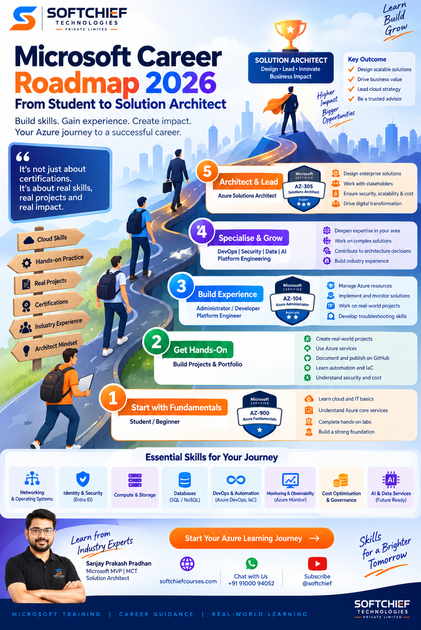
Azure Fundamentals, or AZ-900, fits students who need a first look at cloud ideas, Azure services, governance, pricing, and support. Azure Administrator Associate, or AZ-104, is a stronger next step for learners who want to manage identity, compute, storage, networks, monitoring, and policy.
Do not collect entry-level exams when a project would teach more. Divide each study week between theory, guided labs, independent builds, troubleshooting, and written review. Keep a learning log with failed setups, architecture choices, cost concerns, and lessons learned.
Use Microsoft Learn sandboxes, Azure documentation, technical guidance, and official samples. Measure progress by what you can deploy, secure, monitor, repair, and explain. Check current exam guides because Microsoft updates objectives and certification rules.
Turn Azure knowledge into evidence employers can evaluate
Build projects around business problems
A strong portfolio shows more than a resource created in the Azure portal. Build a secure web application with App Service or containers, Azure SQL Database, Entra ID, monitoring, and automated deployment. Create a segmented network with virtual networks, subnets, private access, security controls, and central logs.
You can also build an event-driven workflow with Functions, messaging, or other suitable services. Explain scaling, failure handling, data protection, and cost. Add AI or data tools only when the use case, data rules, security needs, and operating plan are clear.
Every project should state the business scenario, requirements, limits, architecture, build steps, tests, and operating model.
Document and publish architecture decisions
Write short architecture decision records for choices such as database type, hosting model, region, authentication, or messaging. Explain the trade-offs across cost, speed, performance, security, availability, complexity, and maintenance.
Use diagrams that show users, applications, data flows, trust boundaries, dependencies, and operations. The Azure Architecture Center offers reference designs and technology decision guidance. Compare your work with the Azure Well-Architected Framework.
Publish code, templates, tests, setup steps, and diagrams on GitHub. Add a landing page with short case studies. Label personal work, labs, volunteer projects, and academic work honestly. Never claim production experience for a practice deployment.
Microsoft Career Roadmap 2026 for early-career roles
Start where operational judgment grows
Useful first roles include cloud support associate, technical support engineer, junior cloud administrator, systems administrator, DevOps trainee, platform trainee, software engineer, and data engineer. These jobs expose you to incidents, identity, storage, APIs, databases, releases, monitoring, and customer needs.
Internships, apprenticeships, campus IT jobs, open-source work, and freelance projects can provide similar evidence. The goal is to see how systems behave after deployment, not only how they work in a tutorial.
For the administrator path, practice subscriptions, resource groups, tags, policies, budgets, compute, storage, networks, backups, and monitoring. Use the current AZ-104 skills outline as a guide, but learn incident response and root-cause analysis too.
Move from tasks to design ownership
Architecture work begins when you help define the problem. Join discovery meetings, backlog reviews, technical design sessions, and post-incident reviews. Translate business needs into recovery targets, compliance duties, latency limits, uptime goals, and spending limits.
Own small components first, then complete solutions. Ask senior engineers, architects, security teams, and operations staff to review your decisions. Keep evidence of changes that improved reliability, reduced manual work, lowered cost, or sped up delivery.
Prepare for the Azure Solutions Architect Expert path
Organize study around AZ-305 domains
The current AZ-305 study guide groups architecture work into identity, governance, monitoring, data storage, data integration, business continuity, disaster recovery, infrastructure, compute, networking, applications, and migrations.
Turn each domain into a practical deliverable. Create a permission model, governance plan, data design, recovery plan, threat model, network diagram, deployment approach, and cost estimate. The official Azure Solutions Architect Expert page says candidates need advanced knowledge of networking, identity, security, data platforms, governance, operations, development, and DevOps.
Verify current exam requirements and retirement notices before booking. The English exam version changed in April 2026, which shows why old study plans can become inaccurate.
Use the Well-Architected Framework
Assess designs across reliability, security, cost optimization, operational excellence, and performance efficiency. Add sustainability through efficient resource use, lifecycle rules, workload tuning, and sensible capacity choices.
Build case studies for a customer web platform, hybrid enterprise network, data integration system, or regulated application. Define assumptions, risks, dependencies, and nonfunctional needs before selecting services. Compare two workable designs and explain why one fits the budget, risk level, and delivery date better.
Include deployment, identity, monitoring, failure recovery, and cost plans. Present the design aloud as if you were in a review meeting. This improves both exam readiness and design judgment.
Develop communication skills that distinguish architects
Turn business goals into technical requirements
Ask who will use the system, what failure costs, which rules apply, how fast it must respond, how much growth is expected, and who will operate it. Separate functional requirements from nonfunctional ones, then record assumptions and open questions.
Explain options through business effects: cost, risk, speed, maintenance, and future change. Work with developers, operations, security, data, finance, project, and business teams. The Cloud Adoption Framework for Azure adds guidance for governance, landing zones, migration, security, and operating models.
Prepare for architecture interviews
Practice ambiguous system-design questions. Clarify requirements, state assumptions, propose a design, explain trade-offs, name risks, and describe daily operations. Be ready to discuss availability, scaling, identity, networks, data, observability, recovery, and cost.
Prepare short stories about a failure, a compromise, a migration, a disagreement, and a change made after testing. Use the situation, action, result, and learning format. Interviewers want to see how you reason, not how many Azure products you can list.
Microsoft Career Roadmap 2026 milestones
Follow a flexible progression
Begin with networking, operating systems, identity, security, scripting, Git, and cloud concepts. Then deploy several solutions and practice automation, monitoring, governance, backups, and troubleshooting. Seek an internship or entry-level role that exposes you to real systems.
Next, build experience in administration, development, data, security, DevOps, or platform engineering. Study AZ-305 domains when you can explain operational decisions and have several architecture case studies. Pursue the current expert certification requirements after checking Microsoft Learn.
Useful proof points include:
- A secured application with diagrams and operating procedures
- Version-controlled infrastructure and deployment pipelines
- A documented failure investigation using logs, metrics, and traces
- A cost estimate with its main drivers
- A tested backup or disaster recovery plan
- A design presentation for technical and nontechnical audiences
Keep your plan current
Review Microsoft Learn updates, exam skills, Azure service documents, pricing, and retirement notices. Track changes to product names, costs, features, and recommended patterns. Add cybersecurity, containers, AI, data platforms, FinOps, governance, or platform engineering based on your target role.
Use the Azure pricing page and the pricing calculator for estimates. Refresh portfolio projects when Microsoft guidance changes.
Conclusion
A credible solution architect profile grows in sequence: solid fundamentals, useful projects, operational experience, design ownership, case studies, and clear communication. Certifications can confirm knowledge, but they cannot replace troubleshooting, delivery experience, or stakeholder trust.
Choose a target role now. Fix one skill gap, build one documented Azure project, review the current Microsoft certification path, and ask a practitioner to critique your design. Measure progress by the problems you can define, build, explain, and improve.