THE AI AGENT REVOLUTION: WHAT MICROSOFT PROFESSIONALS NEED TO KNOW THIS WEEK
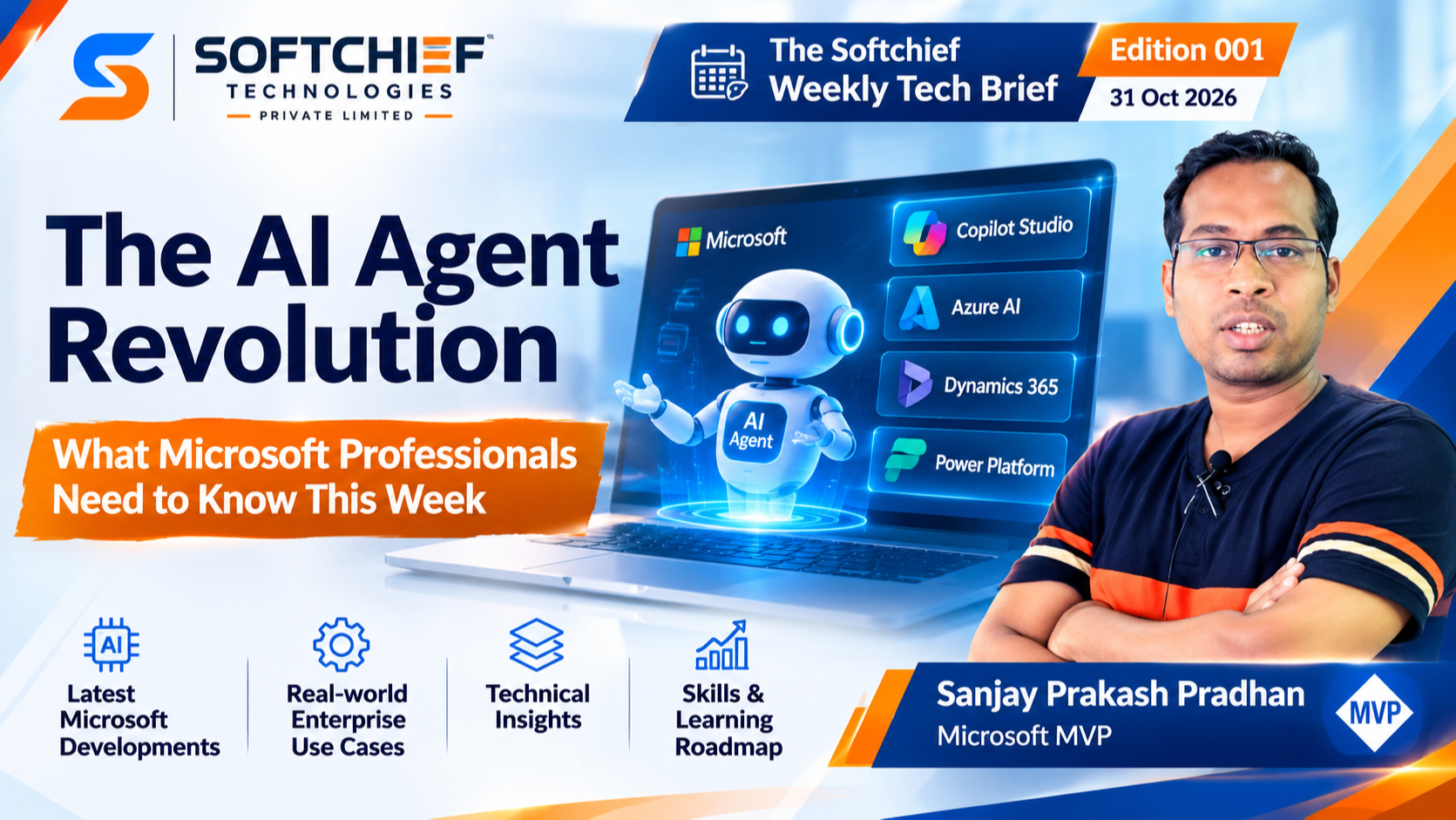
SOFTCHIEF LEARN | THE WEEKLY TECH BRIEF
Edition 001 | 31 October 2026
From intelligent assistants to enterprise-ready AI agents: understanding Microsoft’s latest developments.
Welcome to the first edition!
Artificial Intelligence is moving beyond answering questions and generating content. The next stage is about AI agents that can understand business objectives, use tools, interact with enterprise applications and execute multi-step workflows.
Microsoft is continuing to expand its agent ecosystem across Microsoft Foundry, Copilot Studio and business applications.
For developers, consultants and solution architects, this shift introduces new opportunities as well as new technical responsibilities.
Here are three developments worth following this week.
01. Microsoft Introduces Its Copilot Harness in Foundry Agent Service
Announcement: 28 October 2026 | Public Preview
Microsoft has introduced the Microsoft Copilot harness in Foundry Agent Service, providing developers with a managed foundation for building AI agents capable of reasoning, using tools and handling complex, long-running tasks.
The preview brings together reusable skills, connected tools, execution and delegation capabilities, and source-controlled agent definitions.
Microsoft has also announced general availability of long-running resilience for hosted agents, helping workflows recover from interruptions.
Why does this matter?
Developers no longer need to build every part of the agent execution infrastructure themselves. They can focus more on business logic, tool integration, agent expertise and evaluation.
Real-world application:
Consider an enterprise procurement agent that collects purchase information, checks supporting documents, validates business rules and prepares an approval recommendation.
Such workflows require more than a language model. They need controlled tool access, execution management, recovery mechanisms and appropriate approval boundaries.
What should developers explore?
- Microsoft Foundry Agent Service
- Model Context Protocol (MCP)
- Agent skills and tool integration
- Long-running workflow resilience
Official source: https://devblogs.microsoft.com/foundry/microsoft-copilot-harness-in-foundry/
02. Copilot Studio Moves Towards Persistent Business Process Agents
Announcement: 15 October 2026
Microsoft has announced new Copilot Studio capabilities designed to help organizations delegate recurring business processes to more persistent and proactive agents.
Two important concepts are agent accounts and business process memory.
Agent accounts allow agents to work with their own approved credentials and scoped permissions. Business process memory helps agents carry relevant process context and preferences across recurring tasks.
Microsoft also announced trigger capabilities that can initiate agent work based on configured events or schedules.
Why does this matter?
Traditional chatbots typically respond when a user asks a question. Persistent business process agents are designed to participate in ongoing work, retain relevant context and act when configured conditions are met.
Real-world application:
Imagine an employee onboarding process.
An agent could coordinate document collection, check onboarding requirements, communicate with relevant teams and prepare pending-task summaries.
However, sensitive decisions, exceptions and approvals should remain subject to appropriate human oversight.
What should professionals explore?
- Copilot Studio agent accounts
- Business process memory
- Agent triggers
- Identity, permissions and governance
03. Microsoft Expands Its Agent Capabilities Across Enterprise Business Applications
Microsoft announcement: 23 October 2026
Microsoft has highlighted new AI capabilities across CRM, customer service, contact centers and business process automation.
The developments include Sales Development Agent, Service Agent, reusable Sales and Service Skills, and Agent Accounts in Copilot Studio.
These capabilities demonstrate how AI agents are becoming more closely connected to business applications and everyday enterprise workflows.
Why does this matter?
Enterprise AI adoption is not just about building an intelligent chatbot. It is about connecting business context, customer information, workflows and authorized actions.
For Dynamics 365 and Power Platform professionals, this creates opportunities to understand how AI agents can extend existing business applications.
Real-world application:
A sales organization could use an AI-powered workflow to research prospects, prepare personalized outreach and support lead qualification, while sales professionals retain control over important customer decisions.
What should professionals explore?
- Dynamics 365 and AI integration
- Sales and Service Agent capabilities
- Dataverse and enterprise data
- Business process automation
Official source: https://learn.microsoft.com/en-us/partner-center/announcements/2026-october
TECHNICAL INSIGHT OF THE WEEK
Building an Enterprise AI Agent: What Should Developers Consider?
An enterprise AI agent needs more than a good prompt.
Before implementing an agent, developers and solution architects should consider five important areas:
1. Business Objective
Define the exact business problem the agent must solve. Avoid building agents simply because AI is available.
2. Data and Knowledge
Identify the business data, documents and knowledge sources the agent is authorized to access.
3. Tools and Integration
Determine which APIs, Dataverse operations, connectors or external services the agent needs.
4. Security and Governance
Apply identity controls, least-privilege access, approval boundaries and auditability.
5. Monitoring and Evaluation
Measure accuracy, task completion, failure rates, response quality and operational cost.
The key takeaway: A successful enterprise AI agent is not simply one that can answer questions. It must perform its assigned tasks reliably, securely and within clearly defined business boundaries.
SKILL UP: WHAT SHOULD MICROSOFT PROFESSIONALS LEARN NEXT?
The growth of enterprise AI agents makes several technical skills increasingly relevant:
- Microsoft Copilot Studio
- Azure AI and Microsoft Foundry
- Dataverse and Dynamics 365 integration
- Power Automate and enterprise workflows
- C#, APIs and tool integration
- Entra ID, authentication and authorization
- AI agent testing, monitoring and governance
Professionals who understand both AI capabilities and enterprise application architecture will be better equipped to design practical business solutions.
LEARN WITH SOFTCHIEF
Want to move beyond understanding AI concepts and start building practical Microsoft technology solutions?
Softchief Learn provides technical training and learning resources covering:
- Advanced Azure and AI
- Dynamics 365 and Power Platform
- Copilot Studio and AI Agents
- C# and .NET Full-Stack Development
- Enterprise Integration and Architecture
Explore Softchief Courses:
https://softchiefcourses.com/
Explore Softchief Premium Community:
https://softchiefcourses.com/Community/Membership
FINAL THOUGHT
The future of enterprise software is not just about applications becoming smarter. It is about applications, data, people and AI agents working together to complete meaningful business processes.
For Microsoft professionals, this is the right time to understand how these technologies work, how to integrate them and how to build solutions that organizations can trust.
Stay curious. Keep building. Keep learning.
The Softchief Weekly Tech Brief
Bringing Microsoft Technology Developments Closer to Professionals.
See you in the next edition!