The Rise of Agentic AI in the Microsoft Ecosystem (Complete Guide for 2026)
Introduction
Artificial Intelligence has evolved rapidly over the last few years. Businesses initially embraced AI for tasks such as data analysis, chatbots and workflow automation. The introduction of Generative AI brought systems capable of creating text, images, code and other content, significantly improving productivity across industries.
Today, we are entering the next phase of AI evolution—Agentic AI.
Unlike traditional AI systems that simply respond to prompts, Agentic AI introduces autonomous software agents that can understand goals, make decisions, plan actions, collaborate with other systems and execute complex business processes with minimal human intervention.
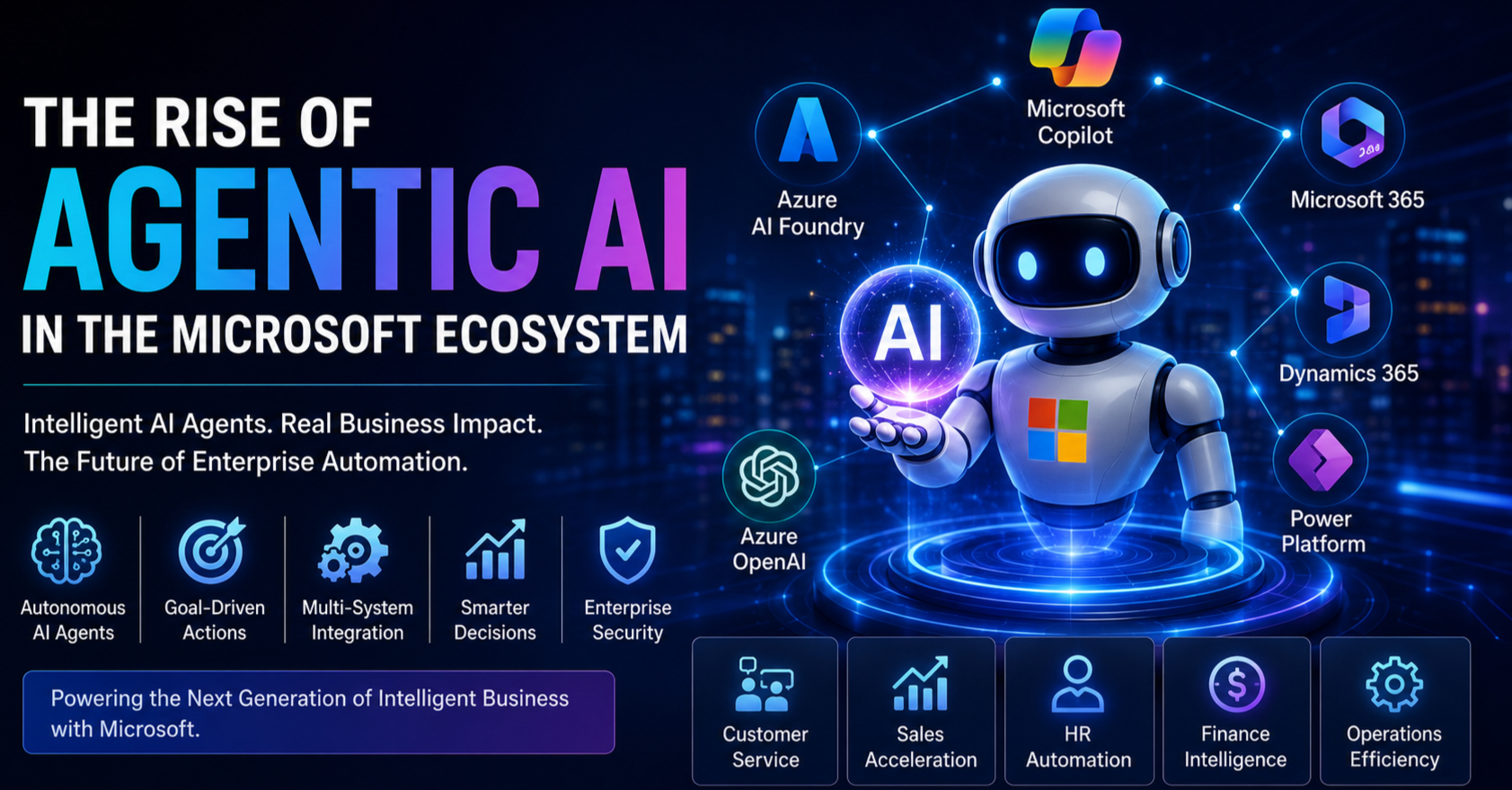
Microsoft is leading this transformation by embedding Agentic AI across its ecosystem, including Azure AI Foundry, Microsoft Copilot, Power Platform, Dynamics 365, Microsoft 365 and Azure cloud services.
In this comprehensive guide, we’ll explore what Agentic AI is, why it’s important, how Microsoft is implementing it and why developers and businesses should start learning this technology today.
What Is Agentic AI?
Agentic AI refers to AI systems that act as intelligent agents capable of pursuing goals rather than simply responding to isolated requests.
Traditional AI typically follows a request-response model:
User: “Write an email.”
AI: Generates an email.
An Agentic AI system can instead:
- Understand the broader objective.
- Gather relevant information.
- Plan multiple steps.
- Interact with business systems.
- Execute tasks.
- Monitor outcomes.
- Ask for clarification when necessary.
- Continue working until the objective is achieved or human approval is required.
This represents a significant shift from passive assistance to proactive collaboration.
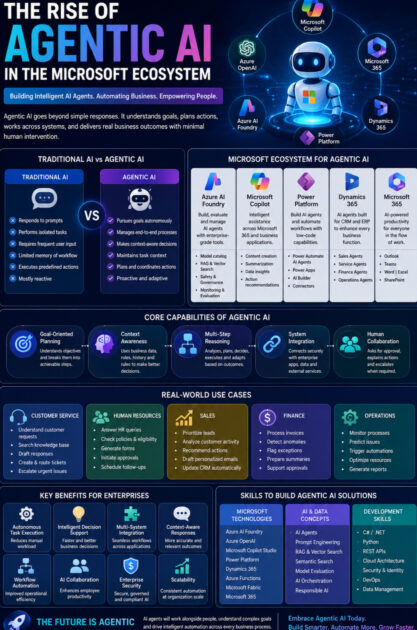
Traditional AI vs Agentic AI
| Traditional AI | Agentic AI |
|---|---|
| Responds to prompts | Pursues goals autonomously |
| Performs isolated tasks | Manages end-to-end processes |
| Requires frequent user input | Makes context-aware decisions |
| Limited memory of workflow | Maintains task context |
| Executes predefined actions | Plans and coordinates multiple actions |
| Mostly reactive | Proactive and adaptive |
Agentic AI combines reasoning, planning and execution to solve more complex business challenges.
Why Agentic AI Matters
Modern organisations deal with:
- Large volumes of business data.
- Complex workflows.
- Multiple enterprise applications.
- Repetitive manual tasks.
- High customer expectations.
Traditional automation is effective for well-defined, repetitive processes but struggles with changing business conditions and unstructured information.
Agentic AI addresses these challenges by:
- Understanding business objectives.
- Coordinating across systems.
- Adapting to changing circumstances.
- Supporting employees with intelligent recommendations.
- Automating multi-step processes.
Microsoft’s Vision for Agentic AI
Microsoft is integrating Agentic AI across its technology ecosystem to create intelligent, collaborative business solutions.
Key platforms include:
- Microsoft Copilot
- Azure AI Foundry
- Azure OpenAI
- Power Platform
- Dynamics 365
- Microsoft 365
- Microsoft Fabric
- Azure cloud services
Together, these technologies enable organisations to build AI agents that can reason, act and collaborate securely within enterprise environments.
Azure AI Foundry: The Foundation for AI Agents
Azure AI Foundry provides the tools needed to design, build and manage enterprise AI agents.
Developers can:
- Select foundation models.
- Build AI agents.
- Implement Retrieval-Augmented Generation (RAG).
- Test prompts.
- Evaluate model performance.
- Monitor AI applications.
- Apply responsible AI practices.
Azure AI Foundry acts as the central platform for enterprise AI development.
Microsoft Copilot Becomes More Intelligent
Microsoft Copilot has evolved beyond being a writing assistant.
Modern Copilot experiences can:
- Summarise meetings.
- Draft emails.
- Generate reports.
- Analyse business data.
- Recommend next actions.
- Coordinate workflows.
- Support decision-making.
As Agentic AI capabilities expand, Copilot is becoming an active digital collaborator rather than just a conversational interface.
Power Platform and Agentic AI
The Microsoft Power Platform is rapidly adopting Agentic AI capabilities.
Power Automate AI Agents can:
- Understand workflow objectives.
- Analyse incoming requests.
- Retrieve business data.
- Make informed decisions.
- Trigger automations.
- Coordinate approvals.
- Generate notifications.
- Escalate issues when appropriate.
This enables organisations to automate complex processes while maintaining governance and human oversight.
Dynamics 365 with AI Agents
Dynamics 365 is increasingly using Agentic AI to enhance CRM and ERP processes.
Examples include:
Sales Agents
- Prioritise leads.
- Recommend next actions.
- Generate follow-up emails.
- Prepare proposals.
- Forecast opportunities.
Customer Service Agents
- Summarise cases.
- Suggest resolutions.
- Route tickets intelligently.
- Draft responses.
- Monitor customer sentiment.
Finance Agents
- Process invoices.
- Detect anomalies.
- Support financial approvals.
- Generate reports.
These agents help employees focus on strategic work while routine tasks are automated.
Microsoft 365 and Intelligent Productivity
Agentic AI is also transforming productivity across Microsoft 365.
AI agents assist with:
- Email management.
- Calendar scheduling.
- Meeting preparation.
- Document creation.
- Task prioritisation.
- Knowledge retrieval.
By reducing administrative effort, employees can devote more time to high-value activities.
Core Capabilities of Agentic AI
1. Goal-Oriented Planning
Instead of following fixed instructions, AI agents identify the steps needed to achieve a business objective.
2. Context Awareness
Agents use organisational data, user roles, previous interactions and business rules to make more informed decisions.
3. Multi-Step Reasoning
Complex business processes often require several coordinated actions.
Agentic AI can:
- Analyse information.
- Evaluate options.
- Select appropriate actions.
- Monitor progress.
- Adjust plans when conditions change.
4. Tool and System Integration
AI agents can securely interact with enterprise systems such as:
- Dynamics 365
- Microsoft 365
- SharePoint
- Dataverse
- Azure SQL Database
- SAP
- ServiceNow
- External APIs
This allows them to complete real business tasks rather than simply providing information.
5. Human Collaboration
Although AI agents can operate autonomously, they are designed to work alongside people.
For critical decisions, agents can:
- Request approval.
- Explain recommendations.
- Present alternatives.
- Escalate exceptions.
This supports responsible AI adoption while keeping humans in control.
Real-World Business Use Cases
Customer Service
An AI agent can:
- Receive a customer request.
- Analyse previous interactions.
- Search the knowledge base.
- Draft a response.
- Create a support ticket.
- Escalate urgent issues.
- Notify the support team.
Human Resources
Employees ask:
“I need parental leave information.”
The AI agent:
- Searches HR policies.
- Explains eligibility.
- Generates the required forms.
- Initiates the approval workflow.
- Schedules follow-up tasks.
Sales
Sales agents can:
- Monitor opportunities.
- Analyse customer activity.
- Recommend follow-up actions.
- Draft personalised emails.
- Update CRM records automatically.
Finance
Finance agents assist by:
- Processing invoices.
- Identifying discrepancies.
- Flagging exceptions.
- Preparing financial summaries.
- Supporting compliance reviews.
Benefits of Agentic AI
| Capability | Business Benefit |
|---|---|
| Autonomous Task Execution | Reduced manual effort |
| Intelligent Decision Support | Faster and more informed decisions |
| Multi-System Integration | Streamlined business processes |
| Context-Aware Responses | More relevant outcomes |
| Workflow Automation | Improved operational efficiency |
| AI Collaboration | Enhanced employee productivity |
| Enterprise Security | Safe and governed AI adoption |
| Scalability | Consistent automation across departments |
Skills Developers Should Learn
To build Agentic AI solutions, developers should become familiar with:
Microsoft Technologies
- Azure AI Foundry
- Azure OpenAI
- Microsoft Copilot Studio
- Power Platform
- Dynamics 365
- Azure Functions
- Microsoft Fabric
AI Concepts
- Prompt Engineering
- AI Agents
- Retrieval-Augmented Generation (RAG)
- Vector Search
- Semantic Search
- Responsible AI
- AI Orchestration
Development Skills
- C#
- Python
- REST APIs
- Cloud Architecture
- Security
- Authentication
- DevOps
Combining these skills prepares developers to build modern AI-powered business applications.
Best Practices
When implementing Agentic AI:
- Start with clearly defined business objectives.
- Keep humans involved in high-impact decisions.
- Secure enterprise data with Microsoft Entra ID and Azure Key Vault.
- Use trusted knowledge sources to improve response quality.
- Monitor agent performance and refine workflows regularly.
- Apply responsible AI principles, including transparency and governance.
Challenges to Consider
Governance
AI agents require clear policies for monitoring, auditing and accountability.
Data Quality
Accurate enterprise data is essential for reliable AI decisions.
Security
Protect sensitive information with robust identity management, encryption and access controls.
User Trust
Employees should understand how AI agents make recommendations and when human review is appropriate.
The Future of Agentic AI
The future of enterprise AI will be increasingly agent-driven.
Emerging trends include:
- Teams of specialised AI agents collaborating on complex tasks.
- Richer multimodal capabilities combining text, images, voice and video.
- Greater integration with Microsoft Fabric and Azure AI Foundry.
- Industry-specific AI agents for healthcare, finance, manufacturing and education.
- Improved reasoning and long-term planning.
- More seamless collaboration between humans and AI.
These advancements will enable businesses to automate sophisticated processes while maintaining control and governance.
Why Learning Agentic AI Is a Smart Career Move
The demand for professionals who understand AI agents is growing rapidly.
Roles expected to benefit include:
- AI Developer
- Azure AI Engineer
- Power Platform Developer
- Dynamics 365 Developer
- Cloud Solutions Architect
- AI Solutions Architect
- Enterprise Application Developer
- Automation Engineer
Learning Agentic AI today positions developers and IT professionals for the next generation of enterprise software development.
Conclusion
Agentic AI represents one of the most significant advancements in enterprise technology. By moving beyond simple prompt-response interactions, AI agents can understand goals, reason through complex workflows, collaborate with business systems and support employees in meaningful ways.
Microsoft is at the forefront of this transformation, integrating Agentic AI across Azure AI Foundry, Microsoft Copilot, Dynamics 365, Power Platform and Microsoft 365. These capabilities are reshaping how organisations automate processes, improve productivity and deliver intelligent business experiences.
For developers, consultants and business leaders, understanding Agentic AI is no longer optional—it’s becoming an essential skill for building the next generation of intelligent enterprise applications. Organisations that embrace this technology early will be better positioned to innovate, streamline operations and remain competitive in the AI-driven future.