Top Power Platform Trends That Will Dominate 2026
Introduction
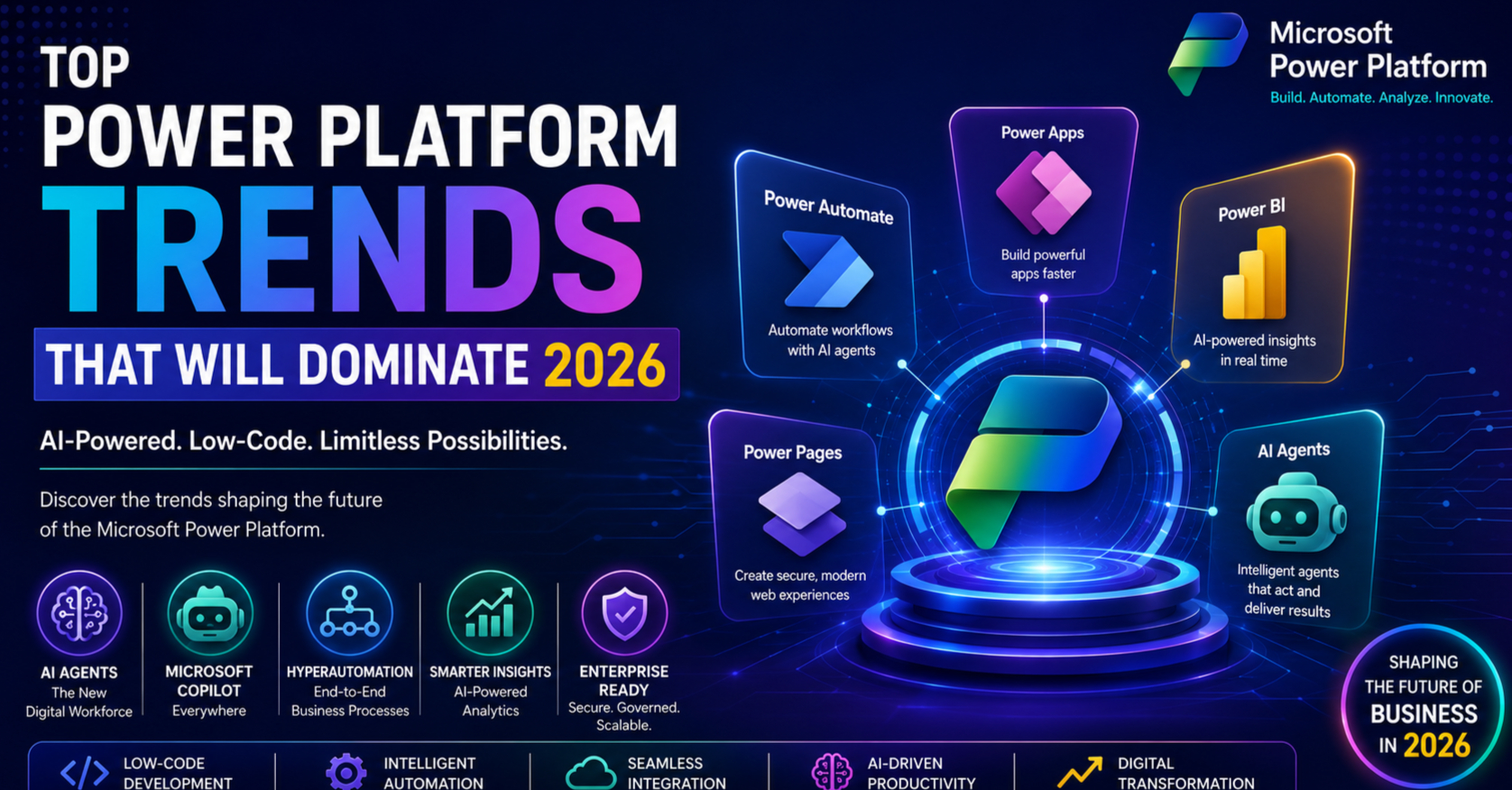
The Microsoft Power Platform has evolved from a low-code development suite into one of the world’s most powerful enterprise application platforms. In 2026, organisations are no longer using Power Platform simply to automate workflows—they’re leveraging AI-powered applications, intelligent business agents and enterprise-scale automation to transform the way they work.
With rapid advancements in Microsoft Copilot, AI Agents, Power Apps, Power Automate, Power BI and Power Pages, businesses of every size are accelerating digital transformation while reducing development costs.
Whether you’re a business leader, developer, IT professional or citizen developer, understanding these emerging trends will help you stay ahead in an increasingly AI-driven world.
In this blog, we’ll explore the biggest Power Platform trends expected to dominate 2026 and how organisations can prepare for the future.
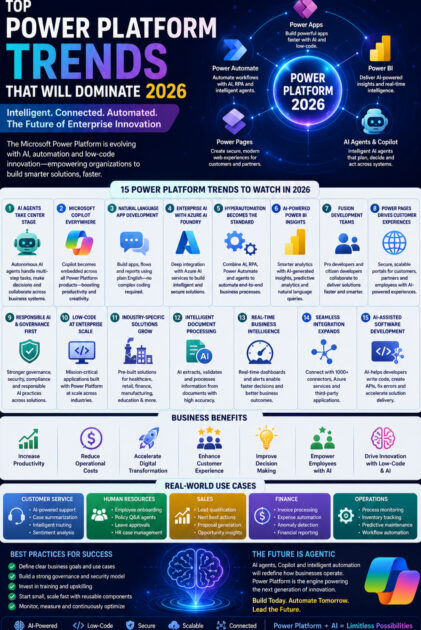
Why Power Platform Continues to Grow
Microsoft Power Platform enables organisations to:
- Build applications faster
- Automate repetitive processes
- Analyse business data
- Create secure business websites
- Integrate hundreds of business systems
- Develop AI-powered business solutions
The combination of low-code development and Generative AI has made Power Platform one of Microsoft’s fastest-growing enterprise technologies.
1. AI Agents Become the New Digital Workforce
The biggest trend in 2026 is the rise of AI Agents.
Unlike traditional chatbots, AI Agents can:
- Understand business processes
- Complete multi-step tasks
- Make intelligent decisions
- Access enterprise data
- Collaborate with employees
- Automate end-to-end workflows
Examples include:
- HR onboarding agents
- Customer support agents
- Sales assistants
- Finance approval agents
- Procurement assistants
Businesses are increasingly deploying AI Agents to reduce manual work and improve operational efficiency.
2. Microsoft Copilot Becomes a Standard Feature
Microsoft Copilot is no longer an optional productivity tool—it has become an essential component across the Power Platform ecosystem.
In 2026, Copilot helps users:
- Build Power Apps using natural language
- Create Power Automate flows with simple prompts
- Generate Power BI reports automatically
- Design Power Pages websites faster
- Produce formulas and expressions
- Explain errors and suggest fixes
This significantly lowers the barrier to application development, enabling both technical and non-technical users to create sophisticated solutions.
3. Natural Language App Development
Building business applications is becoming as simple as describing requirements in plain English.
For example, users can type:
“Create an employee leave management application with approval workflows and dashboards.”
Copilot automatically generates:
- Tables
- Forms
- Screens
- Relationships
- Business logic
- Workflows
- Sample data
This dramatically reduces development time and enables rapid prototyping.
4. Enterprise AI Integration with Azure AI Foundry
Organisations are increasingly integrating Power Platform with Azure AI services to create advanced business solutions.
Popular use cases include:
- Intelligent document processing
- Contract analysis
- Customer sentiment analysis
- Predictive maintenance
- Image recognition
- Voice assistants
- Knowledge search
This integration allows businesses to combine low-code development with enterprise-grade AI capabilities.
5. Hyperautomation Becomes the New Standard
Automation is evolving beyond simple workflows.
Hyperautomation combines:
- Power Automate
- AI Builder
- Robotic Process Automation (RPA)
- AI Agents
- Copilot
- Business Process Flows
Organisations are automating entire business operations, including finance, HR, procurement, customer service and compliance, resulting in faster processes and reduced operational costs.
6. AI-Powered Power BI Insights
Power BI is transforming from a reporting tool into an intelligent decision-making platform.
New AI capabilities include:
- Automatic report generation
- Natural language queries
- Predictive analytics
- Anomaly detection
- Forecasting
- Executive summaries
- AI-driven visual recommendations
Business leaders can now ask questions like:
“Why did sales decline last quarter?”
Power BI provides instant explanations supported by relevant data visualisations.
7. Fusion Development Teams Gain Momentum
Fusion development combines professional developers with citizen developers to deliver solutions more efficiently.
Typical collaboration includes:
- Business users defining requirements
- Citizen developers building initial applications
- Professional developers adding advanced functionality
- IT teams managing governance and security
This collaborative approach accelerates innovation while maintaining enterprise standards.
8. Power Pages Powers Customer Self-Service
Businesses are increasingly using Power Pages to create secure, scalable portals for customers, suppliers and partners.
Popular implementations include:
- Customer support portals
- Student portals
- Vendor management systems
- Appointment booking platforms
- Membership websites
- Government service portals
With AI integration, these portals now offer intelligent search, virtual assistants and personalised user experiences.
9. Responsible AI and Governance Take Centre Stage
As AI adoption grows, organisations are placing greater emphasis on responsible AI practices.
Key priorities include:
- Data security
- Regulatory compliance
- Role-based access control
- Audit trails
- Ethical AI usage
- Human oversight
- Transparency in AI-generated outputs
Microsoft continues to enhance governance tools within Power Platform to help organisations meet compliance requirements.
10. Low-Code Development Becomes Enterprise Standard
Low-code development is no longer limited to small departmental projects.
Large enterprises are using Power Platform to build:
- CRM extensions
- HR systems
- Financial approval applications
- Inventory management solutions
- Healthcare applications
- Manufacturing dashboards
- Field service tools
Professional developers increasingly use Power Platform alongside traditional development frameworks to accelerate project delivery.
11. Industry-Specific Power Platform Solutions
Microsoft and its partners are delivering industry-focused solutions tailored to sectors such as:
Healthcare
- Patient management
- Appointment scheduling
- Compliance tracking
Education
- Student portals
- Learning management integrations
- Attendance automation
Manufacturing
- Production monitoring
- Quality inspections
- Equipment maintenance
Retail
- Inventory management
- Customer loyalty programmes
- Sales analytics
Financial Services
- Loan processing
- Compliance workflows
- Customer onboarding
These pre-built solutions reduce implementation time and improve business value.
12. Intelligent Document Processing Expands
Businesses handle thousands of invoices, contracts, forms and receipts every month.
Using AI Builder and Power Automate, organisations can:
- Extract text from documents
- Identify key information
- Validate data
- Route approvals
- Archive files automatically
- Integrate with ERP and CRM systems
This reduces manual data entry and improves processing accuracy.
13. Real-Time Business Intelligence
Executives increasingly rely on real-time dashboards to monitor business performance.
Power Platform enables organisations to track:
- Sales performance
- Customer engagement
- Inventory levels
- Financial metrics
- Service requests
- Operational KPIs
AI-powered alerts notify decision-makers when critical thresholds are reached, enabling faster responses to business changes.
14. Cross-Platform Integration Continues to Expand
Power Platform now connects seamlessly with hundreds of services, including:
- Microsoft 365
- Dynamics 365
- Azure
- SQL Server
- SAP
- Oracle
- Salesforce
- ServiceNow
- SharePoint
- Teams
This extensive connectivity enables organisations to unify data and automate processes across multiple business systems.
15. AI-Assisted Software Development
Professional developers are increasingly combining Power Platform with traditional programming languages such as C#, JavaScript and .NET.
AI tools assist with:
- Code generation
- API integration
- Formula creation
- Error detection
- Testing
- Documentation
This hybrid approach enables organisations to deliver enterprise applications more quickly and efficiently.
Business Benefits of These Trends
| Trend | Business Benefit |
|---|---|
| AI Agents | Reduced manual effort and increased productivity |
| Microsoft Copilot | Faster application development |
| Hyperautomation | End-to-end business process optimisation |
| AI-Powered Analytics | Better decision-making |
| Low-Code Development | Reduced development costs |
| Power Pages | Improved customer engagement |
| Intelligent Automation | Faster approvals and operations |
| Enterprise Governance | Enhanced security and compliance |
Best Practices for Adopting Power Platform in 2026
To maximise the value of Power Platform, organisations should:
- Define a clear low-code governance strategy.
- Invest in user training for Copilot and AI-powered tools.
- Maintain clean, high-quality data for reliable AI outputs.
- Implement security and compliance policies from the outset.
- Encourage collaboration between business users and professional developers.
- Start with high-impact automation projects before scaling across departments.
- Continuously monitor performance and optimise solutions based on business needs.
The Future of Power Platform
The future of Power Platform is centred on intelligent automation, autonomous AI and seamless collaboration between humans and technology.
Looking ahead, we can expect:
- Autonomous AI agents managing complex business processes.
- Voice-driven application development.
- Predictive business automation.
- Industry-specific AI copilots.
- Advanced natural language programming.
- Deeper integration with Microsoft Fabric and Azure AI services.
- More personalised and context-aware business applications.
As Microsoft continues to invest heavily in AI innovation, Power Platform will remain a key driver of enterprise digital transformation.
Conclusion
The Microsoft Power Platform is entering an exciting new era where artificial intelligence, automation and low-code development converge to reshape how businesses operate. From AI Agents and Microsoft Copilot to hyperautomation and intelligent analytics, the trends defining 2026 empower organisations to innovate faster, improve efficiency and deliver exceptional customer experiences.
Businesses that embrace these advancements early will be better equipped to streamline operations, reduce costs and maintain a competitive edge in an increasingly digital world. Whether you’re just starting your Power Platform journey or looking to expand existing solutions, now is the ideal time to invest in the technologies that will define the future of enterprise applications.