10 C# and .NET Projects to Make Your Developer Resume Stand Out in 2026
Introduction
Recruiters now look beyond lists of C# and .NET skills. They want proof that you can design systems, write tests, secure data, deploy software, handle failure, and make sound product decisions.
These C# projects for resume use ASP.NET Core, .NET 10 or another current long-term-support release, Entity Framework Core, cloud services, APIs, distributed systems, and AI tools. Each project can become one of several strong .NET portfolio projects.
The goal is depth, not ten unfinished repositories. Build two or three projects well, then show the architecture, tests, deployment, trade-offs, and measured results behind each one.
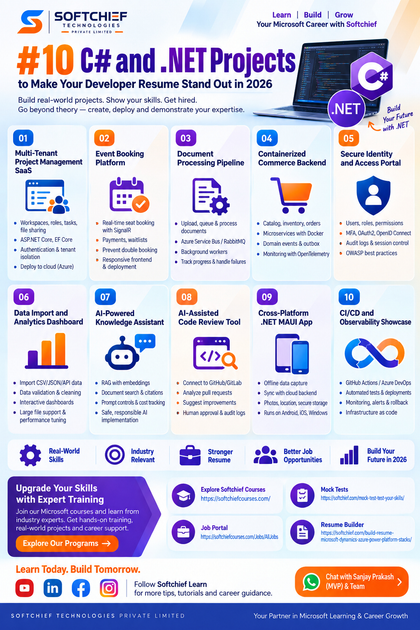
Build C# and .NET Projects That Show Full-Stack Skills
Production-style applications prove that you can connect user needs with reliable backend code. Your projects should include clean architecture, validation, authentication, database design, API documentation, tests, and deployment.
Create a Multi-Tenant Project Management SaaS
Build a project platform for several organizations. Include workspaces, roles, projects, tasks, comments, file attachments, activity logs, and subscription-ready account records.
Use ASP.NET Core Web API, Blazor or a modern JavaScript frontend, Entity Framework Core, PostgreSQL or SQL Server, ASP.NET Core Identity, Docker, and a cloud host. Show tenant isolation, role-based authorization, OpenAPI endpoints, search, pagination, audit history, optimistic concurrency, and automated unit, integration, and end-to-end tests.
Your repository should include a system diagram, database schema, API docs, deployment URL, sample accounts, test coverage summary, and a short explanation of your security choices.
Build an Event Booking Platform with Real-Time Updates
Create a booking system for venues, classes, conferences, or workshops. Users should discover events, view availability, reserve seats, cancel bookings, and join waitlists.
Use ASP.NET Core, SignalR, Entity Framework Core, a relational database, background services, a payment sandbox, and a responsive frontend. Prevent double booking with transaction rules and concurrency checks. Add idempotent reservation operations, confirmation messages, and live updates for seat availability.
Document the booking workflow, failure handling, concurrency tests, API contract, and SignalR behavior. A short product walkthrough can make this one of the best C# projects in your portfolio.
Show Cloud-Native Architecture and Distributed Systems
Advanced .NET projects should show more than CRUD screens. Include queues, workers, containers, health checks, tracing, retries, and clear service boundaries.
Develop a Document Processing Pipeline
Build a service that accepts documents, queues processing jobs, extracts text or metadata, stores results, and reports progress. Use ASP.NET Core, .NET Worker Services, Azure Service Bus or RabbitMQ, object storage, Entity Framework Core, Docker, and OpenTelemetry.
Add upload validation, durable queues, retry policies, dead-letter handling, idempotent workers, status dashboards, structured logs, health checks, and distributed traces. Include an architecture diagram, queue design, observability screenshots, failure tests, and load results when you have measured them.
Build a Containerized Commerce Backend
Create a small commerce backend with separate catalog, inventory, ordering, and notification services. Keep the scope focused so the project shows useful service boundaries instead of unnecessary complexity.
Use ASP.NET Core APIs, .NET Aspire where it fits, Docker Compose, PostgreSQL or SQL Server, Redis, a message broker, and OpenTelemetry. Include separate data ownership, synchronous API calls, asynchronous domain events, an outbox pattern, rate limits, timeouts, retries, circuit breakers, service discovery, and central configuration.
Explain why you chose microservices and when a modular monolith would be better. Add API specifications, event-flow diagrams, local setup instructions, and monitoring screenshots.
Prove Security and Data Engineering Skills
Security and data quality make real-world C# projects easier to assess. Document the threats you considered, the rules you enforced, and the performance choices you measured.
Create a Secure Identity and Access Portal
Build an administration portal for users, roles, permissions, API keys, sessions, and audit events. Use ASP.NET Core Identity, OpenID Connect, OAuth 2.0 concepts, secure cookies or JWTs, Entity Framework Core, and Blazor or another suitable frontend.
Include multi-factor authentication, policy-based authorization, account lockout, password resets, session controls, scoped API keys, expiration, revocation, and tamper-evident audit logs. Protect the app against common OWASP risks.
Publish a threat model, authorization matrix, security test cases, dependency scan results, and secrets-management plan. Reference official Microsoft ASP.NET Core and OWASP guidance in the repository.
Build a Data Import and Analytics Dashboard
Create an application that imports CSV, JSON, or API data, checks records, reports errors, cleans values, and displays useful charts. Use ASP.NET Core, background services, Entity Framework Core, SQL window functions, caching, and a charting library.
Support large files with streaming or batches. Add schema checks, row-level errors, duplicate detection, incremental updates, import history, indexes, projections, exportable reports, and role-restricted dashboards.
Show sample schemas, failed import examples, indexing decisions, and before-and-after query timings. State the test conditions behind every performance claim.
Add AI and Search to Your .NET Portfolio
AI features can help your .NET developer resume projects stand out when they solve a clear problem. They also need privacy controls, evaluation, cost tracking, and safe fallback behavior.
Develop a Retrieval-Augmented Knowledge Assistant
Build a question-answering app that indexes public, synthetic, or permissioned documents. Use ASP.NET Core, Microsoft.Extensions.AI or another .NET AI SDK, embeddings, a vector database or search service, background indexing, and an LLM provider.
Include document chunking, metadata extraction, hybrid search, source citations, conversation controls, prompt versioning, rate limits, token-cost tracking, and fallback responses. Test supported and unsupported questions, retrieval quality, latency, and privacy rules.
Document hallucination risks, prompt injection defenses, sensitive-data handling, copyright limits, and the need to verify generated answers against sources.
Build an AI-Assisted Code Review Tool
Create a developer tool that connects to GitHub or GitLab, reads pull request changes, identifies possible issues, summarizes edits, and links findings to files or lines.
Use OAuth, webhooks, background processing, diff parsing, file filters, structured model output, and persistent review records. Require human approval before posting comments. Store review history, feedback, confidence, severity, and model-output audit data.
Measure response time and define evaluation rules. Explain where deterministic static analysis works better than generative AI, and add safeguards against harmful automatic changes.
Show Mobile Delivery and DevOps Skills
The final projects should show that you can ship software beyond a local machine. Platform support, offline behavior, deployment automation, and monitoring all add visible product value.
Create a Cross-Platform .NET MAUI Field Service App
Build a mobile app for technicians, inspectors, or other workers who need offline data capture. Use .NET MAUI, ASP.NET Core Web API, SQLite, Entity Framework Core, secure local storage, push notifications, and a cloud backend.
Support offline forms, local persistence, photo attachments, sync conflict detection, secure token storage, accessible layouts, and location data only when needed and permissioned. Demonstrate online and offline workflows with device screenshots, sync rules, API documentation, accessibility checks, and cross-platform tests.
Build a CI/CD and Observability Showcase
Package one earlier application, or a smaller service, with a complete delivery pipeline. Use GitHub Actions or Azure DevOps, Docker, infrastructure-as-code, a documented cloud provider, OpenTelemetry, and centralized logging.
Run tests on every pull request. Add API contract tests, static analysis, dependency scans, container scans, secret management, environment settings, staged deployments, health checks, alerts, dashboards, and rollback steps.
Publish the pipeline YAML, deployment diagram, release history, failed-build example, monitoring view, and runbook. Official GitHub Actions, Azure DevOps, Docker, Microsoft .NET deployment, and OpenTelemetry documentation can support the setup.
Make Every Project Resume-Ready
Select Projects with Different Strengths
Choose two or three projects that cover different skills: one polished full-stack app, one cloud or distributed system, and one security, data, mobile, AI, or DevOps project. Match each choice to a target job description.
A backend role may favor queues and APIs. A full-stack role may favor the SaaS platform. A platform role may favor CI/CD, observability, and containers.
Add Proof of Quality and Judgment
Each README should explain the problem, users, features, architecture, setup, trade-offs, and known limits. Add diagrams, reproducible test commands, OpenAPI docs, dependency updates, release notes, and a live demo or recording when privacy and cost allow.
Replace “built a scalable app” with evidence such as measured response times, supported workloads, test results, deployment design, or documented failure behavior. Keep issues, pull requests, and commit history meaningful.
Write Resume Bullets That Show Decisions
Use this formula: action + technology + engineering challenge + measured or verifiable result.
A strong example is: “Built a containerized ASP.NET Core service that processes queued document jobs with retry and dead-letter handling, adding OpenTelemetry traces and automated integration tests.”
Name the C# and .NET tools you used. Mention patterns only when they solved a documented problem, and include measurements only when you can reproduce them.
Conclusion
The strongest portfolio is not the one with the most repositories. It shows complete software, careful engineering decisions, secure design, testing, observability, deployment, and clear communication.
Choose two or three projects that match your target role. Define a realistic scope, publish the implementation, measure what you build, and refine each repository until it communicates the quality expected from a professional .NET developer.