
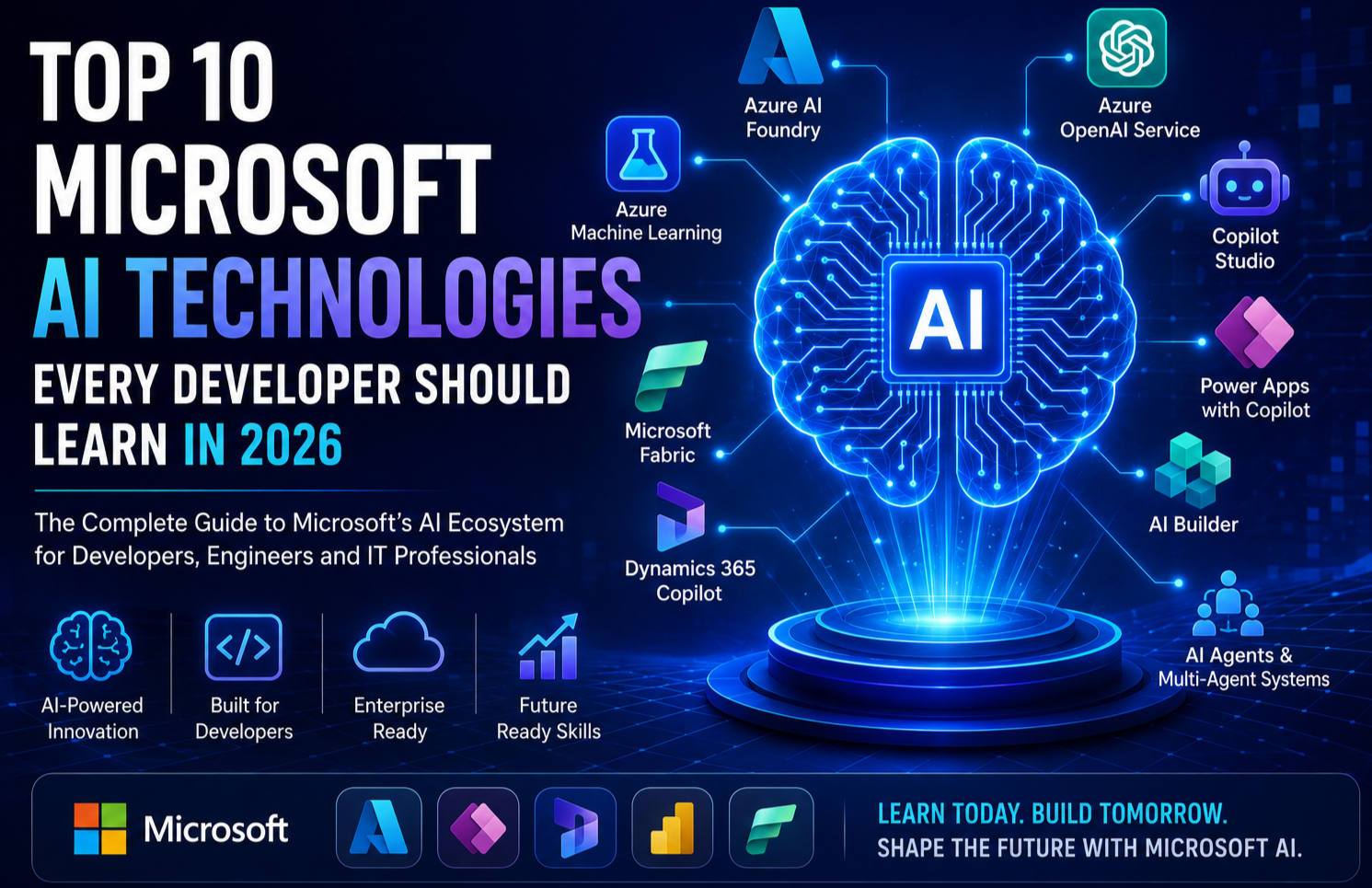
Top 10 Microsoft AI Technologies Every Developer Should Learn in 2026
Introduction
Artificial Intelligence is no longer an emerging trend—it has become the foundation of modern software development. From intelligent chatbots and AI-powered business applications to autonomous agents and predictive analytics, AI is transforming how developers design, build and deploy software.
Microsoft is leading this transformation with an extensive ecosystem of AI technologies integrated across Azure, Microsoft 365, Dynamics 365 and the Power Platform. Whether you’re a software developer, cloud engineer, Power Platform professional or student, understanding these technologies will help you stay competitive in today’s rapidly evolving job market.
In this guide, we’ll explore the Top 10 Microsoft AI technologies every developer should learn in 2026, why they matter and how they can accelerate your career.
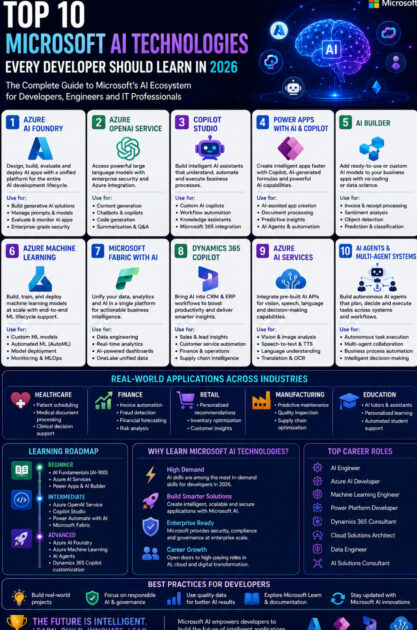
Why Microsoft AI Skills Matter in 2026
Businesses across industries are investing heavily in AI-driven solutions to improve efficiency, automate processes and enhance customer experiences.
Developers with Microsoft AI expertise can build:
- Intelligent business applications
- AI-powered copilots
- Enterprise chatbots
- Workflow automation
- Predictive analytics solutions
- Document processing systems
- Recommendation engines
- AI-integrated web and mobile applications
As organisations continue their digital transformation journeys, demand for professionals skilled in Microsoft AI technologies is expected to remain strong.
1. Azure AI Foundry
Azure AI Foundry has become Microsoft’s unified platform for designing, building, evaluating and managing AI applications.
Developers can use Azure AI Foundry to:
- Build generative AI solutions
- Experiment with large language models (LLMs)
- Evaluate AI responses
- Manage prompts
- Monitor AI performance
- Deploy AI applications securely
Why Learn It?
Azure AI Foundry simplifies the end-to-end AI development lifecycle and serves as the central hub for many Microsoft AI services.
Best For
- AI Engineers
- Cloud Developers
- Solution Architects
- Enterprise AI Teams
2. Azure OpenAI Service
Azure OpenAI Service provides secure enterprise access to powerful large language models hosted within Azure.
Developers can build applications that:
- Generate text
- Summarise documents
- Translate languages
- Answer questions
- Generate code
- Analyse content
- Support conversational AI
Unlike public AI services, Azure OpenAI offers enterprise-grade security, compliance and integration with Azure resources.
Popular Use Cases
- AI customer support
- Knowledge assistants
- Content generation
- Internal enterprise copilots
3. Microsoft Copilot Studio
Copilot Studio enables organisations to create intelligent AI assistants without extensive coding.
Developers can build copilots that:
- Understand natural language
- Access enterprise data
- Automate workflows
- Execute business tasks
- Integrate with Microsoft 365
- Connect to external APIs
Why Learn It?
Businesses increasingly require custom AI assistants tailored to their unique processes.
4. Power Apps with AI and Copilot
Power Apps has evolved beyond low-code development into an AI-powered application platform.
Developers can create intelligent applications featuring:
- Natural language app creation
- AI-generated formulas
- AI document processing
- Image recognition
- AI Agents
- Predictive insights
- Workflow automation
Power Apps enables rapid delivery of enterprise-grade business applications with minimal coding.
5. AI Builder
AI Builder empowers developers and citizen developers to add AI capabilities directly into business applications.
Available models include:
- Invoice processing
- Receipt recognition
- Business card scanning
- Document extraction
- Sentiment analysis
- Object detection
- Prediction models
- Category classification
Business Benefits
- Reduced manual data entry
- Faster document processing
- Improved accuracy
- Enhanced automation
6. Azure Machine Learning
Azure Machine Learning is Microsoft’s comprehensive platform for developing, training and deploying machine learning models.
Developers can:
- Build predictive models
- Train custom AI solutions
- Automate machine learning workflows
- Deploy models at scale
- Monitor model performance
- Manage AI lifecycles
Best For
- Data Scientists
- Machine Learning Engineers
- AI Researchers
7. Microsoft Fabric with AI
Microsoft Fabric combines data engineering, analytics and AI into a unified platform.
Developers can:
- Analyse enterprise data
- Create AI-powered dashboards
- Build predictive analytics
- Connect business intelligence with AI
- Access unified data through OneLake
Fabric simplifies the process of turning business data into actionable insights.
8. Dynamics 365 Copilot
Dynamics 365 Copilot brings AI directly into CRM and ERP applications.
It helps organisations automate:
- Sales forecasting
- Customer interactions
- Financial reporting
- Supply chain optimisation
- Service management
- Marketing campaigns
Developers working with Dynamics 365 increasingly benefit from understanding Copilot customisation and integration.
9. Azure AI Services
Azure AI Services provide ready-to-use APIs that developers can integrate into applications.
Popular services include:
Vision AI
- Image analysis
- OCR
- Face detection
- Object recognition
Speech AI
- Speech-to-text
- Text-to-speech
- Real-time translation
Language AI
- Sentiment analysis
- Key phrase extraction
- Language detection
- Entity recognition
These services allow developers to add AI features without building models from scratch.
10. AI Agents and Multi-Agent Systems
One of the biggest trends in 2026 is the rise of AI Agents.
Unlike traditional chatbots, AI Agents can:
- Understand business context
- Plan tasks
- Make decisions
- Execute workflows
- Collaborate with other agents
- Learn from interactions
- Integrate with enterprise systems
Microsoft continues to expand agent capabilities across Azure AI, Copilot Studio and the Power Platform.
Developers who understand agentic AI will be well positioned for future enterprise projects.
Comparison of Microsoft AI Technologies
| Technology | Primary Purpose | Ideal For |
|---|---|---|
| Azure AI Foundry | AI application development | AI Engineers |
| Azure OpenAI Service | Generative AI | Developers |
| Copilot Studio | AI assistants | Power Platform Developers |
| Power Apps + Copilot | Intelligent business apps | Citizen Developers & Developers |
| AI Builder | Pre-built AI models | Business Apps |
| Azure Machine Learning | Custom ML models | Data Scientists |
| Microsoft Fabric | AI-powered analytics | Data Engineers |
| Dynamics 365 Copilot | CRM & ERP AI | Dynamics Consultants |
| Azure AI Services | Vision, Speech & Language APIs | Application Developers |
| AI Agents | Autonomous business automation | Enterprise Developers |
Real-World Applications
Healthcare
Develop AI-powered patient scheduling systems, automate medical document processing and enhance clinical decision support.
Finance
Build intelligent invoice processing solutions, fraud detection systems and financial forecasting tools.
Retail
Create personalised shopping experiences, recommendation engines and AI-driven inventory management.
Manufacturing
Develop predictive maintenance solutions, automate quality inspections and optimise supply chains.
Education
Build AI tutors, automate student support and generate personalised learning recommendations.
Career Opportunities
Learning Microsoft AI technologies can prepare you for roles such as:
- AI Engineer
- Azure AI Developer
- Cloud Solutions Architect
- Power Platform Developer
- Dynamics 365 Consultant
- Machine Learning Engineer
- Data Engineer
- Software Developer
- AI Solutions Consultant
- Generative AI Specialist
As AI adoption grows, professionals with hands-on experience across the Microsoft AI ecosystem will be in high demand.
Learning Roadmap for Developers
If you’re just starting, follow this progression:
Beginner
- Microsoft AI Fundamentals (AI-900)
- Azure AI Services
- Power Apps
- AI Builder
Intermediate
- Azure OpenAI Service
- Copilot Studio
- Power Automate with AI
- Microsoft Fabric
Advanced
- Azure AI Foundry
- Azure Machine Learning
- AI Agents
- Dynamics 365 Copilot customisation
- Enterprise AI architecture
This roadmap provides a structured path from foundational concepts to advanced enterprise AI development.
Best Practices for Learning Microsoft AI
- Build practical projects rather than focusing only on theory.
- Learn prompt engineering for generative AI applications.
- Understand responsible AI principles and data governance.
- Explore Microsoft Learn modules and official documentation.
- Integrate AI into real business scenarios using Power Platform and Azure.
- Stay informed about new Microsoft AI announcements and platform updates.
The Future of Microsoft AI
Microsoft continues to invest heavily in AI across its cloud and business application platforms. Key trends shaping the future include:
- Autonomous AI Agents
- Multi-agent collaboration
- AI-first software development
- Natural language programming
- Intelligent workflow automation
- Predictive business intelligence
- AI-powered cybersecurity
- Responsible AI governance
- Industry-specific AI copilots
Developers who build expertise in these areas today will be well prepared for tomorrow’s technology landscape.
Final Thoughts
Artificial Intelligence is rapidly becoming a core skill for modern developers, and Microsoft offers one of the most comprehensive AI ecosystems available today. From Azure AI Foundry and Azure OpenAI Service to Copilot Studio, Power Apps and Dynamics 365 Copilot, these technologies enable developers to create intelligent, scalable and enterprise-ready solutions.
Rather than learning isolated tools, focus on understanding how these technologies work together. A strong foundation in Azure AI, the Power Platform and Microsoft’s generative AI capabilities will allow you to build innovative applications that solve real business problems and accelerate digital transformation.
Whether you’re beginning your AI journey or expanding your existing skills, investing in Microsoft AI technologies in 2026 is a smart step towards a future-proof career.