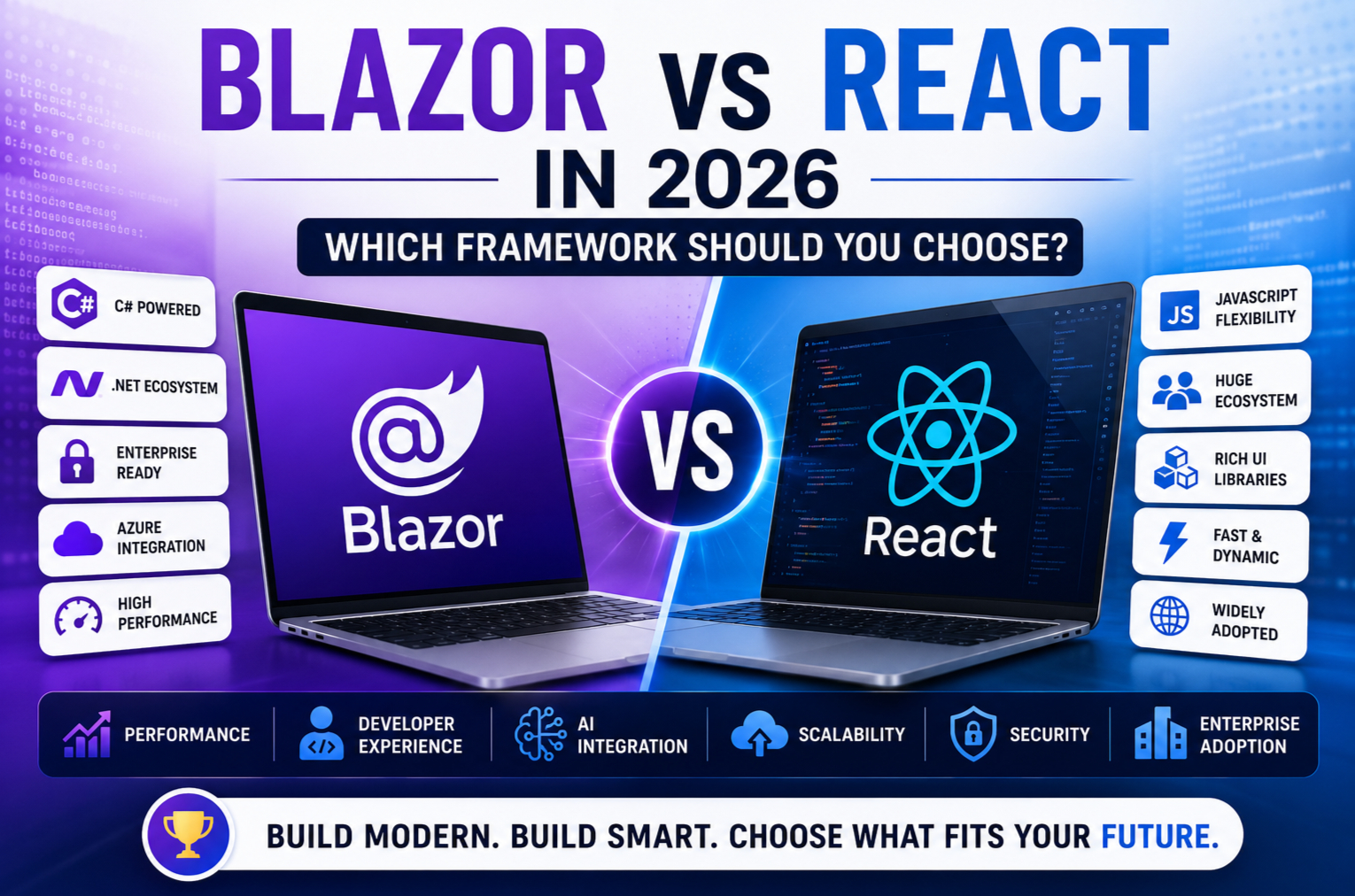
Blazor vs React in 2026: Which Framework Should You Choose?
Introduction
Modern web development is evolving faster than ever, and choosing the right frontend framework can significantly impact your application’s performance, scalability and long-term maintenance. In 2026, two of the most discussed technologies are Microsoft Blazor and React.
React continues to dominate the JavaScript ecosystem, powering millions of websites and enterprise applications worldwide. Meanwhile, Blazor has matured into a powerful framework within the Microsoft ecosystem, allowing developers to build interactive web applications entirely with C# instead of JavaScript.
If you’re planning your next project or upgrading an existing application, this comprehensive comparison will help you decide whether Blazor or React is the right choice.
What is Blazor?
Blazor is Microsoft’s modern web UI framework built on ASP.NET Core. It enables developers to create interactive web applications using C# and .NET rather than JavaScript.
Blazor offers multiple hosting models:
- Blazor WebAssembly
- Blazor Server
- Blazor Web App (Hybrid Rendering)
- Interactive Server Rendering
- Interactive WebAssembly Rendering
- Interactive Auto Rendering
With .NET 9 and the latest improvements available in 2026, Blazor provides excellent performance, simplified deployment and strong integration with the Microsoft ecosystem.
What is React?
React is an open-source JavaScript library developed for building modern user interfaces.
Instead of being a complete framework, React focuses on the UI layer while allowing developers to choose their preferred tools for routing, state management, authentication and backend integration.
React remains the preferred choice for startups, SaaS companies and organisations building highly interactive web applications.
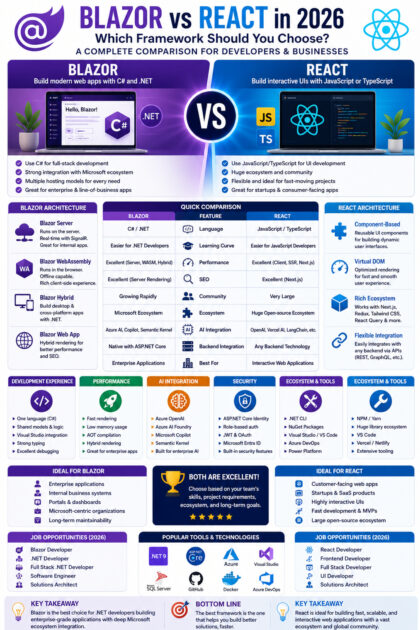
Blazor vs React: Quick Comparison
| Feature | Blazor | React |
|---|---|---|
| Programming Language | C# | JavaScript / TypeScript |
| Learning Curve | Easier for .NET developers | Easier for JavaScript developers |
| Performance | Excellent with Server Rendering | Excellent with Client Rendering |
| SEO | Excellent with Server Rendering | Excellent with Next.js |
| Community | Growing rapidly | Very large |
| Ecosystem | Microsoft | Huge open-source ecosystem |
| Enterprise Support | Outstanding | Excellent |
| AI Integration | Azure AI, Copilot | OpenAI, Vercel AI, LangChain |
| Backend Integration | Native ASP.NET Core | Any backend technology |
| Best For | Enterprise applications | Interactive web applications |
Blazor Architecture
Blazor applications can run in several ways.
Blazor Server
- UI executes on the server.
- Minimal download size.
- Excellent security.
- Real-time communication using SignalR.
Best suited for:
- Internal enterprise portals
- ERP systems
- CRM applications
- Dashboards
Blazor WebAssembly
The application runs directly in the browser using WebAssembly.
Advantages include:
- Offline capabilities
- Reduced server load
- Rich client-side experiences
- Native-like performance
Best suited for:
- Progressive Web Apps (PWAs)
- Interactive portals
- Customer-facing applications
Blazor Hybrid
Blazor Hybrid combines native desktop development with web technologies.
Ideal for:
- Windows desktop applications
- Cross-platform apps
- Enterprise productivity tools
React Architecture
React follows a component-based architecture.
Developers create reusable UI components which manage their own state and rendering.
React commonly works alongside:
- Next.js
- Redux
- Zustand
- React Query
- Tailwind CSS
- Material UI
- Node.js
- Express
- ASP.NET Core APIs
Its flexibility is one of its biggest strengths.
Performance Comparison
Blazor Performance
Recent improvements in .NET have significantly enhanced Blazor’s performance.
Benefits include:
- Faster rendering
- Reduced memory usage
- Native Ahead-of-Time (AOT) compilation
- Better WebAssembly optimisation
- Hybrid rendering
Blazor Server is particularly fast for enterprise applications where server resources are readily available.
React Performance
React remains one of the fastest frontend libraries available.
Features include:
- Virtual DOM
- Concurrent rendering
- Server Components
- Suspense
- Incremental rendering
- Code splitting
Frameworks like Next.js further improve loading speed and SEO.
Development Experience
Blazor
Developers familiar with C# enjoy:
- One language for frontend and backend
- Shared validation models
- Shared business logic
- Visual Studio integration
- Strong typing
- Excellent debugging
For Microsoft developers, productivity is extremely high.
React
React offers:
- Huge package ecosystem
- Extensive documentation
- Massive developer community
- Thousands of reusable libraries
- Flexible architecture
However, projects often require multiple additional libraries for routing, state management and API communication.
Learning Curve
Choose Blazor if you already know:
- C#
- ASP.NET Core
- Entity Framework
- SQL Server
- Azure
Transitioning to Blazor is straightforward.
Choose React if you already know:
- HTML
- CSS
- JavaScript
- TypeScript
- Node.js
Frontend developers typically become productive quickly.
Enterprise Development
Blazor excels in enterprise environments because it integrates naturally with Microsoft technologies.
Typical integrations include:
- Microsoft Entra ID
- Azure
- Azure SQL Database
- Azure App Service
- Azure Functions
- Microsoft 365
- Dynamics 365
- Power Platform
This makes Blazor an excellent choice for organisations already invested in Microsoft technologies.
Startup Development
React remains the preferred choice for many startups because of its:
- Fast development cycle
- Large hiring pool
- Rich ecosystem
- Flexible deployment options
- Strong open-source community
Many SaaS platforms continue to choose React for customer-facing products.
AI Integration in 2026
Artificial Intelligence has become a standard requirement for modern applications.
Blazor AI Integration
Blazor integrates seamlessly with:
- Azure OpenAI
- Azure AI Foundry
- Microsoft Copilot
- Semantic Kernel
- Azure Cognitive Services
Enterprise AI solutions are easier to build within Microsoft’s ecosystem.
React AI Integration
React supports numerous AI frameworks including:
- OpenAI APIs
- Anthropic APIs
- Google Gemini APIs
- LangChain
- Vercel AI SDK
- Hugging Face
React provides excellent flexibility for AI-powered web applications.
Security Comparison
Blazor
Security advantages include:
- ASP.NET Core Identity
- Role-based authorisation
- JWT authentication
- Cookie authentication
- Microsoft Entra ID integration
- Built-in CSRF protection
React
Security depends largely on implementation.
Developers typically integrate:
- OAuth
- JWT
- Auth0
- Firebase Authentication
- Clerk
- Supabase Auth
Both platforms can achieve enterprise-grade security when configured correctly.
SEO Comparison
SEO is critical for business websites.
Blazor
Server-side rendering provides:
- Fast page indexing
- Better Core Web Vitals
- Improved search engine visibility
React
Using Next.js provides:
- Static Site Generation
- Server Side Rendering
- Incremental Static Regeneration
- Excellent SEO
Both frameworks are capable of producing highly SEO-friendly websites.
Scalability
Blazor
Ideal for:
- Government systems
- Healthcare
- Banking
- Manufacturing
- ERP platforms
- Enterprise portals
React
Ideal for:
- Social media platforms
- SaaS products
- E-commerce websites
- Marketing websites
- Consumer applications
Job Market in 2026
Demand for both technologies continues to grow.
Blazor Developers
High demand in:
- Enterprise software companies
- Microsoft partners
- Government projects
- Financial services
- Healthcare organisations
Skills that enhance employability include:
- ASP.NET Core
- Azure
- C#
- SQL Server
- Azure DevOps
React Developers
High demand in:
- Product companies
- Startups
- Digital agencies
- SaaS providers
- E-commerce businesses
Complementary skills include:
- TypeScript
- Next.js
- Node.js
- GraphQL
- Tailwind CSS
Pros and Cons
Blazor Advantages
- Full-stack development with C#
- Strong Microsoft ecosystem integration
- Excellent tooling in Visual Studio
- Shared code between frontend and backend
- Enterprise-ready security
- Simplified maintenance
Limitations
- Smaller community than React
- Fewer third-party UI libraries
- Less common outside Microsoft-centric environments
React Advantages
- Massive ecosystem
- Excellent performance
- Strong community support
- Large talent pool
- Flexible architecture
- Rich third-party component libraries
Limitations
- Requires multiple supporting libraries
- Frequent ecosystem changes
- JavaScript fatigue due to rapidly evolving tooling
Which Framework Should You Choose?
Choose Blazor if:
- You already use .NET and C#.
- Your organisation relies on Microsoft technologies.
- You’re building enterprise applications.
- You want to share code between frontend and backend.
- Long-term maintainability and security are priorities.
Choose React if:
- You’re building highly interactive customer-facing applications.
- Your team specialises in JavaScript or TypeScript.
- You need access to a vast ecosystem of libraries and UI components.
- Flexibility and rapid experimentation are important.
- You’re developing modern SaaS or startup products.
Conclusion
In 2026, both Blazor and React are outstanding choices for modern web development. The right framework depends less on which one is “better” and more on your team’s expertise, project requirements and technology stack.
Blazor has evolved into a mature, enterprise-grade solution that offers exceptional productivity for .NET developers, particularly when integrated with Azure, Microsoft Copilot and the wider Microsoft ecosystem. React, meanwhile, remains a powerhouse for building fast, scalable and feature-rich user interfaces with unmatched community support and flexibility.
Rather than viewing them as competitors, consider them as specialised tools. Blazor is often the stronger choice for Microsoft-centric enterprise solutions, while React continues to excel in consumer-facing applications and fast-moving product development.
By aligning your framework choice with your business goals, developer skills and long-term maintenance strategy, you’ll be well positioned to build modern, high-performing web applications that remain competitive in 2026 and beyond.