The Future of Low-Code Development with Power Platform and AI
Introduction
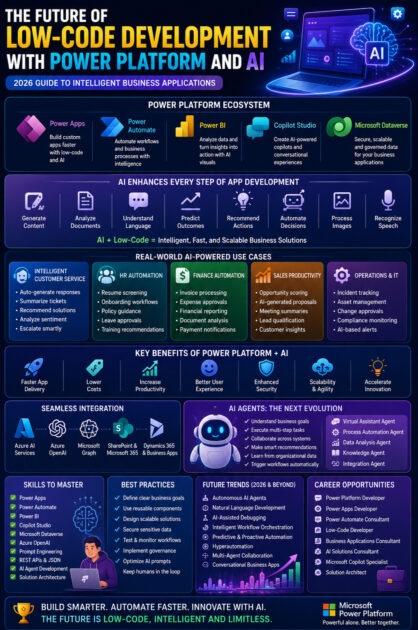
The software development landscape is undergoing one of its biggest transformations since the rise of cloud computing. In 2026, low-code development is no longer just about creating applications quickly—it is about building intelligent, AI-powered business solutions that can automate processes, analyse data and assist users with complex tasks.
At the centre of this transformation is Microsoft Power Platform, enhanced by Artificial Intelligence (AI), Microsoft Copilot, Azure AI and intelligent AI agents. Together, these technologies enable organisations to build enterprise-grade applications with significantly less code while improving productivity, reducing development costs and accelerating digital transformation.
Whether you are a business analyst, citizen developer, professional developer or IT leader, understanding the future of low-code development is essential for staying competitive in the modern technology landscape.
What is Low-Code Development?
Low-code development is a software development approach that uses visual interfaces, drag-and-drop components and prebuilt connectors to create applications with minimal manual coding.
Instead of writing thousands of lines of code, developers assemble applications using visual tools while adding custom code only when necessary.
Benefits include:
- Faster application development
- Lower development costs
- Reduced maintenance effort
- Improved collaboration
- Rapid prototyping
- Increased business agility
Low-code platforms enable both technical and non-technical users to contribute to application development.
What is Microsoft Power Platform?
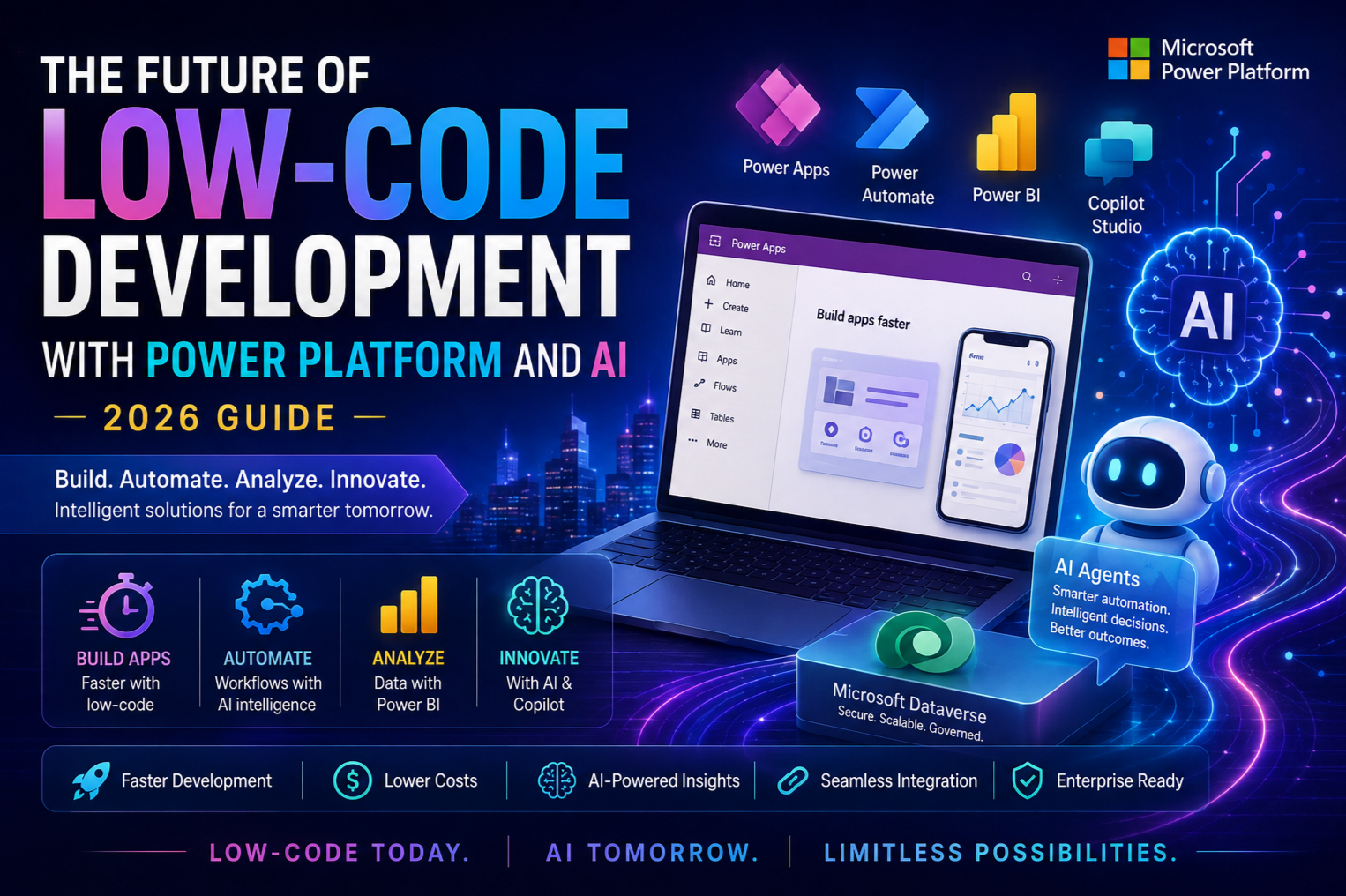
Microsoft Power Platform is a suite of low-code tools that enables organisations to build applications, automate workflows, analyse data and create intelligent virtual agents.
The platform includes:
- Power Apps
- Power Automate
- Power BI
- Microsoft Copilot Studio
- Microsoft Dataverse
Together, these tools provide an end-to-end platform for business application development and automation.
Why AI is Transforming Low-Code Development
Artificial Intelligence extends low-code development beyond automation by enabling applications to understand, generate and reason with information.
AI allows low-code applications to:
- Generate content
- Analyse documents
- Understand natural language
- Predict business outcomes
- Recommend actions
- Automate decision-making
- Process images
- Recognise speech
This shifts low-code from simple workflow automation to intelligent business solutions.
Power Apps: Building Intelligent Business Applications
Power Apps enables organisations to create responsive business applications for desktop, mobile and web.
With AI integration, developers can build applications that:
- Generate reports automatically
- Summarise customer interactions
- Predict maintenance requirements
- Analyse uploaded documents
- Answer employee questions
- Provide AI-powered recommendations
These capabilities reduce manual effort while improving user experiences.
Power Automate: Intelligent Workflow Automation
Power Automate enables organisations to automate repetitive business processes.
When combined with Azure AI, workflows can:
- Read invoices
- Extract document data
- Generate email responses
- Summarise contracts
- Classify customer requests
- Route approvals intelligently
- Detect anomalies
- Trigger AI-powered actions
This creates workflows capable of making informed decisions rather than simply executing predefined rules.
Microsoft Copilot Studio
Copilot Studio enables organisations to build AI-powered copilots and conversational assistants without extensive coding.
Businesses can create copilots that:
- Answer employee questions
- Support customers
- Retrieve enterprise knowledge
- Guide users through business processes
- Automate repetitive tasks
- Connect with Dynamics 365 and Microsoft 365
Copilot Studio significantly reduces the complexity of developing conversational AI.
AI Agents: The Next Evolution
One of the most exciting developments in 2026 is the rise of autonomous AI agents.
Unlike traditional chatbots, AI agents can:
- Understand business goals
- Execute multiple tasks
- Collaborate with other systems
- Make recommendations
- Learn from organisational data
- Trigger workflows automatically
Power Platform increasingly supports AI agents capable of managing complex enterprise processes with minimal human intervention.
Microsoft Dataverse
Dataverse provides a secure, scalable data platform for Power Platform applications.
Benefits include:
- Centralised business data
- Role-based security
- Standardised tables
- Business rules
- Easy integration
- Enterprise scalability
Dataverse enables developers to build consistent applications without managing complex database infrastructure.
Azure AI Integration
Power Platform integrates seamlessly with Azure AI services.
Popular services include:
- Azure OpenAI Service
- Azure AI Foundry
- Azure AI Search
- Azure AI Document Intelligence
- Azure AI Language
- Azure AI Vision
- Azure AI Speech
These services enable advanced AI capabilities within low-code applications.
AI-Powered Business Scenarios
Intelligent Customer Service
Applications can:
- Generate responses
- Summarise support tickets
- Recommend solutions
- Escalate complex cases
- Analyse customer sentiment
HR Automation
AI can assist with:
- Employee onboarding
- Resume screening
- Leave approvals
- Policy guidance
- Training recommendations
Finance Automation
Businesses can automate:
- Invoice processing
- Expense approvals
- Financial reporting
- Document analysis
- Payment notifications
Sales Productivity
Sales teams can benefit from:
- Opportunity scoring
- AI-generated proposals
- Meeting summaries
- Lead qualification
- Customer insights
Benefits of AI-Powered Low-Code Development
Organisations adopting Power Platform and AI experience:
- Faster application delivery
- Lower operational costs
- Increased productivity
- Better user experiences
- Reduced manual work
- Improved business agility
- Enhanced innovation
- Easier scalability
These advantages enable businesses to respond more quickly to changing market conditions.
Security and Governance
Enterprise applications require robust governance.
Power Platform supports:
- Microsoft Entra ID authentication
- Role-Based Access Control (RBAC)
- Data Loss Prevention (DLP) policies
- Environment management
- Audit logs
- Compliance monitoring
- Secure connectors
- Microsoft Purview integration
These features help organisations maintain security while encouraging innovation.
Best Practices for Low-Code Development
To build successful Power Platform solutions:
- Define clear business objectives.
- Use reusable components.
- Design scalable architectures.
- Secure sensitive data.
- Test workflows thoroughly.
- Monitor application performance.
- Implement governance policies.
- Optimise AI prompts.
- Keep humans involved in high-risk decisions.
These practices improve maintainability and long-term success.
Skills Every Power Platform Professional Should Learn
Future-ready developers should build expertise in:
- Power Apps
- Power Automate
- Power BI
- Microsoft Copilot Studio
- Microsoft Dataverse
- Azure OpenAI Service
- Azure AI Foundry
- Prompt Engineering
- REST APIs
- JSON
- Microsoft Graph API
- Dynamics 365
- SharePoint
- Azure Functions
- C#
- AI Agent Development
- Solution Architecture
These skills are increasingly valuable across industries adopting intelligent automation.
Career Opportunities
The demand for Power Platform professionals continues to grow.
Popular roles include:
- Power Platform Developer
- Power Apps Developer
- Power Automate Consultant
- Low-Code Developer
- Business Applications Consultant
- Dynamics 365 Developer
- AI Solutions Consultant
- Microsoft Copilot Specialist
- Solution Architect
Professionals with AI and Power Platform expertise are becoming highly sought after in enterprise digital transformation projects.
Future Trends
The future of low-code development will include:
- Autonomous AI agents
- Natural language application development
- AI-assisted debugging
- Intelligent workflow orchestration
- Predictive automation
- Hyperautomation
- Multi-agent collaboration
- Conversational business applications
These trends will continue to reduce development complexity while increasing application intelligence.
Conclusion
The future of low-code development is being shaped by the convergence of Microsoft Power Platform and Artificial Intelligence. What began as a way to simplify application development has evolved into a comprehensive ecosystem for building intelligent, scalable and enterprise-ready business solutions.
With Power Apps, Power Automate, Copilot Studio, Microsoft Dataverse and Azure AI working together, organisations can rapidly develop applications that automate complex workflows, analyse data, generate insights and support better decision-making. This empowers both citizen developers and professional developers to collaborate more effectively while delivering greater business value.
As AI continues to advance, low-code platforms will become even more capable, enabling organisations to innovate faster, reduce development costs and respond more quickly to changing business needs. Learning Power Platform alongside AI technologies is therefore an excellent investment for anyone pursuing a career in modern software development or digital transformation.