Power Platform vs Salesforce: Which CRM & Low-Code Platform Should You Learn in 2026?
Introduction
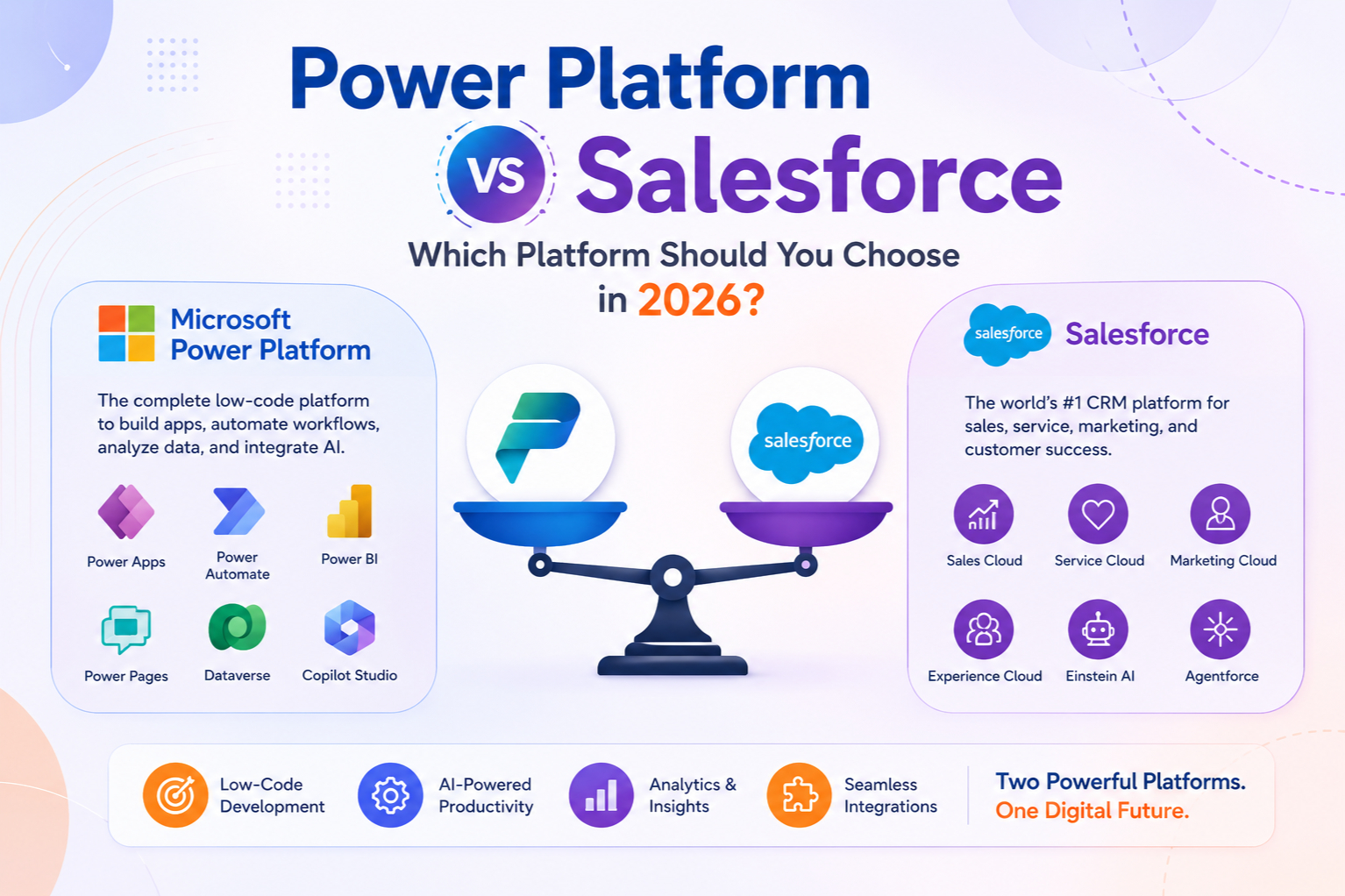
As businesses accelerate their digital transformation initiatives, the demand for professionals skilled in enterprise platforms continues to grow. Two of the most influential ecosystems in this space are Microsoft Power Platform and Salesforce.
Although they are often compared, they serve slightly different purposes:
- Microsoft Power Platform focuses on low-code application development, workflow automation, business intelligence, AI, and business process optimization.
- Salesforce is primarily a Customer Relationship Management (CRM) platform that has expanded into low-code development, AI, analytics, and enterprise applications.
Both platforms are leaders in the enterprise technology landscape and offer excellent career opportunities. However, choosing the right one depends on your career goals, technical interests, and the industries you want to work in.
This comprehensive guide compares Microsoft Power Platform and Salesforce from technical, business, and career perspectives.
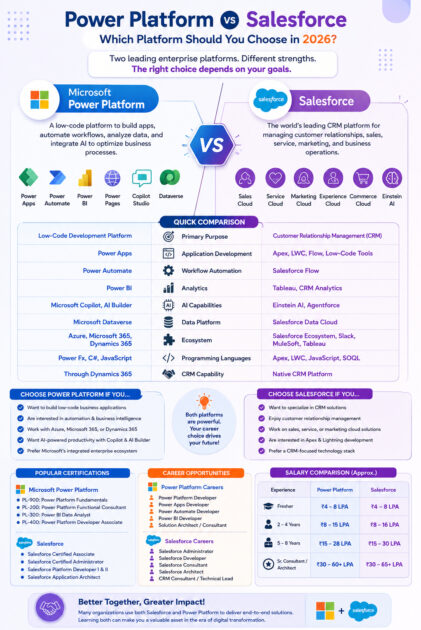
What is Microsoft Power Platform?
Microsoft Power Platform is a suite of low-code development tools that enables organizations to build business applications, automate workflows, analyze data, create websites, and integrate AI into business processes.
Power Platform is tightly integrated with Microsoft Azure, Microsoft 365, Dynamics 365, Dataverse, and Microsoft Copilot, making it one of the most comprehensive enterprise low-code ecosystems.
Core Components of Power Platform
Power Apps
Build custom business applications using low-code development.
Power Automate
Automate workflows and repetitive business processes.
Power BI
Create interactive dashboards, reports, and business intelligence solutions.
Power Pages
Develop secure external business websites and customer portals.
Microsoft Copilot Studio
Build AI-powered copilots and conversational agents.
Microsoft Dataverse
Secure enterprise data platform for Power Platform applications.
What is Salesforce?
Salesforce is the world’s leading cloud-based CRM platform that helps organizations manage customer relationships, sales, marketing, customer service, and business operations.
Over the years, Salesforce has evolved into a comprehensive cloud ecosystem that includes CRM, analytics, AI, automation, and low-code development.
Major Salesforce Products
- Sales Cloud
- Service Cloud
- Marketing Cloud
- Experience Cloud
- Commerce Cloud
- Salesforce Platform
- Tableau
- MuleSoft
- Slack
- Agentforce
- Einstein AI
Power Platform vs Salesforce: Quick Comparison
| Feature | Microsoft Power Platform | Salesforce |
|---|---|---|
| Primary Purpose | Low-Code Development Platform | Customer Relationship Management (CRM) |
| Application Development | Excellent | Excellent |
| Workflow Automation | Power Automate | Salesforce Flow |
| Analytics | Power BI | Tableau CRM |
| AI | Microsoft Copilot | Einstein AI & Agentforce |
| Database | Microsoft Dataverse | Salesforce Data Cloud |
| CRM | Through Dynamics 365 | Native CRM |
| Enterprise Integration | Azure, Microsoft 365, Dynamics 365 | Salesforce Ecosystem |
| Programming Language | Power Fx, C#, JavaScript | Apex, Lightning Web Components (LWC), JavaScript |
Understanding the Core Difference
The biggest difference is their primary focus.
Microsoft Power Platform
Designed for:
- Low-code application development
- Workflow automation
- Business intelligence
- Process digitization
- AI-powered productivity
- Enterprise integrations
Salesforce
Designed for:
- Customer Relationship Management
- Sales automation
- Customer service
- Marketing automation
- Customer engagement
- Enterprise CRM customization
While Power Platform can build CRM-related applications, Salesforce provides a CRM-first platform with extensive customer management capabilities.
Technology Comparison
Microsoft Power Platform Technologies
Professionals work with:
- Power Apps
- Power Automate
- Power BI
- Power Pages
- Copilot Studio
- Dataverse
- Power Fx
- JavaScript
- C#
- PCF Controls
- Azure Functions
- SQL Server
- Azure OpenAI
Salesforce Technologies
Developers commonly use:
- Apex
- Lightning Web Components (LWC)
- SOQL
- SOSL
- Salesforce Flow
- Visualforce (legacy)
- Einstein AI
- Agentforce
- MuleSoft
- JavaScript
- Salesforce DX
Low-Code Development
Power Platform
Microsoft provides an integrated low-code experience with:
- Drag-and-drop app development
- Business automation
- AI-assisted development
- Data modeling
- Business intelligence
- Website creation
Power Platform is ideal for building complete business solutions quickly.
Salesforce
Salesforce also supports low-code development through:
- Flow Builder
- Lightning App Builder
- Experience Builder
- Screen Flows
- Dynamic Forms
For advanced customization, developers use Apex and Lightning Web Components.
Business Intelligence
Microsoft Power BI
Power Platform includes Power BI for:
- Interactive Dashboards
- KPI Monitoring
- Financial Reporting
- Executive Analytics
- AI Insights
- Data Visualization
Salesforce Analytics
Salesforce offers:
- Tableau
- CRM Analytics
- Dashboards
- Reports
- Einstein Analytics
Both platforms deliver robust analytics capabilities, though Power BI is often recognized for its flexibility and integration across diverse data sources.
Artificial Intelligence
AI has become a major differentiator for both ecosystems.
Microsoft Power Platform AI
Developers can leverage:
- Microsoft Copilot
- Copilot Studio
- AI Builder
- Azure OpenAI Service
- Azure AI Services
- Intelligent Document Processing
Salesforce AI
Salesforce provides:
- Einstein AI
- Einstein Copilot
- Agentforce
- Predictive Analytics
- AI-powered CRM
- Generative AI for Sales and Service
Both companies continue to invest heavily in enterprise AI.
Integration Ecosystem
Microsoft Ecosystem
Power Platform integrates seamlessly with:
- Microsoft 365
- Dynamics 365
- Azure
- SQL Server
- SharePoint
- Microsoft Teams
- Outlook
- GitHub
- Azure DevOps
Salesforce Ecosystem
Salesforce integrates with:
- Slack
- MuleSoft
- Tableau
- Marketing Cloud
- Commerce Cloud
- SAP
- Oracle
- Google Workspace
- Microsoft 365
Both ecosystems support hundreds of third-party integrations.
Development Comparison
Power Platform Developers
Typically work with:
- Power Apps
- Dataverse
- Power Automate
- JavaScript
- C#
- Azure
- REST APIs
- PCF Controls
- AI Builder
Salesforce Developers
Typically work with:
- Apex
- Lightning Web Components
- Flow
- SOQL
- JavaScript
- REST APIs
- Platform Events
- Salesforce DX
Both roles require strong problem-solving skills and an understanding of enterprise business processes.
Career Opportunities
Microsoft Power Platform Careers
Popular roles include:
- Power Platform Developer
- Power Apps Developer
- Power Automate Developer
- Power BI Developer
- Dynamics 365 Developer
- Solution Consultant
- Technical Consultant
- Solution Architect
Salesforce Careers
Popular roles include:
- Salesforce Administrator
- Salesforce Developer
- Salesforce Consultant
- Salesforce Business Analyst
- Salesforce Architect
- Technical Lead
- CRM Consultant
Both platforms offer strong global demand across consulting firms, system integrators, and enterprise organizations.
Certifications
Microsoft Certifications
Recommended learning path:
Beginner
- PL-900: Microsoft Power Platform Fundamentals
Intermediate
- PL-200: Power Platform Functional Consultant
- PL-300: Power BI Data Analyst
Advanced
- PL-400: Power Platform Developer Associate
Salesforce Certifications
Recommended certifications:
Beginner
- Salesforce Certified Associate
Intermediate
- Salesforce Certified Administrator
- Salesforce Platform App Builder
Advanced
- Salesforce Platform Developer I
- Salesforce Platform Developer II
- Salesforce Application Architect
- Salesforce System Architect
Both certification paths are highly respected by employers.
Salary Comparison
(Approximate salaries vary depending on experience, employer, and location.)
| Experience | Power Platform | Salesforce |
|---|---|---|
| Fresher | ₹4–8 LPA | ₹4–8 LPA |
| 2–4 Years | ₹8–15 LPA | ₹8–16 LPA |
| 5–8 Years | ₹15–28 LPA | ₹15–30 LPA |
| Senior Consultant / Architect | ₹30–60+ LPA | ₹30–65+ LPA |
Professionals with expertise in cloud platforms, AI, integrations, and enterprise architecture often earn premium salaries in both ecosystems.
Which Platform Should You Learn?
Choose Microsoft Power Platform if you:
- Want to build low-code business applications.
- Are interested in workflow automation and business intelligence.
- Plan to work with Azure, Microsoft 365, or Dynamics 365.
- Want to leverage Microsoft Copilot and AI Builder.
- Prefer Microsoft’s integrated enterprise ecosystem.
Choose Salesforce if you:
- Want to specialize in CRM solutions.
- Enjoy customer relationship management.
- Plan to work on sales, service, or marketing cloud implementations.
- Are interested in Apex and Lightning development.
- Prefer a CRM-focused technology stack.
Can You Learn Both?
Absolutely.
Many organizations use both Microsoft and Salesforce products.
For example:
- Salesforce manages customer relationships.
- Power BI analyzes Salesforce data.
- Power Automate integrates Salesforce with Microsoft 365.
- Power Apps provides custom applications for internal users.
- Azure AI and Copilot enhance productivity across systems.
Professionals who understand both ecosystems are highly valuable for enterprise integration and digital transformation projects.
Conclusion
Microsoft Power Platform and Salesforce are both market-leading enterprise platforms, but they address different business needs. Power Platform excels in low-code application development, workflow automation, business intelligence, and AI-driven productivity, while Salesforce remains the industry leader in customer relationship management and customer engagement solutions.
The right choice depends on your career aspirations. If you’re interested in building business applications, automating processes, and working within the Microsoft ecosystem, Power Platform is an excellent path. If your passion lies in CRM implementation, sales automation, and customer experience management, Salesforce offers a rewarding and globally recognized career.
For professionals seeking long-term growth, understanding how Microsoft Power Platform integrates with Salesforce can provide a significant competitive advantage, enabling the delivery of end-to-end enterprise solutions across multiple business platforms.