From MCA Graduate to Microsoft Consultant: A Step-by-Step Career Plan
Introduction
The IT industry is evolving faster than ever, and Microsoft technologies are at the center of enterprise digital transformation. Organizations worldwide are adopting Microsoft Dynamics 365, Power Platform, Azure, Microsoft 365, and AI-powered Copilot solutions to modernize business operations.
For MCA graduates, this creates an incredible opportunity.
Unlike many traditional software careers that require years of specialized experience, the Microsoft ecosystem offers structured learning paths, globally recognized certifications, and strong demand for skilled professionals.
If you’re wondering:
- What should I do after MCA?
- Which Microsoft technology should I learn?
- How can I become a Microsoft Consultant?
- Is Dynamics 365 or Power Platform a good career?
This comprehensive guide answers all these questions while providing a practical roadmap from MCA graduate to Microsoft Consultant.
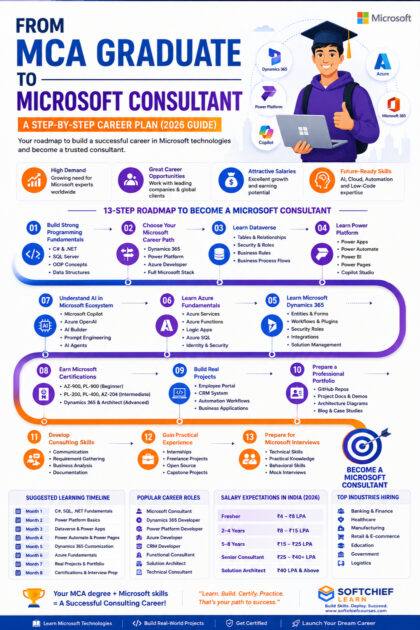
Why Microsoft Consulting Is a Great Career Choice
Microsoft dominates enterprise software across industries such as:
- Banking
- Healthcare
- Manufacturing
- Retail
- Education
- Government
- Logistics
- E-commerce
Thousands of companies use Microsoft solutions to manage customers, finance, HR, operations, analytics, automation, and cloud infrastructure.
This creates continuous demand for professionals who can:
- Develop business applications
- Automate workflows
- Build cloud solutions
- Customize enterprise systems
- Integrate applications
- Implement AI-powered business processes
Instead of building only websites or standalone applications, Microsoft Consultants solve real business problems for large organizations.
Who Is a Microsoft Consultant?
A Microsoft Consultant helps businesses implement, customize, integrate, and optimize Microsoft technologies.
Depending on specialization, you may work as:
- Microsoft Dynamics 365 Consultant
- Power Platform Developer
- Azure Developer
- Azure Administrator
- Dynamics CRM Developer
- Business Central Consultant
- Solution Architect
- Functional Consultant
- Technical Consultant
- AI & Copilot Consultant
Many professionals combine multiple skills as they grow.
Why MCA Graduates Have an Advantage
An MCA curriculum already covers many concepts required in enterprise software development.
You likely already understand:
- Programming fundamentals
- Database Management Systems
- Object-Oriented Programming
- Software Engineering
- Web Technologies
- Networking basics
- Data Structures
- Operating Systems
These subjects make learning Microsoft technologies significantly easier compared to someone starting without a technical background.
Step 1: Build Strong Programming Fundamentals
Before specializing, strengthen your core development skills.
Focus on:
C#
The primary language for Microsoft development.
Learn:
- Classes
- Objects
- Interfaces
- Inheritance
- Delegates
- LINQ
- Async Programming
- Exception Handling
.NET
Understand:
- ASP.NET Core
- REST APIs
- Entity Framework
- Dependency Injection
- Authentication
- Web API Development
SQL Server
Master:
- Queries
- Joins
- Stored Procedures
- Views
- Indexes
- Performance Optimization
Strong programming skills remain valuable even when working with low-code platforms.
Step 2: Choose Your Microsoft Career Path
The Microsoft ecosystem offers multiple career options.
Option 1: Dynamics 365 Consultant
Ideal for students interested in enterprise business applications.
You’ll learn:
- Customer Engagement (CRM)
- Sales
- Customer Service
- Marketing
- Field Service
- Dataverse
- Plugins
- JavaScript
- Power Automate
- Integrations
Suitable roles:
- CRM Developer
- Dynamics Developer
- Functional Consultant
Option 2: Power Platform Developer
Perfect if you enjoy rapid application development.
Learn:
- Power Apps
- Power Automate
- Power BI
- Power Pages
- Copilot Studio
- AI Builder
Career roles include:
- Power Platform Developer
- Automation Consultant
- Low-Code Developer
Option 3: Azure Developer
Ideal for cloud-focused professionals.
Topics include:
- Azure App Services
- Azure Functions
- Storage
- Logic Apps
- Event Grid
- Service Bus
- Azure SQL
- Identity Management
Roles include:
- Azure Developer
- Cloud Engineer
- Cloud Consultant
Option 4: Full Microsoft Stack
Many employers prefer professionals who understand:
- C#
- .NET
- Azure
- Power Platform
- Dynamics 365
This combination significantly increases employability.
Step 3: Learn Dataverse
Dataverse is the backbone of many Microsoft business applications.
Topics to master:
- Tables
- Relationships
- Security
- Business Rules
- Business Process Flows
- Choice Columns
- Calculated Fields
- Rollup Columns
- Auditing
A solid understanding of Dataverse makes transitioning between Dynamics 365 and Power Platform much easier.
Step 4: Learn Power Platform
Power Platform is among Microsoft’s fastest-growing technologies.
Focus on:
Power Apps
Create business applications with minimal code.
Power Automate
Automate repetitive business processes.
Power BI
Build interactive dashboards and reports.
Power Pages
Develop secure external business portals.
Copilot Studio
Build AI-powered conversational agents.
Step 5: Learn Microsoft Dynamics 365
Dynamics 365 is used by thousands of global enterprises.
Understand:
- Entities (Tables)
- Forms
- Views
- Dashboards
- Business Process Flows
- Security Roles
- Workflows
- Plugins
- JavaScript
- Ribbon Customization
- Web API
- Solution Management
Step 6: Learn Azure Fundamentals
Cloud knowledge is becoming mandatory.
Important Azure services:
- Azure Active Directory
- Azure Functions
- Logic Apps
- Key Vault
- Storage Accounts
- Azure SQL
- App Services
- API Management
Azure knowledge helps consultants build scalable enterprise solutions.
Step 7: Understand AI in Microsoft Ecosystem
Microsoft is investing heavily in Artificial Intelligence.
Learn:
- Microsoft Copilot
- Copilot Studio
- Azure OpenAI
- AI Builder
- Prompt Engineering
- Intelligent Automation
- AI Agents
Consultants with AI skills are increasingly sought after across industries.
Step 8: Earn Microsoft Certifications
Certifications validate your knowledge and improve your resume.
Recommended progression:
Beginner
- Microsoft Certified: Azure Fundamentals (AZ-900)
- Microsoft Certified: Power Platform Fundamentals (PL-900)
Intermediate
- Power Platform Developer (PL-400)
- Power Platform Functional Consultant (PL-200)
- Azure Developer Associate (AZ-204)
Advanced
- Dynamics 365 certifications
- Azure Solutions Architect
- Power Platform Solution Architect
Certifications combined with practical projects make your profile more competitive.
Step 9: Build Real Projects
Projects demonstrate practical skills beyond certifications.
Create solutions such as:
- Employee Leave Management System
- Customer Complaint Portal
- Sales CRM
- Inventory Management App
- Hospital Management System
- Vendor Portal
- Student Management System
- Invoice Automation
- HR Onboarding Workflow
Host your projects and document them clearly for interviews.
Step 10: Prepare a Professional Portfolio
Your portfolio should include:
- GitHub repositories
- Project documentation
- Architecture diagrams
- Screenshots
- Power Apps demos
- Azure deployments
- Certifications
- Technical blog posts
Recruiters value candidates who can showcase real work.
Step 11: Develop Consulting Skills
Technical expertise is only part of consulting.
Work on:
- Communication
- Requirement gathering
- Client presentations
- Documentation
- Business analysis
- Problem-solving
- Team collaboration
- Time management
These skills often differentiate successful consultants.
Step 12: Gain Practical Experience
You can gain experience through:
- Internships
- Freelance projects
- Open-source contributions
- Capstone projects
- Mock implementations
- Personal business applications
Hands-on experience accelerates learning and boosts confidence.
Step 13: Prepare for Microsoft Interviews
Recruiters typically assess:
Technical Skills
- C#
- .NET
- SQL
- JavaScript
- Azure
- Power Platform
- Dynamics 365
Practical Knowledge
- Dataverse
- Plugins
- Security
- Workflows
- REST APIs
- Power Automate
- Azure Services
Behavioral Skills
- Problem-solving
- Communication
- Teamwork
- Client interaction
- Learning attitude
Practice explaining your projects clearly and confidently.
Suggested Learning Timeline
| Month | Learning Goal |
|---|---|
| Month 1 | C#, SQL, .NET Fundamentals |
| Month 2 | Power Platform Basics |
| Month 3 | Dataverse & Power Apps |
| Month 4 | Power Automate & Power Pages |
| Month 5 | Dynamics 365 Customization |
| Month 6 | Azure Fundamentals |
| Month 7 | Real Projects & Portfolio |
| Month 8 | Certifications & Interview Preparation |
Following a structured plan can make you job-ready within 8–10 months, depending on your pace and consistency.
Common Mistakes MCA Graduates Should Avoid
Avoid these pitfalls:
- Learning too many technologies simultaneously
- Relying solely on certifications without projects
- Ignoring SQL and C#
- Skipping Azure fundamentals
- Neglecting communication skills
- Not maintaining a GitHub portfolio
- Avoiding mock interviews
- Failing to understand real business processes
A focused approach delivers better long-term results.
Career Opportunities After Following This Roadmap
Completing this roadmap can prepare you for roles such as:
- Microsoft Consultant
- Dynamics 365 Developer
- Dynamics Functional Consultant
- Power Platform Developer
- Azure Developer
- Azure Cloud Engineer
- CRM Developer
- Solution Consultant
- Technical Consultant
- Business Applications Developer
- AI Solutions Consultant
These roles are in demand across IT services, consulting firms, product companies, and enterprise organizations.
Salary Expectations in India (2026)
Approximate annual salary ranges vary by location, employer, and skill level:
| Experience | Expected Salary (LPA) |
|---|---|
| Fresher | ₹4 – ₹8 LPA |
| 2–4 Years | ₹8 – ₹15 LPA |
| 5–8 Years | ₹15 – ₹25 LPA |
| Senior Consultant | ₹25 – ₹40+ LPA |
| Solution Architect | ₹40 LPA and above |
Professionals with expertise in Dynamics 365, Power Platform, Azure, and AI often command higher compensation due to their ability to deliver end-to-end enterprise solutions.
Final Thoughts
For MCA graduates, the Microsoft ecosystem offers a structured and rewarding career path with opportunities to work on enterprise-scale digital transformation projects. By mastering C#, .NET, SQL, Power Platform, Dynamics 365, Azure, and AI technologies, you can build a strong foundation for a successful consulting career.
Success doesn’t come from collecting certifications alone—it comes from combining technical expertise, practical projects, business understanding, and continuous learning. Stay consistent, build real-world solutions, and keep updating your skills as Microsoft technologies evolve.
The demand for Microsoft Consultants continues to grow globally. With the right roadmap and dedication, your journey from an MCA graduate to a trusted Microsoft Consultant can begin today.
Conclusion
An MCA degree gives you a strong technical foundation, but success in today’s IT industry depends on building specialized, practical skills. The Microsoft ecosystem offers one of the clearest career paths for aspiring consultants, combining cloud computing, enterprise applications, automation, and AI. Invest in continuous learning, create impactful projects, earn relevant certifications, and develop your consulting mindset. With persistence and the right roadmap, you can transform your MCA qualification into a rewarding career as a Microsoft Consultant.